You’ll manage Supra track temps by prioritizing oil, coolant, transmission fluid and IAT control: verify levels and sensors pre‑session, fit CSF heat exchangers and an auxiliary radiator, add a transmission cooler and hood vents, and use conservative throttle and shorter stints to avoid oil >300°F and IATs >140°F that trigger limp mode. Log oil peaks, crankcase and manifold pressures, and fuel temp; replace synthetic oil if it exceeds ~270°F. Continue for detailed upgrade priorities and procedures.
How Heat Affects Your Supra: Oil, Coolant, Trans, and IATs
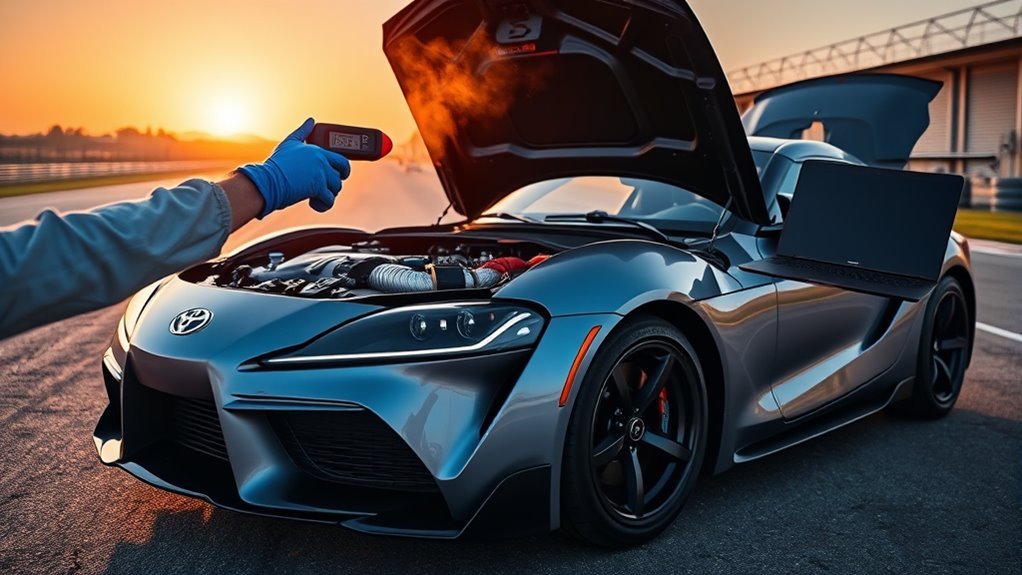
When you push a Supra on track, heat becomes the limiting variable for oil, coolant, transmission fluid, and intake air—each system responds differently but they all erode performance as temperatures climb. You’ll see oil temperatures approach 300°F during intense sessions, risking power cuts and accelerated wear unless you institute strict post-run oil change discipline. Coolant capacity dictates sustained power; insufficient heat rejection leads to engine overheating and reduced timing margins. Transmission fluid under load rises similarly, so auxiliary radiators and heat exchangers are logical upgrades to preserve shift quality. Intake air temps above ~140°F can force limp mode, killing lap times. Data logging shows hood vents lower peak oil temps by ~9°F, a small but actionable gain in thorough thermal management.
Pre‑Track Checklist: Fluids, Sensors, and Quick Fixes to Avoid Limp Mode
Before you hit the track, verify oil and coolant levels and condition—low or degraded fluids raise temperatures and trigger limp mode. Check that oil temperature and coolant sensors plus fuel-temp/crankcase pressure inputs are reporting within spec, since faulty signals can force the ECU into protective maps. If readings are marginal, top off with the correct-grade synthetic and address any sensor or leak issues before the session.
Oil & Coolant Check
Start by verifying oil and coolant status with the same rigor you’d apply to brake checks: low or inappropriate-viscosity oil and marginal coolant capacity are common failure points on 2020–21 Supras that can produce “add-oil” alerts, elevated temperatures, or limp-mode triggers under sustained high load. Check dipstick levels cold and hot, record oil consumption trends, and choose a viscosity rated for sustained track temps—many owners move to a slightly thicker grade for thermal stability. Inspect coolant reservoir and radiator fill, confirm coolant efficiency via concentration and flow, and replace degraded fluid. Secure caps and hoses, verify no external leaks, and torque fittings to spec. These disciplined checks free you from avoidable failures and preserve peak power under repeated high-load cycles.
Sensor Function Verification
Having confirmed oil and coolant integrity, shift focus to the vehicle’s sensor suite—faulty or miscalibrated sensors can provoke limp-mode or degraded fuel/ignition strategies under sustained track loads. You’ll verify fuel temperature sensor operation and perform sensor calibration to maintain consistent fuel delivery under thermal stress. Check coolant pressure sensor outputs for data accuracy to guarantee the cooling system holds pressure and avoids overheating-triggered limp responses. Inspect crankcase pressure sensor readings to prevent excessive blow-by and “add-oil” alerts mid-session. Confirm all wheel speed sensors supply reliable signals so traction control won’t introduce unintended cutbacks. Finally, capture exhaust manifold pressure and engine pressure ratio metrics; accurate data lets you tune boost and fueling to sustain power without safety-mode intervention.
Cooling Upgrades That Work (Cost & Priority): Heat Exchangers, Aux Rads, Trans Coolers, Hood Vents
When you push a Supra hard on track, component temperatures climb rapidly, so prioritizing cooling upgrades by their impact and cost is critical: You’ll get heat exchanger benefits immediately; CSF units boost core capacity and lower temps. You’ll appreciate auxiliary radiator importance for sustained runs. A transmission cooler necessity is non-negotiable to prevent heat-related shift degradation. Hood vent effectiveness shows in oil drops from 302°F to ~293°F.
| Upgrade | Impact | Cost/Priority |
|---|---|---|
| CSF Heat Exchanger | High temp reduction | Medium / 1 |
| Auxiliary Radiator | Sustained cooling | Medium-High / 2 |
| Transmission Cooler | Protects gearbox | Low-Medium / 1 |
| Hood Vents | Oil temp down ~9°F | Low / 3 |
Implement in that order to liberate consistent performance.
Intake & Turbo Strategies for Supra: CAI, Manifold, Ethanol, and Turbo Sizing
Start with a cold-air intake to sharpen throttle response and cut heat soak, which directly lowers intake air temperatures during repeated track pulls. Pairing a Wagner-style intake manifold further reduces pre-throttle temps and stabilizes IATs under sustained load. Finally, consider ethanol content and turbo sizing together—moderate ethanol blends can reduce combustion temps while a properly sized larger turbo runs in a more efficient map area, both reducing thermal stress when matched with correct tuning.
Cold-Air Intake Benefits
Although a well-designed cold-air intake won’t alone transform peak horsepower, it noticeably sharpens throttle response and trims midrange lag by lowering inlet air temperatures and reducing intake restriction, which also mitigates heat soak compared with the stock airbox. You gain crisper throttle response and measurable improvements in engine efficiency during sustained runs; CAI reduces pressure drop and delays heat soak onset so the turbo works closer to its ideal map. Pairing CAI with sensible fuel blends and monitoring lets you exploit gains without risking detonation. Track-focused tuning should include consistent IAT logging.
- Reduces intake restriction, improving performance tuning precision
- Lowers IATs to protect against limp modes and thermal drift
- Complements turbo upgrades by stabilizing inlet conditions
- Enables safer use of ethanol blends for cooler combustion
Manifold And IATs
Having stabilized inlet conditions with a CAI, you should next focus on how manifold design, IAT management, ethanol content, and turbo sizing interact to sustain power on extended track runs. You’ll find manifold upgrades—like the Wagner intake manifold—lower pre-throttle temperatures, reducing heat soak and preserving headroom for repeat pulls. Prioritize IAT stabilization through routing and material choices that limit conductive heat transfer to the plenum. While higher ethanol blends cut combustion temps, don’t assume stock turbo efficiency will hold; mismatches force the turbo to run off its peak map. Larger, properly sized turbos paired with targeted tune strategies improve efficiency and reduce thermal load. Execute changes incrementally, monitor IATs, and free yourself from conservative factory limits by validating performance under sustained, track-like duty cycles.
Ethanol And Turbo Sizing
When you balance ethanol content and turbo sizing for track duty, you’re optimizing both combustion temperature and compressor efficiency to sustain power over repeated high-load laps. You choose ethanol blending to lower combustion temps, but with a stock turbo that benefit can fade, creating heat-management issues. A larger turbo improves turbo efficiency and reduces charge temps under stress, stabilizing power and protecting components. The Wagner intake manifold lowers pre-throttle temperatures; pair it with a well-optimized CAI to limit heat soak and sharpen throttle response. Run moderate ethanol to keep combustion stable and reliable across laps.
- Use ethanol blending strategically, not maximally
- Match turbo size to your power curve and cooling plan
- Fit Wagner manifold for IAT control
- Prioritize CAI design to prevent heat soak
What to Do on Track: Logging, Driving Tips, and When to Stop
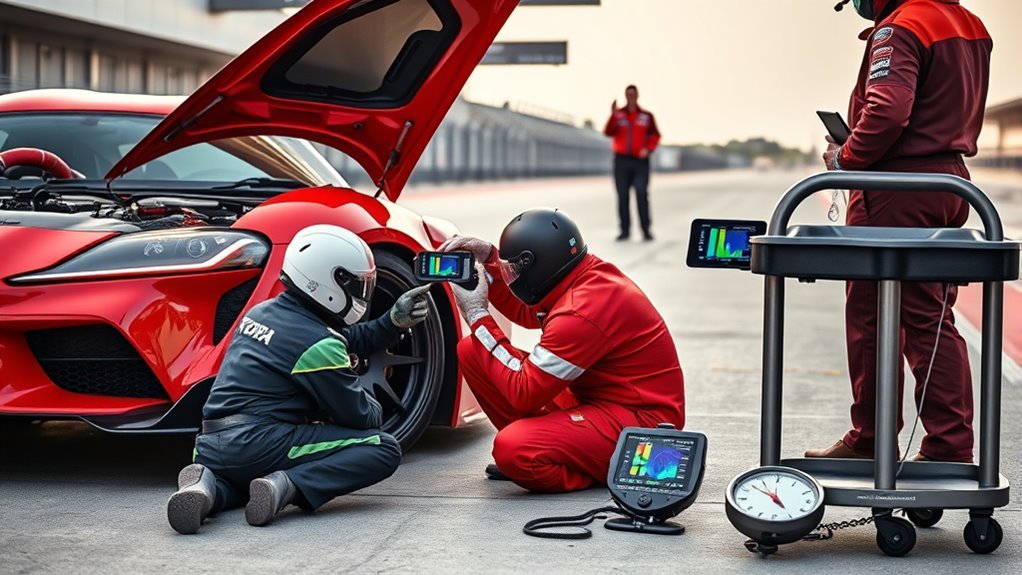
If you’re running laps, prioritize continuous data logging of oil, transmission, coolant, and intake temperatures so you can spot trends and intervene before the ECU starts pulling timing or cutting power. Use data analysis to compare runs and define session strategies: log peak oil (watch for >300°F), IATs (keep <140°F), and transmission heat. Drive with thermal management in mind—shorter stints, conservative throttle into slow corners, and reduced full-throttle time on long straights to limit heat soak. Fit vents and high-performance exchangers to widen safe operating windows; verify their effect in real time. If you observe rapid spikes, timing pulls, or sustained IATs above threshold, stop immediately, cool the car, and reassess before resuming.
Post‑Session Maintenance: Oil Checks, Changes, and Data Review
Because high-track stress can push oil temperatures past safe limits, you should check oil level and temperature immediately after each session and log the results for later analysis. You’ll document peak oil temp, IAT, and any “oil a quart low” alerts, then decide on immediate action. Prioritize oil temperature monitoring and structured performance analysis to inform maintenance.
- Inspect oil level; record spots and recovery amounts.
- Note max oil temps (reports up to 302°F) and compare pre/post mods.
- Replace synthetic oil if temps exceeded ~270°F to avoid shearing.
- Review coolant condition to prevent limp mode on extended runs.
Keep a disciplined log of changes and sensor data; liberation comes from control through repeatable, technical feedback loops and decisive servicing.
Frequently Asked Questions
Is a Supra Good for Winter?
No, you shouldn’t expect excellent winter performance; you’ll need deliberate tire selection, traction management adjustments, and cautious driving to mitigate rear-wheel-drive limits, low clearance, and summer-tire deficiencies while preserving freedom to drive confidently in cold conditions.
What Are the Common Problems With Supras?
You’ll face nagging engine issues like high oil burn and limp-mode overheating; transmission failures include sluggish DCT shifts and heat-related strain. You’ll also contend with rattles, pricey BMW-sourced parts, and constrained cooling under load.
Conclusion
You’ve seen how heat degrades oil, coolant, transmission fluid and IATs; act before failure. Track‑prep checklist and targeted cooling upgrades cut risk: a 20–30% reduction in oil temperature from an aux cooler often equals fewer limp‑downs. Log temps, err on the conservative driving side, and stop at set thresholds. After each session inspect and record fluids, then use that data to refine cooling, fueling and turbo choices for consistent performance.