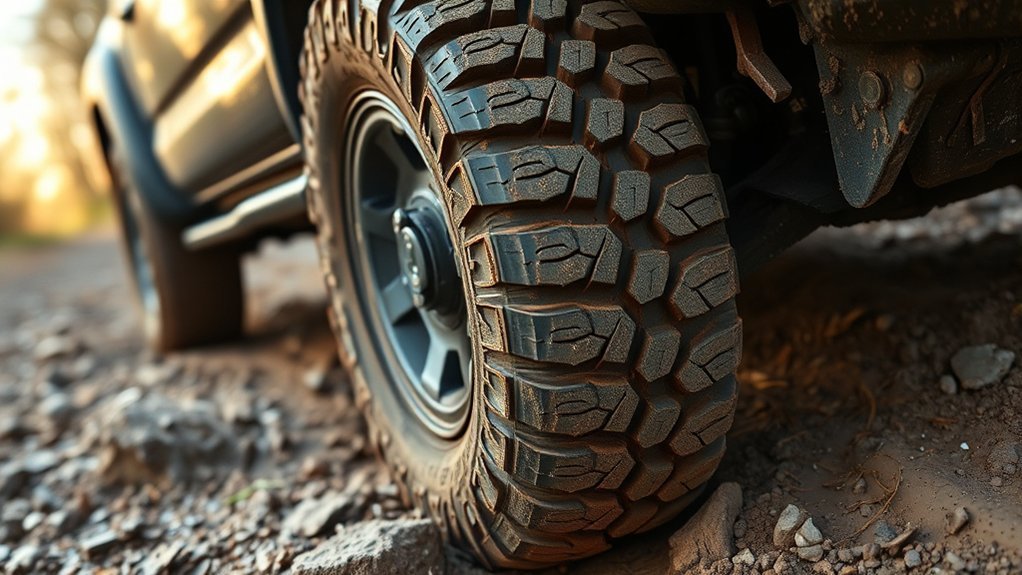
Your Tacoma’s off‑road traction comes down to tires, pressure, differentials, and inputs. Choose all‑terrain or mud tires for bite; tune pressure—low for sand/mud, higher for rocks—to control contact patch and sidewall support. Use lockers or limited‑slip to prevent single‑wheel spin, and let traction control modulate torque when needed. Inspect tread, pressures, and driveline noise regularly, and drive with smooth throttle and steering. Keep going to learn specific settings, upgrades, and diagnostics that improve grip.
How to Improve Tacoma Traction Today
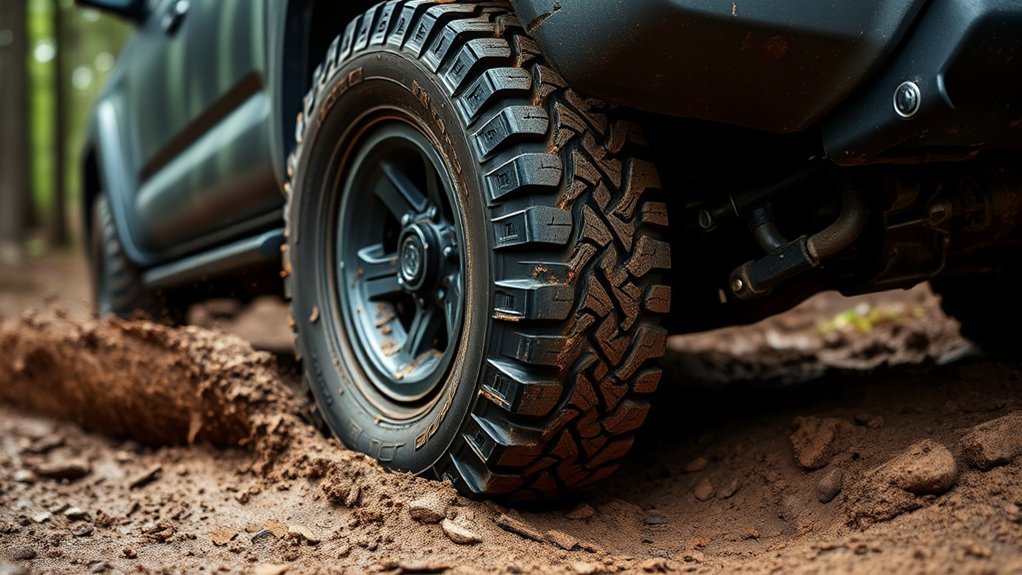
Start by prioritizing tire choice and mechanical traction aids: fit all-terrain or mud-terrain tires formulated for sand, mud, and gravel, check and maintain proper tire pressures for the conditions, and consider mechanical upgrades like a rear locking differential and sway-bar disconnect to improve torque distribution and wheel articulation. You’ll then sequence interventions: choose tires with proven tread compounds and sidewall strength, set pressures to match substrate firmness, and verify pressures pre- and mid-run. Add a rear locker to guarantee equal torque distribution when one wheel loads down; engage traction-control modes to let ECU and brakes optimize slip management. Consider sway-bar disconnects and targeted suspension upgrades to increase wheel travel and articulation, improving continuous ground contact. Reassess weight distribution—shift gear and cargo to minimize light rear loading that induces spin. Inspect components after each outing, adjust tire pressure based on feedback, and iterate settings until the Tacoma’s traction becomes predictable and liberating across varied terrain.
Why Your Tacoma’s Tires Matter More Than 4WD
Having picked tires and mechanical aids, you should recognize that tires determine how that hardware actually performs off road. You rely on tire technology and tread patterns to convert drivetrain inputs into lateral and longitudinal forces; 4WD can only distribute torque, it can’t fabricate adhesion. Analyze rubber compound, void ratio, and siping: these govern contact patch behavior on mud, sand, and rock. Off-road-specific tires with self-cleaning tread patterns maintain bite by ejecting debris, preserving predictable shear resistance. Tire diameter and inflation modulate ground pressure and clearance—larger, correctly aired tires reduce sink and improve obstacle negotiation. Regular inspection of tread depth and casing integrity prevents catastrophic loss of traction when you need it most. In liberated terms, you reclaim mobility by choosing components that create grip rather than relying on electronic or mechanical overrides. Prioritize purpose-built tire technology, verify pressures for the terrain, and you’ll find your Tacoma’s 4WD becomes an amplifier of grip, not a substitute for it.
Toyota Traction Control: How It Affects Tacoma Traction
You’ll first want to understand traction control basics: the Tacoma’s system detects wheel slip and modulates engine torque to preserve grip. In low-traction modes it permits controlled wheel spin and alters throttle response to sustain momentum on sand or mud, though it doesn’t substitute for a locking differential. Finally, electronic brake intervention selectively applies brakes to individual wheels to transfer torque and stabilize the vehicle during traction loss.
Traction Control Basics
Although often misunderstood, Toyota’s traction control on the Tacoma actively monitors wheel spin and modulates brake force and engine torque to maintain grip across mud, sand, and snow. You’ll engage it by holding the traction control button for 10 seconds in park or neutral; indicator lights flash to confirm activation. The system’s roots in traction control history inform modern electronic systems that permit controlled wheel slip to regain grip without sacrificing momentum. Compared with locking differentials, Tacoma’s system delivers effective 2WD performance and complements your driving choices, enhancing liberation on trails. You’ll rely on precise brake intervention and power management rather than brute mechanical lock. Below is a concise reference for behavior and use.
| Condition | Action | Result |
|---|---|---|
| Wheel spin | Brake modulation | Grip restored |
| Low traction | Controlled slip | Momentum maintained |
| Activation | 10s hold | Lights confirm |
Low Traction Modes
When you select low-traction modes on a Tacoma, the traction control recalibrates permissible wheel slip and brake intervention to optimize escape from soft surfaces without sacrificing directional stability. You can activate the system in park or neutral and hold the traction-control button for 10 seconds; indicator lights confirm readiness. The controller modulates brake pressure and power distribution to allow controlled wheel spin, a deliberate low traction technique that aids momentum through mud, snow, or sand. You’ll use these settings to trade continuous grip for targeted spin where necessary, enabling traction recovery methods that free a bogged wheel or restart forward motion. Mastering activation timing and throttle modulation lets you exploit the system while maintaining steering authority.
Electronic Brake Intervention
Because Toyota’s Electronic Traction Control (ETC) constantly monitors wheel-speed differentials and modulates brake pressure and engine output, it becomes the primary electronic brake intervention system governing Tacoma traction across varied off-road conditions. You’ll use ETC to target wheel spin, employing brake modulation and engine cut to redistribute torque without mechanical lockers. In sand and mud it permits measured spin to recover momentum; in snow it balances torque front-to-rear for stability; in rock-crawling it applies precise brake pressure to free up traction points. You can activate traction control in park or neutral by holding the button 10 seconds, empowering you to choose control strategy.
- Brake modulation governs individual-wheel torque.
- Terrain adaptability shifts ETC response profiles.
- Momentum recovery via controlled slip.
- Obstacle negotiation with precision braking.
2WD Off‑Roading: What Works (And What Doesn’t)
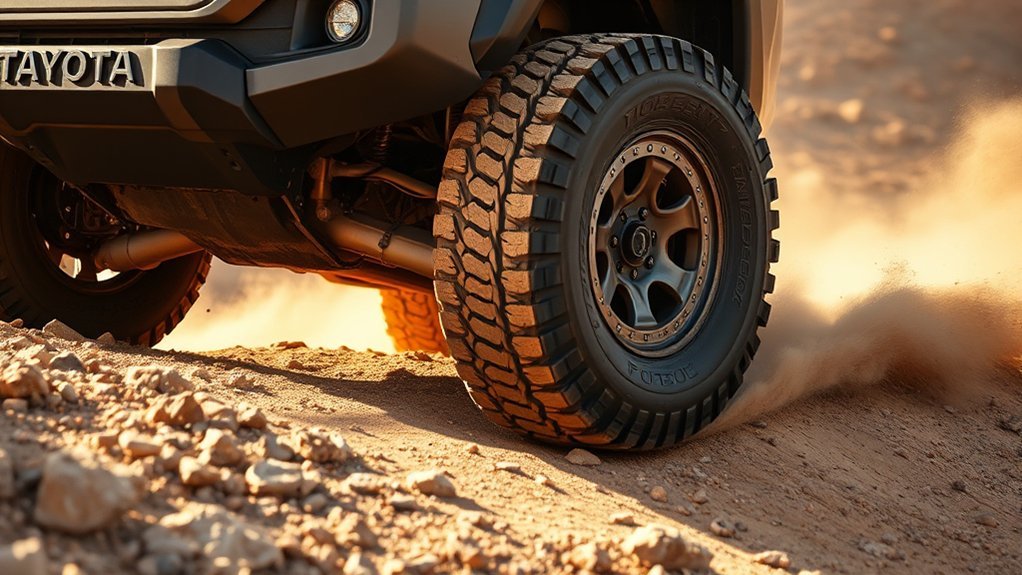
When you tackle WD off‑roading in a 2018 Tacoma Sport, recognize that traction control has defined limits and can’t replicate the mechanical grip of locking differentials on extreme surfaces. You’ll need to apply deliberate weight‑transfer techniques—braking, throttle modulation, and cargo placement—to bias load to the driven wheels and maximize contact patch effectiveness. Combine those tactics with appropriate tire choice and conservative expectations to avoid overreliance on electronic aids.
Traction Control Limits
Although traction control systems on a Toyota Tacoma are designed to reduce wheel slip and improve stability on slick surfaces, they can actively hinder recovery in deep mud or sand where controlled wheel spin is needed to find traction. You’ll need to grasp traction control limitations versus wheel slip benefits to exploit liberation from being stuck. In 2WD you can still modulate slip, but true recovery often requires 4WD or lockers. Hold the traction button for 10 seconds (flashing indicator) to change behavior before exiting park; monitor sounds and settings to avoid drivetrain stress. Remember that traction control may curb acceleration on steep climbs, so match system use to terrain and objective.
- Know system states
- Use timed override
- Prefer 4WD/lockers for deep terrain
- Monitor cues
Weight Transfer Techniques
If you shift weight rearward deliberately, you’ll increase rear-wheel bite for better acceleration and reduced spin on steep or loose surfaces; this is fundamental to controlled recovery and traction management. You’ll use weight distribution deliberately: move cargo, seat position, and brief braking to bias the rear axle, then apply measured throttle control to maintain grip. Simultaneous throttle and brake inputs can stabilize pitch and prevent sudden transfer that causes slip. In rock crawling, controlled transfers keep tires loaded on contact patches, minimizing roll risk. Analyze center-of-gravity shifts and practice modulation to liberate capability without risking stability.
| Action | Effect | Use case |
|---|---|---|
| Rear biasing | Increases rear normal force | Steep climbs |
| Throttle-brake mod | Damps pitch | Mud/sand |
| Controlled crawl | Maintains contact | Rock obstacles |
Traction & Differential Basics for Tacomas (Open, LSD, Lockers)
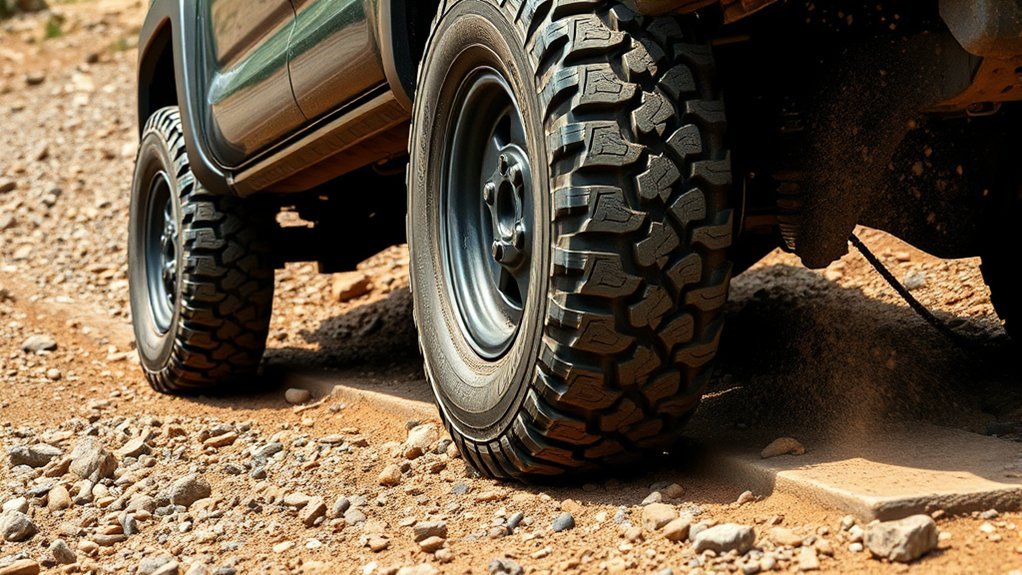
Traction systems determine how effectively your Tacoma converts engine torque into forward motion on loose or uneven surfaces, so understanding open differentials, limited-slip units, and lockers is essential. You’ll analyze differential types and traction mechanics to free your driving capability from terrain constraints. The 2018 Tacoma Sport’s open differential lets wheels rotate independently but sacrifices traction when one wheel loses grip. LSDs sense slip and bias torque to the better wheel, improving momentum without driver intervention. Lockers force equal torque to both wheels, delivering predictable traction in extreme conditions; you’ll engage lockers deliberately to escape obstacles.
Know your Tacoma’s diffs—open, LSD, or locker—so you can manipulate torque and conquer loose, uneven terrain.
- Open differential: independent wheel rotation, poor when one wheel spins.
- Limited-slip (LSD): torque biasing, automatic slip response.
- Locker: full torque lock, manual or automatic engagement for max traction.
- TCS interaction: hold button 10s in park/neutral to enable TCS functions.
Understand these systems precisely so you can choose control strategies that liberate your Tacoma’s off-road potential.
Using Traction Modes, Hill Descent, and Crawl Control
When you select a traction mode on the Tacoma, the vehicle adjusts power distribution and brake pressure to match surface conditions like mud, sand, or snow. Use Hill Descent Control to maintain a controlled downhill speed while the system applies braking to the appropriate wheels for stability on loose grades. Engage Crawl Control for low-speed, automated throttle and braking so you can concentrate on steering across technical terrain.
Traction Mode Selection
Because off-road conditions vary rapidly, you’ll want to deliberately select the Tacoma’s traction mode and use Hill Descent and Crawl Control to match the terrain and speed demands. You’ll exploit traction mode benefits and terrain adaptability to optimize power distribution, minimize wheel spin, and maintain momentum in mud, sand, or rocks. Choose modes proactively: they reconfigure throttle response, differential behavior, and braking intervention for specific surfaces.
- Assess terrain and select corresponding traction mode for grip optimization.
- Engage Crawl Control for sustained low-speed traversal across obstacles.
- Use Hill Descent as needed to stabilize downhill speed without rider input.
- Monitor wheel slip and switch modes to restore forward progress.
You’ll gain operational freedom and performance precision by mastering mode selection.
Hill Descent Control
After you’ve selected the appropriate traction mode and engaged Crawl Control as the situation demands, Hill Descent Control (HDC) takes over downhill braking to hold a set low speed without brake or throttle input from you. You’ll rely on HDC to execute precise hill descent techniques: the system modulates individual-wheel braking and integrates traction-mode parameters to suit gravel, mud, or rocky grades. Operate in 4WD Low for maximum mechanical advantage; HDC’s calibration reduces wheel lockup and preserves momentum while you steer. This lowers your cognitive load and enhances off road safety by minimizing throttle-brake oscillation and preventing uncontrolled slip. Use HDC as a controlled tool in your liberation toolkit—trusting vehicle systems while maintaining situational awareness and steering authority.
Off‑Road Crawl Control
Engage Crawl Control in 4WD Low and the system will manage engine output and selective wheel braking to hold a steady low speed while you negotiate obstacles. You’ll exploit Crawl Control benefits to decouple throttle modulation from decision-making, freeing you to choose line and momentum without micro‑inputs. The system modulates engine torque and applies brakes to individual wheels, maintaining traction on mud, sand, loose gravel, and rock. Multiple speed settings let you match control to gradient and obstacle density. Expect consistent Off Road performance and reduced wheel spin, preserving tire integrity and reducing recovery risk.
- Maintains steady low speed across varied terrain.
- Selective braking targets slipping wheels.
- Multiple speed settings for situational precision.
- Frees driver to focus on path selection.
Tire Pressure & Tread: Mud, Sand, and Rock
When you’re preparing a Tacoma for mud, sand, or rock, tire pressure and tread selection become primary controls that directly affect traction, flotation, and sidewall protection. You’ll use tire pressure to tune contact patch: lower pressure increases surface area, improving flotation and bite in soft substrates, while higher pressure stiffens the tire for precise rock negotiation. For mud, target ~15–20 psi to maximize flotation and reduce sink; in sand, drop to roughly 12–15 psi so the tire conforms and rides atop granular surfaces. For rock crawling, raise pressure to about 25–30 psi to preserve sidewall integrity and improve steering feedback over sharp edges.
Tread patterns must align with terrain: aggressive, deep-lug mud tires evacuate debris and dig into soft ground; all-terrain treads provide compromise traction, wear life, and on-road civility. Match pressure and tread to terrain, and you’ll liberate capability while minimizing damage and recovery risk.
Diagnosing Noises: Quick Drivetrain & Suspension Checks
If you hear unfamiliar ticking, clunking, or creaking during shifts or articulation, start with a focused, systematic inspection of the drivetrain and suspension to isolate the source. You’ll perform a drivetrain inspection targeting universal joints, CV joints, differential fluid level and leaks, and undercarriage fasteners. Simultaneously, a suspension evaluation should assess bushings, shocks, struts, and visible damage that produces creaks under load. Be methodical: reproduce the noise at low speed, then park and inspect.
When you hear ticking, clunks, or creaks, methodically inspect drivetrain and suspension—reproduce the noise, then probe joints, boots, fluids, and mounts.
- Visually check U-joints/CV boots and differential for leaks or low fluid.
- Compress and articulate suspension, feeling for bushing play and shock damping loss.
- Scan tires for uneven wear or embedded debris that transmits noise and degrades traction.
- Probe underbody fasteners and mounts for looseness or wear from off-road vibration.
You’ll document findings, prioritize repairs that restore reliable engagement and control, and avoid cosmetic fixes that don’t eliminate mechanical freedom.
Simple Upgrades and Settings to Boost Tacoma Traction
Start by prioritizing changes that yield measurable traction gains without compromising safety: fit all-terrain or mud-terrain tires sized to maintain proper load ratings, tune tire pressures for the specific surface (lower for soft sand/mud, higher for hardpack), and consider a locking rear differential to guarantee equal torque delivery under slip conditions. You’ll apply tire selection strategies to balance tread pattern, sidewall strength, and payload requirements. Use the Tacoma’s Multi-Terrain Select to complement mechanical upgrades, matching electronic traction control to the new tire behavior. Add skid plates as a protective traction safeguard so underbody damage doesn’t degrade capability.
| Upgrade | Benefit |
|---|---|
| All-terrain/mud tires | Increased bite on loose surfaces |
| Tire pressure tuning | Optimized contact patch |
| Locking rear differential | Equal torque under slip |
| Skid plates | Preserve drivetrain integrity |
Select traction enhancement accessories that integrate mechanically and electronically, and choose components that liberate your route choices without introducing failure modes.
Driving Techniques and Maintenance for Reliable Traction
Having upgraded tires, pressures, and differentials, you now need to focus on driving techniques and routine maintenance that preserve and predictably deliver traction. You’ll monitor tire pressure and tread depth frequently, perform scheduled tire rotation to equalize wear, and inspect for cuts or bulges that compromise grip. Use tires matched to terrain—mud, sand, rock—and engage traction control selectively to manage wheel slip without overriding driver intent.
After upgrading tires and diffs, focus on smooth driving and routine checks to preserve predictable off-road traction.
You’ll apply controlled inputs: smooth throttle ramps, progressive braking, and deliberate steering to avoid sudden weight shifts that reduce contact patch effectiveness. Balance load evenly to maintain predictable axle loads and optimize traction.
- Check tire pressure and tread depth weekly; record changes.
- Rotate tires per mileage schedule; log orientation.
- Calibrate suspension adjustments for load and terrain.
- Use traction control and driving technique together; avoid reliance on electronics alone.
These practices free you from avoidable failures and deliver consistent off-road traction.
Frequently Asked Questions
How Does Traction Control Work on a Toyota Tacoma?
Traction control on your Tacoma detects wheel slip, then uses brake modulation and engine torque reduction to rebalance power to gripping wheels, letting you exploit loose terrain while maintaining control and maximizing your vehicle’s off-road freedom.
Conclusion
You’ll get more grip by choosing the right tires and setup than by relying on 4WD alone. Remember the time you crawled over that slick rock with new AT tires and a locked rear, breathing easier as the Tacoma didn’t slip — that single successful pass shows traction is a system, not a switch. Focus on tire choice, pressures, diffs, and maintenance; measured changes (even 10% improvement in contact patch) compound into reliable off‑road performance.