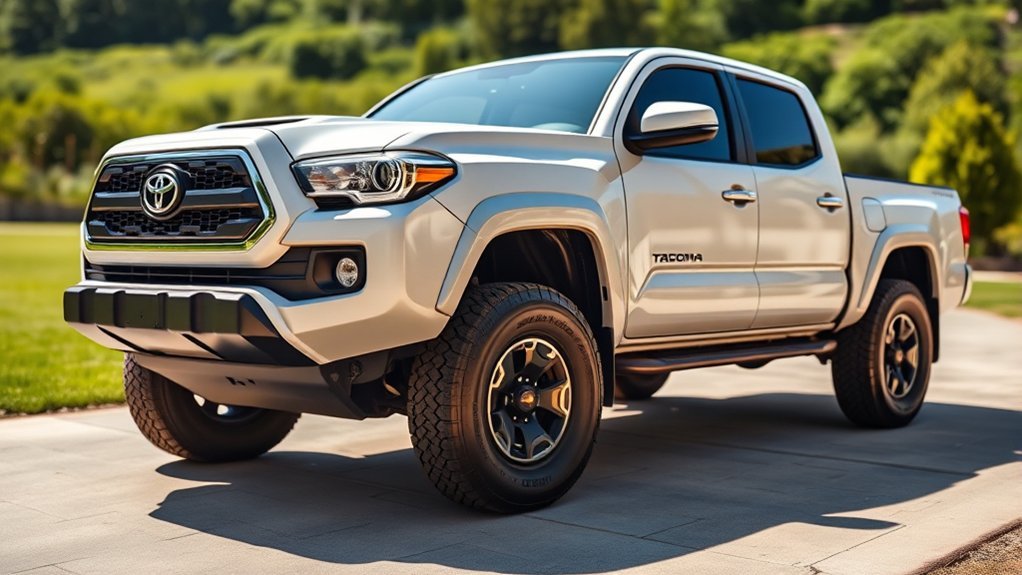
You should use GL‑5 gear oil in your Tacoma’s differentials and transfer case—typically 75W or 75W‑90—to provide the extreme‑pressure protection hypoid gears need. Don’t use GL‑5 in the manual transmission; Toyota calls for GL‑4 there to protect brass/bronze synchros. Change differential fluid about every 30,000 miles (15,000 for heavy off‑road use), watch for contamination, and match viscosity to climate and load. Continue for specifics on products, procedures, and torque/fill tips.
Toyota Tacoma Diff & Transfer Case Fluid Specs

Differentials and the transfer case on a Toyota Tacoma require GL‑5 rated gear oil to handle the high‑pressure contact of hypoid gears; you should use GL5 for both systems to guarantee proper protection. Toyota specifies 75W viscosity for the transfer case while still requiring GL‑5 chemistry; for differentials, 75W‑90 GL‑5 is common and acceptable, though it may slightly reduce fuel economy. Focus on fluid properties: GL‑5 additives provide extreme‑pressure agents and film strength to resist gear scuffing under load; 75W viscosity balances cold flow with high‑temperature film stability. For maintenance tips, change differential and transfer case fluids every 30,000 miles or every 15,000 miles if you off‑road heavily. When you DIY, confirm the product explicitly states GL‑5 compatibility to prevent cross‑contamination or transmission harm. Use sealed, labeled containers and proper torque when reassembling. These steps free you to keep driveline components durable and predictable without overcomplication.
Why GL4 vs GL5 Matter for Your Tacoma
You already covered why GL‑5 is right for the Tacoma’s diffs and transfer case; now look at why GL‑4 must be used in the manual transmission. You want parts that last and shifts that stay crisp—GL4 benefits center on protecting soft-metal synchros and preventing abrasive wear. GL4 formulations avoid the heavy extreme-pressure additives that attack yellow metals, so synchronizers maintain their mating surfaces and you retain precise, confident shifting.
GL5 risks derive from elevated EP chemistry: it lubricates hypoid gear faces well but chemically compromises synchro friction materials over time. You might notice initially smooth operation with GL5, yet progressive synchro wear degrades shift quality and invites expensive repairs. Toyota’s guidance is clear: GL5 for diffs/transfer case, GL4 strictly for the manual transmission. Follow that split to minimize component failure, control maintenance costs, and keep your Tacoma liberated from avoidable drivetrain damage.
Recommended Gear Oil Weights for Tacoma (75W, 75W90)
Think of gear oil as the drivetrain’s blood: for a Tacoma you’ll typically choose 75W for cold-start flow and 75W‑90 for higher-load protection, with both grades meeting API GL‑5 for diffs and the transfer case. You want peak performance without compromise — 75W gives the low-viscosity flow needed in cold weather so gears engage cleanly at startup, while 75W‑90 preserves film strength under sustained load and heat.
- Use 75W where subfreezing starts are common and immediate lubrication matters.
- Favor 75W‑90 for towing, heavy use, or prolonged high-load operation.
- Replace differential and transfer case fluid every ~30,000 miles to sustain durability.
You’ll choose based on duty cycle: liberation from breakdown risk comes from matching viscosity to climate and load. Both weights are specified for Tacoma drivetrains; selecting the right one reduces wear, noise, and thermal degradation. Stay precise, change intervals consistent, and prioritize proven GL‑5 formulations for protection.
Choosing Compatible Gear Oil: API/GL Labels & Equivalents
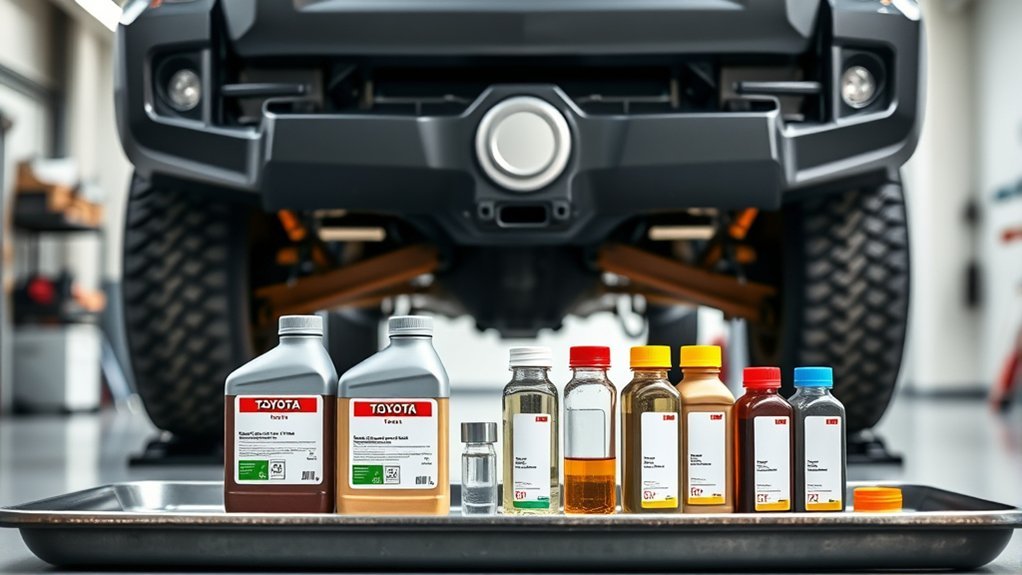
After picking the right viscosity for your Tacoma’s axles and transfer case, check the API/GL rating to guarantee compatibility: Toyota calls for GL‑5 in diffs and transfer cases to handle extreme-pressure contacts, while manual gearboxes originally specified GL‑3 (GL‑4 is an acceptable substitute) to protect softer synchro materials. You’ll prioritize gear oil compatibility: GL‑5 contains EP additives that protect hypoid gears under high sliding and contact loads; GL‑4/GL‑3 have milder additives less likely to corrode brass or bronze synchros. Don’t assume GL‑5 is safe everywhere—misuse in manuals can feel fine initially but accelerates synchro wear. For transfer cases Toyota moved to 75W fluids while keeping GL‑5 chemistry, so match both viscosity and GL rating. Decide between synthetic vs conventional based on operating temperature and duty: synthetics offer better shear stability, low‑temp flow, and longer life under severe use favored by liberated drivers; conventional oils are economical for light, predictable use.
Service Guide: Change Intervals, DIY Fill/Drain, Troubleshooting
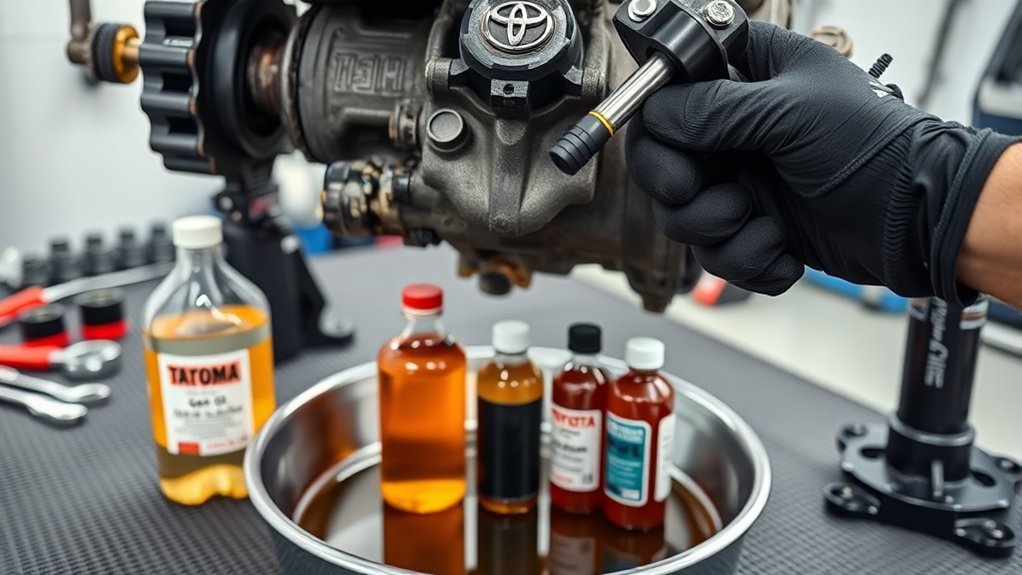
Start by following Toyota’s recommended differential service intervals: change rear and front diff fluid every 30,000 miles, or every 15,000 miles if you frequently go off‑road or tow heavily, to prevent premature wear from contamination and degraded lubricity. You’ll protect gears and seals by adhering to intervals and watching for signs of fluid contamination (metal particles, water, burnt smell). For DIY drain/fill: warm the axle, fully drain, then refill slightly above the fill hole level to guarantee proper lubrication. Use GL5-rated gear oil for diffs; choose reputable brands like Valvoline, Mobil 1, or Liquid Wrench.
- Inspect drain plug debris and magnet for metal shavings.
- Use the correct torque on fill/drain plugs; avoid overtightening.
- Record service date, mileage, and fluid type as maintenance tips.
If you detect grinding, leaks, or excessive play, stop driving and troubleshoot: verify fluid level, inspect seals, and consult a shop for bearing or gear inspection to maintain your vehicle’s freedom and reliability.
Frequently Asked Questions
What Kind of Differential Fluid Does a Toyota Tacoma Take?
Your Tacoma uses GL5 gear oil, typically 75W or 75W90; follow fluid maintenance tips and schedule a differential fluid change every 30,000 miles (15,000 for heavy off‑roading) to protect gears and preserve liberated performance.
What Is the Difference Between Toyota ATF TC and FE?
Boldly better: you’ll choose ATF TC for transfer cases and ATF FE for automatic transmission use. They differ in viscosity, additive chemistry, and fluid specifications, so don’t compromise performance—follow manual guidance for freedom.
What Differential Oil Does Toyota Use?
Toyota uses GL5-rated gear oil (commonly 75W90) for differentials. You’ll perform differential maintenance and an oil change regularly; follow Toyota specs, verify compatibility, and change more often if you off-road heavily to protect gears.
What Are the Different Types of Rear Differential Fluid?
You’ll find three main rear differential fluid types: mineral, synthetic options, and semi-synthetic, each offered in various viscosity ratings (e.g., 75W, 80, 75W85); choose GL5-spec oils for high-pressure, liberating reliability.
Conclusion
Think of your Tacoma’s differential like a relay runner—using the right oil keeps the handoff smooth. You’ll want GL4-compatible gear oils (75W–75W90) for most Tacomas; GL5 can corrode yellow metals unless it’s explicitly safe. Change intervals and DIY fill/drain steps matter—neglect doubles wear rates in some fleets. Use API/GL labels or manufacturer equivalents, follow service specs, and your drivetrain will finish every leg efficiently and quietly.