Use the manual override when you need independent, targeted trailer braking—correcting sway, recovering traction, or making precise low‑speed moves like tight turns or parking—without applying your vehicle brakes. Engage gently and pulse for control; avoid high‑speed or abrupt use to prevent jackknife or loss of control. Check lights, breakaway cable, gain setting, and wiring before use. Know whether your controller is manual or proportional and test the override so you can apply it confidently and safely as needed.
How the Trailer Brake Controller Manual Override Works

When you flip the trailer brake controller’s manual override, it lets you apply the trailer brakes independently of the tow vehicle’s foot pedal, activating tail lights and increasing brake voltage so you can precisely augment braking force—useful for correcting minor sway, testing connections during setup, or making slow-speed maneuvers like hitching a fifth-wheel, and on some models it serves as an emergency anti-jackknife measure. You use manual activation to deliver controlled, immediate braking to the trailer without altering vehicle brake input. The override routes higher voltage to the trailer circuit; a firmer button press yields greater current and braking torque. You’ll notice this direct control gives superior modulation compared with pedal-linked systems, letting you dial brake sensitivity for task-specific response. In tight maneuvers or corrective actions, it’s the tool that frees you from inertia constraints. Maintain disciplined, measured inputs: the override is precise but potent, and mastering its modulation brings safer, more liberated towing control.
Pre‑Use Checks: Lights, Breakaway, Gain, and Wiring
Before you hit the road, check that all trailer lights and signals operate correctly so brake and turn indications are visible to others. Confirm the breakaway cable is securely attached and set the controller gain to match the trailer weight for consistent stopping. Also inspect wiring for wear and perform a manual-override test to verify the trailer brakes engage independently.
Check Lights & Signals
Start by engaging the manual override and visually confirming the trailer’s brake lights illuminate. You rely on clear trailer lights and signal checks to maintain control and freedom on the road. Inspect wiring for chafing, corrosion, and secure connections. Test each turn signal and hazard lamp from the cab and at the trailer to confirm instant response. Keep a compact checklist and act on any fault immediately.
- Visually confirm brake light illumination with manual override engaged.
- Cycle left/right turn signals and hazards; watch for synchronization.
- Inspect wiring harness, connectors, and ground integrity for damage.
- Repeat manual override test to verify responsive braking control before departure.
Verify Breakaway & Gain
A quick pre‑use check of breakaway and gain guarantees your trailer will stop reliably and your lights and wiring will carry the necessary signals. Verify the breakaway cable is clipped to the tow vehicle, not the hitch, so a trailer detachment will engage the emergency brake. Activate the brake controller and observe tail and brake lights to confirm electrical continuity. Inspect wiring for corrosion, frays, or loose terminals that would defeat signals or trailer brakes. Set gain adjustment based on trailer weight — start low or midrange and increase until brakes engage smoothly without locking. Test the manual override switch to confirm it independently applies the trailer brakes. These steps free you from uncertainty and keep control under stress.
When to Use the Override: Sway, Traction Loss, and Emergencies
When trailer sway, traction loss, or an emergency threatens control, use the manual override to apply the trailer brakes independently and stabilize the rig; it gives you a rapid, isolated braking action that can stop a sway, slow a sliding trailer on slick surfaces, or reduce jackknife risk without dragging the tow vehicle. You’ll engage sway control instantly, isolating trailer momentum from the tow vehicle. In traction loss, the override lets you slow the trailer while your tow vehicle regains grip. For true emergencies, hit the manual for emergency braking on the trailer only, cutting instability and buying time to regain command.
Use the manual override to brake the trailer independently—stop sway, slow slides, and buy time in emergencies.
- Arrest minor sway with a firm, brief override pulse to re-center the trailer.
- Apply trailer brakes during traction loss to decouple trailer motion from wheel slip.
- Use override in jackknife-prone emergencies to reduce trailer momentum quickly.
- Test override function pre-trip to guarantee reliable operation and liberation on the road.
Use the Override for Low‑Speed Maneuvers and Hitching
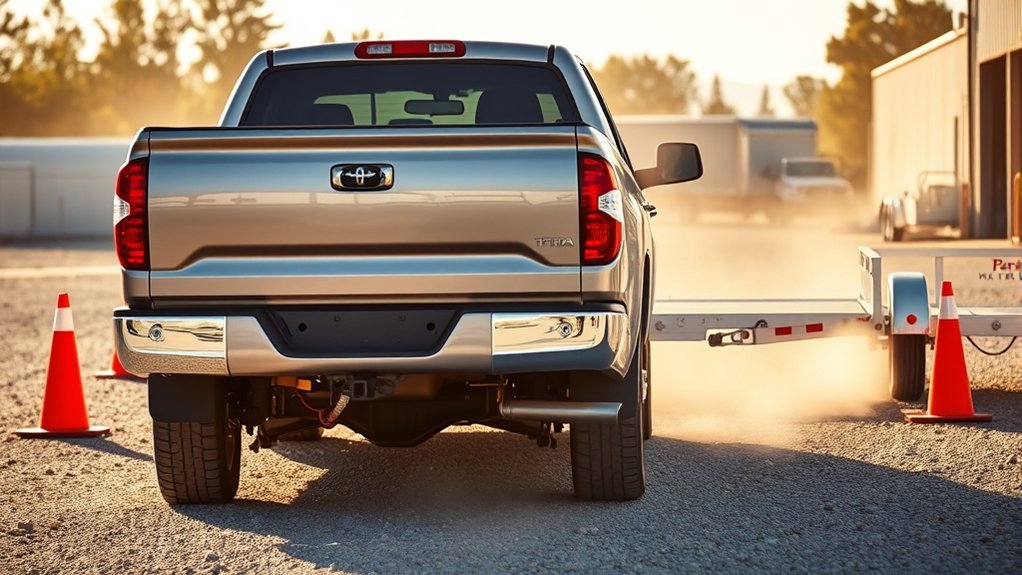
Use the manual override to apply trailer brakes independently during slow-speed maneuvers so you can precisely control trailer movement when parking or steering through tight spaces. It also lets you increase braking force to correct minor sway and stabilize the load at low speeds. When hitching a 5th wheel or gooseneck, use the override to test and apply brakes for precise, secure coupling.
Slow-Speed Maneuver Control
Although slow-speed maneuvers demand precision, you can rely on the manual override to apply trailer brakes independently for tight turns, backing, and hitching. You’ll gain trailer stability and precise braking when you need micro‑adjustments without engaging vehicle brakes. Engage the override gently to ramp brake force, avoid abrupt stops, and correct minor sway while parking or threading tight spaces. The override also activates trailer tail lights, increasing visibility during low‑speed ops.
- Use gradual input to prevent lockup and maintain control.
- Apply short pulses to counteract sway during tight turns.
- Brake independently when reversing to steer the trailer more accurately.
- Keep eyes on surroundings; lights signal intent to others.
You’re choosing freedom through controlled, deliberate action.
Safe Hitching Assistance
One simple action—pressing the manual override—lets you apply the trailer brakes independently to fine‑tune trailer alignment during hitching or unhitching. Use controlled button pressure to vary voltage to the brakes, so small increases give precise deceleration for hitch alignment techniques. The override engages tail lights, providing visibility enhancements that warn bystanders and drivers during low‑speed moves. For 5th wheel or gooseneck setups, apply gradual braking to position the kingpin or coupler before locking; you’ll avoid rebound or overrun. During initial setup or minor sway correction, the override stabilizes the trailer without engaging full tow‑vehicle braking profiles. Practice modulation in an open area to internalize feel. Rely on this tool when you want liberated control over tight, technical hitching maneuvers.
Control Descents: Override Technique and Gear Choice
When descending steep grades, engage the trailer brake controller’s manual override to apply immediate braking force and help keep both the tow vehicle and trailer under control. You’ll combine braking techniques with deliberate gear selection to hold speed without riding the service brakes. Use a lower gear to add engine braking; then pulse the manual override to damp trailer surge and prevent jackknifing. Watch mirrors closely and adjust force to preserve stability.
- Choose a low gear before the descent to maximize engine braking and reduce brake wear.
- Apply the manual override in controlled pulses rather than continuous force to modulate trailer influence.
- Monitor trailer behavior in mirrors; tighten or ease override based on sway or compression.
- Practice the sequence in safe areas so you trust the controller’s response under load.
This approach frees you from reactive braking, lets you control momentum, and keeps the combination stable on steep grades.
When Not to Use the Override: Common Mistakes and Risks

Because the manual override gives immediate brake force, you shouldn’t use it in situations where that sudden input creates more hazard than control. Don’t engage it at high speed — that common mistake can induce unexpected braking, destabilize the tow unit, and cause loss of control. Avoid using the override during sharp turns; the abrupt trailer braking increases sway and raises jackknife potential risks.
You also shouldn’t rely on the override on flat terrain as a substitute for proper controller calibration. That shortcut causes premature brake wear and reduces braking efficiency when you need predictable response. Overuse is another common mistake: repeated manual inputs heat the trailer brakes, especially on long stops or downhill runs, leading to fade and reduced stopping power. Use the override sparingly, for short, tactical corrections only. Maintain calibrated settings and address controller faults through proper adjustment or repair to minimize these potential risks and preserve your freedom to tow safely.
Troubleshooting and Model Differences (Manual vs. Proportional; Tail‑Light Behavior)
Although models vary, you need to know how manual and proportional controllers behave and how that affects troubleshooting, especially given differences in tail-light indicators and override response. You’ll rely on model compatibility and clear user experience expectations when diagnosing issues. Proportional units modulate braking with vehicle deceleration; time‑delayed or manual units need you to set intensity. The manual override raises brake voltage as you press harder, useful for sway correction or pre‑trip testing.
- Check tail‑light behavior: some models illuminate trailer lights with override activation, others don’t—confirm with the manual to avoid false alarms.
- Verify voltage output: use a meter while pressing the manual button to confirm progressive voltage increase and correct wiring.
- Match controller type to symptoms: erratic braking often points to model incompatibility or proportional sensor faults; steady late pulses suggest time‑delayed settings.
- Consult manufacturer guidelines for firmware, installation quirks, and recommended troubleshooting steps to preserve safety and freedom on the road.
Frequently Asked Questions
When Should I Use a Trailer Brake Controller?
You should use a trailer brake controller whenever towing to match load and terrain; choose appropriate brake controller types, exploit manual override benefits for sway correction, precise positioning, testing, or emergencies, and practice to gain confident control.
Do I Need a Brake Controller for a 3000 Lb Trailer?
Yes — you’ll need a brake controller for a 3,000 lb trailer: brake controller necessity hinges on trailer weight considerations, ensuring synchronized braking, improved control, and safety so you’re free to tow confidently without risking sway or push.
Conclusion
You’ll practice the manual override and still find it surprises you: when sway, traction loss, or an emergency arrive, you’ll grab the override and slow the trailer without waiting for the tow vehicle’s brakes. Check lights, breakaway, gain, and wiring first, and use override for low‑speed maneuvers, hitching, and controlled descents with proper gear. Don’t use it as a substitute for correct gain or to mask wiring faults; misuse increases lockup and wear.