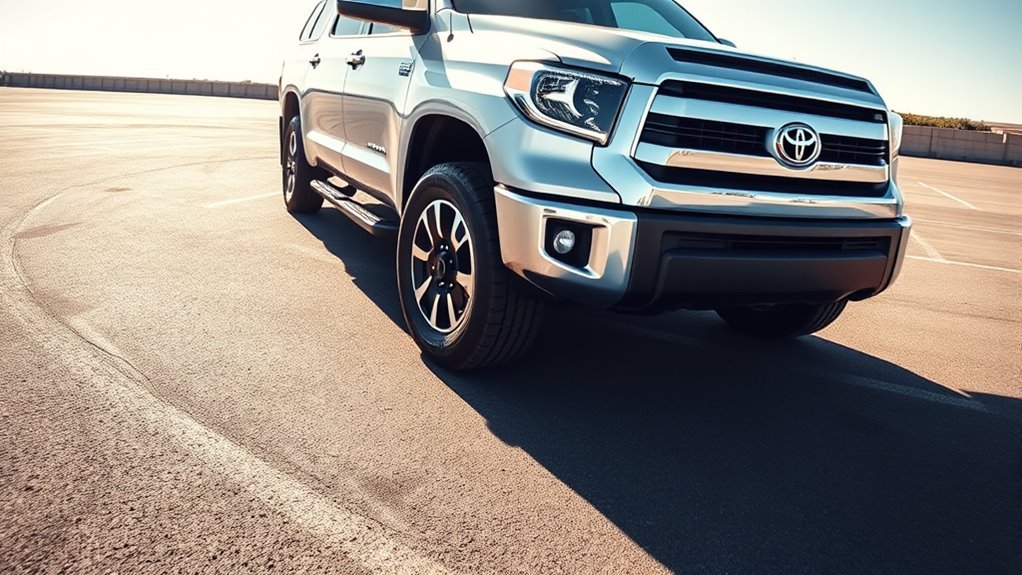
The Toyota Tundra’s turning radius is about 7.4 m (24.3 ft), so you’ll get full‑size pickup capacity with predictable U‑turn and curb maneuvers. That radius is measured at full lock and reflects wheelbase, steering geometry, and overall length. Wider bodies and longer beds increase sweep, while shorter configurations tighten it. You’ll need slightly more space than a compact truck but far less than an 18‑wheeler, and the next sections explain how setup and technique can help.
Tundra Turning Radius: the 7.4 M Quick Answer
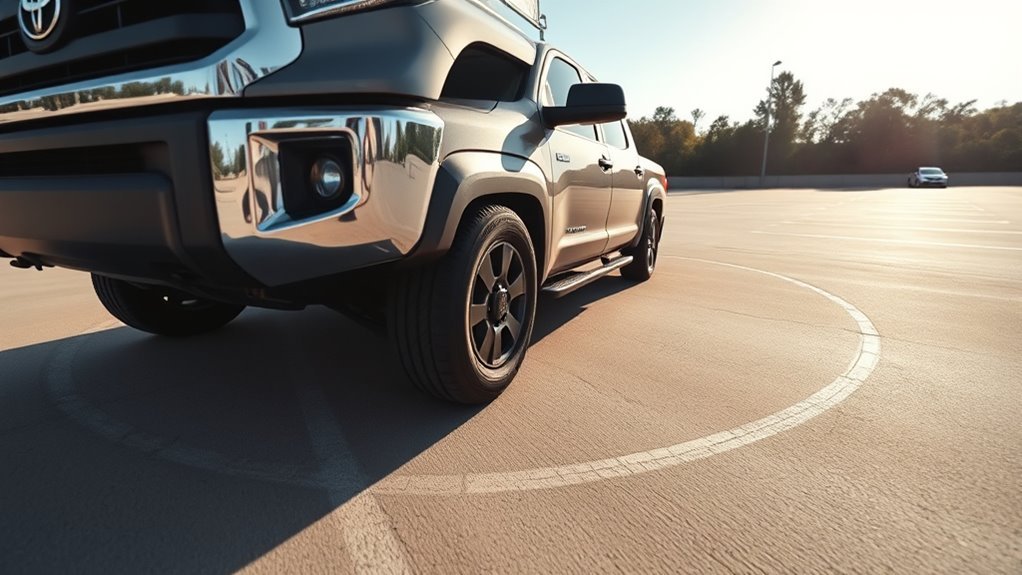
The 2020 Toyota Tundra has a turning radius of about 7.4 meters (24.3 feet), giving you maneuverability that’s reasonable for a full‑size pickup yet larger than compact trucks and cars. You’ll find Tundra agility manifests as a measured compromise: enough wheel articulation and steering ratio to negotiate city streets, alley turns, and curbside parking more easily than large commercial rigs, yet not as tight as compact SUVs or sedans. For urban driving, that means you can execute common maneuvers with confidence, but you’ll plan aisles and reverse maneuvers with slightly larger clearance margins. The figure positions the Tundra competitively within full‑size peers, balancing load capacity and daily usability. You’ll accept modest spatial requirements in exchange for cargo and towing capability, and you’ll exploit the truck’s steering geometry to minimize multi‑point turns. In short, the 7.4 m radius supports liberated movement in constrained environments without compromising utility.
How Turning Radius Is Measured (And Why It Matters)
You measure turning circle by steering to full lock and recording the diameter of the smallest stable circle the vehicle traces, which directly quantifies maneuverability. You’ll see this metric change with wheelbase, track width and steering geometry, so it reflects vehicle design as much as size. In practice a smaller turning circle means easier U‑turns, tighter parking and reduced steering inputs in confined urban settings.
Measuring Turning Circle
One convenient way to quantify a vehicle’s maneuverability is to measure its turning radius, defined as the shortest circular path the vehicle can negotiate measured from the circle’s center to the vehicle’s outer edge; for a 2020 Toyota Tundra this is roughly 7.4 meters (24.3 ft). You assess the turning circle by steering full lock while tracking the center point and outermost body edge, then measuring the radius to that edge. That standardized procedure gives you an objective metric for turning performance and vehicle agility. You use the figure to compare models, predict parking and urban behavior, and decide if a full-size pickup fits your liberated lifestyle needs. Smaller radii yield better maneuverability; larger radii demand compensatory planning.
Practical Driving Effects
Anyone parking or threading a 2020 Toyota Tundra through city streets will notice how its roughly 7.4 m (24.3 ft) turning radius directly affects maneuvering: tighter turns and U‑turns require fewer steering inputs and less back-and-forth correction than larger‑radius trucks, while tight lots and narrow residential streets demand planning for the Tundra’s swept path. You’ll use that dimension to judge feasibility of maneuvers, balancing cargo balance against street constraints. A measured turning radius translates into predictable arc and required clearances, aiding confident urban navigation.
- Easier U‑turns in constrained lanes
- Reduced corrective steering in tight parking
- Predictable swept path for planning
- Tradeoff between cargo balance and maneuverability
- Practical advantage over larger commercial rigs
Size, Wheelbase, and the Tundra’s Turning Circle
You’ll assess how the Tundra’s long wheelbase and overall dimensions translate into a roughly 7.4 m turning radius and influence low-speed maneuvering. Consider how larger body width and length increase sweep requirements for U‑turns and tight parking compared with smaller trucks, while steering geometry and Ackermann characteristics define actual tire paths and inner wheel angles. This balance explains why the Tundra remains competitive in class yet needs more space than compact pickups.
Wheelbase And Maneuverability
Although the Tundra’s full-size proportions prioritize stability and cargo capacity, its 2020 wheelbase and overall footprint were engineered to keep the turning circle manageable; with a roughly 7.4 m (24.3 ft) turning radius, the truck balances on-road stability from a long wheelbase against the tighter maneuvering demands of urban driving. You’ll feel the wheelbase impact in steady tracking and reduced yaw, yet you’ll accept a larger turning radius than compact trucks. Assess maneuverability factors like wheelbase length, overall width (2,040 mm), and steering ratio when planning city routes. The Tundra’s design aims for liberated mobility without sacrificing utility.
- 7.4 m turning radius compared to class
- 5,955 mm overall length influence
- Wheelbase vs stability trade-off
- Urban maneuver constraints
- Practical parking considerations
Body Size Versus Turning
When you factor in the Tundra’s 5,955 mm overall length and 2,040 mm width, its roughly 7.4 m (24.3 ft) turning radius reflects a deliberate compromise between cargo-stable wheelbase geometry and urban maneuverability. You’ll notice those body proportions dictate required sweep for U-turns and parking: larger lateral envelope increases minimum turning circle versus compact pickups. Compared with an 18-wheeler’s >18 m radius, the Tundra remains manageable on city streets, yet it still demands more clear space than passenger cars. You benefit from a platform tuned to utility without sacrificing everyday usability. In practical terms, the maneuverability trade offs favor load capacity and stability; you accept a modest increase in turning radius to retain the freedom to carry payloads and tow confidently.
Steering Geometry Effects
Because steering geometry links wheel angle, wheelbase, and track width to turning circle, the Tundra’s larger dimensions and wheelbase translate directly into its roughly 7.4 m (24.3 ft) turning radius. You’ll find steering dynamics driven by geometry: longer wheelbase and 5,955 mm length increase arc radius, while 2,040 mm width affects required clearance. You can exploit design knowledge to reclaim urban freedom, but you must plan turns.
- Wheelbase length raises turning radius, limiting tight turns
- Track width and body width demand lateral clearance
- Maximum wheel angle and Ackermann setup set inner-wheel path
- Compared to an 18-wheeler, the Tundra offers superior maneuverability factors in cities
- Among full-size pickups, its steering geometry yields competitive, not compact, turning behavior
How the Tundra’s Turning Radius Compares to Rival Pickups: And to Semis
While the Tundra’s roughly 7.4 m (24.3 ft) turning radius keeps it less nimble than compact trucks and passenger cars, it remains competitive among full-size pickups and far more maneuverable than 18-wheelers, which often exceed 18 m (60 ft). You’ll find the Tundra aligns with class norms: its radius sits in the typical range for full-size trucks, so you won’t sacrifice necessary space compared with rival pickups when executing urban or suburban maneuvers. Against smaller trucks and cars you’ll need larger clearances; against semis, you gain substantial agility. Semi comparisons highlight the operational gulf — commercial rigs require roughly two to three times the sweep, restricting access to tight streets and loading bays. For drivers seeking freedom of movement without downsizing capacity, the Tundra offers a pragmatic balance: ample cargo and towing capability with turning geometry that keeps most city and worksite routes accessible, while still demanding more room than compact alternatives.
Tundra Turning Radius in Real Driving: Parking, U-Turns, City Maneuvers
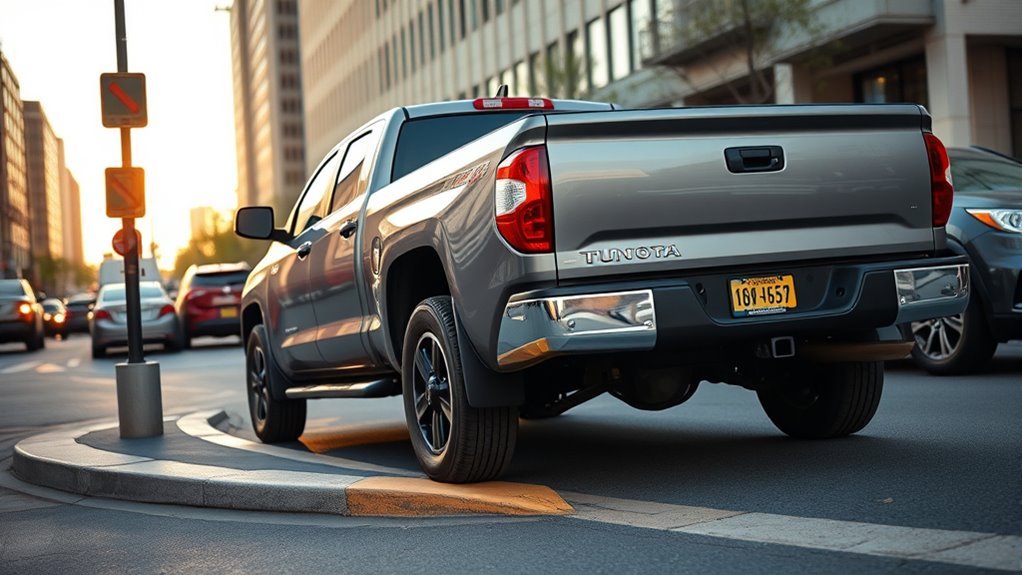
Having established how the Tundra stacks up against rivals and semis, let’s look at how its roughly 7.4 m (24.3 ft) turning radius affects everyday driving maneuvers like parking, U‑turns, and tight city navigation. You’ll find the Tundra offers reasonable maneuverability for a full‑size pickup, but it still requires conscious space management and vehicle awareness.
- Recognize U turn challenges: you’ll need a wider gap than in smaller trucks; scout for safe clearance.
- Apply parking strategies: angle parking and multi‑point corrections reduce collisions in tight spaces.
- City driving: negotiate lanes and curbside spots knowing the Tundra is tighter than semis but larger than cars.
- Maneuverability tips: plan entry/exit arcs early; use mirrors and minimal steering inputs for controlled turns.
- Build driver confidence: practice in low‑traffic zones to internalize radius limits and improve space management.
These concise, technical habits free you from hesitation and let the Tundra serve utility without sacrificing urban mobility.
Reduce Turning Space: Driving Tips and Setup Changes
Want to tighten your turning footprint in a Tundra? Use targeted tight space techniques: prefer a controlled three-point turn over a wide U-turn when roads narrow, exploiting the Tundra’s ~7.4 m (24.3 ft) turning radius. Adjust tire pressure to manufacturer-recommended values to restore predictable steering response and minimize lag during aggressive wheel angles. Practice measured maneuvers in an empty lot to internalize pivot points, wheel lock limits, and vehicle overhang—training frees you to choose paths that shave meters off each turn. Employ visibility enhancements actively: angle mirrors, rely on the rear-view camera and parking sensors, and scan mounting lines so you can place the truck precisely without hesitation. If you can, select a shorter bed to reduce overall length and slightly improve sweep without compromising core capability. Combine technique, setup, and sensing to compress turning space confidently and reclaim tight urban and rural corridors on your terms.
Choose the Right Tundra Configuration If Maneuverability Matters
If maneuverability is a priority, choose a Tundra configuration that minimizes overall length and overhangs, since a shorter bed and cab combination directly reduces sweep and makes tight turns and parking easier. You’ll benefit from selecting a short bed and the most compact cab that meets your needs; this trims the 5,955 mm footprint and reduces the effective turning radius drivers must manage in urban driving. The 2020 Tundra’s estimated 7.4 m (24.3 ft) turning radius is workable, but configuration choices matter.
- Opt for short bed to cut rear overhang and reduce sweep.
- Prefer crew or double cab only if space justifies longer wheelbase.
- Factor vehicle width (2,040 mm) into clearance planning.
- Train consistently to build confidence in tight U-turns and parking.
- Compare configurations in real-world urban driving scenarios.
Choose deliberately to reclaim mobility without sacrificing capability; a compact Tundra setup lets you navigate city streets with greater freedom and predictable handling.
Frequently Asked Questions
What Is the Turning Radius of the Toyota Tundra?
The Toyota Tundra’s turning radius is about 7.4 meters (24.3 feet). You’ll experience improved steering dynamics and vehicle maneuverability, so you can confidently navigate urban streets while retaining the freedom to handle larger turns.
What Is the Turning Radius of the Toyota Tacoma Compared to the Tundra?
Like slipping into a narrow alley, the Tacoma’s ~6.0 m turning radius makes it particularly tighter than the Tundra’s ~7.4 m. You’ll value Tacoma maneuverability over bulkier Tundra dimensions when seeking urban freedom.
What Is Considered a Good Turning Radius?
A good turning radius is typically 5.3–6.4 meters, letting you maneuver tight spaces and urban driving confidently; larger pickups may be ~7.4 m, so you’ll balance cargo needs against maneuverability and freedom.
Is a 10M Turning Circle Good?
Yes—you’ll find a 10m turning circle good; it boosts steering efficiency and passes a basic maneuverability assessment, letting you free yourself from tight-spot stress while still trading off some agility versus compact cars.
Conclusion
You’ve seen that the Tundra’s 7.4 m turning radius is a concrete spec shaped by wheelbase, track width, and steering geometry — and that configuration choices change it. That matters when you’re threading into tight lots, executing U‑turns, or parking in the city. Want to avoid awkward multi‑point turns and curb strikes? Opt for shorter bed/crew‑cab combos, tighter tires, and deliberate steering inputs to keep maneuvering predictable and safe.