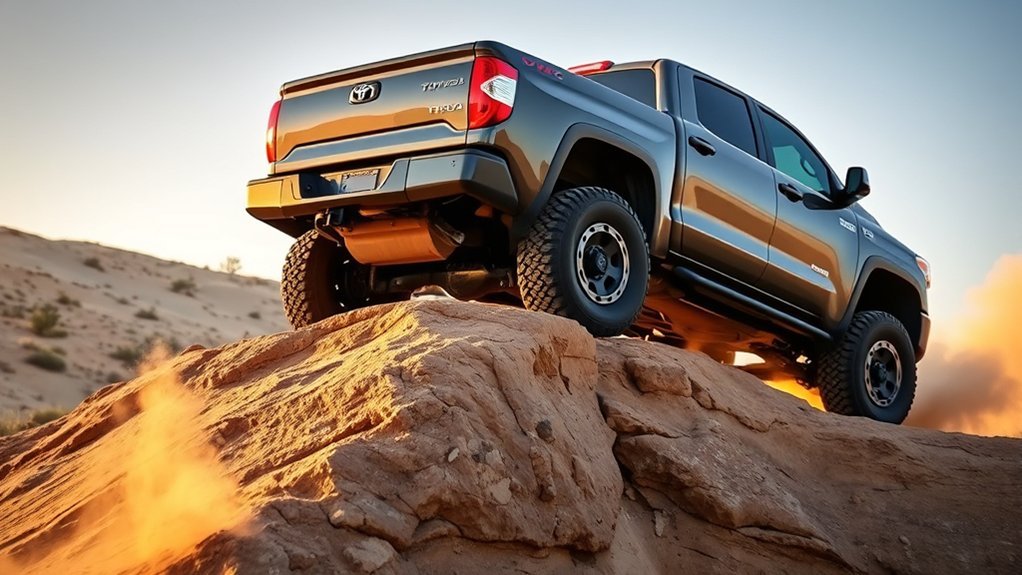
For a Toyota Tundra you’ll assess approach, departure and breakover angles to predict bumper and belly clearance: approach (~25–30° stock) shows front obstacle clearance, departure (~22–25° stock) shows rear clearance on declines, and breakover (~16° stock) gauges mid‑chassis grounding risk based on wheelbase and ride height. Lifts, larger tires and high‑clearance bumpers raise approach/departure but can reduce mechanical reliability or stability; continue for measured methods, upgrade gains and tradeoffs.
What Approach, Departure & Breakover Angles Mean for the Tundra
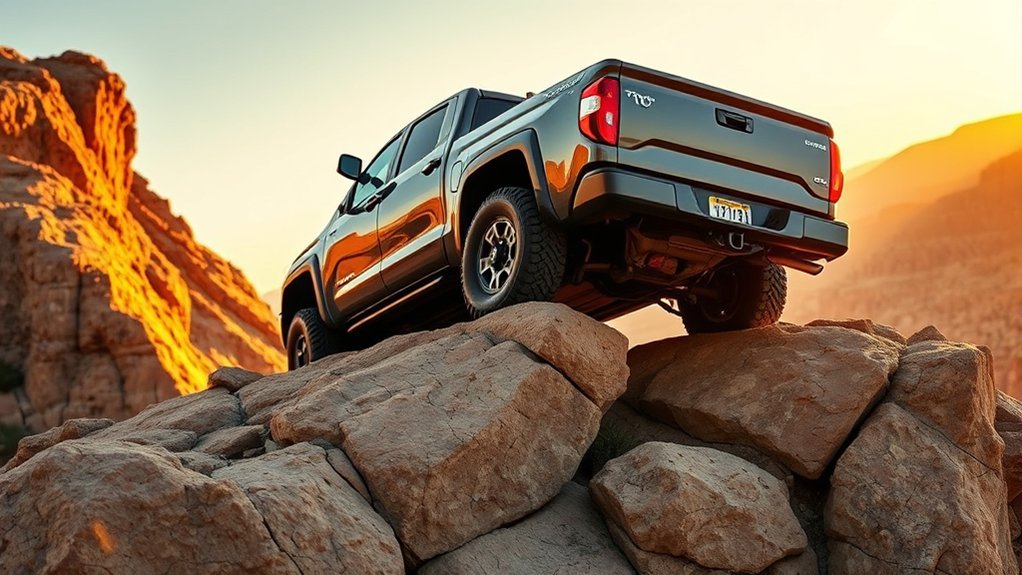
Angles determine how the Tundra negotiates terrain: the approach angle tells you how steep an obstacle the front can meet without contact, the breakover angle (about 16°) indicates the midpoint clearance to avoid bellying out, and the departure angle defines how the rear clears declines. You assess approach benefits when evaluating frontal clearance: a steeper approach angle reduces bumper strikes on rocks and ledges, letting you engage obstacles with controlled momentum. The 16° breakover angle is a fixed geometric limiter; you use it to predict where the chassis may contact terrain and to plan line choice that preserves freedom of movement. Departure challenges emerge on steep exits where rear overhang can hook or drag; you compensate through exit angle awareness and throttle modulation. Together, these angles form a simple, actionable map of capability: you read them, adapt your route, and reject unnecessary risk—liberating your driving by converting measured geometry into confident terrain choices.
How Wheelbase and Ride Height Determine Tundra’s Stock Angles
Because wheelbase and ride height set the geometry that defines clearance points, they directly determine the Tundra’s stock approach, breakover and departure angles and thereby its off‑road limits. You need to grasp wheelbase effects: a longer wheelbase reduces the breakover angle (about 16° stock) because the center of the vehicle spans more distance between contact points, increasing the likelihood of grounding on cresting obstacles. Ride height modifies both approach and departure angles; increasing ride height (commonly 7″–9″ for improved clearance) raises the chassis relative to tire contact patches, steepening those angles and enabling more aggressive obstacle engagement. In stock form, limited ride height and wheelbase length combine to constrain capability, so you’ll hit moderate terrain limits and risk underbody damage. Analytical assessment of the relationship—wheelbase length versus vertical lift from ride height—lets you predict angle gains and plan targeted modifications that liberate the truck’s potential without guesswork.
Measure Your Tundra’s Approach, Departure and Breakover (Easy Field Method)
When you’re out in the field, you can quickly and accurately determine your Tundra’s approach, departure, and breakover angles with a few simple measurements and a protractor or app; these on‑vehicle readings let you evaluate current capability and the effect of lifts or larger tires. You’ll use basic measuring tools and focus on angle accuracy to make decisive, liberating assessments.
- Approach: measure from the front tire contact point to the lowest front bumper point; expect ~25–30° for ideal clearance.
- Departure: measure from the rear tire contact to the lowest rear bumper point; target ~22–25° for reliable obstacle egress.
- Breakover: measure half the wheelbase to the lowest mid‑underbody point; Tundra ≈16°.
Use a protractor or smartphone app to record angles on-site. Note vehicle load and tire pressure for repeatable results. Regular checks prevent being immobilized on trail and let you plan routes within your Tundra’s true limits.
Upgrades That Change Angles : Lifts, Tire Sizes, Bumpers, and Hitch Mods (Expected Gains)
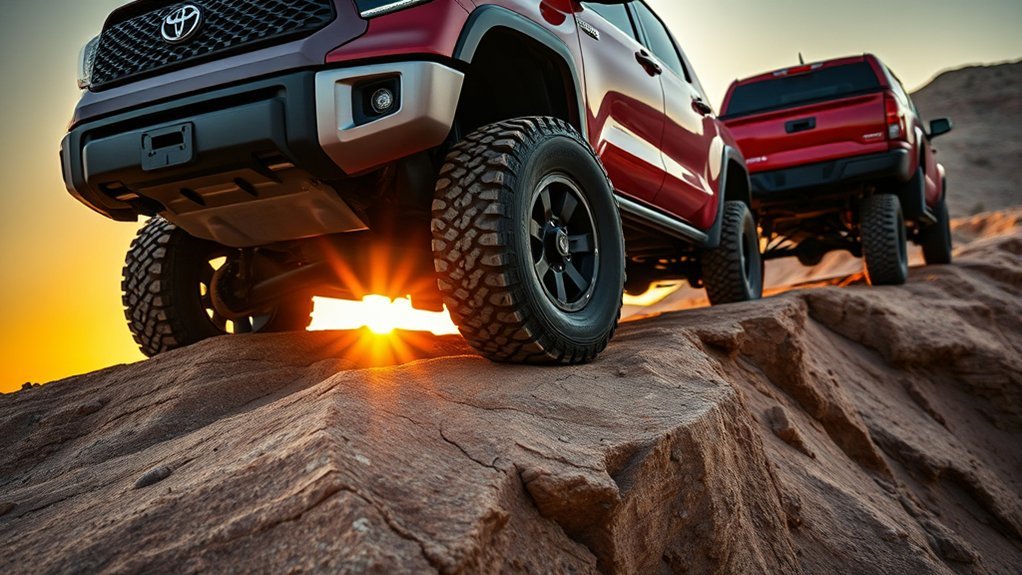
A targeted set of upgrades—suspension lift, larger tires, high‑clearance bumpers, and hitch rework—will measurably change your Tundra’s approach, departure, and breakover angles, so plan mods around quantifiable gains rather than aesthetics. Increase lift height to 7–9″ to significantly improve approach and departure angles; that lift benefits package is the most direct way to raise contact points and clear chassis obstructions. Pairing a lift with 37–43″ tires amplifies ground clearance and obstacle negotiation; tire selection should balance diameter, weight, and sidewall strength for predictable contact patch and steering behavior. Swap to high‑clearance bumpers to reduce frontal and rear overhang interference—bumper advantages include improved ramp angles and reduced snag risk. Rework the stock hitch to a custom, higher‑clearing design so it doesn’t become the limiting point; hitch modifications can preserve towing while raising rear clearance. Monitor breakover angle (≈16° stock) after each mod to guarantee you maintain non‑interference across travel and articulation.
When Bigger Tires or Higher Lifts Hurt Tundra Performance
You’ve seen how lifts, larger tires, and bumper or hitch changes can raise approach, departure, and breakover angles, but pushing size and height past practical limits creates new liabilities. You gain clearance but also introduce tire stress and component damage that erode reliability. Lift effects change geometry: driveshaft angles, CV loads, and steering effort rise, translating to accelerated wear and failure points. Height misconceptions often ignore center-of-gravity shifts; stability challenges become real on side slopes and during dynamic maneuvers.
- Mechanical: oversized tires (40″+) multiply drivetrain load and risk breaking axles, differentials, and U-joints — clear component damage pathways.
- Dynamic: lifts beyond ~7–9″ markedly increase rollover risks and reduce predictable handling; skid-plate and tank scraping can still occur.
- Retrofit: bumpers and hitch mods needed to preserve angles add weight and complexity, compounding lift effects.
You’ll want to balance liberation with engineering limits to retain safe, capable off-road performance.
Use Tundra Angles to Pick Lines and Avoid Hang‑Ups
Use the Tundra’s approach, breakover, and departure angles to read terrain lines and predict where contact points will occur. You’ll choose routes that keep high points and ledges outside those critical angle envelopes, reducing the chance of hang‑ups. Factor in ground clearance and wheelbase when comparing theoretical angles to real trail geometry.
Reading Terrain Lines
When evaluating a prospective line, start by comparing the Tundra’s roughly 16° breakover angle and its approach/departure specs to the terrain profile so you can spot pinch points that will hang the belly or bumpers. You’ll perform rapid terrain assessment and plan obstacle navigation using objective measures: angles, ground clearance, wheelbase. Read the slope, crests, and depressions; mark likely contact points.
- Measure crest-to-crest distances against wheelbase to avoid mid-axle grounding.
- Compare rise angles to approach/departure specs to prevent bumper strikes.
- Evaluate clearance against local obstacles for safe belly traversal.
This analytical method frees you from reactive driving. Use the Tundra’s known limits to assert control, reduce risk, and choose lines that preserve momentum and vehicle integrity.
Choosing Safer Routes
Although terrain can look passable at a glance, you should pick lines by matching the Tundra’s angles and clearances to the route profile so you avoid hang‑ups. Use breakover (≈16°), approach and departure angles, ground clearance, and wheelbase data in route planning and obstacle assessment. Compare slope angles and obstacle heights to vehicle limits; reject lines that exceed approach/departure or risk center‑span contact. Prioritize lines that maintain tire contact and preserve momentum without forcing clearance pushes. This empowers you to move freely and safely.
| Parameter | Limit | Decision |
|---|---|---|
| Breakover | 16° | Avoid center span dips |
| Approach | Vehicle‑specific | Reject steep lips |
| Wheelbase | Measured | Choose shorter arc |
Frequently Asked Questions
What Is the Approach Angle of a Tundra?
The Tundra’s approach angle is about 24 degrees. You’ll use that figure to evaluate Tundra performance and off road capabilities, letting you confidently modify bumpers or driving strategy to maximize trail freedom.
What Are Approach, Departure, and Breakover Angles?
You think angles are tiny drama queens—they’re actually approach, departure, and breakover: the front, rear, and midpoint clearance limits you’ll respect. They’re determined by suspension design and dictate your vehicle’s off road capabilities and route choices.
What Is the Approach Angle of the 2025 Toyota Tundra?
The 2025 Tundra’s approach angle is about 27 degrees. You’ll leverage that for improved Tundra performance and off road capabilities, letting you confidently tackle steep obstacles while preserving your freedom to explore rugged terrain.
Conclusion
You’ve learned how approach, departure and breakover angles hinge on wheelbase and ride height, and how lifts, tires, bumpers and hitch mods shift those numbers. Measure your Tundra in the field, then apply expected gains to pick lines and avoid hang‑ups. Coincidentally, the same small millimeters that raise clearance also shift load and handling—so when you optimize angles, you’re altering overall performance. Use that tradeoff analytically to choose sensible upgrades.