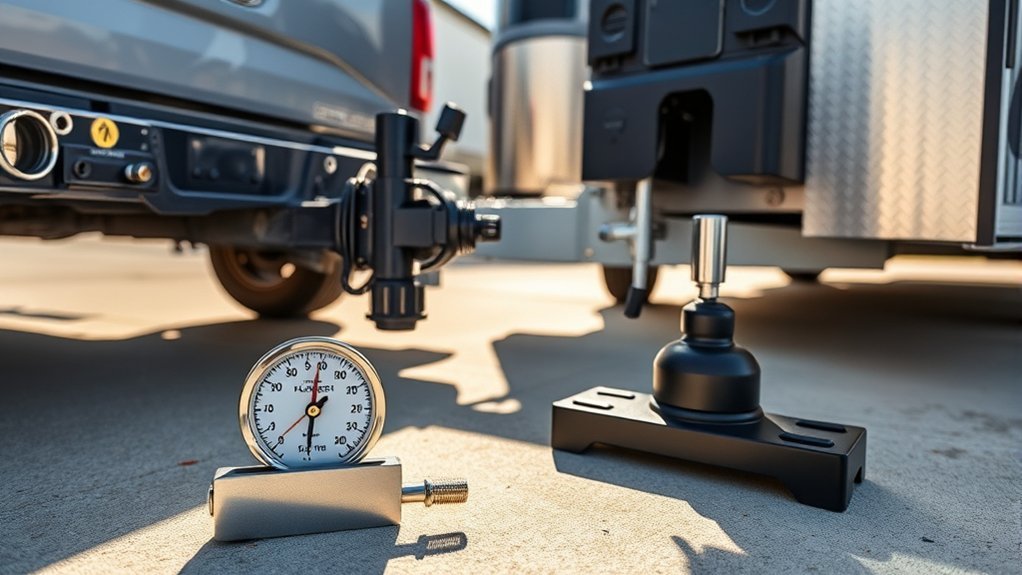
You need to know tongue weight and hitch weight because they affect stability and vehicle load. Tongue weight is the downward force the trailer coupler applies to the hitch ball, typically 10–15% of the trailer’s gross weight for bumper-pull rigs. Hitch weight is the total downward load on your vehicle’s receiver, which includes tongue weight plus any adapter or hitch hardware. Measure both with a scale and adjust cargo placement; keep going and you’ll learn how to measure and correct them.
Quick Answer: Tongue Weight vs Hitch Weight
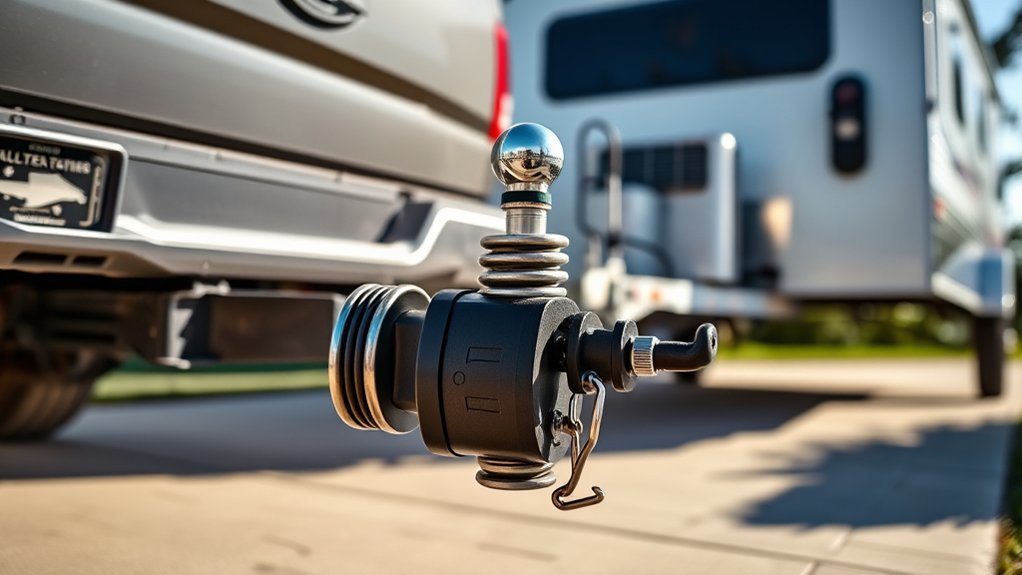
Think of tongue weight as the downward force the trailer coupler places on the hitch ball, while hitch weight is the total vertical load the receiver sees from the trailer; you’ll want tongue weight around 10–15% of the trailer’s gross weight to keep the rig stable. You’ll measure tongue weight and hitch weight to verify load balance and maintain trailer safety. If you let tongue weight grow excessive, your vehicle will sag, handling will degrade, and tires will wear prematurely. If tongue weight’s too light, you’ll invite fishtailing and instability. You’ll distribute cargo, move the load fore or aft, or use weight-distribution equipment to correct imbalance. You should calculate hitch weight after loading and make iterative adjustments until the trailer behaves predictably. Accurate measurement, disciplined loading, and corrective gear let you tow with control and freedom; they turn technical constraints into reliable performance so you can move confidently and safely toward your destination.
What Is Tongue Weight and Why It Matters?
You already know the general difference between tongue weight and hitch weight; now focus on tongue weight itself and how it affects your tow vehicle. Tongue weight is the downward force the trailer coupler applies to the hitch ball, typically 10–15% of the trailer’s gross weight for bumper-pull rigs. You’ll use that percentage to center load over the trailer axle and preserve trailer stability and towing safety.
If tongue weight is too low the trailer can fishtail, amplifying steering inputs and risking loss of control. If it’s too high the rear of your vehicle will sag, causing premature tire wear, degraded steering response, and compromised braking. You liberate yourself from guesswork by measuring tongue weight—use a tongue weight scale or a commercial scale at a truck stop—to confirm balance before every trip. Accurate measurement and adjustment keep handling predictable, reduce risk, and let you tow with confidence and autonomy.
What Is Hitch Weight : How It Differs From Tongue Weight?
Hitch weight is the total downward force the trailer applies to your vehicle’s receiver, and it includes tongue weight as one of its components. You need to grasp this distinction so you can control stability and reclaim freedom on the road. Hitch weight is the aggregate force at the hitch; tongue weight is the local downward pressure at the coupler. Both affect handling, braking, and safety, but hitch weight reflects the combined reaction transmitted through the receiver and frame.
- Hitch weight changes when you alter load distribution inside the trailer.
- Tongue weight usually equals about 10–15% of trailer mass for bumper-pull rigs.
- Misjudged hitch weight undermines braking balance and steering responsiveness.
- Calculating and controlling hitch weight frees you from preventable towing risk.
You’ll use hitch weight and load distribution together to optimize dynamics. Treat hitch weight as the system-level metric and tongue weight as its critical subset; manage both to tow confidently and independently.
Measuring Tongue Weight: Tools and Step-by-Step Method
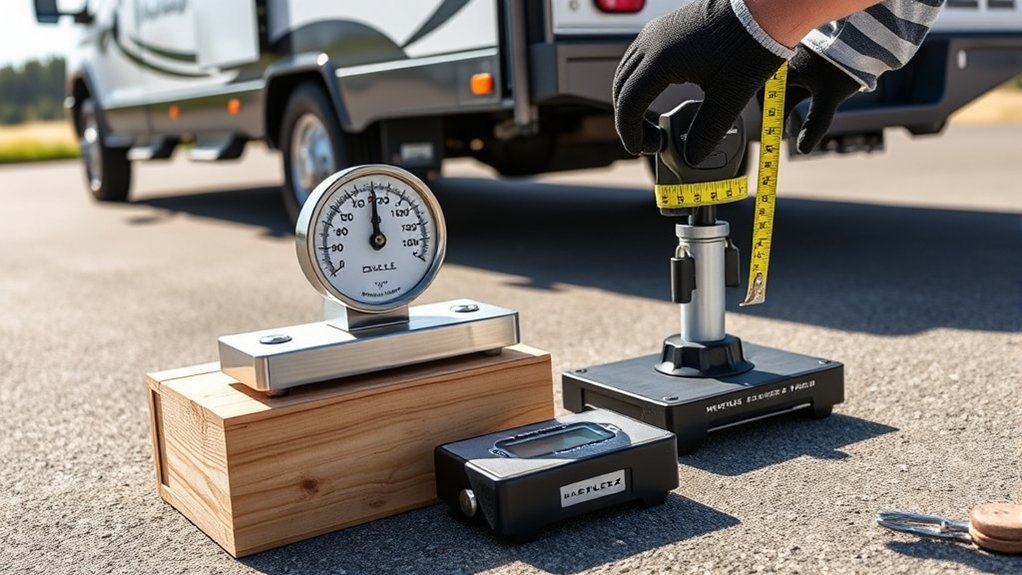
When measuring tongue weight, start with the right tool and a level trailer to get a precise reading. Choose between dedicated tongue weight scales or general-purpose scale types; dedicated units give a direct downward pressure readout, while commercial scales require weighing the entire trailer and subtracting to derive tongue load. Set the trailer on a level surface, chock wheels, and stabilize to eliminate angle-induced error.
For a tongue weight scale: position it under the coupler or hitch ball per manufacturer instructions, lower the trailer onto the scale, record the direct reading. For commercial scales: weigh the trailer with tongue engaged, then weigh without the trailer connected or use axle-by-axle readings; subtract appropriately to calculate tongue force. Use consistent units and repeat measurements to confirm.
If readings fall outside recommended ranges, redistribute cargo fore or aft to reach safe tongue percentages. These measuring techniques empower you to control towing safety and claim your freedom on the road.
Quick Calculations for Tongue and Hitch Weight
Calculating tongue and hitch weight quickly lets you verify safe load distribution before you hit the road. Use these direct weight calculation methods to confirm that tongue weight falls in the recommended range (10–15% for bumper-pull; 15–25% for fifth-wheel/gooseneck) and that hitch loads won’t compromise control. Measure with a tongue scale or commercial truck-stop scale for accuracy.
Calculating tongue and hitch weight quickly ensures safe load balance—measure with a tongue or truck scale before every trip.
- Weigh the loaded trailer on a scale, then measure tongue weight directly with a tongue scale or by placing the trailer jack on a portable scale.
- For hitch weight, consider combined vertical force on the receiver; use vehicle-mounted scales or consult measured tongue weight plus known hitch geometry.
- If measured values fall outside safe towing guidelines, you’ll know to redistribute cargo or reduce load.
- Recheck weights after any significant change in cargo or fuel to maintain stability.
You’re aiming for liberation on the road: precise, repeatable checks keep you in control and free from avoidable risks.
How to Adjust Load Distribution to Hit Ideal Tongue Weight
If you want predictable handling and safe tow limits, aim to get 10–15% of a bumper-pull’s loaded weight (15–25% for fifth-wheel/gooseneck) pressing down on the hitch and adjust cargo until a tongue weight scale confirms that target. Start by weighing the trailer on a tongue weight scale; that measurement guides load shifting and weight balancing decisions. Move heavy items forward to increase tongue weight; slide them rearward or transfer lighter items aft to reduce it. Secure loads to prevent in-transit load shifting that alters balance. Re-weigh after each major adjustment and after loading or unloading to verify you remain in range. Use tie-downs, storage compartments, and repositionable cargo to fine-tune placement without exceeding axle limits. Aim for a stable center of gravity and even side-to-side distribution as well. Consistent checks and deliberate weight balancing free you to tow confidently while minimizing sway and mechanical stress.
Towing Checks: Tongue & Hitch Weight Troubleshooting Checklist
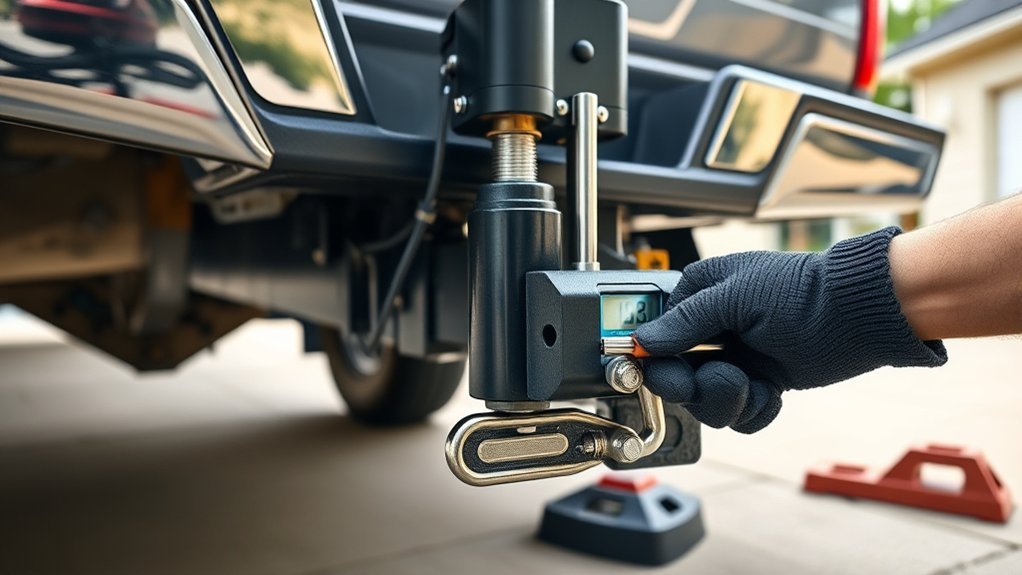
Because proper tongue and hitch weight directly affect handling and safety, you should run a quick troubleshooting checklist before every trip to catch problems early. You’ll verify tongue weight is 10–15% of the trailer’s total, and confirm hitch weight matches your vehicle’s rated capacity. Use a tongue weight scale to get precise readings, then adjust cargo placement for load balancing. Place the heaviest items toward the front axle (about 60–65%) to minimize sway and improve sway control. If you notice steering or braking issues, don’t ignore them—reassess weights and rebalance.
Run a quick pre-trip checklist: verify 10–15% tongue weight, match hitch limits, and rebalance cargo.
- Measure tongue weight with a scale; adjust until within 10–15%.
- Check hitch weight against vehicle limits; reduce load if excessive.
- Reposition heavy items forward (60–65%) for proper load balancing.
- Test drive at low speed; if sway or handling persists, adjust or add sway control measures.
Follow this checklist to maintain stability, braking performance, and the freedom to tow safely.
Frequently Asked Questions
Is Tongue Weight and Hitch Weight the Same Thing?
No — they’re different. You’ll treat tongue weight as the downward coupler force and hitch weight as total load on the receiver; you’ll prioritize hitch safety and correct weight distribution to maintain control and tow with freedom.
How Much Tongue Weight Is a 5000 Lb Trailer?
Think of balance like a tightrope: you’ll want 500–750 lbs of tongue weight for a 5,000 lb trailer. You’ll guarantee trailer safety and proper weight distribution, keeping control and preventing sway or vehicle sag.
What Does 200 Lb Tongue Weight Mean?
A 200 lb tongue weight means the trailer presses down 200 pounds on your hitch ball, indicating load distribution; you’ll balance cargo and trailer for towing safety, freeing you to tow confidently while reducing sway and wear.
What Is the Tongue Weight of a 10,000 Lb Trailer?
You should aim for 1,000–1,500 lbs tongue weight on a 10,000 lb trailer. That 10–15% statistic guarantees trailer balance and proper weight distribution, so you’ll tow confidently, maintain control, and minimize dangerous sway.
Conclusion
You’ve learned that tongue weight is the bite of the trailer on your vehicle’s ball, while hitch weight describes load at the hitch assembly; both need precision. Treat tongue weight like the trailer’s heartbeat—too light or too heavy throws everything off balance. Measure with a scale, load smartly, and adjust via placement, cargo tie-downs, or a weight-distributing hitch. Follow the checks consistently, and you’ll keep towing steady, safe, and predictable.