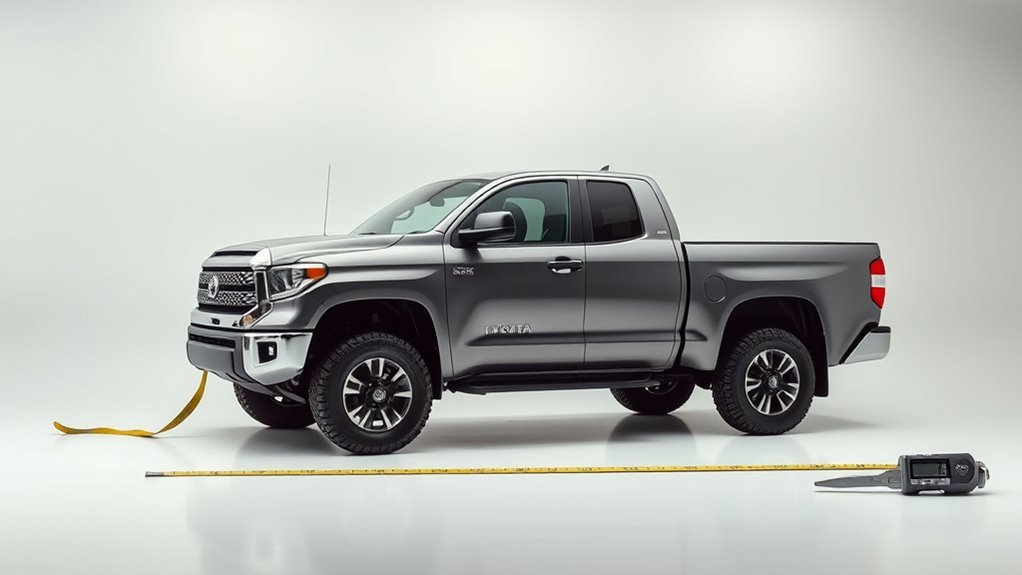
The Toyota Tundra’s overall lengths are 233.6 inches (5.5′ and 6.5′ beds) or 247.8 inches (8.1′ bed). It’s 80.2 inches wide excluding mirrors and has about 9.3 inches of ground clearance. The bed floor is 58.7 inches wide with 48.7 inches between wheelhouses; total bed depth is ~22.2 inches. CrewMax and Double Cab share many exterior dimensions but differ in rear legroom and cargo access—keep going to see which fits your needs.
Quick Dimensions: Tundra Overall Lengths (5.5′, 6.5′, 8.1′)
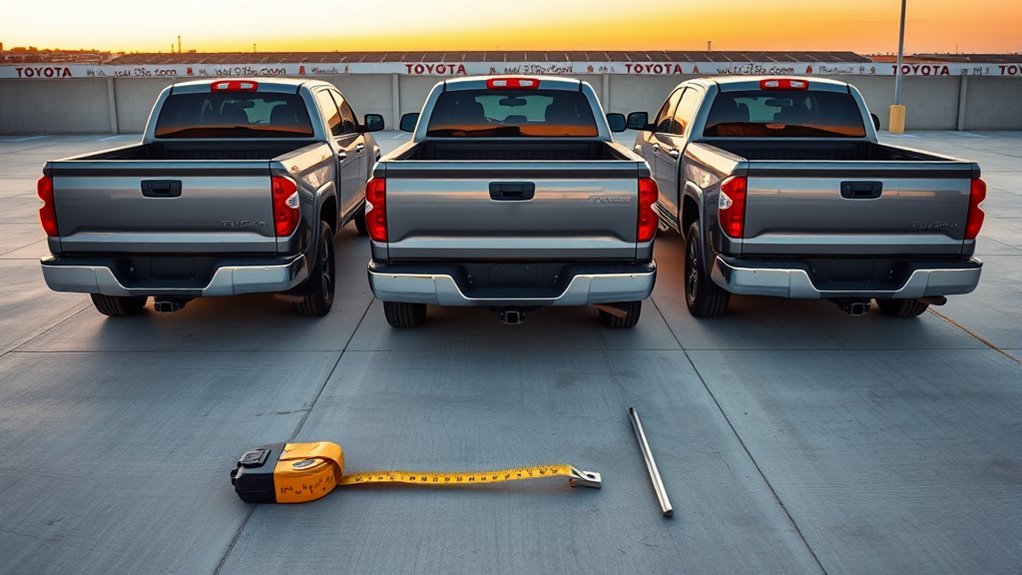
The Tundra comes in three bed-length configurations: two short-bed options (5.5′ and 6.5′) share an overall length of 233.6 inches, while the long-bed 8.1′ model stretches to 247.8 inches; all versions are 80.2 inches wide (excluding mirrors) and offer 9.3 inches of ground clearance.
You’ll use bed length to match mission requirements: the 5.5′ and 6.5′ variants keep overall dimensions compact for tighter parking and maneuverability, while the 8.1′ extends length for greater cargo reach. When planning routes or storage, factor the specific overall dimensions to guarantee access and legal compliance. The uniform width simplifies side-clearance calculations across trims, and consistent ground clearance preserves off-road and loading geometry. You’ll prefer the short-bed for urban freedom and the long-bed when cargo sovereignty matters. Choose based on measured need rather than aesthetics: verify bed length and overall dimensions against your operational constraints before committing.
Tundra Bed Dimensions: Floor Width & Wheelhouse Clearances
You’ll find the Tundra’s bed floor width is 58.7 inches, giving you a broad flat surface for pallets and equipment. Between the wheelhouses the clearance narrows to 48.7 inches, so plan wider loads accordingly. The cargo bed height measures 20.9 inches (total depth 22.2 inches), which affects stacking and tie-down positioning.
Bed Floor Width
Every Tundra bed gives you a consistent 58.7-inch floor width, with 48.7 inches between the wheelhouses and a total width of 66.4 inches, so you can quickly judge what cargo will fit and how it’ll sit relative to the wheel wells. You’ll use that certainty to optimize cargo versatility and bed organization: the fixed width simplifies load planning across 5.5-, 6.5- and 8.1-foot beds. Depth is 20.9 inches, so vertical stacking strategies remain consistent. Apply modular racks or tie points confidently, knowing side-to-side clearances won’t change.
| Specification | Measurement |
|---|---|
| Floor width | 58.7 in |
| Between wheelhouses | 48.7 in |
| Total width | 66.4 in |
| Bed depth | 20.9 in |
Wheelhouse Clearance Dimensions
One clear metric to check is the 48.7-inch clearance between the wheelhouses, since that dimension dictates the maximum flat-profile load you can lay across the bed without interference from the wells. You’ll appreciate that within a 58.7-inch floor width the wheelhouse features are engineered to preserve usable surface while reinforcing structure. That 48.7-inch span gives you predictable cargo placement for pallets, sheet goods, or modular gear, enhancing cargo flexibility without guesswork. The wheelhouses are contoured to minimize intrusion, so you can exploit the full floor width when needed and still rely on consistent anchoring points. In practice, you’ll plan loads knowing the wheelhouse clearances balance capacity and integrity, freeing you to configure the bed for varied hauling tasks.
Cargo Bed Height
Having noted the wheelhouse clearances, consider how bed height affects loading ergonomics and cargo compatibility. At 20.9 inches from ground to bed floor, the Tundra keeps load transfer low, reducing strain and enabling efficient loading techniques without a lift. The floor width is 58.7 inches, with 48.7 inches between wheelhouses, and a depth of 22.2 inches, so you can plan placements and tie-downs precisely. Choose among 5.5-, 6.5- or 8.1-foot beds to match task scope and maximize usable volume. You’ll integrate cargo bed accessories—rails, ramps, or bed extenders—to optimize access given the sub-21-inch floor height. These measurable dimensions let you design liberated workflows that prioritize safety, speed, and secure transport.
Double Cab vs. CrewMax: Real-World Exterior Lengths
Although both Double Cab and CrewMax Tundras can share the same overall length, their real-world practicality changes with bed choice: you’ll weigh double cab advantages against crewmax benefits when matching space to mission. The Double Cab with a 6.5-foot bed measures 228.9 inches overall, giving you a balanced footprint—enough passenger room and cargo capacity without overextending. CrewMax models also register 228.9 inches when fitted with 5.5- or 6.5-foot beds, delivering full-size rear seating while keeping the same exterior length as the Double Cab option. Opting for the 8.1-foot bed extends overall length to 247.8 inches, which you should reserve for sustained hauling needs where maneuverability is less critical. Width and basic clearance remain constant across cabs—80.2 inches (no mirrors) and about 9.3 inches ground clearance—so your turning envelope and off-road potential hinge primarily on bed length. Choose based on liberated utility: passenger priority or maximum cargo capacity.
Exterior Width & Height : Mirrors, Ground Clearance, Typical Heights
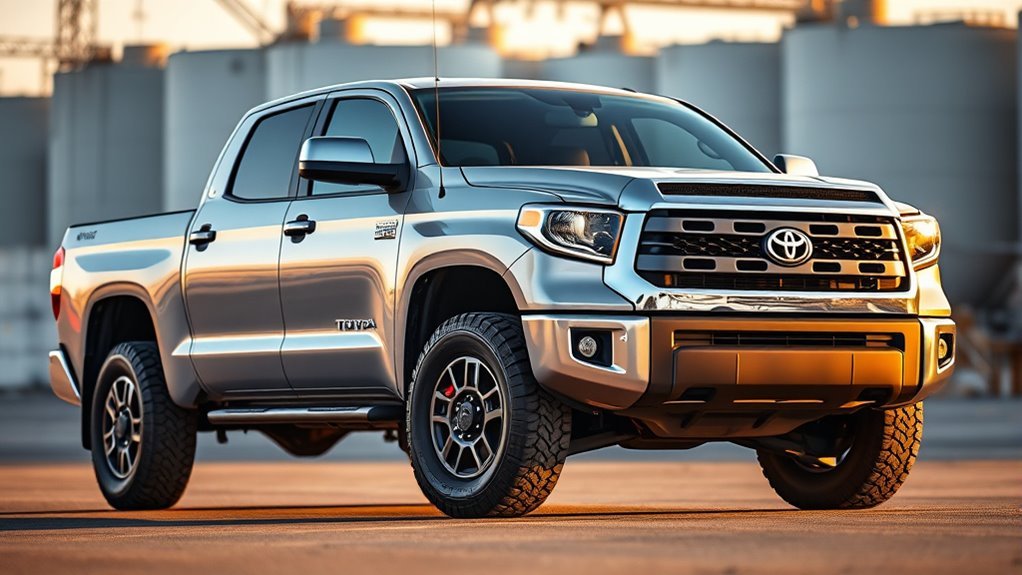
You’ve already weighed length and bed choices; now look at width, mirrors, and ride height to understand how the Tundra occupies road and trail space. The Tundra’s 80.2-inch exterior width (without mirrors) gives you a bold exterior aesthetics and predictable driving stability; add mirrors and urban clearance planning. Ground clearance of 9.3 inches boosts off road performance and lets you pick lines with confidence while protecting components. Height isn’t explicitly stated, but the truck’s stance promotes a commanding view and purposeful presence.
| Attribute | Effect |
|---|---|
| Width 80.2 in | Solid lane presence, better driving stability |
| Ground Clearance 9.3 in | Improved off road performance, obstacle clearance |
| Implied Height | Elevated visibility, enhanced exterior aesthetics |
You’ll appreciate how these dimensions free your routes and cargo accessibility choices—clearance, confidence, and the room to move without compromise.
Interior Space: Front/Rear Legroom and Rear Storage Impact
You’ll find 42.5 inches of front legroom in both Double Cab and CrewMax configurations, which keeps driver and passenger positioning ergonomic for long drives. Rear legroom varies by cab—34.7 inches in the Double Cab versus 42.3 inches in the CrewMax—affecting passenger comfort and seating configuration choices. Consider how rear storage access and bed capacity interact with cabin layout, since seat geometry and cargo provisions influence loadability and ease of retrieval.
Front And Rear Legroom
When you sit in a Tundra, the cabin’s measured dimensions translate directly to usable space: front legroom is 42.5 inches, front shoulder room is 65.7 inches, rear legroom is 34.7 inches in Double Cab models and 42.3 inches in CrewMax models, and that extra rear clearance improves passenger comfort and lets you stow bulkier items behind the rear seats without encroaching on occupant space. You’ll notice the interior layout prioritizes freedom of movement; seats and controls are positioned to maximize usable floor space. Comfort features focus on supporting long drives and group travel without compromise. Double Cab balances passenger and cargo needs; CrewMax liberates rear occupants with near-front legroom. Measurements confirm the Tundra’s practical, spacious cabin for varied missions.
Rear Storage And Accessibility
Because rear legroom varies considerably between Double Cab and CrewMax, accessing and stowing items behind the seats differs in practice: the CrewMax’s 42.3 inches of rear legroom lets you use the back area for bulkier soft bags or fold-flat storage without impinging occupant comfort, while the Double Cab’s 34.7 inches limits behind-seat clearance and often shifts larger loads into the 66.4-inch-wide, 22.2-inch-deep bed for secure transport. You’ll find front legroom of 42.5 inches generous for driver ergonomics, so loading and unloading chores start with a comfortable operating posture. Prioritize cargo organization with modular bins and tie-down points in the bed to exploit the 66.4″ width and 22.2″ depth. Rear accessibility is cab-dependent; choose CrewMax for flexible interior storage, Double Cab if bed-based organization suits your liberated workflow.
Tundra Towing & Payload: Capacity by Cab and Bed Choice
Although configurations vary, the Tundra’s towing and payload figures are driven primarily by engine choice, cab style, and bed length, so you should match those to your hauling needs. You’ll use towing features like the integrated tow hitch and Toyota Safety Sense 2.5 to enhance stability and control under load; combine these with payload optimization practices—proper load distribution and securement—to maximize capability and safety. With the Double Cab you can tow up to 8,300 pounds, suitable for boats, trailers, and heavy gear. Selecting a longer bed (6.5- or 8.1-foot) shifts cargo handling and may affect tongue weight and trailer setup; the 5.5-foot bed favors payload over long cargo. The Tundra’s top spec reaches 11,200 pounds towing when properly equipped—verify engine, axle ratio, and package. You should consult the specific configuration’s placard and payload calculator before towing to guarantee compliance and retain freedom to tow and carry what you need.
Will a Tundra Fit in My Garage? Measurements & Parking Tips
Wondering if a Tundra will fit in your garage? Measure your usable garage depth against the Tundra’s lengths: standard models are 233.6 inches, while the longest configuration reaches 247.8 inches. Subtract clearance for a closed door and a comfortable buffer—3–12 inches at minimum—so make sure garage depth accommodates the chosen configuration.
Measure your usable garage depth against the Tundra’s 233.6–247.8 inch lengths, allowing 3–12 inches clearance.
Check width without mirrors: 80.2 inches. Confirm side clearances, hinge swing, and any storage along walls so you can open doors and exit. Account for 9.3 inches of ground clearance if you have ramps or low thresholds.
Assess maneuvering: the turning radius is approximately 47.4 feet, so tight driveways or confined garages may require multi-point adjustments. If your property limits turns, plan angling techniques or widen approaches.
You’re entitled to freedom of movement—measure deliberately, remove obstructions, and choose the Tundra configuration that matches your spatial constraints before committing.
Quick Spec Comparison: Common Tundra Configurations at a Glance
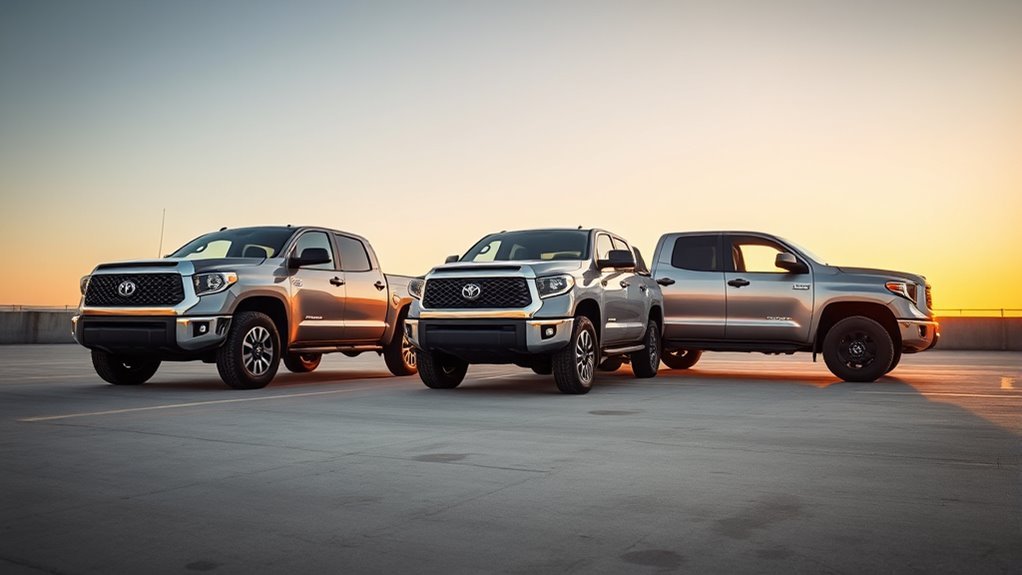
Start by matching your garage and towing needs to three common Tundra layouts: Double Cab with a 6.5-foot bed (228.9 in overall), CrewMax with a 5.5-foot bed (228.9 in overall), and the long-bed 8.1-foot configuration (247.8 in overall). You’ll notice identical overall length for Double Cab and CrewMax despite bed-length differences; that reflects purposeful tundra design features balancing cabin space and exterior footprint. Width without mirrors is 80.2 in, giving you consistent lateral clearance for cargo loading and interior movement. Ground clearance is 9.3 in, which improves approach/departure tolerance when you’re operating off pavement or loading heavy gear. Use these concise metrics to plan parking, trail access, and hitch positioning without guesswork. Focus on cargo space optimization within the bed length you select and the spatial constraints of your environment. These specs let you choose confidently and act decisively toward mobility and freedom.
Decision Cues: Which Cab/Bed Fits Your Use Case and Space Constraints
Which cab and bed combo matches your day-to-day needs and garage footprint? Choose the Double Cab with a 6.5-foot bed if you need urban maneuverability and cargo versatility: at 228.9 inches overall, it fits tighter garages and still yields a 22.2-inch bed depth for varied loads. If your work or freedom requires hauling longer items, opt for the 8.1-foot bed; the 247.8-inch length gives expanded cargo capacity but demands larger parking and storage space. For maximum passenger comfort and unencumbered access, select the CrewMax: 42.3 inches of rear legroom and four full-size doors prioritize occupant freedom without sacrificing stability—the Tundra is 80.2 inches wide (without mirrors), supporting interior space in both cabs. Match your choice to where you park, tow, and transport people: prioritize garage clearance and maneuverability for Double Cab, or prioritize interior space and rear-seat comfort with CrewMax and the longer bed when liberation means carrying more and carrying passengers comfortably.
Frequently Asked Questions
How Long and Wide Is a Toyota Tundra?
You’ll find the Tundra is about 233.6 inches long (up to 247.8 inches with the 8.1-foot bed) and 80.2 inches wide. These Tundra dimensions and Tundra specs empower your liberated driving choices.
Which Is a Bigger Truck, Toyota Tundra or Tacoma?
The Tundra’s bigger. You’ll feel Tundra dimensions dominate the road — broader stance, loftier frame, heavier tow — while Tacoma specs keep things nimble; you’ll choose full-size power and space if you crave true liberation.
Conclusion
You’ll pick a Tundra variant based on bed length, cab choice and garage clearance: the CrewMax with a 5.5′ bed gives max cabin space while the 8.1′ bed on Double Cab maximizes payload and cargo length. Note this: a CrewMax 5.5′ Tundra still tops 228 inches overall—so measure your garage opening and aisle; you’ll often need at least 19 feet of clearance to park comfortably and open doors fully.