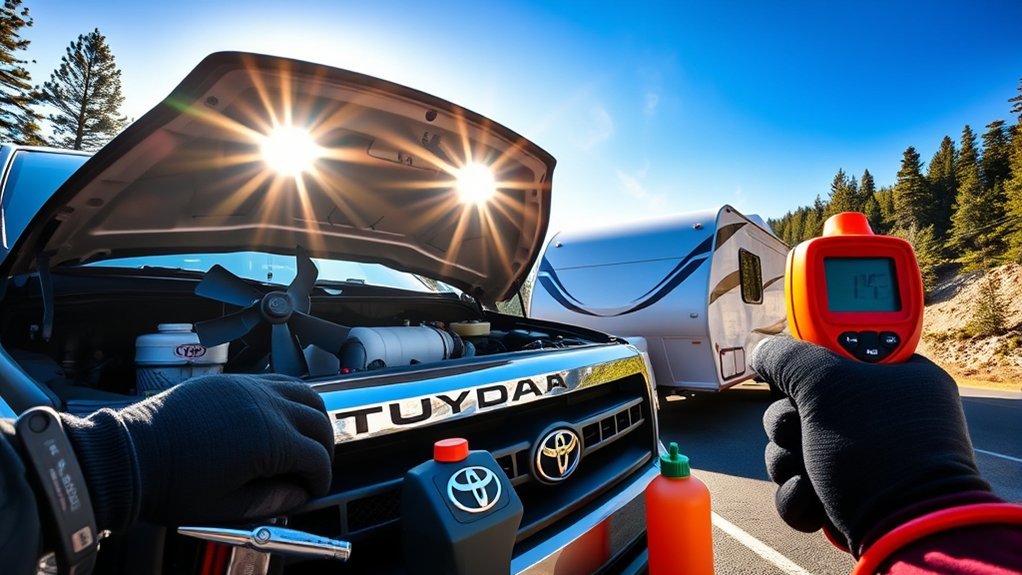
When towing, you’ll prevent Tundra overheating by keeping coolant and transmission fluid topped, clearing radiator/condenser debris, and verifying fan and hose integrity. Monitor coolant (aim under 216°F) and transmission temps with a real‑time gauge, downshift or reduce throttle on grades, and disable A/C when needed. Install higher‑pressure radiator cap and auxiliary coolers for heavy loads, and follow a strict fluid‑change schedule. Follow these steps and you’ll find practical tuning, upgrades, and troubleshooting to further lower risk.
How Towing Affects Your Tundra’s Cooling
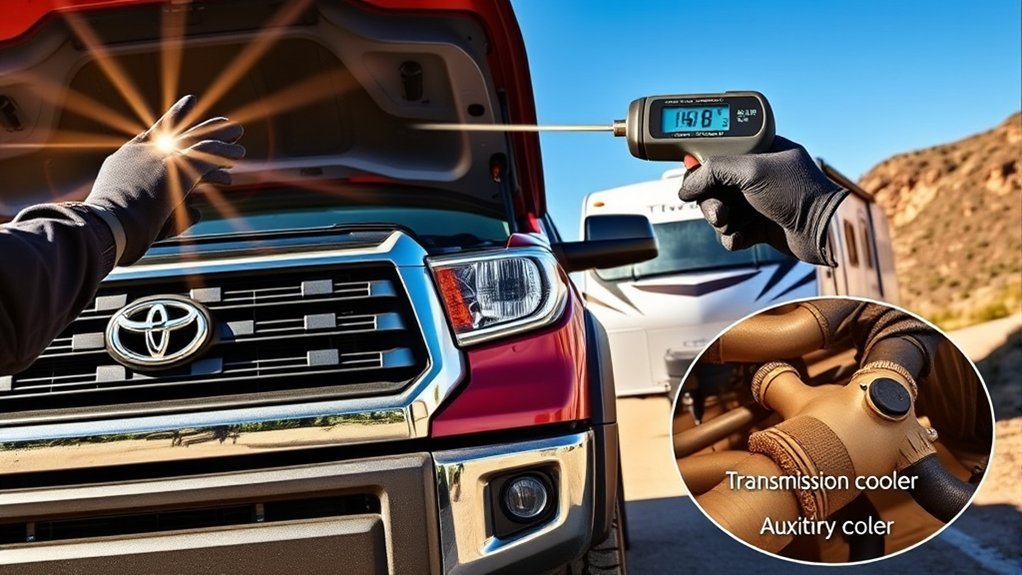
When you tow heavy loads—especially uphill—you’ll raise both engine and transmission temperatures quickly, and without an auxiliary transmission cooler (as on the 2021 Tundra) those components can approach or exceed safe limits; monitor coolant and trans temps (ideally 204–216°F range) with a ScanGauge or equivalent, keep the cooling system maintained (including a sound radiator cap), and use lower gears to reduce drivetrain stress and heat buildup. You need predictable towing techniques that prioritize steady load management and minimal heat spikes. Track coolant pressure and temperature, inspect hoses and the radiator cap, and replace degraded coolant on schedule. Shift earlier into lower gears on grades to reduce torque demand and transmission slip; that lowers internal friction and dissipates less heat. Without an auxiliary cooler, you’ll rely on conservative driving and rigorous maintenance for effective heat management. Those choices free you from mechanical failure risk and let you tow with confidence and resilience.
Quick Tundra Checks Before Every Tow
Towing techniques and cooling maintenance matter, but you also need a short pre-tow checklist to catch immediate failure points. You’ll start with basic coolant checks: confirm level and concentration, top to the recommended mark, and secure the cap. Perform a radiator inspection—look for leaks, bent fins, and a sealing cap that holds pressure.
| Item | Action |
|---|---|
| Coolant level | Verify fill and concentration |
| Radiator cap | Check seal and pressure retention |
| Cooling stack | Clear debris from fins |
| Fan operation | Run engine, listen for fan engagement |
| Visual leaks | Inspect hoses, clamps, and core |
Execute the table-driven checks methodically each time you tow. Clean the cooling stack to restore airflow and prevent hotspots. If the radiator cap fails or you hear abnormal fan behavior, fix it before departure. These concise steps free you from roadside overheating risks and keep towing reliable.
How to Monitor Engine and Transmission Temps : Safe Ranges
How hot is too hot for your Tundra’s engine or transmission? You’ll use engine temp monitoring and transmission temp gauges to keep control. Aim for steady ranges: engine coolant typically runs 204°F–216°F under tow; approaching 220°F alerts you to a rising risk. The danger zone starts above 230°F — act before you hit it. Transmission pan temps should stay roughly 150°F–240°F, with ideal towing performance near 180°F–190°F. Use real-time gauges, log trends, and respond to excursions immediately to avoid damage.
Monitor coolant and transmission temps closely while towing—act before coolant nears 220°F and transmission exceeds safe ranges.
- Install reliable engine temp monitoring and transmission temp gauges before heavy towing.
- Treat consistent climbs toward 220°F as a trigger to reduce load or stop.
- If transmission temps exceed 190°F steadily, downshift or add cooling measures.
- Log temperatures over trips to identify cooling-system degradation early.
- Prioritize intervention when either coolant or transmission hits the defined danger thresholds.
Maintenance Checklist to Prevent Overheating
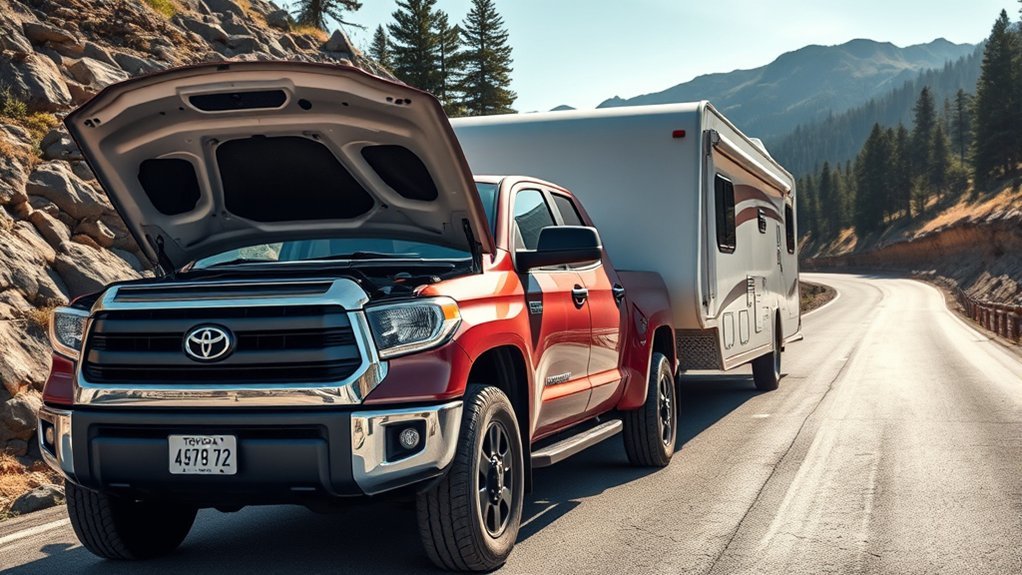
You’ve learned the safe operating ranges for engine coolant and transmission temps; now apply that data through practical maintenance to keep your Tundra running within those limits. You’ll follow a concise checklist: install a TRD 18.5 psi radiator cap, verify coolant maintenance schedule and level, inspect hoses and water pump for leaks, clean the cooling stack, and change transmission fluid regularly. Use a Scan Gauge to monitor temps under load and catch anomalies early. Fit towing accessories that aid cooling—fan shrouds, airflow-guides—and remove debris before trips. Document service dates and readings to stay proactive and free.
| Task | Frequency |
|---|---|
| Radiator cap (TRD 18.5 psi) | Inspect/repeat at service |
| Coolant level/condition | Monthly |
| Hoses & water pump | At oil change |
| Cooling stack cleaning | Before each trip |
| Transmission fluid service | Per heavy-tow interval |
Execute methodically, record data, and act on deviations immediately to preserve capability and maintain the liberty to tow without overheating.
Driving Techniques to Lower Temps on Grades and Long Hauls
Manage engine and transmission temps on long hauls by driving deliberately: maintain a steady speed, avoid rapid acceleration or braking, and use lower gears on sustained climbs to keep RPMs in an efficient range and reduce heat buildup. You’ll preserve engine performance and towing efficiency by controlling inputs and monitoring systems. Use lower gears on grades to prevent transmission overheating and keep engine load balanced. Disable AC when climbing hard to cut parasitic load. Engage 4Lo in slow, demanding conditions to distribute torque and aid cooling. Watch temps with a Scan Gauge; target transmission temps near 180–190°F.
- Monitor engine and transmission temps continuously; respond before warnings trigger.
- Maintain momentum on grades; avoid stop-start cycles that spike heat.
- Shift proactively to hold RPMs in the engine’s efficient band.
- Turn off nonessential accessories (AC, heated seats) under heavy load.
- Use 4Lo or proper gearing to reduce strain and stabilize towing efficiency.
These tactics free you from reactive driving and protect drivetrain longevity.
Trailer and Load Setup to Reduce Strain on Your Tundra
When towing, set up your trailer and load so the weight is evenly distributed and stays within the Tundra’s rated capacity (typically 8,300–10,200 lb); this minimizes drivetrain strain, improves handling, and lowers the odds of transmission and engine overheating. You’ll use trailer balance and weight distribution techniques: center heavy items low and slightly forward of the axle, secure cargo to prevent shifting, and install a weight distribution hitch to share tongue load between axles. Check tire pressures on both vehicles to reduce rolling resistance and heat. Limit A/C use on climbs to cut engine load; ventilate when safe. Inspect coolant level and radiator cleanliness before departures.
| Position | Action | Effect |
|---|---|---|
| Fore | Place 60% of cargo forward | Reduce sway |
| Axle | Keep center low | Lower CG |
| Rear | Minimal heavy load | Improve steering |
| Hitch | Use weight distribution | Even axle loads |
| Tires | Set correct PSI | Less friction and heat |
When to Upgrade Tundra Cooling Gear (Radiator, Trans/Oil Coolers)
If you regularly tow near the Tundra’s capacity, tackle steep grades, or notice transmission/engine temps climbing into the upper normal range, it’s time to upgrade cooling gear. You’ll prevent failures and reclaim freedom on the road by choosing targeted cooling upgrades: higher-pressure radiators, external transmission coolers, and vigilant monitoring. Swap the stock 15–16 psi radiator for an 18.5 psi high-performance unit to raise boiling point and improve heat rejection. Add an external trans/oil cooler for sustained heavy towing. Replace thermostats proactively and keep the cooling stack clear of debris to preserve airflow. Use aftermarket monitors to track trends, not just spikes, so you can act before critical limits.
- Fit an 18.5 psi-rated radiator to increase coolant boiling point.
- Install an external transmission cooler for prolonged loads.
- Replace thermostat on schedule to guarantee proper coolant flow.
- Clean grille/core area to maintain peak airflow.
- Use ScanGauge/EDGE CTS3 to monitor temps and towing performance.
Common Failure Modes and Step‑by‑Step Troubleshooting
Start by isolating the two most common failure modes: cooling system blockages and transmission cooling issues, since both directly raise engine and trans temps under load. You’ll methodically check for radiator and condenser obstructions, collapsed hoses, and restricted passages from prior component failures, then verify radiator cap pressure and coolant flow with a pressure tester and flow gauge. For the transmission, you’ll monitor temps with a ScanGauge or EDGE CTS3, inspect cooler lines and fittings for restrictions or leaks, and engage 4Lo under heavy towing while testing cooler effectiveness.
Cooling System Blockages
Because debris from a failed radiator cap or incomplete post-repair flushing can restrict the crossover pipe and coolant jackets, you’re likely to see reduced flow and localized overheating at towing RPMs. You must diagnose and clear blockages to restore coolant maintenance and system efficiency. Pressure-test the system, inspect the thermostat and cap, and monitor temps with a ScanGauge while reproducing towing load. If hotspots appear, flush the jackets and crossover, use targeted brushes or chemical cleaners, and recheck flow. Replace degraded hoses and clamps to prevent recurrence.
- Pressure-test for leaks and correct pressure loss
- Scan for temperature differentials under load
- Flush cooling jackets and crossover pipe thoroughly
- Mechanically remove stubborn debris, then re-flush
- Replace caps, thermostats, hoses to secure system efficiency
Transmission Cooling Issues
After clearing coolant blockages and verifying radiator and engine flow, check the transmission cooling path — overheating there will still produce cabin and drivetrain symptoms during towing. You’ll monitor transmission temperatures with a ScanGauge II, target 150°F–240°F, ideal ~180–190°F. Inspect lines, cooler, and fluid for contamination, low level, or air pockets. Replace “lifetime” transmission fluid on a schedule when towing. Consider external transmission coolers and cooling upgrades if you haul heavy loads frequently. Pin the transmission thermostat for towing trips, then remove the pin for normal driving. Run pressure tests and trace leaks systematically.
| Component | Checkpoint |
|---|---|
| Lines | Kinks, corrosion |
| Cooler | Fins, flow |
| Fluid | Level, color |
| Thermostat | Pin/removal |
| Diagnostics | Pressure, temp readings |
Immediate Actions If Temps Climb While Towing
If temps climb while towing, immediately reduce speed and throttle to cut engine load and begin cooling. Monitor the temperature gauge—normal towing can hit ~216°F, but rising toward higher limits means you must act and look for a safe place to pull over. When you stop, shut off A/C, select a lower gear or 4Lo if needed for control, and inspect the coolant reservoir for spills or pressure signs before proceeding.
Reduce Load Immediately
Slow down immediately and reduce engine load the moment temperature gauges start climbing while you’re towing. You’ll cut heat generation and buy time for recovery. Prioritize load reduction as your core towing strategy: shift to a lower gear, ease off the throttle, and maintain steady RPMs to let the cooling system work.
- Pull over safely, stop, and shut the engine to let temperatures fall.
- Inspect coolant reservoir level and confirm the radiator cap is secure.
- If temps approach danger (above 216°F), disconnect the trailer to remove strain.
- Use lower gears to increase coolant flow and combustion efficiency without overspeeding.
- Keep your load reduction plan simple, decisive, and aligned with liberation from avoidable failures.
Act swiftly and deliberately; freedom on the road depends on control.
Monitor Engine Temperatures
Having reduced load, keep a precise eye on engine and transmission temps with a dedicated monitor (Scan Gauge, EDGE CTS3) and aim to hold coolant below 216°F. Use temperature gauges proactively: if readings climb, immediately ease off the throttle, reduce speed, and downshift to lower RPMs to cut engine load and restore towing efficiency. Turn off the air conditioning to remove auxiliary demand on the engine. Verify coolant level visually or with a quick dipstick check and scan for leaks or blocked hoses that impede flow. Consider an 18.5 psi radiator cap to raise boiling point and improve cooling system performance. You’ll maintain control and preserve freedom on the road by monitoring, reacting, and optimizing systems without delay.
Find Safe Pull-Over
When the temperature gauge climbs while you’re towing, stop looking for a quick fix and pull over to a safe spot immediately to prevent engine damage and give the cooling system a chance to recover. You’ll perform disciplined, liberty-minded emergency procedures: secure the trailer, move to a designated turnout or wide shoulder for safe stopping, and shut the engine to halt heat generation. Open the hood to vent trapped heat, then evaluate coolant level visually at the reservoir. Never open the radiator cap until the engine cools; steam risk is real. After cooling, restart and monitor temperatures; choose a lower-speed, less demanding route if needed to maintain control and prevent recurrence.
- Secure trailer and apply parking brake
- Select wide shoulder or turnout
- Shut engine and open hood
- Inspect coolant reservoir level
- Restart cautiously; monitor gauge
Frequently Asked Questions
How to Prevent Overheating When Towing?
You’ll prevent overheating by using towing techniques like lower gears and steady speeds, practicing disciplined load management, monitoring temps, maintaining cooling systems, upgrading pressure-rated caps, and engaging 4Lo when needed so you stay free and in control.
How to Keep Transmission Temperature Down When Towing?
Sure, let it boil—except don’t. You’ll monitor transmission fluid temps, swap degraded fluid, pin thermostat temporarily, fit higher‑pressure cap, use 4Lo for heavy loads, and respect towing capacity so you’ll tow free, not fried.
Do I Need to Add a Transmission Cooler for Towing?
Yes — you should add an aftermarket cooler if you tow frequently or carry heavy loads; you’ll improve transmission maintenance, reduce peak temps, and pair it with proper towing accessories to liberate reliable, sustained performance.
What Causes a Toyota Tundra to Overheat?
You overheat when engine cooling’s compromised: blocked radiator or failed cap, bad thermostat, low compression, inadequate transmission cooling, or exceeding towing capacity uphill or in heat; you’ll need targeted repairs and upgraded cooling to regain control.
Conclusion
Towing pushes your Tundra’s systems harder, so treat overheating like an avoidable nuisance rather than a disaster. Do the basics: inspect cooling, fluids, belts, hoses, and trailer setup before you leave; monitor temps and shift to lower gears or pull over early if numbers creep up. Upgrade coolers when duty cycles demand it, and follow the troubleshooting checklist if something’s off. With routine care and prompt action, you’ll keep things pleasantly under control.