How to Jump Start a Toyota Camry Safely
What’s in This Article
- Before You Begin: Check Your Camry and Battery
- What You’ll Need to Jump Start Your Car
- Step-by-Step Guide: Connecting Jumper Cables
- Safe Starting Procedures for the Donor Vehicle
- Jump Start Success Indicators
- How to Disconnect Jumper Cables Safely
- Caring for Your Camry After a Jump Start
- Troubleshooting Common Jump Start Issues
- Frequently Asked Questions
A dead Camry battery can leave you stuck at the worst time, but a safe jump start can get you moving again. You need the right cable order, a good 12-volt power source, and a clean metal ground point away from the battery. This guide shows you how to jump start your Toyota Camry, remove the cables, and spot battery problems after it starts.
Quick Answer
To jump start a Toyota Camry, connect red to the dead Camry’s positive terminal, then red to the donor battery’s positive terminal. Connect black to the donor battery’s negative terminal, then connect the final black clamp to a solid, unpainted metal point on the Camry. Start the donor vehicle, start your Camry, then remove the cables in reverse order.
Key Takeaways
- Use only a 12-volt donor battery or jump starter that matches your Camry’s needs.
- Connect the final black clamp to solid, unpainted metal away from the dead battery.
- Keep both vehicles from touching and turn off lights, radio, fans, and chargers first.
- Remove jumper cables in reverse order to reduce spark and electronics risk.
- Test the battery if your Camry needs another jump soon after the first one.
Estimated total time: 10 to 20 minutes for the jump start, plus at least 20 minutes of driving or charging after the engine starts.
Before You Begin: Check Your Camry and Battery
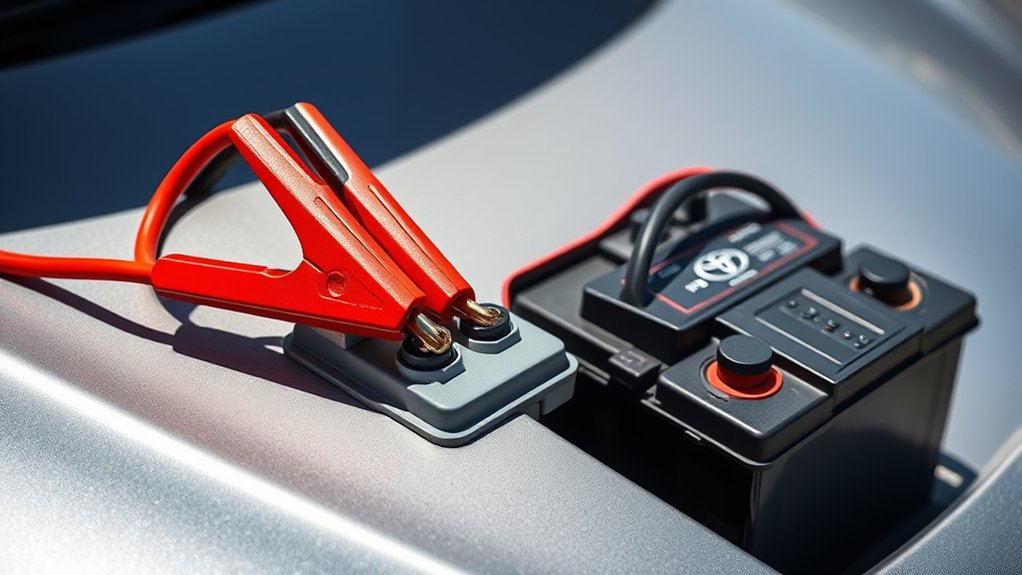
Jump starting your Toyota Camry safely starts with a few checks. Look at the battery case first. Do not jump start it if you see cracks, leaking fluid, swelling, a frozen battery, or a strong rotten-egg smell.
Find the positive terminal and negative terminal. The positive terminal usually has a plus sign or a red cover, while the negative terminal has a minus sign or black marking. Some Camry Hybrid models use an under-hood jump terminal, so check your owner’s manual before you connect cables.
Attach the final negative clamp to a solid, stationary, unpainted metal point on the Camry instead of the dead battery post. Toyota owner’s manuals use this style of ground point because it keeps the final spark away from battery gas.
Warning: Do not smoke, use open flames, or lean over the battery while you connect jumper cables.
Follow the correct clamp order every time: Camry positive, donor positive, donor negative, then Camry metal ground. After your Camry starts, drive it for at least 20 minutes or use a charger to help the battery recover. If the battery drains again, test the battery and charging system.
What You’ll Need to Jump Start Your Car
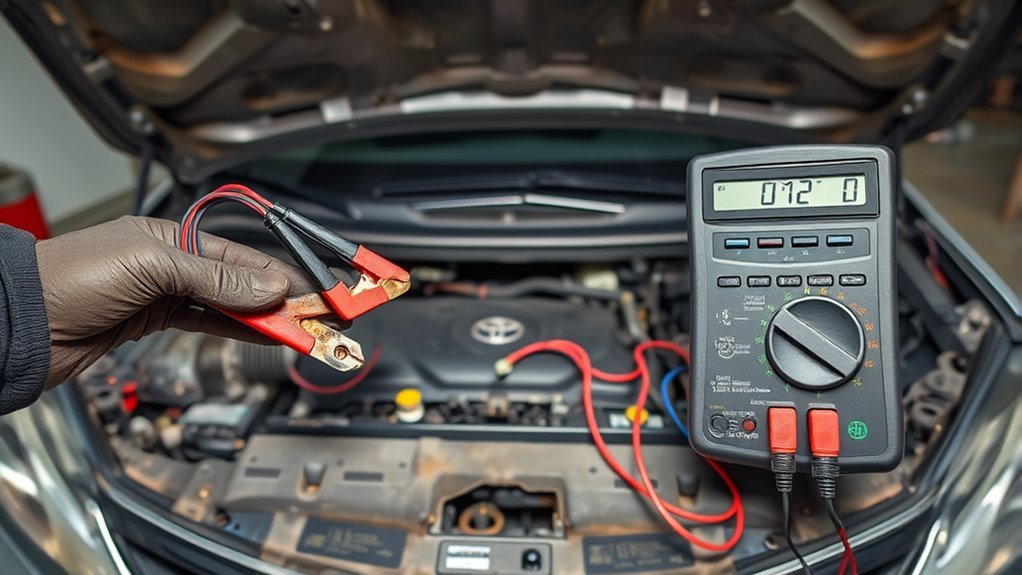
To jump start your Toyota Camry, gather the right tools before you connect anything. You’ll need:
- A set of jumper cables with red and black clamps
- A 12-volt donor vehicle or a 12-volt portable jump starter
- Safety glasses and insulated gloves
- A flashlight if you work in low light
- Your Camry owner’s manual, especially for hybrid models
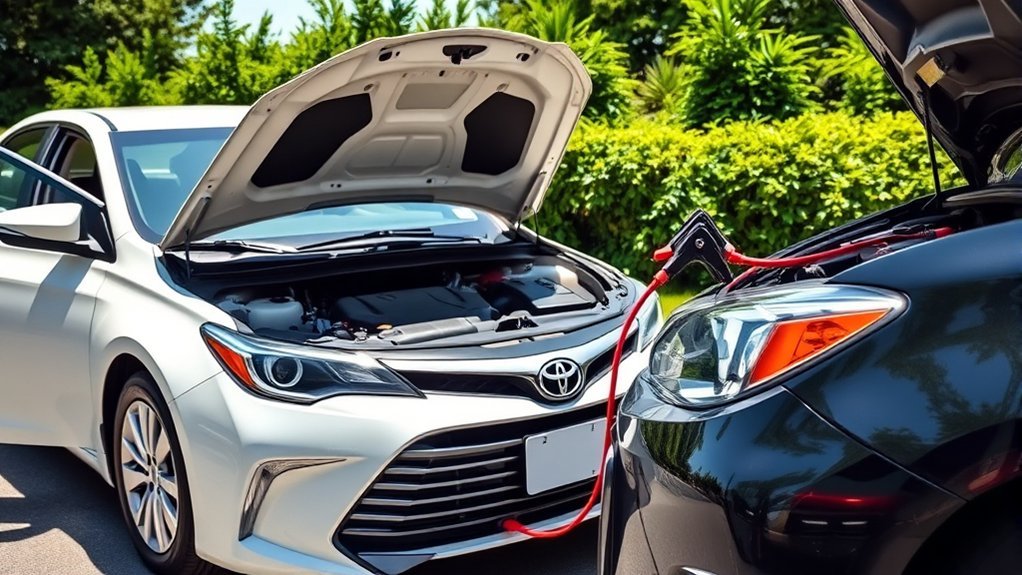
Park both vehicles close enough for the cables to reach, but do not let the vehicles touch. Put each vehicle in park or neutral, set the parking brakes, and turn off the ignition and accessories.
Jumper Cables Specifications
Choose jumper cables that can carry enough current without heating up. For most Camry jump starts, 4 to 8 American Wire Gauge (AWG) cables work well. A 4-gauge cable offers stronger current flow than an 8-gauge cable, which helps in cold weather.
Pick cables at least 16 feet long so you can reach both vehicles without stretching the leads. Use heavy-duty, insulated clamps that grip tightly and keep your hands away from bare metal. Choose red and black color-coded clamps so you can avoid reverse connections.
Safety Gear Essentials
Use safety goggles to protect your eyes from sparks or battery acid. Wear insulated gloves so your hands stay away from terminals, clamps, and hot engine parts. Keep a fire extinguisher rated for electrical and flammable liquid fires nearby when possible.
A flashlight helps you see the battery posts, plus and minus marks, and safe ground points at night. Do not use jumper cables with exposed wires, loose clamps, or heavy corrosion.
Donor Vehicle Requirements
Select a donor vehicle with a healthy 12-volt battery. A similar-size or larger vehicle can help, but voltage matters more than size. Do not connect a Camry to a 6-volt or 24-volt system.
| Donor Vehicle Requirement | Description |
|---|---|
| Battery Condition | Healthy 12-volt battery with clean terminals |
| Vehicle Size | Similar size or larger when available |
| Engine Status | Off during cable setup, then running during charging |
Start the donor vehicle only after you finish connecting the clamps. Some older Camry manuals mention about 2,000 rpm with light accelerator pressure, but many modern guides only call for idle. Follow your owner’s manual if it gives model-specific instructions.
Step-by-Step Guide: Connecting Jumper Cables
Use this order to connect jumper cables safely. Keep the metal clamps from touching each other or any wrong metal surface.
- Park both vehicles close enough for the cables to reach, then set both parking brakes.
- Turn off lights, radios, chargers, climate control, and other accessories in both vehicles.
- Connect the red clamp to the positive terminal on your Camry’s dead battery or approved jump post.
- Attach the other red clamp to the positive terminal on the donor battery.
- Connect the black clamp to the negative terminal on the donor battery.
- Clamp the final black end to solid, unpainted metal on the Camry, away from the battery and moving parts.
- Start the donor vehicle and let it run for a few minutes.
- Start your Camry. Wait a few more minutes and try again if it cranks slowly.
Proper Clamp Connection Order
The clamp order matters because the final connection can create a small spark. Red clamps go to positive terminals first. The first black clamp goes to the donor battery’s negative terminal, and the final black clamp goes to a safe metal ground on the Camry.
Do not connect the final black clamp to the dead battery’s negative post unless your owner’s manual tells you to do that. A ground point away from the battery lowers the chance that a spark reaches battery gas.
Safety Precautions During Jumping
Keep your face, hands, and clothing away from the battery, belts, fans, and pulleys. Make sure the cables do not hang near moving engine parts before anyone starts a vehicle.
- Check that each clamp grips the correct point firmly.
- Keep the red and black clamps apart during the whole process.
- Stand to the side of the battery when you make the final connection.
- Stop if you see smoke, smell burning plastic, or hear a loud pop.
Safe Starting Procedures for the Donor Vehicle
Before you start the donor vehicle, make sure both vehicles sit in park or neutral with the parking brakes set. Turn off the ignition, lights, radio, fan, and chargers in both vehicles. Confirm that the cable clamps sit firmly on the correct terminals or ground point.
Start the donor vehicle first and let it run for a few minutes. If your Camry owner’s manual calls for light accelerator pressure, follow that exact guidance. Otherwise, let the donor vehicle idle and avoid hard revving.
Try to start your Camry in the normal way. Do not crank the engine for long stretches. If it does not start after a few short attempts, stop and recheck the cable connections.
Jump Start Success Indicators
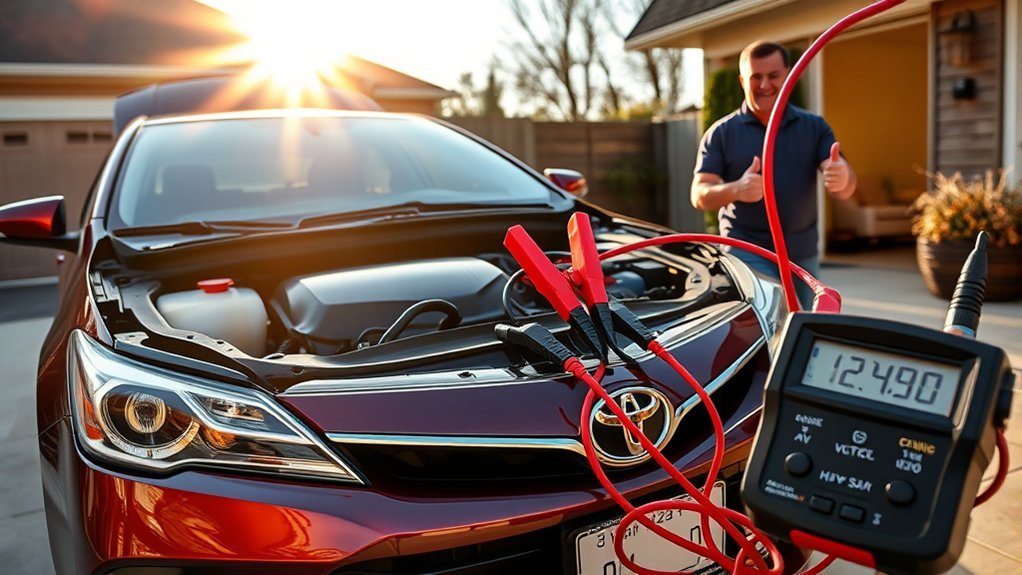
A successful jump start gives you a few clear signs. Use these checks before you remove the cables and drive away.
- Listen for smooth cranking: The engine should turn over faster than it did with the dead battery.
- Watch for stable idle: The Camry should keep running without stalling after it starts.
- Check warning lights: Battery or charging lights may point to a weak battery or alternator issue.
- Test basic accessories: Headlights and cabin lights should work with normal brightness.
If the engine starts but dies quickly, the battery may not hold a charge or the charging system may have a fault. Schedule a battery and alternator test before you rely on the car again.
How to Disconnect Jumper Cables Safely
Disconnect jumper cables in reverse order after your Camry starts. Move slowly, hold each clamp by its insulated handle, and do not let clamp ends touch.
| Step | Action |
|---|---|
| 1 | Remove the black clamp from the Camry’s metal ground. |
| 2 | Remove the black clamp from the donor vehicle. |
| 3 | Remove the red clamp from the donor vehicle. |
| 4 | Remove the red clamp from the Camry. |
| 5 | Store the cables only after all clamps stay separate. |
Keep your Camry running after you remove the cables. If the engine stalls right away, the battery may have failed or the alternator may not charge it.
Caring for Your Camry After a Jump Start
After you jump-start your Toyota Camry, take a few simple steps to protect the battery and charging system.
- Drive your Camry: Drive for at least 20 minutes, or connect a battery charger when you get home.
- Replace terminal covers: Put the red positive cover back in place if you removed it.
- Watch for repeat issues: Note slow cranking, dim lights, or another no-start problem.
- Inspect the battery: Look for corrosion, loose terminals, swelling, leaks, or damaged cables.
If starting problems return, have an auto parts store, repair shop, or Toyota service center test the battery. A battery that needs frequent jump starts may need replacement.
When You Should Not Jump Start Your Camry
Skip the jump start if the battery looks cracked, swollen, frozen, or wet with acid. Also stop if you smell sulfur, see damaged cables, or cannot identify the correct terminals. Call roadside help or a qualified mechanic instead of risking injury or electrical damage.
Use extra care with Camry Hybrid models. Many hybrids have specific jump posts and ground points under the hood, even when the 12-volt battery sits elsewhere. Your owner’s manual gives the safest point for your exact model year.
Troubleshooting Common Jump Start Issues
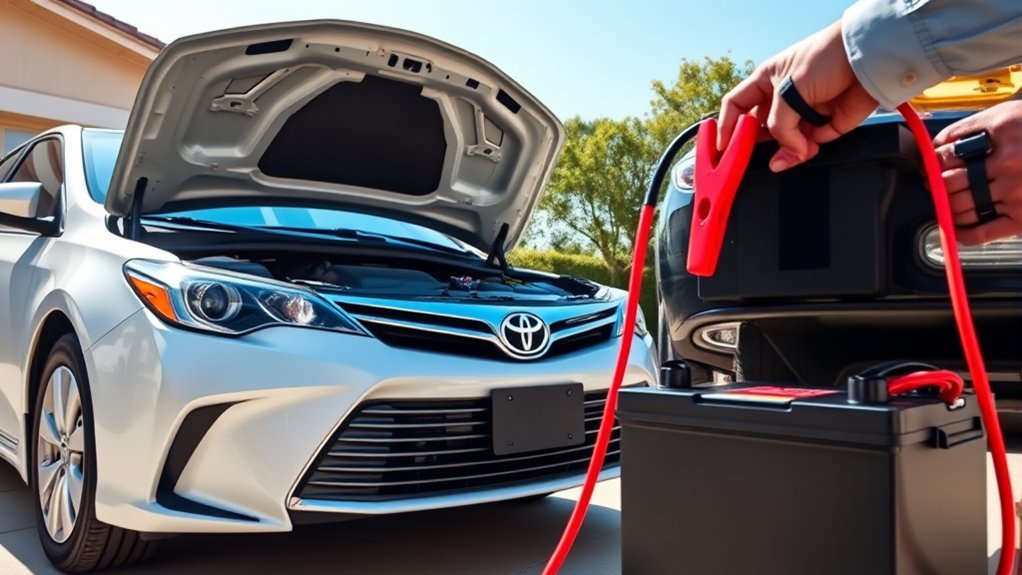
Jump-starting your Toyota Camry can fail for several simple reasons. First, check every clamp and make sure it grips clean metal. A loose clamp can block current and make a good battery act dead.
If your Camry clicks but does not crank, the battery may have too little charge or the starter may need service. Let the donor vehicle run for a few more minutes, then try again. If it still only clicks, stop and test the battery and starter.
If your Camry starts but dies quickly, suspect a weak battery, loose terminal, failed alternator, or another charging-system fault. Cold weather can also reduce battery power, so give the battery more charge time before a second attempt.
Pro tip: Keep a compact 12-volt jump starter in your trunk if you often park far from other vehicles.
Frequently Asked Questions
Can you damage your alternator by jump-starting a Toyota?
Yes, a wrong connection, reverse polarity, or voltage spike can damage electrical parts, including the alternator. Use the correct cable order and stop if you see sparks, smoke, or warning lights.
Should I press the gas when jumping a car?
You usually do not need to press the gas hard. Some older Toyota manuals mention about 2,000 rpm with light accelerator pressure, but many modern guides only require idle. Follow your Camry owner’s manual for your model year.
Can I jump start a Camry Hybrid the same way?
A Camry Hybrid still uses a 12-volt system for startup power, but the connection points can differ by model year. Use the approved positive jump terminal and ground point from your owner’s manual.
How long should I drive after jump-starting my Camry?
Drive for at least 20 minutes after a successful jump start, or charge the battery with a proper battery charger. A short idle in the driveway may not restore enough charge.
What if my Camry won’t start after a jump?
Check the clamp order, cable grip, battery terminals, and donor battery first. If the Camry still will not crank, ask a repair shop to test the battery, starter, and charging system.
Safety Disclaimer: This article gives general vehicle safety information. Follow your Toyota owner’s manual, and call roadside assistance or a qualified mechanic if you feel unsure.
Conclusion
A safe Camry jump start comes down to the right order: red to positive, black to donor negative, and final black to a clean metal ground. Check the battery first, keep sparks away from the battery, and remove the cables in reverse order. After the engine starts, drive long enough to help the battery recover. If the problem comes back, test the battery and charging system before the next no-start leaves you stranded.
References
- 2025 Camry Hybrid Owner’s Manual, Toyota Motor Sales, U.S.A., 2025
- Toyota Camry Owner’s Manual, jump starting procedure, Toyota Motor Sales, U.S.A.
- How to Jump Start a Car in 6 Steps, Kelley Blue Book, 2025
- How to Jump Start Correctly, VARTA Automotive
- Vehicle Battery Safety Fact Sheet, Texas Department of Insurance, 2025