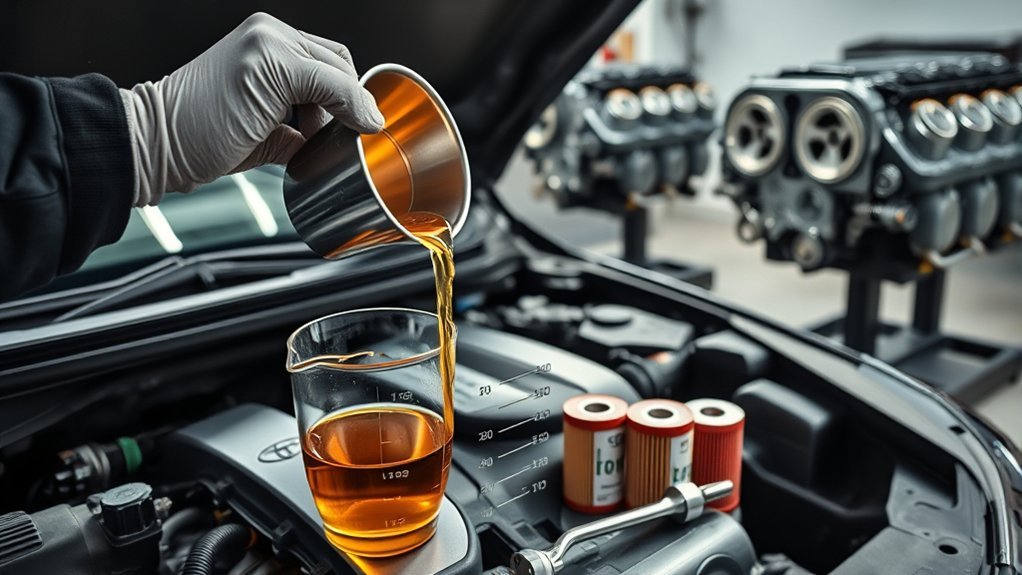
You’ll need between 4.5 and 6.4 quarts of engine oil for a Toyota Camry depending on engine and model year: 2.5L four-cylinders use about 4.5–4.8 qts (2012–2017 ~4.6 qts; 2018–2024 ~4.8 qts; 2024 hybrid 4.5 qts with filter), while 3.5L V6s require 5.7–6.4 qts (2018–2024 = 5.7 qts; 2012–2017 = 6.4 qts). Use the specified SAE grade and full synthetic where recommended to protect warranty and performance, and continue for model-specific details.
Toyota Camry Oil Capacity: Engine & Model-Year Quick Reference

When checking oil for your Toyota Camry, use the exact capacity specified for your engine and model year to avoid under- or overfilling. You’ll reference oil capacity by engine displacement and year: 2018–2023 2.5L = 4.8 quarts, 3.5L V6 = 5.7 quarts; 2012–2017 2.5L = 4.6 quarts, 3.5L V6 = 6.4 quarts. The 2024 hybrid specifies 4.5 quarts with filter. Older 2002–2011 entries typically list 2.4L = 4.0 quarts and 3.5L V6 = 5.0 quarts. Use this model comparison to select the correct service volume before draining or topping off. Precise fill prevents oil pressure deviations, reduces wear, and preserves warranty standing. You should record engine code and model year, confirm the manufacturer chart, and measure with the dipstick after warm-up. Act deliberately: match volumes exactly, reject approximations, and free yourself from avoidable engine damage through strict adherence to stated capacities.
Recommended Oil Grade and Viscosity by Camry Engine
You should match viscosity to your Camry’s engine and model year: 2018–24 2.5L calls for SAE 0W-16 while the 3.5L V6 uses SAE 0W-20, 2012–17 engines standardize on 0W-20, and older 2002–11 models generally used 5W-30 but shifted toward 0W-20. Use manufacturer-recommended oil types (full synthetic where specified) to guarantee proper cold-start flow and film strength at operating temperature. Compare synthetic versus conventional based on specs and service interval requirements—synthetic is required or preferred for most modern Camry engines.
Recommended Viscosity Ranges
Although specific viscosities vary by year and engine, you should follow Toyota’s recommended grades to guarantee fuel efficiency and engine protection: prioritize oil efficiency and consider viscosity impact when selecting oil. For 2018–2024 2.5L and 2.5L hybrid engines, Toyota specifies 0W‑16 to minimize friction and optimize hybrid system longevity. 3.5L V6 models use 0W‑20 to balance cold-start flow with high-temperature film strength. From 2012–2017, Toyota standardized 0W‑20 synthetic across engines for improved economy and protection. Older 2002–2011 Camrys typically used 5W‑30, later moving to 0W‑20 to reduce internal drag. Always choose manufacturer‑approved oils (Mobil 1, Castrol GTX, etc.) to maintain warranty compliance and ascertain the viscosity you select delivers intended protection and performance.
Engine-Specific Oil Types
For each Camry engine variant there’s a specified synthetic oil grade and precise fill volume you should use to guarantee proper lubrication and warranty compliance. You’ll use SAE 0W‑16 for 2024 2.5L A25A‑FXS and the 2.5L hybrid, each requiring 4.5 quarts including the oil filter types fitted by Toyota. For 3.5L V6 (2GR‑FKS, 2018–2024) you’ll use SAE 0W‑20 with a 5.7‑quart capacity. Models from 2012–2017 standardized on SAE 0W‑20 across engines. Don’t substitute viscosities: improper oil risks engine damage and may void warranty. Select oils with compatible engine oil additives and follow manufacturer specs for filter micron ratings and type. You’re empowering reliable performance by adhering to exact grades, volumes, and approved filter choices.
Synthetic Vs Conventional Oils
Having followed the engine-specific oil grades and fill volumes, it’s important to choose synthetic oils rather than conventional for 2012‑on Camrys to meet lubrication demands and warranty requirements. You’ll use 0W‑20 for 2012–2017 engines and 0W‑16 (2.5L) or 0W‑20 (3.5L) for 2018–2024 models. Synthetic advantages include thermal stability, low-temperature flow, and wear protection; conventional drawbacks are inadequate shear resistance and contamination susceptibility. Don’t mix types or wrong viscosities — you risk damage and voided warranties. For vehicles over 75,000 miles, use high‑mileage 0W‑20 formulations to reduce leaks and consumption while keeping spec compliance.
| Engine/Year | Recommended |
|---|---|
| 2012–2017 | 0W‑20 synth |
| 2018 2.5L | 0W‑16 synth |
| 2018 3.5L | 0W‑20 synth |
| High‑mile | 0W‑20 HM synth |
Why Oil Capacity Changed by Generation : Maintenance & Warranty Impact
When Toyota revised the Camry’s 2.5L engine and moved from 5W-30 to 0W-20 synthetic oil, they also adjusted crankcase volume—so you must use the exact, generation-specific capacity to guarantee correct oil pressure, lubrication film thickness and emissions control performance. You’ll note 2012–2017 2.5L engines take 4.6 quarts, while 2018–2023 need 4.8 quarts; hybrids typically use 4.5 quarts. Those small differences matter: over- or under-filling alters oil pressure, changes hydrodynamic film behavior and accelerates wear.
For maintenance, follow the specified capacity every service to preserve measured clearances and predictable thermal control; inconsistent volumes can skew service-interval planning and increase component stress. For warranty, Toyota expects compliance with specified volumes and approved fluids—deviating risks denial for damage linked to improper lubrication. You’ll protect engine longevity and retain your rights by using generation-specific capacities, documenting service, and treating oil volume as a controlled engineering parameter, not a flexible variable.
Approved Oils and Brands for Toyota Camry (And Oils to Avoid)
Although Toyota specifies particular viscosities to meet its engine tolerances, you should always use manufacturer-approved synthetic oils (0W‑16 or 0W‑20 for most modern Camrys) to preserve performance and warranty coverage. Stick to approved brands—Mobil 1, Castrol GTX, Pennzoil Platinum, Valvoline MaxLife and Toyota Genuine Motor Oil (TGMO)—because they meet oil certification standards and engineered additive packages. Using conventional oils in 2012‑and‑newer models or incorrect viscosities risks engine damage and voided warranty.
Don’t mix disparate oil chemistries or brands; blending can create oil performance issues by altering viscosity, detergent balance and shear stability. If you aim for mechanical freedom, choose certified oils with the right SAE grade and API/ILSAC ratings, change at prescribed intervals, and document service. Avoid uncertified knock‑offs, ambiguous “multi‑grade” blends that don’t list standards, and any oil that doesn’t explicitly meet Toyota’s specs. That disciplined choice preserves reliability, minimizes risk, and keeps your Camry operating on your terms.
High‑Mileage & Hybrid Oils: When to Use and Exact Capacities
If your Camry has over 75,000 miles, use a high‑mileage formulation with seal conditioners to reduce leaks and oil consumption while keeping the recommended viscosity (e.g., 0W‑20 for conventional Camrys). For hybrids follow exact capacities and oil types: the 2.5L hybrid takes 4.5 qt and the 3.5L V6 hybrid 5.7 qt, and both require synthetic oil. For 2018–2024 Camry hybrids use 0W‑16 synthetic as specified (0W‑20 only as a temporary alternative), ensuring you never substitute the wrong viscosity.
High‑Mileage Oil Benefits
Because older engines often develop seals that harden and valves that wear, switching to a high‑mileage formula can reduce leaks and oil consumption by conditioning seals and improving lubrication. You’ll protect engine health and prioritize leak prevention while restoring compression and reducing blow‑by. For Camry owners past ~75,000 miles, seal conditioners and tailored additive packages slow wear and lower oil top‑off frequency. Use the exact oil volumes—2.5L = 4.5 quarts, 3.5L = 5.7 quarts—so additive concentrations remain correct. Maintain the manufacturer’s viscosity spec when selecting high‑mileage blends to preserve flow characteristics and component clearances. Regularly scheduled changes with high‑mileage oil extend longevity, support reliability, and help retain resale value by keeping the powertrain mechanically honest and serviceable.
Correct Viscosity Selection
When should you switch viscosities for high‑mileage or hybrid Camrys and which exact volumes apply? You should move to a high‑mileage formulation once oil degradation or increased consumption appears—generally after ~75,000 miles—using 0W‑20 high‑mileage (with seal conditioners) for affected engines to restore seal integrity and reduce leaks. Maintain viscosity stability by avoiding mixes and following OEM specs: 2018–2024 2.5L I‑4 uses 4.8 qt of 0W‑16 synthetic; 3.5L V6 requires 5.7 qt of 0W‑20 synthetic. Hybrid 2.5L hybrids need 4.5 qt of 0W‑16 formulated for hybrid duty. Respect variable‑speed oil pump tolerances; incorrect viscosity risks performance loss, component wear, or warranty issues. Use exactly specified grades and volumes.
Hybrid Oil Capacities
Although hybrids often run cooler and demand lower-viscosity lubricants, you should use exactly 4.5 quarts of SAE 0W‑16 synthetic (filter included) for the 2025 Camry hybrid and switch to a high‑mileage 0W‑16 formulation with seal conditioners once oil degradation or elevated consumption appears—typically after about 75,000 miles—to restore seals and reduce leaks. You’ll preserve efficiency and warranty compliance by using the specified 0W‑16 viscosity and avoiding mixed or non-certified oils. Toyota’s 10,000-mile interval applies, with severe conditions prompting 5,000–7,500-mile changes; check levels frequently. For liberation-minded owners, disciplined hybrid maintenance and choosing high‑mileage oil when needed extend oil longevity, curb consumption, and limit leak repair exposure while maintaining hybrid system performance and fuel economy.
Oil‑Change Checklist: Drain, Fill, Torque Specs, and Verify Level
Start by draining the old oil completely and replacing the filter to prevent contaminants from re-entering the engine; torque the drain plug to 30 ft·lbs, then refill with the correct capacity (4.8 qts for 2.5L or 5.7 qts for 3.5L), run the engine briefly to circulate the fluid, let it cool and settle, and verify level with the dipstick—use a graduated beaker for precise measurement if dipstick readings seem inconsistent. You’ll perform each step to guarantee a proper oil change and preserve engine longevity. Torque control prevents leaks; filter replacement blocks debris. After a short run, let the oil return to the pan so the dipstick gives an accurate reading. If the dipstick is unclear, pour measured oil from a graduated beaker to hit the target level between low and full marks. Confirm no drips under the plug or filter. Document volume used and torque applied for repeatable maintenance that frees you from guesswork and keeps your Camry reliable.
- Warm engine, fluid circulation visualized
- Clean filter, trapped particles removed
- Tightened plug, sealed interface
- Dipstick check, beaker precision
Frequently Asked Questions
How Many Quarts of Oil Does a 2.5 L Toyota Camry Take?
A 2.5L Camry takes about 4.6–4.8 quarts for a full change including filter. Use oil type SAE 0W‑20 synthetic; follow maintenance tips, check the dipstick, and don’t overfill to protect your engine and freedom.
How Many Quarts Does a 2.4 L Toyota Camry Take?
4.0 quarts with filter change — you’ll keep engine maintenance tight and free. Picture constraint versus freedom: you’ll perform the oil change precisely, using recommended viscosity, monitoring dipstick levels to preserve performance and vehicular autonomy.
Can You Put 5 Quarts of Oil in a Toyota Camry?
You can add 5 quarts, but you shouldn’t assume it’s correct; during an oil change you’ll check dipstick and let oil drain, using a beaker if needed—engine maintenance favors slightly below MAX to avoid overfill.
How Much Oil Does a 2012 Toyota Camry 2.5 L 4 Cylinder Take?
You’ll need about 4.6 quarts (with filter) for the 2012 Camry 2.5L. For oil change and engine maintenance, use 0W‑20 synthetic oil; this oil type supports performance enhancement and long‑term mechanical liberation.
Conclusion
You’ve got the facts to keep your Camry’s heart running clean: match the oil grade to the engine, respect the exact capacity, and follow torque and fill procedures. Treat oil choice like oxygen—subtle changes affect performance instantly. Stick with approved brands, consider high‑mileage or hybrid formulations when appropriate, and verify level after warmup. Do this every service interval and you’ll protect longevity, efficiency, and warranty compliance.