You’ll most often need Group 51R, 24F or 94R/H7 depending on year, engine and OEM specs; 51R runs about 500 CCA, 24F and 94R/H7 around 700–800 CCA for cold starts. Always check your owner’s manual or VIN fitment for the exact BCI group, terminal placement and minimum CCA. Match AGM with AGM if equipped to avoid charging issues, and register the new battery with the vehicle’s BMS so charging stays correct — more specifics follow below.
Quick Answer: Common Camry Battery Group Sizes
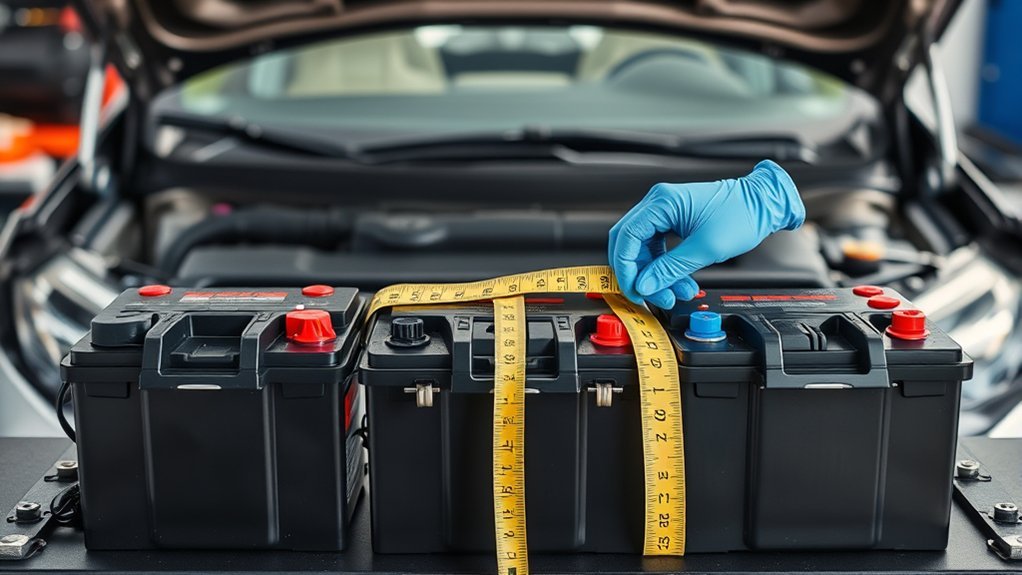
Most Camrys use either Group 51R or 24F batteries, so check your year and trim before buying. You’ll choose 51R on many models where a ~500 A CCA suffices; that delivers reliable battery performance for standard driving and moderate cold weather. Opt for 24F when your Camry’s trim or model year specifies it—24F typically provides around 750 A CCA, giving stronger starts and greater reserve in freezing conditions. You’ll want the higher CCA if you face frequent low temperatures, heavy accessory loads, or longer periods between drives. Using the specified group size preserves the electrical system’s integrity and avoids fitment or grounding issues. Don’t guess: verify the correct group for your exact vehicle rather than assuming one size fits all. That small step frees you from repeated replacements and keeps you moving with predictable, resilient starting power.
Verify Fit: Use Your Owner’s Manual or VIN
When you’re replacing a Camry battery, start by checking the owner’s manual or using the VIN to confirm the BCI group size and minimum CCA—these authoritative sources tell you the exact specifications for your model and trim. You want certainty: manual consultation gives factory-recommended group size and CCA, while VIN verification ties specs to your exact build. Use both when possible to eliminate guesswork.
Check your Camry’s manual or VIN for the correct BCI group size and minimum CCA to ensure proper fit.
- Check the owner’s manual for BCI group size and minimum CCA.
- Use VIN verification via dealer or fitment tools to confirm compatibility.
- Read the current battery label to see existing group size and ratings.
- Cross-reference online fitment tools (e.g., Batteries Plus) for a second opinion.
- Verify correct group size for secure mounting and proper terminal orientation.
This practical, technical approach frees you from uncertainty, guarantees reliable starting in extremes, and prevents fitment errors that limit mobility and autonomy.
Common Camry Battery Group Sizes by Year and Engine
You’ll see that Camry battery group size varies by model year and engine displacement, so check specifics before you buy. For example, many 2020 Camrys use Group 51R with ≥500 CCA, while 2021–2022 models often require Group 94R/H7 with ~750–800 CCA; Group 78 and 48/H6 appear on other trims and engines. Use this yearly and engine-size breakdown to match physical fit and required CCA.
Yearly Model Breakdown
Start by checking your Camry’s year and engine to match the right battery group size: small fours and base V6s often use 24F or 51R, while later or higher-output engines may require 94R or 48 variants with higher CCA. You’ll want correct fitment to maximize battery lifespan and follow maintenance tips that preserve capacity. Below is a concise yearly breakdown to guide confident swaps:
- 2015: typically 24F — reliable CCA for standard engines.
- 2017: commonly 48 or 51R — CCA ~500–700 for varied climates.
- 2020: usually 51R or 24F — depends on trim and engine.
- 2022: 51R or 94R — higher CCA options for cold performance.
- Always consult the owner’s manual or fitment tool for exact match; variations exist by options and features.
Engine Size Variations
Although engine size and trim don’t always dictate a single battery choice, you should match the Camry’s engine to the correct group size and CCA to guarantee proper fit and starting performance. You’ll choose 51R, 78, or 94R depending on displacement and accessory load; higher-displacement or newer engines often need higher CCA for reliable starts and improved engine performance. That preserves battery longevity and frees you from needless replacements. Consult the owner’s manual for exact specs tied to engine variant.
| Year Range | Common Group | Typical CCA |
|---|---|---|
| 2010–2015 | 51R | 500–650 |
| 2016–2020 | 51R / 78 | 500–750 |
| 2021+ | 78 / 94R | 600–750+ |
Common Group Sizes
After matching engine size to the right CCA range, you’ll want to pick the correct BCI group to guarantee fit and terminal placement. You’ll find common group sizes tied to year and powertrain so you can swap confidently, protect battery longevity, and secure reliable starts in cold weather. Note hybrid models often need AGM variants.
- 2007–2022: Group 51R — standard fit with adequate CCA for most engines.
- 2020 Camry: minimum 500 A CCA — prioritize cold-weather performance.
- 1997–2001: Group 24F — different dimension and terminal layout.
- Hybrids: AGM or specialized batteries — meet electrical demands.
- BCI group: guarantees dimension, terminal type, and secure installation.
Choose to free yourself from guesswork; match specs, not assumptions.
Why Physical Size and Terminal Placement Matter
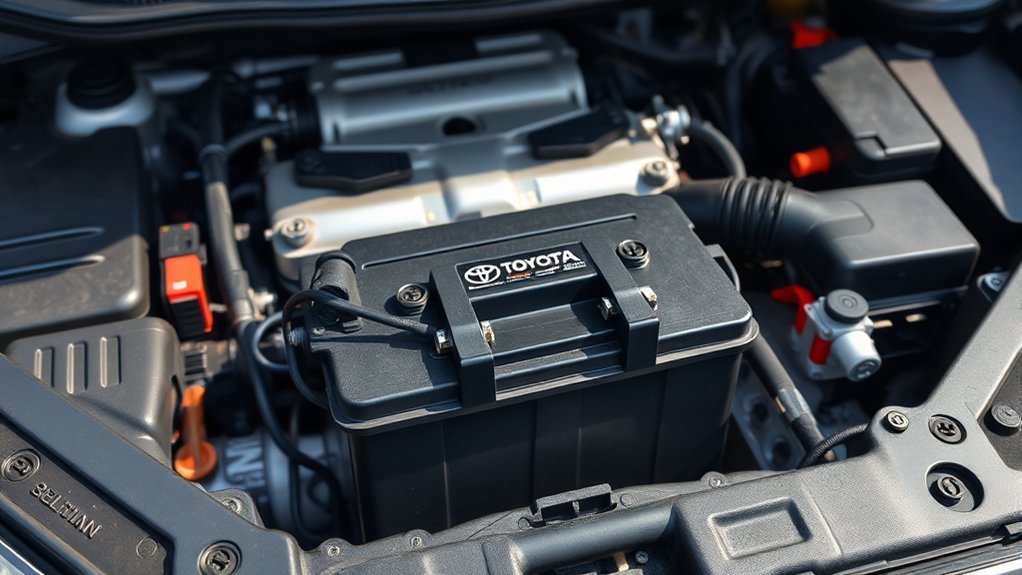
When you replace a Camry battery, matching the BCI group size and terminal placement guarantees the unit seats securely in the tray and connects without routing or clearance issues; incorrect dimensions or reversed terminals can cause poor contact, electrical shorts, and accelerated wear of both the battery and vehicle wiring. You need precise fit: Group 51R or 94R dimensions keep the pack stable under vibration and prevent movement that stresses cables and tray mounts. Terminal orientation matters for safe, direct cable runs—improper orientation forces awkward routing, risks chafing, and can short to nearby metal. A correct fit also promotes battery longevity by ensuring consistent charging, heat dispersion, and reduced mechanical strain. To preserve your autonomy over maintenance, consult the owner’s manual or a fitment tool before buying. That step prevents starting problems, reduced service life, and avoidable electrical damage, letting you choose confidently and keep the Camry’s systems reliable.
Camry Battery CCA Requirements and How to Choose
Because cold cranking amps (CCA) determine whether your Camry will start reliably in cold conditions, you should match or exceed the manufacturer’s minimum—500 CCA for the 2020 Camry—while also validating the correct group size (51R or 78) for fitment. You want a battery that frees you from hesitation at startup and extends battery lifespan through deliberate selection.
- Verify group size with the owner’s manual or a fitment tool.
- Choose CCA well above 500 (720–800 CCA improves cold weather starts).
- Prioritize fit and terminal orientation to avoid installation issues.
- Consider durable construction (AGM/EFB options) for extreme conditions.
- Balance cost vs. expected battery lifespan and performance.
Select a higher CCA when you need reliable cold weather performance and longer service life. You’ll reduce failure risk and reclaim mobility. Validate specifications for your exact Camry model, then pick the highest practical CCA within the correct group size to guarantee fit, power, and lasting value.
Camry Battery Types: Flooded, AGM, or TPPL?
Matching group size and CCA was only the first step; you also need to pick the right battery chemistry for your Camry. You’ll typically choose between standard flooded batteries, Enhanced Flooded Batteries (EFB), or Absorbed Glass Mat (AGM). Standard flooded batteries are simple, cost-effective, and fine for low-electronics trims, but they wear faster under stop-start or heavy accessory loads.
EFB sits between flooded and AGM: it’s more durable, handles cycling better, and extends uptime without the cost of AGM. Choose EFB for liberation from frequent replacements when you drive unpredictably.
AGM performance shines with modern Camrys that have high electronic demand or start-stop systems. AGM offers higher cycle life, better charge acceptance, and lower internal resistance, so it supports accessories and improves reliability. If your Camry originally used AGM, match it to maintain system compatibility. Consider CCA requirements (usually 500–750 CCA) alongside chemistry to guarantee dependable starts and resilient operation.
When You Must Match the OEM Battery (AGM Rules)
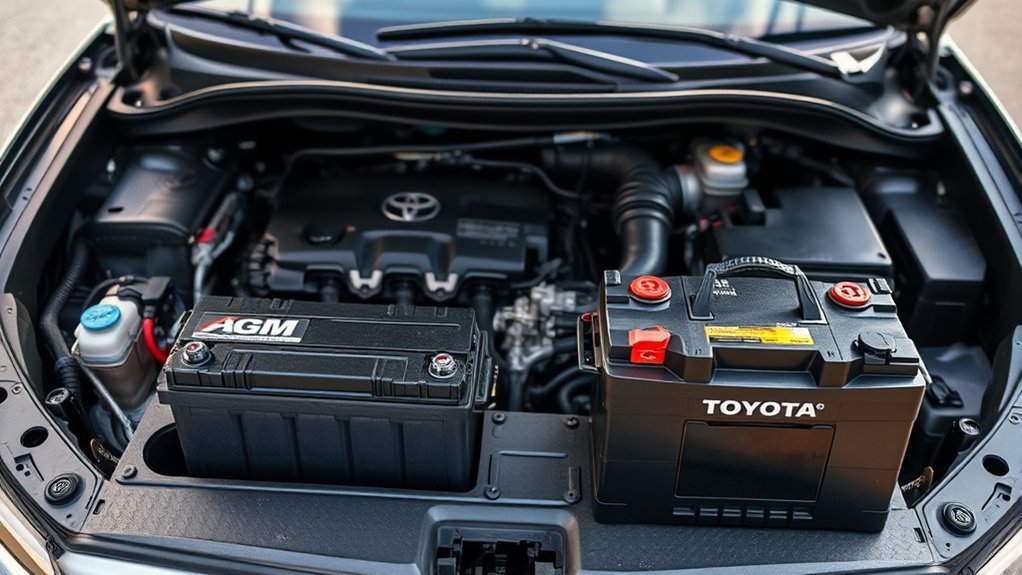
If your Camry originally came with an AGM, you must replace it with another AGM to preserve charging compatibility and electronic stability. Swapping in a non‑AGM battery can reduce cold‑start reliability, stress the charging system, and risk electrical damage or voided warranties. Check the owner’s manual or dealer specs for the required CCA and AGM designation before buying.
Always Replace With AGM
When your Camry originally came with an AGM battery, you should replace it with another AGM to preserve charging behavior, cold-cranking performance, and the vehicle’s electrical protection systems; OEM-specified AGM chemistry handles higher charge rates and electronic loads that standard flooded batteries don’t. You’ll keep AGM advantages and battery longevity by matching chemistry and specs. Verify the label or owner’s manual, then install the correct 12V AGM rated for the required CCA and reserve capacity.
- Match AGM chemistry to maintain charging algorithm compatibility
- Confirm CCA and reserve capacity on the replacement label
- Use OEM or equivalent group size and terminal layout
- Inspect charging system settings after installation
- Recycle the old battery through approved channels
This keeps your electronics safe and your freedom to drive uncompromised.
Risks Of Non‑AGM Swap
Because your Camry’s OEM battery is likely AGM, swapping in a conventional flooded battery can compromise electrical performance and system longevity: you’ll see reduced battery performance, weakened starting reliability, and impaired power delivery to electronic systems. AGM requires unique charging profiles; a non‑AGM may be overcharged or undercharged, causing longevity concerns. In cold weather a lower CCA non‑AGM risks no-starts. You must match OEM specs to protect electronic systems and avoid warranty implications.
| Risk Factor | Effect | Action |
|---|---|---|
| Charging profiles | Over/undercharge | Use AGM-compatible charger |
| Cold weather | Low starting reliability | Match CCA rating |
| Power delivery | Electronic faults | Install AGM equivalent |
| Longevity concerns | Shorter life | Replace like-for-like |
| Warranty implications | Voided coverage | Keep OEM specs |
How to Read Your Battery Label and Avoid Fitment Mistakes
Although battery labels can look cryptic, you’ll find the BCI group size clearly printed on the top or front of your existing battery and it’s the key to physical fit and terminal placement. Check that code first, then confirm minimum CCA in the owner’s manual. That preserves reliable starts and your freedom from roadside hassles. Use manufacturer tools or a Batteries Plus fitment lookup to double‑check group size (51R or 78 are common). Match dimensions and terminal orientation exactly.
Find the BCI group size on your battery, confirm CCA in the manual, and match dimensions and terminal orientation.
- Locate the BCI group size on the battery top or front.
- Cross‑reference owner’s manual for group size and CCA.
- Use an online fitment tool for model‑specific confirmation.
- Measure physical dimensions to guarantee correct terminal alignment.
- Prefer exact matches to avoid clearance or hold‑down issues.
Follow battery maintenance tips and seasonal checks to catch degradation before it strands you. Accurate reading prevents wrong purchases and installation headaches, so act deliberately and keep control of your vehicle’s electrical reliability.
Installation Notes: Registration, Programming, and Warranty
When you replace the Camry’s battery, you’ll need to register it with the vehicle’s ECU so the charging system and start-stop features work correctly. Follow the required programming steps—usually done with dealer-level tools by factory-trained techs—to update battery state-of-charge, capacity parameters, and energy management settings. Keep warranty requirements in mind: many warranties (e.g., Duralast) require installation or authorized verification at a certified dealership to maintain coverage.
Battery Registration Process
If you replace the Camry’s battery, you’ll need to register it with the vehicle’s onboard computer so the charging system correctly recognizes the new unit and manages state-of-charge and health data. You’ll do this to preserve battery longevity and maintain charging efficiency; the vehicle’s BMS must track the new battery’s parameters. Registration requires a diagnostic tool to update the system so it monitors state-of-charge, health, and specs like CCA. Failing to register risks improper charging, reduced performance, and warranty issues. Certified technicians usually handle this to keep coverage valid.
- Use an OEM or compatible diagnostic tool
- Confirm battery specs (CCA, capacity) before install
- Update BMS records during installation
- Verify charging behavior post-registration
- Keep documentation for warranty claims
Required Programming Steps
After you register the new battery with the vehicle’s BMS, follow a defined set of programming steps to guarantee the charging system, start‑stop functions, and warranty requirements are satisfied. You’ll verify battery registration importance by confirming the vehicle recognizes the new unit and adjusts charge profiles. Programming variations exist across model years and battery types; consult the owner’s manual or a certified technician to apply model‑specific procedures. For AGM or start‑stop systems, run the additional programming routine so regenerative braking and idle‑stop behave correctly. Document each step and the technician’s credentials to maintain warranty compliance. If you skip registration or misapply programming variations, you risk incorrect charging, dashboard faults, and shortened battery life.
Warranty Coverage Details
Anyone installing a replacement battery should register and program it immediately to keep warranty coverage valid and guarantee the vehicle’s charging and start‑stop systems operate correctly. You’ll want to follow factory procedures and use trained technicians so the warranty benefits apply and coverage limits aren’t voided. Keep clear documentation of installation and service; it’s essential for claims covering parts and workmanship. Regular maintenance and adherence to the warranty terms extend battery life and free you from avoidable failures.
- Register the battery with the manufacturer after installation.
- Program the vehicle’s battery management system for compatibility.
- Use factory-trained technicians to preserve warranty benefits.
- Retain invoices and service records for claims.
- Follow scheduled maintenance to respect coverage limits and maximize performance.
Buying Guide: Recommended Group Sizes, Options, and Warranties
When choosing a battery for your Toyota Camry, start by confirming the correct group size—typically 51R, 78, or 94R/H7—as this guarantees proper fit and terminal orientation for your model year and trim. Match the recommended group size and required CCA (435–800A) to your climate and equipment; higher CCA helps in cold starts. Consider Duralast Platinum options if you want factory-level reliability; expect prices near $159.99–$259.99 plus a $22 refundable core deposit. Check warranty lengths: Duralast Platinum commonly offers 2–3 years replacement coverage for manufacturing defects. Use owner’s manual or fitment tools to verify exact specs before purchase.
Adopt battery maintenance tips and ideal charging techniques immediately: use a smart charger, avoid deep discharge, and inspect terminals for corrosion. These habits extend service life and protect your autonomy. Prioritize correct fit, adequate CCA, clear warranty terms, and a disciplined charging regimen when deciding.
Frequently Asked Questions
What Group Size Is a Toyota Camry Battery?
Your Camry typically uses Group Size 51R or 24F. You’ll evaluate Camry battery types, compare Battery replacement options, and choose the size matching your model year and power needs to free yourself from unexpected failures.
How Do I Tell What Group Size My Car Battery Is?
Like finding the right shoe, check your battery specifications label or owner’s manual for the group size; you can also read the printed group size on the battery top or use online fitment tools to confirm compatibility and CCA.
Conclusion
You’ve got the facts to pick the right Camry battery: check your owner’s manual or VIN, match size and terminal layout, and meet CCA and AGM requirements. If you stray, fit and electronics may suffer—measure twice, install once. Stick with OEM specs or approved equivalents, verify registration/programming, and keep warranty details. With the right prep, you’ll avoid surprises and keep your Camry reliable for years.