

For most Toyota Camry models, the right 12-volt battery is not a one-size-fits-all choice. Toyota’s current replacement-battery guide points to 24F, 35, H5/LN2, and H6/LN3 as the main Camry battery group sizes, depending on model year, engine, hybrid status, and original equipment. Always confirm the exact battery by VIN, the label on your existing battery, and the Toyota owner’s manual or parts catalog before buying.
Quick Answer
A Toyota Camry commonly uses Group 24F or Group 35 on many older non-hybrid models, while many 2018 and newer Camrys use H5/LN2 or H6/LN3. Some lookups may show other sizes, so verify by VIN, battery label, terminal layout, and required CCA before purchase.
Key Takeaways
- Do not assume every Camry uses Group 51R. Toyota’s current battery guide lists 24F, 35, H5/LN2, and H6/LN3 for many Camry applications.
- The correct battery group controls physical fit, hold-down fit, and terminal placement; CCA and chemistry control starting performance and charging compatibility.
- Match the original chemistry when the label says AGM, EFB, or a vented hybrid/trunk-mounted battery design.
- Battery “registration” is not a universal Camry requirement, but some models may need simple relearns or dealer service after a 12-volt battery swap.
- For hybrids and any battery located inside the trunk or cabin area, use the exact Toyota-approved battery design and follow Toyota service guidance.
At a Glance
| Time Required | 5–10 minutes to identify the battery; 20–45 minutes for a basic under-hood replacement |
| Difficulty | Easy for many non-hybrid under-hood batteries; dealer service recommended for many hybrid or vented trunk batteries |
| Tools Needed | Owner’s manual, VIN, battery label, tape measure, 10 mm wrench or socket, gloves, eye protection |
| Cost | Usually the battery price, refundable core charge, and optional installation labor; AGM/EFB and OEM batteries cost more than basic flooded batteries |
Quick Answer: Common Camry Battery Group Sizes
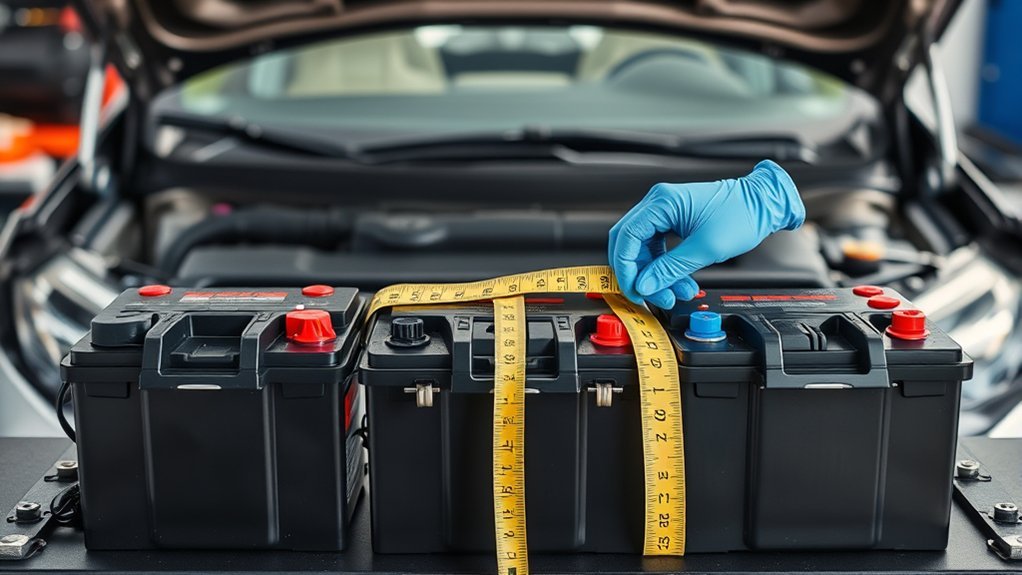
The most common Toyota Camry battery group sizes are 24F, 35, H5/LN2, and H6/LN3. The right one depends on the Camry’s year, engine, trim, hybrid status, and original battery equipment. A current Toyota replacement-battery guide lists many 1992–2017 non-hybrid Camrys with 24F or 35, many 2018+ non-hybrid Camrys with H5/LN2 or H6/LN3, and many 2018+ Camry Hybrid applications with H5/LN2.
That means you should treat any single-size answer with caution. A battery can have the right voltage and still be wrong if the case is too large, the posts are reversed, the hold-down will not clamp, the venting is wrong, or the CCA is below the vehicle’s needs.
Note: Some aftermarket fitment tools may show Group 51R for certain Toyota applications, but Toyota’s current Camry battery guide does not make 51R the main Camry replacement size. If a store lookup shows 51R, confirm it against your VIN and the existing battery before buying.
Verify Fit: Use Your Owner’s Manual or VIN
When you are replacing a Camry battery, start with the owner’s manual, the VIN, and the label on the battery already installed in the vehicle. Toyota’s owner resources let you access manuals and warranty information by vehicle, and Toyota’s parts catalog can check fitment by VIN.
The battery group size tells you the case dimensions and terminal layout. It does not guarantee the correct CCA, reserve capacity, chemistry, venting, or fitment for your exact Camry.
- Check the Toyota owner’s manual for battery warnings and service guidance.
- Use your VIN in the Toyota Genuine Parts catalog or with a Toyota dealer to confirm fitment.
- Read the current battery label for group size, CCA, reserve capacity, chemistry, and venting information.
- Match the battery tray, hold-down, cable reach, and positive/negative terminal orientation.
- Use a second fitment lookup only as a cross-check, not as the only source.
Pro Tip: Take a photo of the old battery label before you remove it. That photo gives you the group size, CCA, reserve-capacity rating, post layout, and chemistry if the parts counter asks for details.
Common Camry Battery Group Sizes by Year and Engine
Camry battery size changed across generations. The table below is a practical guide based on Toyota replacement-battery application data and common fitment patterns. It is not a substitute for VIN confirmation, because options, engine codes, regional equipment, and prior battery-tray changes can affect the correct replacement.
[Products Worth Considering]

This rear trunk lid weatherstrip is designed to fit select Toyota Camry and RAV4 models, helping restore a secure seal around the trunk area. It supports protection against dust, moisture, and road noise while offering a reliable replacement for worn or damaged factory seals. Made for straightforward installation, it provides a practical fit-and-finish upgrade for everyday driving.

This WEJOWE OBD2 scanner helps drivers quickly identify check engine causes, read and clear trouble codes, and view live vehicle data with built-in DTC lookup. It also includes battery voltage testing, I/M readiness checks, freeze frame retrieval, and support for printing diagnostic reports to help simplify repairs and maintenance. Designed for most OBDII vehicles since 1996, it offers an easy-to-use solution for DIY car diagnostics.

This automotive test light combines a bright LED voltage display with quick polarity indication for fast, accurate circuit checks in a wide range of vehicle systems. It helps diagnose battery, charging, lighting, and fuse issues with a sharp stainless probe, long spring wire, and easy-to-use alligator clip for efficient troubleshooting.
Yearly Model Breakdown
| Camry Year / Application | Common Battery Group | What to Verify |
|---|---|---|
| 1992–1998 non-hybrid | 24F | Case length, top-post layout, hold-down fit |
| 1999–2011 non-hybrid | 24F or 35 | Engine/application code and terminal orientation |
| 2012–2017 non-hybrid | 24F | CCA, tray fit, and original battery label |
| 2018–2019 non-hybrid | H6/LN3 | DIN/EN case size, battery height, and hold-down |
| 2020+ non-hybrid 4-cylinder | H5/LN2 | VIN, engine, CCA, and chemistry |
| 2020+ non-hybrid V6 | H6/LN3 | VIN, engine, CCA, and chemistry |
| 2007–2017 Camry Hybrid | OE-specific application | Toyota dealer or exact OE replacement guidance |
| 2018+ Camry Hybrid | H5/LN2 in many applications | Venting, trunk location, chemistry, and Toyota-approved design |
Engine Size Variations
Engine size matters because higher electrical loads and different packaging can call for a larger battery. A four-cylinder Camry and a V6 Camry from the same generation may not use the same battery. For example, Toyota’s current battery application guide separates some 2020+ Camry applications by engine: H5/LN2 for many four-cylinder models and H6/LN3 for many V6 models.
Do not choose only by “more CCA is better.” A stronger battery is helpful only if it also fits the tray, matches the terminals, works with the hold-down, and uses the right chemistry. A too-tall or wrong-post battery can create a safety problem even when its CCA rating looks good.
Common Group Sizes
| Battery Group | Common Camry Use | Why It Matters |
|---|---|---|
| 24F | Many older and mid-generation non-hybrid Camrys | Large top-post battery with reversed polarity layout compared with Group 24 |
| 35 | Some older non-hybrid Camry applications | Shorter case than 24F; verify cable reach and hold-down |
| H5/LN2 | Many 2020+ four-cylinder Camrys and many 2018+ hybrid applications | DIN/EN case style; verify venting and chemistry |
| H6/LN3 | Many 2018–2019 non-hybrid Camrys and many 2020+ V6 Camrys | Larger DIN/EN case than H5/LN2 |
| 51R | Seen in some Toyota battery catalogs and aftermarket lookups, but not the main current Camry listing | Use only if your VIN, battery label, and tray confirm it |
Why Physical Size and Terminal Placement Matter
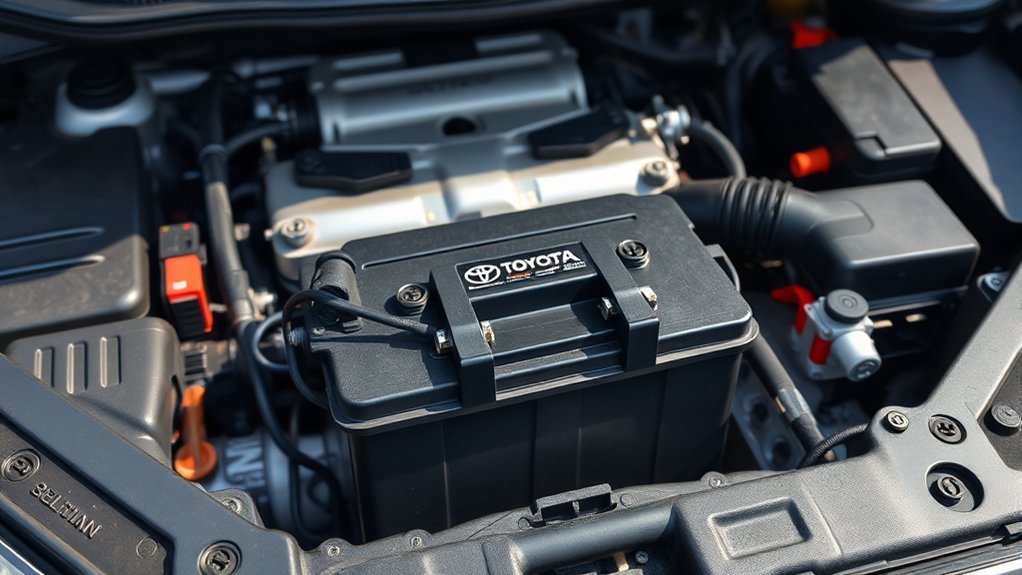
Battery group size controls the outer dimensions, hold-down style, and terminal layout. The Battery Council International group-size reference lists physical dimensions for groups such as 24, 35, 51R, 48/H6, and 94R/H7. For Camry owners, that matters because a battery that is slightly wrong can still cause real problems.
- Loose battery: If the case does not fit the tray or hold-down, vibration can damage the plates, terminals, or cables.
- Wrong post location: If the terminals are reversed or too far away, the cables may be stretched or routed across sharp metal.
- Too much height: A tall battery can contact the hood, bracket, or nearby components.
- Wrong venting: This is especially serious on trunk-mounted or cabin-adjacent hybrid batteries.
- Poor electrical contact: Loose or corroded terminals can create hard starts, warning lights, and charging issues.
Warning: Never force a battery into the tray, bend cables to make the posts reach, or leave the hold-down loose. Toyota warns that 12-volt batteries can produce flammable gas and contain corrosive sulfuric acid, so wear eye protection and keep sparks, flames, and cigarettes away from the battery.
Camry Battery CCA Requirements and How to Choose
Cold cranking amps, or CCA, tells you how much current a battery can deliver for starting in cold conditions. Higher CCA can help in freezing weather, but only after you confirm the correct group size, chemistry, and fitment. A battery with more CCA is not automatically safer or better if the case, terminals, or venting are wrong.
Use this order when choosing:
- Confirm the exact group size by VIN, owner’s manual, old battery label, and parts lookup.
- Match the battery chemistry if the old battery is AGM, EFB, or an OE vented hybrid battery.
- Meet or exceed the original CCA shown on the old battery or Toyota-approved replacement.
- Check reserve capacity if you use many accessories, make short trips, or park for long periods.
- Confirm terminal orientation before leaving the parts counter.
For example, Toyota lists a Toyota TrueStart Group 24F EFB battery with 750 CCA, while a Toyota TrueStart Group 51R battery is listed with 500 CCA. Those examples show why CCA varies by battery line and group size; you still need the correct application for your Camry.
Camry Battery Types: Flooded, AGM, EFB, or TPPL?
Group size is only the first part of the decision. You also need to match the battery chemistry that your Camry was designed to use.
| Battery Type | Best Use | Camry Buying Note |
|---|---|---|
| Flooded lead-acid | Basic starting battery for many older vehicles | Use only when it matches the OE style and rating |
| EFB | Better cycling than standard flooded batteries | Match EFB if Toyota or the battery label calls for it |
| AGM | Higher electrical demand, better vibration resistance, sealed design | Replace AGM with AGM when originally equipped |
| TPPL AGM | Premium AGM design with strong power delivery | Only choose it if it fits and meets the OE specs |
If your Camry’s original battery label says AGM or EFB, do not downgrade to a basic flooded battery just to save money. The charging behavior, reserve capacity, and expected cycle life may not match what the vehicle needs.
[Products Worth Considering]

The KONNWEI KW371 is a versatile 2-in-1 diagnostic tool that tests automotive batteries and 4/5-pin relays with fast, accurate results. It supports 6V, 12V, and 24V systems across multiple battery types, and also checks cranking and charging performance to help pinpoint battery, starter, or alternator issues. Built for mechanics and DIY users, it offers clear visual readouts, multiple language support, and convenient vehicle-powered operation with no batteries required.

This mech-style heavy metal key fob cover is designed to protect compatible Toyota E-style smart keys with a precise 1:1 fit. Built with a durable zinc alloy frame and soft silicone buttons, it helps guard against daily wear while keeping full access to key functions. The set includes a metal keychain and screwdriver for easy installation, making it a practical upgrade for select Toyota models.

This portable jumper cable adapter is designed for seamless compatibility with Milwaukee M18 batteries, helping you jump-start a dead or weak vehicle battery quickly and conveniently. Built with 8 AWG cables and simple clamp connections, it supports a range of vehicles including cars, SUVs, and trucks. It offers a practical, tool-battery-powered solution for emergency starting, with clear usage steps and safety guidance for dependable operation.
When You Must Match the OEM Battery
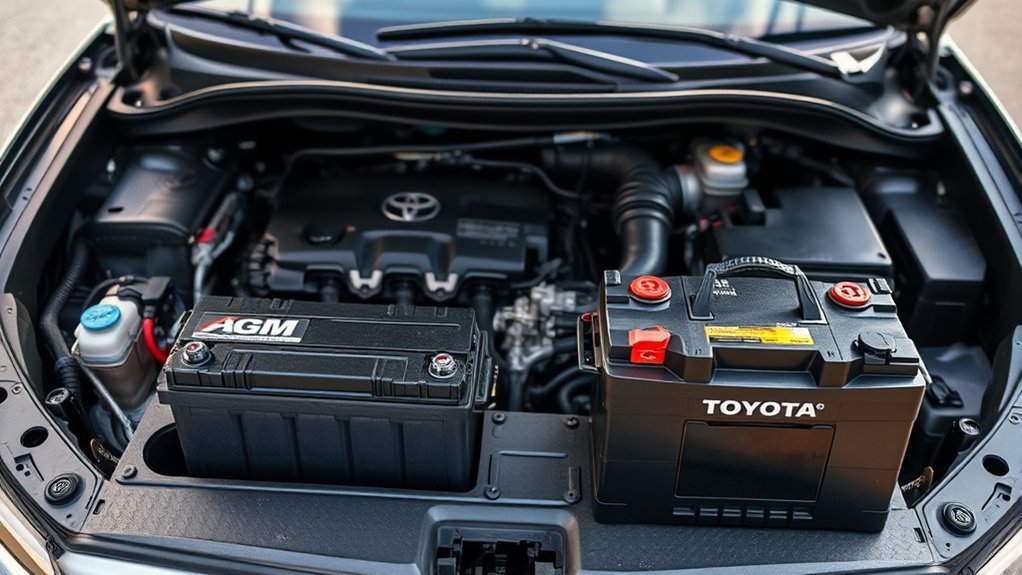
You must match the OEM-style battery when the original battery uses AGM, EFB, special venting, or a hybrid-specific design. This is not just a performance issue. Toyota’s 2025 Camry Hybrid manual warns owners to use a 12-volt battery designed for the vehicle, because an incorrect battery can allow hydrogen gas to enter the passenger compartment and create a fire or explosion risk.
Always Replace With the Same Chemistry
If the old battery is labeled AGM, use a replacement AGM with the correct group size, posts, venting, CCA, and reserve capacity. If the old battery is labeled EFB, use the correct EFB or a Toyota-approved equivalent. If the battery is a hybrid-specific vented design, follow the Toyota manual and dealer guidance.
- Match the battery group size and terminal layout.
- Match or exceed the OE CCA and reserve capacity.
- Match the chemistry shown on the original label.
- Match vent-tube provisions on trunk-mounted or enclosed-location batteries.
- Keep invoices and battery test results for warranty claims.
Risks of the Wrong Battery Swap
| Mistake | Possible Result | Better Action |
|---|---|---|
| Wrong group size | Loose fit, cable strain, or hood clearance issue | Match the old label and VIN lookup |
| Wrong terminal orientation | Cables will not reach or may be routed unsafely | Confirm positive and negative post locations |
| Flooded battery replacing AGM/EFB | Shorter life, lower cycling ability, or charging mismatch | Use the same chemistry or approved upgrade |
| No vent connection where required | Gas may enter enclosed areas | Use a vehicle-designed vented battery |
| CCA below OE rating | Weak cold starts or no-starts | Meet or exceed the original rating |
How to Read Your Battery Label and Avoid Fitment Mistakes
The battery label is the fastest way to avoid a wrong purchase. Look on the top and front of the battery case before you disconnect anything.
Find the group size, CCA, reserve capacity, voltage, chemistry, and terminal layout before you shop.
- Group size: Look for codes such as 24F, 35, H5, LN2, H6, or LN3.
- CCA: This is the cold-start rating. Match or exceed the original rating.
- RC or Ah: Reserve capacity or amp-hour rating shows how much energy the battery can support over time.
- Chemistry: The label may say flooded, AGM, EFB, VRLA, or maintenance-free.
- Post layout: Confirm which side the positive terminal is on when the posts face you.
- Vent port: Check for a vent-tube connection, especially on hybrid or trunk-mounted batteries.
Note: BCI, DIN, and EN names can overlap. For example, BCI’s reference chart maps H5 to LN2, H6 to LN3, and 94R to H7/LN4. Use the whole code and the physical dimensions, not just one label.
Installation Notes: Registration, Programming, and Warranty
Many Camry owners can replace a basic under-hood 12-volt battery without special programming, but you should not assume every Camry is the same. Toyota does not state a universal “battery registration” requirement for every Camry, but modern vehicles may need simple relearns after battery power is disconnected.
Battery Registration and Relearns
For a Camry, the safer wording is this: check whether your exact model needs a relearn, initialization, or scan-tool procedure after battery replacement. Some vehicles may need window, moonroof, steering-angle, idle, key, or start-stop related relearns. If warning lights remain after the swap, use a capable scan tool or have a Toyota technician inspect it.
For hybrid models and any battery located in the trunk or an enclosed area, Toyota’s manual guidance is stricter. Use a battery designed for the vehicle and contact a Toyota dealer when the manual calls for dealer replacement.
Safe Replacement Steps
- Turn the vehicle off and remove the key or keep the smart key away from the car.
- Wear gloves and eye protection.
- Photograph the old battery label and cable routing.
- Disconnect the negative cable first, then the positive cable.
- Remove the hold-down and lift the battery straight out.
- Install the correct replacement and secure the hold-down.
- Connect the positive cable first, then the negative cable.
- Start the vehicle and check for warning lights, loose terminals, and charging problems.
- Perform any owner’s-manual relearns or dealer-required procedures.
Warranty Coverage Details
Warranty terms depend on the battery brand, seller, and installation method. Toyota’s parts warranty information states that TrueStart batteries are covered with free exchange for 24 months and prorated coverage up to 84 months, while True-2 batteries have free exchange for 18 months and prorated coverage up to 60 months. Third-party brands have their own terms, so keep the receipt, installation record, and battery test paperwork.
- Ask whether labor and towing are included or excluded.
- Check whether online or over-the-counter purchases have different coverage.
- Keep the old battery core receipt until the refund is processed.
- Save the printed battery test if the shop provides one.
- Do not modify terminals, posts, or venting, because improper installation can affect coverage.
Buying Guide: Recommended Group Sizes, Options, and Warranties
Use this buying checklist before you pay for a battery:
- Best first step: Enter your VIN in Toyota’s parts catalog or ask a Toyota parts counter to confirm the replacement.
- Best cross-check: Compare the new battery to the old battery label and physical dimensions.
- Best cold-weather choice: Choose the correct group size with the highest practical CCA that still matches OE specs.
- Best hybrid choice: Use the exact Toyota-approved design, especially if the battery is vented or located in the trunk.
- Best warranty habit: Keep the receipt and confirm the free-replacement and prorated periods before leaving the store.
Pro Tip: Bring the old battery’s group size, CCA, and a photo of the terminals to the parts counter. This prevents mix-ups between similar-looking H5/LN2 and H6/LN3 batteries.
[Products Worth Considering]

The GEARWRENCH Professional Bi-Directional Diagnostic Scan Tool brings OE-level diagnostics to your smart device for efficient troubleshooting and repair. It offers full bi-directional control, live actuation testing, live data mapping, freeze frame capture, and support for 23 reset and relearn functions to help technicians complete complex jobs with confidence. With software updates included, broad vehicle coverage, and a two-year warranty, it delivers powerful shop-ready capability without ongoing fees.

This front bumper license plate bracket is designed for Toyota Camry and Camry Hybrid models from 2018 to 2026, offering a secure and street-legal way to mount your plate. Built from durable, rust-proof plastic with included screw bolts and a wrench, it helps protect your bumper paint while making installation straightforward. The bracket fits US and Canada plates and is made to keep your license plate and registration sticker visible.

The ANCEL BA101 helps diagnose 12V batteries quickly with clear readings for battery health, charge level, voltage, CCA, cranking, and charging system performance. Designed for a wide range of vehicles and battery types, it offers easy-to-read results, reliable clamp connections, and built-in protection to make testing safer and more convenient.
Troubleshooting After a Camry Battery Replacement
If the Camry still has trouble after the new battery is installed, do not assume the battery is bad. Check the basics first.
| Symptom | Likely Cause | What to Do |
|---|---|---|
| Clicking or no crank | Loose terminal, weak new battery, starter issue | Tighten terminals and test battery voltage |
| Warning lights after replacement | Low voltage event or needed relearn | Drive normally if safe, then scan if lights remain |
| Battery drains overnight | Parasitic draw or charging fault | Test charging voltage and parasitic draw |
| Hold-down will not fit | Wrong group size or case height | Do not force it; exchange for correct size |
| Trunk battery has no vent connection | Wrong battery design | Stop installation and get the proper vented battery |
Frequently Asked Questions
What group size is a Toyota Camry battery?
Common Toyota Camry battery group sizes include 24F, 35, H5/LN2, and H6/LN3. Older non-hybrid Camrys often use 24F or 35, while many 2018 and newer Camrys use H5/LN2 or H6/LN3 depending on engine and hybrid status. Always verify by VIN and the existing battery label.
How do I tell what group size my car battery is?
Look for the group code printed on the top or front label of the battery. It may say 24F, 35, H5, LN2, H6, LN3, or another code. Then confirm the same size with your owner’s manual, VIN lookup, or Toyota parts counter before buying.
Does a Toyota Camry use a Group 51R battery?
Some aftermarket lookups may show 51R for certain Toyota applications, and Toyota sells 51R batteries for compatible vehicles. However, Toyota’s current Camry replacement-battery guide mainly lists 24F, 35, H5/LN2, and H6/LN3 for Camry applications. Use 51R only if your VIN, old battery label, tray, and terminal layout confirm it.
Do I need an AGM battery for a Toyota Camry?
You need AGM only if your original battery or Toyota fitment data calls for AGM. Some Camry batteries are flooded, some are EFB, and some hybrid or enclosed-location batteries may use special vented designs. Match the original battery chemistry and venting instead of guessing.
Does a Camry battery need to be registered after replacement?
There is no universal battery-registration rule for every Camry. Many basic 12-volt battery replacements only need normal checks and possible simple relearns. Some newer, hybrid, or warning-light situations may require a scan tool or Toyota dealer service. Follow the manual for your exact year and model.
Conclusion
The correct Toyota Camry battery group size depends on the exact vehicle, not a generic answer. For many Camrys, the likely choices are 24F, 35, H5/LN2, or H6/LN3, but the only safe choice is the one confirmed by your VIN, owner’s manual, existing battery label, and terminal layout. Match the group size, CCA, chemistry, venting, and warranty requirements, and your Camry will start reliably without fitment surprises.
Sources
- Toyota Owners Manuals & Warranties — owner’s manual lookup, warranty information, and vehicle-specific Toyota guidance.
- Toyota 2025–2026 TrueStart and True-2 Battery Guide — Toyota replacement-battery application chart and warranty information.
- Toyota Genuine Parts Catalog — VIN-based parts and battery fitment checking.
- 2025 Toyota Camry Hybrid 12-Volt Battery Manual Section — hybrid 12-volt battery location, replacement warning, and recharge precautions.
- Toyota Do-It-Yourself Service Precautions — battery acid, flammable gas, and safety warnings.
- Battery Council International Group Size Reference — BCI, DIN, EN, and JIS battery dimension and terminal reference data.



[…] Camry Hybrids use different 12-volt battery locations and charging arrangements. Check the exact Toyota Camry battery group size, powertrain, and VIN before […]
[…] capacity, and electrical specifications. For a year-by-year fitment discussion, see the separate Toyota Camry battery group-size guide; this page focuses on diagnosis and […]