
You’ll find the Camry’s rear seat gives about 38 in. of legroom and roughly 38 in. of headroom, yielding around 99–100 cu ft passenger volume, so you’ll usually sit upright comfortably for longer trips. All trims share these dimensions, so differences are in materials and features rather than space. Front-seat position and passenger height change usable clearance and child-seat fit, and small adjustments will improve comfort—keep going for practical setup and comparison tips.
Camry Rear Legroom & Headroom : The Quick Numbers
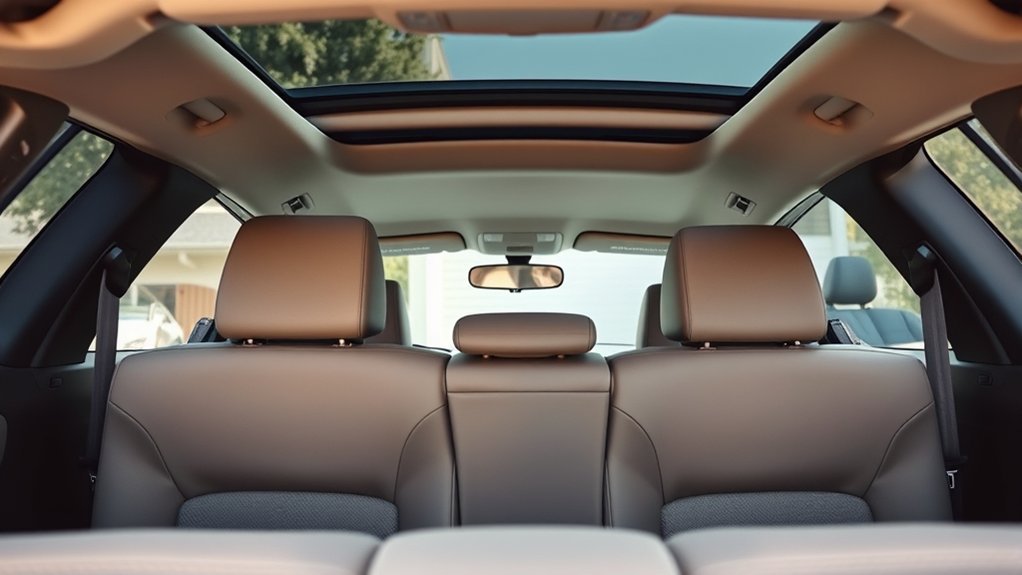
While the Camry prioritizes cabin space, its rear seat dimensions deliver clear, measurable comfort: 38 inches of legroom, 38 inches of headroom without a moonroof, and 55.7 inches of shoulder room. You’ll find rear seat comfort is engineered, not assumed: 38 inches of legroom supports extended posture changes and reduces fatigue on long drives. The 38-inch headroom (without moonroof) preserves vertical space so taller occupants won’t feel constrained. With 55.7 inches of shoulder room, three adults can sit with reduced lateral compression, improving ergonomic alignment. Overall passenger volume ranges 99.3 cu ft with a moonroof and 100.4 cu ft without, reflecting modest trade-offs between roof features and internal space. The rear seating configuration prioritizes passenger accessibility through clear entry geometry and unobstructed cushion placement, so you can move in and out without negotiation. These figures let you evaluate comfort objectively and claim spatial freedom for routine commutes and longer trips.
2023–2025 Camry Rear Legroom & Headroom by Trim
All 2025 Camry trims deliver identical rear-seat dimensions: 38 inches of legroom and 37.6 inches of headroom, so you get consistent passenger space regardless of model. You’ll find uniform rear-seat geometry across LE, SE, XLE and XSE, eliminating trim differences in basic dimensions and simplifying choice when passenger comfort is the priority.
| Trim | Rear Legroom | Rear Headroom |
|---|---|---|
| LE | 38 in | 37.6 in |
| SE | 38 in | 37.6 in |
| XLE | 38 in | 37.6 in |
| XSE | 38 in | 37.6 in |
This parity supports up to five occupants without dimensional compromise. You can focus on features, materials and tech rather than dimensional trade-offs; your selection will reflect style and capability aligned with passenger preferences. The interior’s design intent is liberation through predictability: consistent space so occupants aren’t constrained by trim choice.
What 38 In. Headroom / 38 In. Legroom Actually Feel Like
Think of 38 inches of rear headroom and legroom as a middle-ground for adult comfort: you’ll have enough vertical space to sit upright without forehead clearance issues and sufficient knee-to-seat spacing to avoid cramped legs on multi-hour trips. That dimensional pairing yields measurable rear comfort: taller adults won’t need to tilt or slouch, and average adults can extend legs for reduced fatigue. You’ll notice easier entry and exit because the cabin feels open rather than confining, which supports a liberated passenger experience during family trips or carpools.
Technically, 38 in. headroom prevents contact with roof contours while 38 in. legroom maintains a neutral knee angle for seated posture, lowering pressure points. You can install child seats or stow modest cargo without compromising occupant space. In short, the Camry’s layout balances ergonomic clearance and usable floor length so rear-seat occupants get practical comfort and freedom of movement without excess bulk.
How Passenger Height and Front-Seat Position Change Rear Space
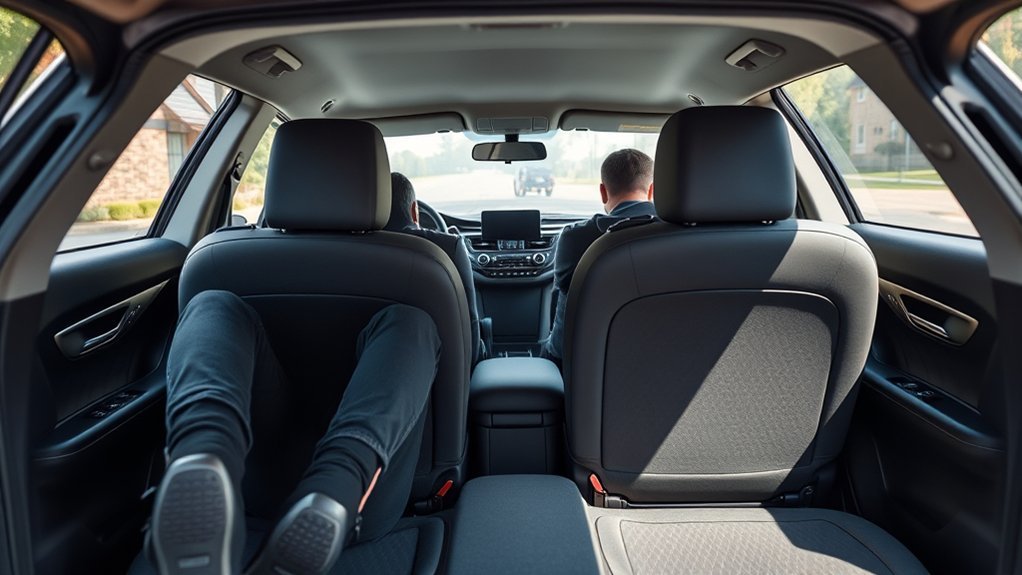
When you move the front seats fore or aft, legroom stays at 38 inches but reachable knee clearance and perceived headroom change. Taller rear passengers will notice reduced head clearance (37.6 inches nominal) and more contact with seatbacks if front seats are pushed back. Also consider seat recline and cushion thickness, which alter seating geometry and can make the rear feel roomier or more cramped despite unchanged volume.
Front Seat Fore/Aft Impact
Because front-seat position directly alters available rear space, the Camry’s 42.1-inch front legroom and adjustable seats determine how much of the 38-inch rear legroom remains usable for back-seat occupants. You’ll control rear space through front seat adjustment: sliding the seat aft increases front passenger comfort but subtracts usable rear legroom. Keep fore/aft movement minimal when you want liberated rear passengers.
- Measure clearance before long trips to balance front seat adjustment and rear legroom.
- Set front seat limits to preserve at least 34–36 inches rear legroom for average adults.
- Use incremental adjustments to optimize both passenger comfort and rear mobility.
- Recline moderately; full rearward front-seat travel reduces rear vertical and leg space.
This approach lets you prioritize collective freedom without compromising ergonomics.
Passenger Height Effects
Passenger height directly interacts with front-seat position to determine usable rear space: with 38 inches of rear headroom and 38 inches of legroom, taller occupants can be accommodated only if front seats are set to preserve rear clearance. You should evaluate height considerations against your passenger preferences when configuring front-seat fore/aft and height adjustments. Pushing front seats rearward increases cockpit comfort but reduces rear legroom, potentially making space cramped for tall rear occupants. The rear shoulder width of 55.7 inches provides lateral comfort, yet front-seat height alters perceived headroom and leg clearance. For liberated seating choices, prioritize rear occupant dimensions: slide the front seat marginally forward or raise it only as needed to reclaim rear legroom without compromising driver ergonomics.
Seat Recline And Cushion
Having considered how height and front-seat placement affect available space, now look at how the Camry’s rear seat recline and cushion geometry interact with those variables. You’ll find the rear cushion design uses a slight recline to reduce thigh pressure and shift torso angle, so taller passengers benefit even when the front seats are set back. With 38 inches of legroom and 37.6 inches headroom (no moonroof), adjustments to front-seat position materially change perceived space but not comfort baseline. The seat comfort features prioritize sustained support, so you can sit relaxed on long trips without sacrificing space for others.
- Slight recline improves posture and reduces fatigue
- Cushion contouring supports leg length variation
- Front-seat forward bias increases rear legroom
- Headroom maintains upright clearance
Camry vs. Accord, Altima, Sonata : Rear-Seat Space Comparison
When you compare rear-seat dimensions across midsize sedans, the 2024 Camry delivers a balanced mix of legroom (38.0 in), headroom (38.0 in), and shoulder room (55.7 in), sitting between the roomiest Accord (legroom 40.4 in, headroom 38.5 in, shoulder 56.5 in) and the more compact Altima (legroom 36.1 in, headroom 36.9 in, shoulder 54.5 in), with the Sonata offering similar but slightly different proportions (headroom 37.8 in). You’ll notice Camry advantages in overall equilibrium: it pairs Comfort features with usable dimensions that aid Rear visibility and Passenger accessibility without excess bulk. The Camry supports five occupants like its rivals, but optimizes space distribution for varied users seeking autonomy in seating choices.
| Model | Rear Legroom | Rear Headroom |
|---|---|---|
| Camry | 38.0 in | 38.0 in |
| Accord | 40.4 in | 38.5 in |
| Altima | 36.1 in | 36.9 in |
| Sonata | — | 37.8 in |
Fitting Child Seats and Boosters in the Camry Rear Seat
Although compact, the Camry’s rear seat layout and dimensions make installing child seats straightforward: you get 38 inches of headroom and 38 inches of legroom, so rear-facing child seats fit without forcing passenger compromise. The 60/40-split rear seat lets you position a seat and still access the trunk; the 15.1 cu ft trunk stores strollers and gear. Shoulder room of 55.7 inches supports booster seat safety as children grow.
- Verify lower anchors and top tether locations before securing any child seat.
- Use the 60/40 split to optimize seat placement and maintain trunk access.
- Stow bulky gear in the 15.1 cu ft trunk to keep the cabin uncluttered for installations.
- Confirm booster placement aligns with vehicle belt geometry and shoulder room.
You’ll perform child seat installation with predictable geometry and ample space, reducing installation errors and enhancing occupant freedom and safety without sacrificing practicality.
How to Maximize Rear Comfort (Adjustments, Cushions, Accessories)
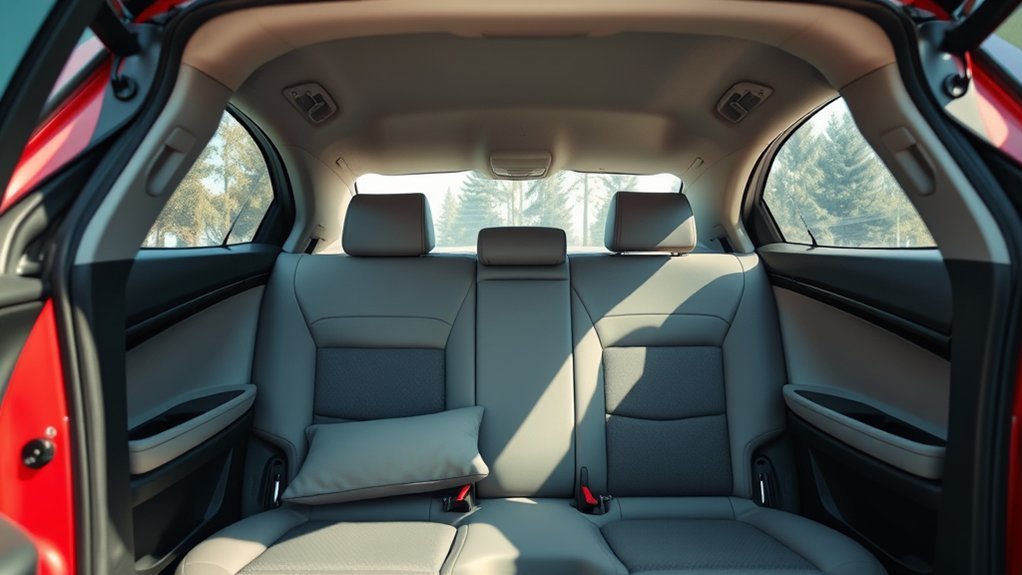
You can optimize rear comfort by adjusting front seatbacks slightly upright to free up the Camry’s 38 inches of rear legroom. Choose thin, high-density seat cushions or lumbar supports to add thigh and lower-back support without reducing available space. Use rear organizers to keep items accessible and prevent clutter that can impede passenger comfort.
Seat Positioning Tips
1 key adjustment you can make is setting the front seats slightly forward to restore the Camry’s 38 inches of rear legroom, then fine-tune rear seatback recline where available. You’ll gain clear space for knees and can use minor seat tilt to fine-tune thigh support without encroaching on legroom. Choose cushion types that add comfort while preserving clearance; prioritize low-profile lumbar supports and avoid bulky pads. Pack the trunk efficiently to prevent load-induced cabin intrusion. These steps give you control over personal space and mobility.
- Move front seats incrementally and verify rear clearance
- Adjust rear seatback recline for long-trip comfort
- Use low-profile lumbar cushions that maintain legroom
- Keep trunk load compact to protect cabin space
Cushion & Support Choices
Three practical cushion and support strategies will noticeably improve rear comfort in the Camry without compromising its 38 inches of legroom: Use lumbar cushions, adjust seating, and select quality seat covers. First, add dedicated lumbar support cushions made from memory foam or high-density foam; these support materials maintain spinal alignment on long drives and relieve lower-back fatigue, especially for taller passengers. Second, exploit available rear seat adjustments—recline where possible and fine-tune seat position—to distribute weight and reduce pressure points. Third, choose seat covers with integrated padding or gel inserts; premium cushion types combine breathability with resilience, preserving headroom and aesthetics. Implementing these targeted changes keeps the cabin open and mobile while maximizing ergonomic comfort and personal autonomy.
Test-Drive Checklist to Confirm Rear-Seat Fit and Clearance
When evaluating rear-seat fit during a test drive, focus on measurable clearances and real-world accessibility to verify the Camry meets your needs. You’ll confirm rear seat accessibility and passenger comfort by checking legroom (38 inches) and headroom (37.6 inches without a moonroof) against your body dimensions. Sit behind your regular driver position, then at full rear recline, noting knee clearance, shoulder space, and head clearance. Test entry and exit repeatedly to assess threshold height and door aperture.
- Measure knee-to-seatback gap with a relaxed posture to verify legroom for long trips.
- Sit with a taller passenger profile to validate 37.6-inch headroom in practice.
- Fold the 60/40-split rear seats to simulate cargo scenarios and ascertain seating remains usable.
- Evaluate perceived spaciousness relative to the 99.9 cu ft passenger volume while seated.
Be precise, document findings, and prioritize freedom of movement when judging fit and clearance.
Frequently Asked Questions
Are Toyota Camrys Good for Tall Guys?
Yes—you’ll find Camry comfort suits tall passengers: rear legroom and headroom are roomy, front seats offer ample adjustment, and the cabin layout supports taller bodies for commute or long drives without feeling constrained.
How Big Is the Backseat of a Toyota Camry?
The backseat dimensions give 38 inches legroom, 37.6 inches headroom (no moonroof), and 55.7 inches shoulder room; you’ll find passenger comfort solidly spacious, with 100.4 cu ft total volume and 60/40 split flexibility.
Which Has a Bigger Leg Room Camry or RAV4?
Ironically, you get more rear legroom in the Camry: Camry Comfort offers 38.0 inches versus RAV4 Space at 37.8 inches. You’ll appreciate that marginal freedom; the data’s technical, objective, and liberating.
Conclusion
You’ll find the Camry’s rear seat offers about 38 inches of legroom and headroom, a figure that matches or slightly exceeds many midsize rivals; that single stat—38 in.—helps quantify usable space. When test-driving, sit in the rear with your typical front-seat position to verify knee clearance and sightlines. Use seat-back pockets, slim front-seatbacks, and a booster-friendly cushion to maximize comfort. Confirm child-seat fit and footroom before you decide.