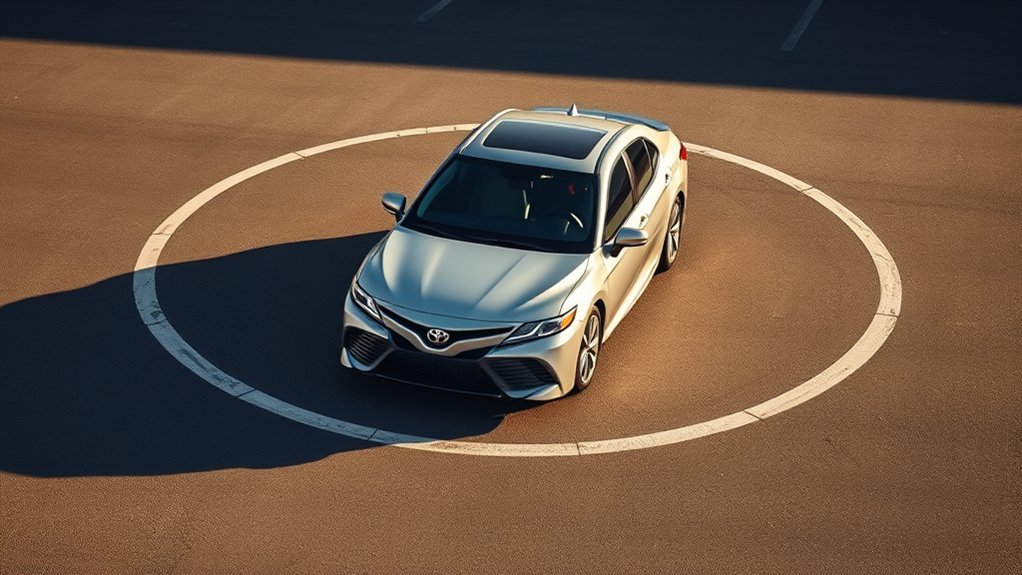
Your Camry’s turning radius is mostly fixed by wheelbase and steering geometry, so you won’t cure a big radius with simple tweaks. The 2018 models gained about 3 inches of wheelbase and a milder rack ratio, increasing U‑turn space versus older Camrys. Tire width, pressure, alignment and suspension wear give small gains; a quicker rack or chassis changes give real reductions. Keep expectations realistic—more details on measurements, checks and upgrade trade‑offs follow.
Quick Answer: Can You Tighten a 2018 Camry Turning Radius?
Curious whether you can tighten the 2018 Camry’s turning radius? You can pursue limited turning adjustments, but significant reduction is constrained by fixed design parameters: wheelbase, steering angle, and revised suspension geometry. Practically, you’ll find marginal gains from suspension tweaks or wider tires—these can sharpen handling and influence driver experiences, yet they won’t meaningfully shrink the 37.4–38 ft radius compared with the older 36.1 ft Camry. Achieving a substantially tighter circle requires major modifications—altering steering rack ratio, increasing wheel lock, or shortening wheelbase—which are complex, costly, and may compromise safety or legality. Community feedback reflects predictable frustration: many drivers still need to reverse to complete U-turns. If liberation means greater maneuverability without radical intervention, focus on optimizing alignment, tire selection, and suspension tuning to improve response and confidence rather than chasing an impractical reduction in raw turning radius.
2018 Camry Turning Radius by Trim (LE / SE / XLE / V6)
Different Camry trims yield measurable differences in turning radius because wheelbase, suspension tuning, and steering geometry vary across LE, SE, XLE, and V6 models. You’ll notice Camry trim differences clearly when you compare numbers: older 2002 LE models report about 5.3 m, tighter than a Corolla’s 5.4 m, while newer, wider models increase the circle you need to complete a U-turn. The 2018 SE’s 38 ft radius vs the 2011 SE’s 36.1 ft shows evolving packaging that reduces maneuverability. The 2018 LE at 37.4 ft further confirms that newer Camrys trend larger.
| Trim / Year | Turning Radius |
|---|---|
| 2002 LE | 5.3 m (~17.4 ft) |
| 2011 SE | 36.1 ft |
| 2018 SE | 38 ft |
| 2018 LE | 37.4 ft |
Use these turning radius comparisons to choose the Camry that aligns with your desire for freedom in urban maneuvering.
How Turning Radius Is Calculated (Wheelbase, Steering Angle, Tires)
You can predict turning radius from wheelbase, steering angle and tire width using R = (Wheelbase / sin(turn angle)) + (1/2 · Tire Width), so a longer wheelbase directly increases the radius. The maximum achievable front-wheel angle—set by steering geometry and components—often has a larger effect on maneuverability than small changes in tire width. Compare a 110 in wheelbase at 30° (≈18.7 ft) versus 40° (≈14.6 ft) to see how steering limits dominate practical turning performance.
Wheelbase Effects
Because wheelbase directly sets the distance the front wheels must pivot around relative to the rear axle, it’s the dominant geometric factor in a vehicle’s turning radius: longer wheelbases produce larger radii for a given steering angle. You should focus on wheelbase impact when evaluating turning dynamics; the basic formula Rturn = (Wheelbase / sin(turn angle)) + ½ Tire Width makes the relationship explicit. For a 110‑inch wheelbase, a 30° turn yields about 18.7 ft, while 40° shrinks that to ~14.6 ft, showing how sensitive radius is to angle but governed by wheelbase. Tire width alters radius only marginally, so you’ll prioritize wheelbase and achievable steering angle when optimizing maneuverability and pursuing greater freedom in vehicle control.
Steering Angle Limits
While wheelbase sets the base geometry, steering angle limits determine how tightly those wheels can redirect the vehicle, so they directly constrain the achievable turning radius; to compute Rturn you divide the wheelbase by the sine of the maximum front-wheel angle and add half the tire width, so higher allowable angles yield disproportionately smaller radii. You’ll evaluate steering limitations by measuring max front-wheel angle (often up to ~50° but limited by suspension/inner CV design). Use geometry and Ackermann corrections to plan angle adjustments that preserve tire contact and scrub control. Table for imagery:
| Parameter | Influence | Constraint |
|---|---|---|
| Wheelbase | Increases Rturn | Fixed by chassis |
| Max Angle | Reduces Rturn | CV/suspension limits |
| Ackermann | Aligns wheels | Design trade-offs |
Tire Width Contribution
Although tire width only adds a small geometric offset to the path, it still enters directly into the turning-radius calculation as half the tire width added to the wheelbase/sin(steering angle) term, so you should include it when converting axle-centerline geometry into swept-path clearances. Use R = (Wheelbase / sin(turn angle)) + 0.5·TireWidth; a longer wheelbase increases R, and higher steering angle reduces it (110 in at 30° ≈ 18.7 ft; at 40° ≈ 14.6 ft). Tire width’s contribution is minor numerically but matters for tire performance and handling dynamics during the maneuver: wider tires raise lateral grip and stability, enabling you to exploit steering limits. For liberated drivers, quantify tire width when modelling clearances and vehicle responsiveness.
Why the 2018 Camry’s Radius Increased Vs Older Models
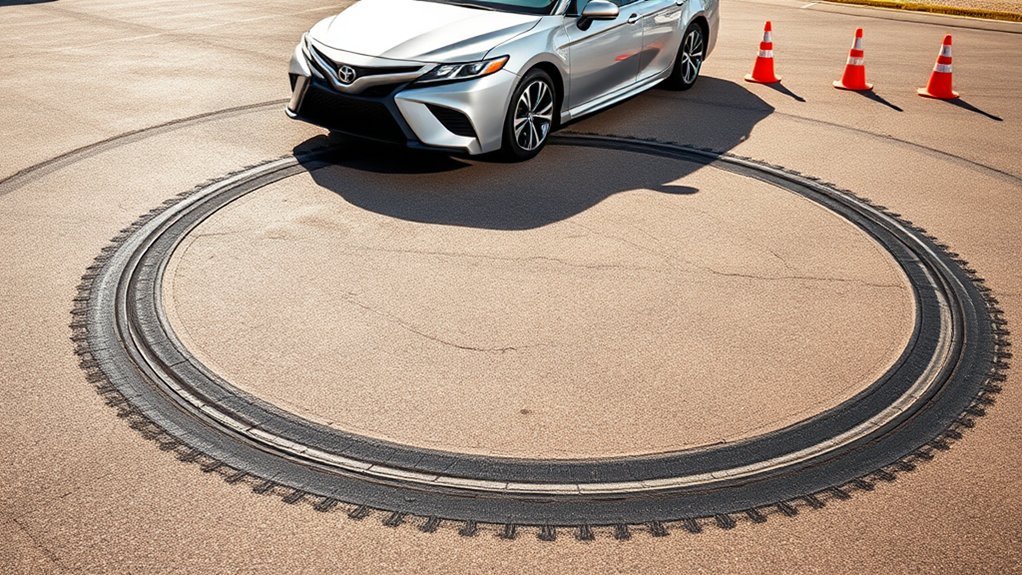
You’ll notice the 2018 Camry’s turning circle grows primarily because its wheelbase is longer and the body is wider, which geometrically increases the path radius for a given steering angle. Changes to the steering rack ratio and suspension geometry further limit front-wheel steering lock and alter Ackermann characteristics, reducing achievable yaw per wheel input. Together these dimensional and kinematic revisions explain why you’ll need more space to complete tight turns than in older Camry models.
Longer Wheelbase, Wider Body
Because Toyota stretched the Camry’s footprint for stability and interior space, the 2018 model’s longer wheelbase (about 3 inches longer) and slightly wider body directly increased its turning radius to roughly 37.4–38 feet versus the 2011’s 36.1 feet. You’ll see the wheelbase impact in basic geometry: a longer distance between axles raises the radius required to pivot without tire scrub. The wider body increases swept path and reduces allowable steering lock before contact or tire interference. Those dimensional shifts trade maneuverability for cabin freedom and high-speed composure; you gain room and stability but lose some urban agility. Combined with marginal tire or steering-rack variations, the net effect is a measurable, frustrating increase in U-turn and tight-turn effort.
Revised Steering Geometry
When you turn the wheel of the 2018 Camry, revised steering geometry and suspension kinematics change the wheel path and effective steering ratio, which raises the car’s minimum turning radius to about 37.4–38 ft versus the 2011’s 36.1 ft. You’ll notice steering sensitivity calibrated for stability rather than tight urban maneuvers; tie-rod angles and knuckle steering arm lengths reduce maximum wheel steer angle. Suspension compliance and track width adjustments shift scrub radius and roll center, altering handling feedback under load. The result is a deliberate trade-off: greater straight-line composure at the expense of nimble turns. Consider these technical points affecting your experience:
- Reduced maximum wheel angle due to revised steering arm geometry.
- Altered scrub radius from wider track and suspension mounts.
- Increased effective steering ratio for steadier highway feel.
- Dampened handling feedback from compliance and bushing choices.
How a Larger Turning Radius Affects U‑Turns, Parking, and Daily Driving
If you drive a Camry with a larger turning radius, expect tighter U‑turns to require more space and often a multi‑point maneuver rather than a single sweep. You’ll face U turn challenges: the 2002’s ~5.3 m and the 2018’s ~37.4 ft figures force you to plan reversing steps and curb clearance. For Parking strategies, select wider bays, angle entry, and use controlled e‑brake holds; adjust tire width where feasible. In Daily driving, anticipate reduced maneuverability in urban grids and tighter lanes. Apply Maneuverability tips: slow, precise steering techniques, staged wheel inputs, and proactive lane positioning. Space considerations become operational parameters you manage, not constraints you accept. The table below visualizes scenarios you might encounter.
| Scenario | Response |
|---|---|
| Tight U‑turn | Multi‑point, reverse assist |
| Narrow bay | Angle-in, e‑brake stabilize |
| Parallel park | More forward/backward moves |
| Urban lane | Early lane selection |
| Liberation goal | Optimize technique, reclaim space |
Quick Checks: Diagnose If Your Camry Actually Handles Worse
Having noted how a larger turning radius changes maneuvers, you should run a few quick checks to confirm whether your Camry’s handling has actually degraded. Start methodically: measure turning radius and note changes versus stock numbers (2002 LE ≈5.3 m, 2018 SE ≈11.6 m). Use targeted checks to isolate causes and pursue liberation from vague symptoms.
- Vibration diagnosis: drive 60–80 mph and observe steering wheel vibration; this points to unbalanced tires or worn rotors and guides further tire inspection.
- Tire inspection: check pressure, tread, and asymmetric wear; uneven wear often precedes pull and altered turning response.
- Alignment issues: perform a lane-test; persistent pull or uneven steering angle suggests misalignment affecting nominal radius and control.
- Suspension condition: inspect shocks, struts, and bushings for play or leakage; degraded components will reduce responsiveness and negate handling modifications or performance tweaks.
Follow these checks before committing to parts or upgrades.
Cheap Fixes That Often Help (Tires, Balance, Alignment, Shocks)
Although small and inexpensive, targeted fixes often restore a Camry’s steering feel and effective turning radius quickly: start with tire maintenance — proper pressure, tread inspection and rotation eliminate uneven grip that widens turns. Balance each tire (~$7 each) to remove 60–80 mph steering vibrations that mask true handling. If vibrations persist, pursue alignment adjustments; alignment restores intended toe/camber settings and directly improves maneuverability and turning predictability. Consider wider tires for measurable performance enhancements in cornering and tighter U-turns, but weigh trade-offs in roll resistance. For suspension checks, inspect shocks for leakage and damping loss; stiffer, serviceable shocks improve suspension control and reduce body roll during steering inputs. Replace worn ball joints, tie rods, and bushings as needed to reclaim steering precision. These are cost effective solutions and practical steering upgrades you can prioritize yourself or request at a shop. They deliver noticeable driving stability gains without committing to wholesale steering or suspension overhauls.
When to Consider Professional Upgrades (Rack, Steering, Suspension)
When persistent steering vagueness, excessive body roll, or a noticeably large turning radius remain after basic fixes, you should consider professional upgrades to the rack, steering, or suspension. You’ll want targeted interventions when regular maintenance and tire options haven’t yielded the liberation of confident, tight maneuvers. Upgrading steering racks can speed response; stiffer suspension components deliver suspension benefits by cutting roll and sharpening turning behavior. But you’ll need alignment importance emphasized before and after any change to lock in handling improvements.
- Evaluate current wear: worn tie rods or bushings mask gains from upgrading steering; inspect and replace first.
- Rack upgrade scope: choose a rack with quicker ratio only after confirming alignment specs and compatibility.
- Suspension benefits vs. trade-offs: stiffer springs and dampers reduce roll but alter ride—confirm goals.
- Tire options and alignment importance: fit wider tires for grip, then perform professional alignment to prevent pull and maximize handling improvements.
Seek professional advice for parts selection and setup.
Realistic Trade‑Offs and What to Expect After Each Change
Because every modification shifts one set of compromises for another, you should expect measurable but bounded gains in turning behavior rather than dramatic reversals of a Camry’s inherent geometry. You’ll see that a widening of tires and firmer shocks delivers quantifiable handling improvements in tight maneuvers, shaving degrees off steering effort and tightening the effective turning feel, but you’ll trade ride comfort and increase road feedback. Lowering the car enhances cornering by reducing center of gravity and roll, yet you’ll restrict suspension travel and risk harsher impacts over urban surfaces. Increasing wheelbase or choosing a generation with greater stability inherently enlarges radius—so you’ll gain high‑speed composure at the expense of U‑turn agility. Use this trade offs summary to prioritize: choose modest tire and damper upgrades for liberated control without extreme sacrifice, or accept the permanence of geometry changes only if you’re prepared for reduced daily comfort and occasional maneuverability limits.
Frequently Asked Questions
What Is the Turning Radius of a Toyota Camry?
It depends: typical Camry turning radius ranges about 5.3–11.6 meters, so you’ll assess steering mechanics and vehicle maneuverability to choose models that free you from tight-turn limits and maximize confident urban mobility.
What Is Considered a Good Turning Radius?
Coincidentally, you’ll find a good turning radius is about 36–38 feet; you’ll handle tight maneuvers and urban driving confidently, because that range balances maneuverability, wheelbase, and vehicle dimensions for liberated, precise control.
What Is the Turning Radius of the All New Camry?
The all‑new Camry’s turning radius is about 37.4–38 feet; you’ll assess Camry maneuverability and steering dynamics as slightly reduced versus older models, so you’ll plan tighter maneuvers or accept occasional multi‑point turns.
What Determines a Car’s Turning Radius?
The turning radius is determined mainly by wheelbase influence and steering dynamics: you’ll find longer wheelbases increase radius, limited steering angle and suspension geometry constrain tightness, while tires and design packaging play secondary, technical roles.
Conclusion
You can tighten a 2018 Camry’s turning feel, but expect trade‑offs: small tweaks like tires or alignment give the biggest bang, while rack or suspension changes cost more and alter ride. I once swapped to grippier tires and cut a parking turn by about 0.5 m—like fitting stiffer springs to a tape measure, the scale changes but the tape’s length doesn’t. Weigh handling gains against comfort, cost, and alignment complexity.