2026 Toyota Camry Wheelbase: 111.2 Inches
Last updated: September 16, 2026. Specifications and fitment guidance were rechecked against current U.S.-market Toyota information.
Editorial basis: This guide uses published Toyota specifications, current vehicle-spec data, and a repeatable hub-center measurement method. It does not claim a hands-on measurement of a specific 2026 Camry.
For a U.S.-market 2026 Toyota Camry, the factory wheelbase is 111.2 inches, or about 2,824 mm by direct unit conversion. Wheelbase is the distance between the front and rear axle centerlines. The published figure applies across the current LE, SE, Nightshade, XLE, and XSE lineup.
Quick Answer
The U.S.-market 2026 Toyota Camry has a 111.2-inch wheelbase. Use Toyota’s published specifications to confirm the factory figure. To verify your own car, measure from the center of the front hub to the center of the rear hub on the same side while the car is parked on level ground with the front wheels straight.
Key Takeaways
- The U.S.-market 2026 Toyota Camry wheelbase is 111.2 inches.
- The published wheelbase is the same across LE, SE, Nightshade, XLE, and XSE.
- Wheelbase means the front-axle-center to rear-axle-center distance, not bumper-to-bumper length.
- Use the Camry’s 193.5-inch overall length, not its wheelbase, when checking garage or parking-space depth.
- Use the VIN and exact Toyota part fitment rather than wheelbase when ordering replacement components.
At a Glance
| Factory Wheelbase | 111.2 in. / about 2,824 mm |
| Verification Time | About 5–10 minutes |
| Difficulty | Easy |
| Tools Needed | Tape measure, masking tape or chalk, flat surface, helper recommended |
| Best Official Check | Toyota vehicle specifications |
2026 Camry Wheelbase Specs at a Glance
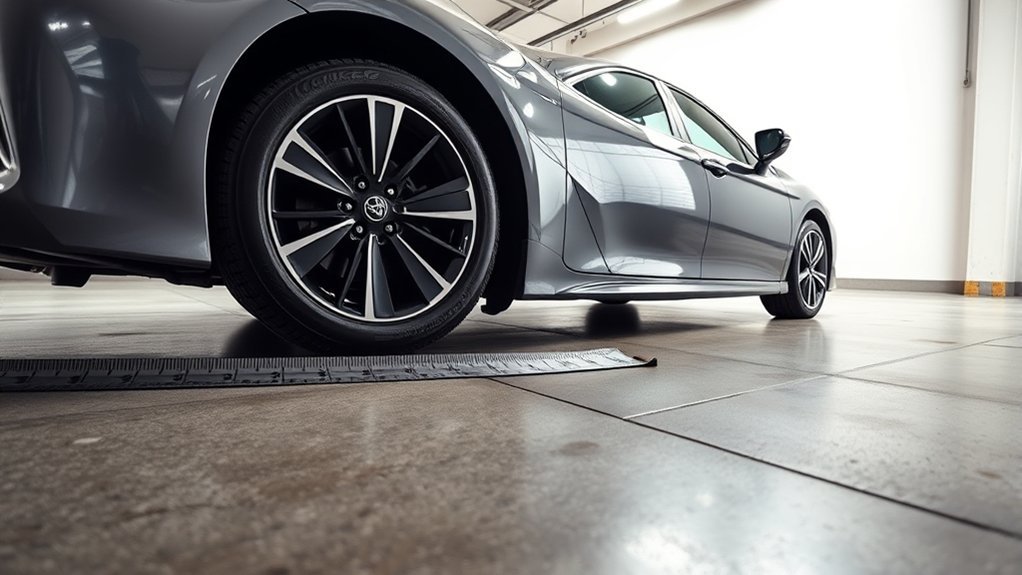
The 2026 Toyota Camry specifications from Toyota list a 111.2-inch wheelbase. Current U.S. Camry information also identifies five trims—LE, SE, Nightshade, XLE, and XSE—with front-wheel drive and available Electronic On-Demand All-Wheel Drive.
| 2026 Camry Item | Published U.S. Specification | Best Use |
|---|---|---|
| Wheelbase | 111.2 in. | Axle spacing and chassis geometry |
| Overall length | 193.5 in. | Garage and parking depth |
| Overall width | 72.4 in. | Body-width and side-clearance checks |
| Overall height | 56.9 in. | Vertical-clearance comparison |
| Current U.S. trims | LE, SE, Nightshade, XLE, XSE | Model identification |
One useful distinction is the difference between wheelbase and total vehicle length. Subtracting the 111.2-inch wheelbase from the 193.5-inch overall length leaves 82.3 inches. That 82.3 inches represents the combined body length ahead of the front axle and behind the rear axle; it is not the length of either individual overhang.
Important: Use wheelbase for axle-to-axle geometry, overall length for garage or parking fit, and VIN/OEM catalog data for replacement-part fitment. These measurements are not interchangeable.
What Does Wheelbase Mean on a Toyota Camry?
The wheelbase is the straight-line distance between the centerline of the front axle and the centerline of the rear axle. On a passenger car such as the 2026 Camry, you can approximate that measurement by using the center of the front wheel hub and the center of the rear wheel hub on the same side.
Wheelbase is one part of a vehicle’s geometry. It helps establish the relationship between the axles, passenger compartment, suspension mounting areas, and body overhangs. It should not be treated as a stand-alone measure of ride quality or handling because suspension geometry, tires, track width, damping, steering calibration, mass, and weight distribution also affect how a car behaves.
Wheelbase Defined
Wheelbase is not the same as overall length. The Camry’s body extends beyond both axle centerlines, so its 193.5-inch overall length is much greater than its 111.2-inch wheelbase.
If you need broader exterior measurements, garage-fit information, ground-clearance context, or trim-by-trim dimensional detail, see the site’s 2026 Camry dimensions guide. Keeping those broader measurements on the dimensions page lets this guide stay focused on wheelbase and how to verify it.
What Does Wheelbase Affect?
Wheelbase is a chassis dimension rather than a universal parts-fitment code. It contributes to how engineers package the passenger compartment, suspension locations, underbody systems, and front and rear body overhangs.
- Axle spacing: It defines the front-to-rear distance between the vehicle’s axle centerlines.
- Cabin packaging: Axle placement is one factor engineers work around when laying out passenger space.
- Vehicle proportions: Wheelbase can be compared with overall length to understand how much body extends beyond the axles.
- Chassis verification: It provides a reference dimension when checking a repaired, modified, or uncertain vehicle.
- Parts fitment: It does not replace VIN, drivetrain, trim, production data, or the exact Toyota part number.
Where Can You Find the 2026 Camry Wheelbase Spec?
The most direct source is Toyota’s published vehicle specification data. A reputable current specification database can provide a useful cross-check, while a physical measurement can verify the car in front of you.
The driver-side door-jamb labels are useful for identifying the vehicle, but wheelbase is not one of the standard items required on the U.S. federal certification label. Federal certification-label requirements include information such as the manufacturer, manufacture date, GVWR, GAWR, compliance statement, VIN, and vehicle classification.
Note: Toyota’s official parts site identifies the top of the dash and driver-side door jamb as VIN locations. That VIN is useful for identifying the exact vehicle and confirming replacement-part fitment, but the VIN label should not be treated as your primary wheelbase source.
What Should You Check on the Driver-Side Door Jamb?
Open the driver door and inspect the certification and tire/loading labels. These labels help identify the exact vehicle and its weight or tire-related information. They are not a substitute for Toyota’s dimensional specification page.
- Open the driver door fully.
- Locate the certification and tire/loading labels.
- Confirm the VIN matches the VIN visible through the lower driver-side windshield area.
- Use the VIN when a Toyota dealer, Toyota parts catalog, insurer, or repair facility needs exact vehicle identification.
- Use Toyota’s published specifications when your question is specifically about factory wheelbase.
What Is the Best Source for the Wheelbase Number?
Use the following order depending on what you are trying to confirm:
| Source | Best Use | How to Treat It |
|---|---|---|
| Toyota official specifications | Factory wheelbase | Primary source |
| Current reputable spec database | Cross-check trim data | Secondary confirmation |
| VIN-based Toyota parts lookup | Vehicle and parts identification | Use for fitment, not wheelbase measurement |
| Manual tape measurement | Verify the physical vehicle | Approximate unless measured with professional equipment |
| Door-jamb labels | VIN, weight and tire-related vehicle information | Do not rely on them for wheelbase |
How Do You Measure a Camry Wheelbase With a Tape Measure?
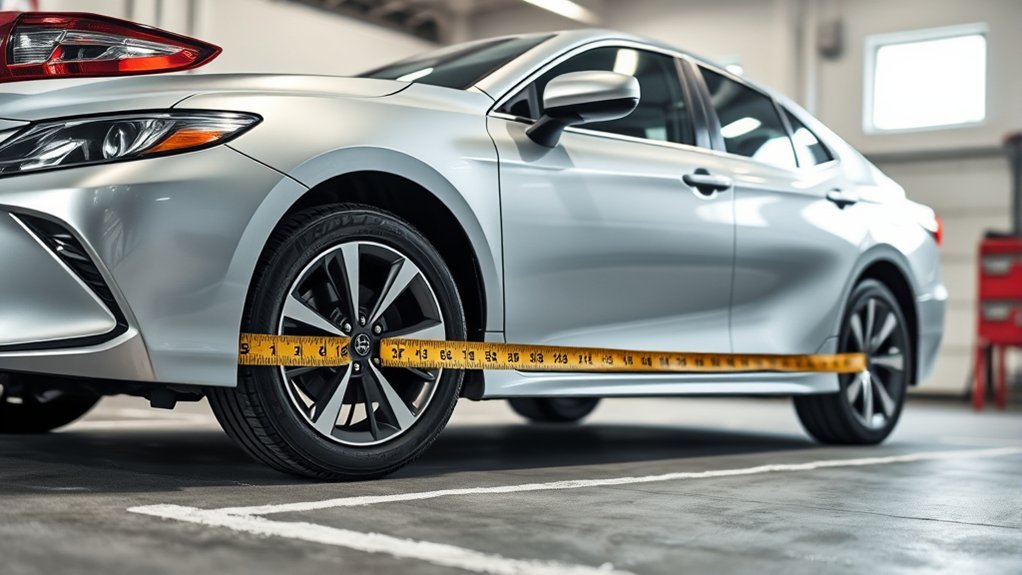
You can verify the Camry’s wheelbase at home with a tape measure, masking tape or chalk, and a flat surface. The goal is to measure the longitudinal distance between the front and rear hub centers on the same side of the vehicle.
- Park on level ground. Use a flat driveway, garage floor, or shop floor and secure the vehicle in Park with the parking brake applied.
- Straighten the front wheels. Center the steering so the front wheels point straight ahead.
- Locate the front hub center. Use the center cap or geometric center of the front wheel as your axle-center reference.
- Locate the rear hub center. Identify the corresponding center point on the rear wheel on the same side.
- Transfer the points if needed. If the body makes a direct tape measurement awkward, mark the ground directly beside or below each hub-center reference with masking tape or chalk.
- Measure center to center. Keep the tape straight and parallel with the side of the vehicle rather than measuring diagonally.
- Repeat the measurement. Measure again before recording the result.
- Check the opposite side. A second-side measurement can expose an angled tape or misplaced reference point.
- Compare with the factory specification. Your home measurement should be close to the published 111.2-inch figure, allowing for normal tape-measure and marking error.
Pro Tip: The ground-mark method is often easier than trying to stretch a tape directly between two wheel centers. Mark both hub-center reference points on the floor, then measure between the marks.
[Products Worth Considering]

This genuine Toyota fuel tank cap assembly is designed for a direct fit and dependable replacement on compatible vehicles. As an OEM factory original part, it helps maintain proper fuel system sealing and supports reliable everyday driving. Built to Toyota quality standards, it offers trusted fitment and long-lasting performance.
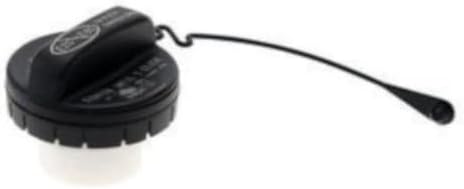
This genuine Toyota fuel tank cap assembly is designed for vehicle-specific fitment and reliable performance. As an OEM part, it delivers Toyota quality assurance and backed manufacturer warranty support, making it a dependable replacement choice for maintaining proper fuel system sealing and function.

This dual dash cam captures detailed road footage with front and rear recording for added driving security. Built-in WiFi and app control make it easy to review, download, and manage videos from your phone, while the IPS screen provides clear on-device viewing. With loop recording, G-sensor protection, parking mode, and WDR support, it is designed to help document incidents day or night.
Why Might Your Camry Wheelbase Measurement Be Wrong?
An unexpected home measurement usually means the setup or reference points should be checked again before you assume the car has structural or suspension damage.
| Problem | Why It Changes the Reading | Fix |
|---|---|---|
| Car parked on a slope | Makes it harder to transfer and compare reference points consistently | Move to level ground |
| Front wheels turned | Makes the visible front-wheel reference harder to align longitudinally | Straighten the steering |
| Tape held diagonally | A diagonal line is longer than the true front-to-rear distance | Keep the tape parallel with the vehicle |
| Measuring tire edges | Tire sidewalls do not define the axle centerlines | Use hub centers |
| Loose or sagging tape | Adds measurement error | Keep the tape straight and taut |
| Ground marks not transferred consistently | Moves one or both reference points | Re-mark both centers and repeat |
A home tape measurement is a verification method, not a substitute for a frame machine or professional alignment measurement. If repeated measurements remain meaningfully different from the published specification or differ noticeably from side to side, have the vehicle inspected by a qualified alignment or collision-repair facility before drawing conclusions.
How Does the Camry Wheelbase Relate to Chassis Packaging?
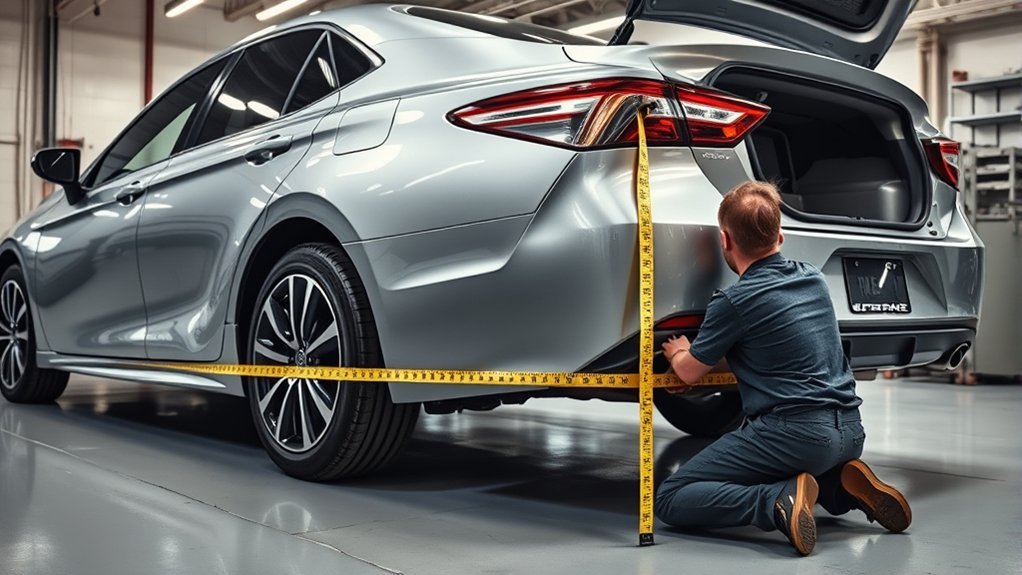
Wheelbase is one of many dimensions engineers work around when locating suspension components, passenger space, exhaust routing, shields, hybrid-system hardware, and fuel-system components. It describes the relationship between the axles, but it does not identify the exact component installed on a particular car.
That distinction matters because different vehicle configurations can share the same wheelbase while using different hardware elsewhere. A wheelbase measurement can therefore verify a chassis dimension without proving that a fuel pump, tank component, suspension part, shield, hose, or electrical component is compatible.
Use wheelbase for axle geometry, overall length for garage fit, and VIN/OEM catalog data for replacement-part fitment.
Does Wheelbase Determine Fuel-Tank or Fuel-Pump Fit?
No. Wheelbase can influence the space available for underbody packaging during vehicle design, but it does not determine whether a replacement fuel-system component fits a 2026 Camry.
A replacement component may need to match the tank design, electrical connector, mounting arrangement, sender configuration, seals, pressure requirements, drivetrain, production application, and exact Toyota part number. Two cars can therefore share a 111.2-inch wheelbase without every underbody or fuel-system component being interchangeable.
For ordinary repair work, treat the wheelbase as a chassis specification rather than a parts-catalog key.
[Products Worth Considering]

This custom cargo mat and seat-back liner is designed specifically for the 2026 Toyota RAV4 Hybrid, helping protect the trunk and rear seat area from dirt, scratches, spills, and everyday wear. The full-coverage design shields felt surfaces while the non-slip TPE construction helps keep cargo in place, and the easy-clean surface makes maintenance simple after outdoor trips, pet transport, or messy hauls. Double fixation with hook-and-loop fasteners and elastic ropes helps keep the liner securely positioned.

These custom-fit floor mats and door sill protectors are designed specifically for Toyota RAV4 2026 Hybrid models to help keep the interior cleaner and better protected. Made with all-weather TPE material and molded using vehicle-specific measurements, they provide coverage for dirt, mud, snow, and everyday wear while helping maintain a tidy factory look. Easy to install, remove, and clean, this set adds practical protection for daily driving and frequent passenger entry.

This mud flaps kit helps protect your Toyota Camry’s lower body panels from snow, salt, sand, rocks, and road debris thrown up by the wheels. Designed for SE and XSE Sport models, it offers a direct-fit install with included mounting hardware for a cleaner, more finished look. Built from durable ABS thermoplastic, it is made to handle harsh driving conditions while helping keep your vehicle cleaner.
What Should You Use When Ordering a Camry Fuel-System Part?
If you need a fuel pump, tank seal, sender, hose, valve, or another fuel-system component, give the supplier the exact vehicle information instead of shopping by wheelbase.
- VIN: Use the full 17-character vehicle identification number.
- Year, make, and model: Confirm that the vehicle is a 2026 Toyota Camry.
- Trim: LE, SE, Nightshade, XLE, or XSE.
- Drivetrain: Confirm FWD or Electronic On-Demand AWD.
- Exact component: Specify whether you need a complete assembly, seal, sender, hose, valve, or another part.
- OEM part number: Cross-check the Toyota number when available.
- Previous modifications or repairs: Tell the supplier about non-factory fuel-system, wiring, collision, or tank work that could change fitment.
Note: Toyota’s official parts site allows vehicle and VIN-based lookup. That is more appropriate for parts compatibility than matching a component to the car’s 111.2-inch wheelbase.
[Products Worth Considering]
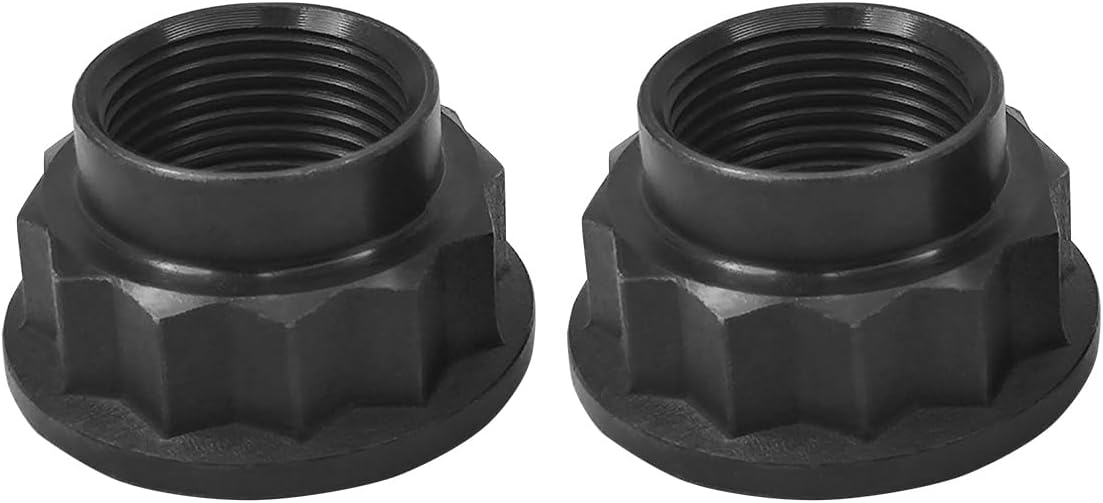
This pair of front axle shaft nuts is designed to secure CV joints and wheel bearings on compatible Toyota and Lexus front drive axles. Built from heat-treated carbon steel for durability and corrosion resistance, it helps maintain proper torque and reliable power transfer. It is a direct replacement for several factory part numbers and is recommended for paired replacement.

This front left door lock actuator assembly is a direct replacement for select Toyota and Lexus models, helping restore reliable power door locking and latch operation. Built as an OEM-quality aftermarket part, it includes the latch assembly and is factory tested for dependable performance. It is designed for driver-side front door fitment across a wide range of compatible vehicles and comes with replacement support for added peace of mind.
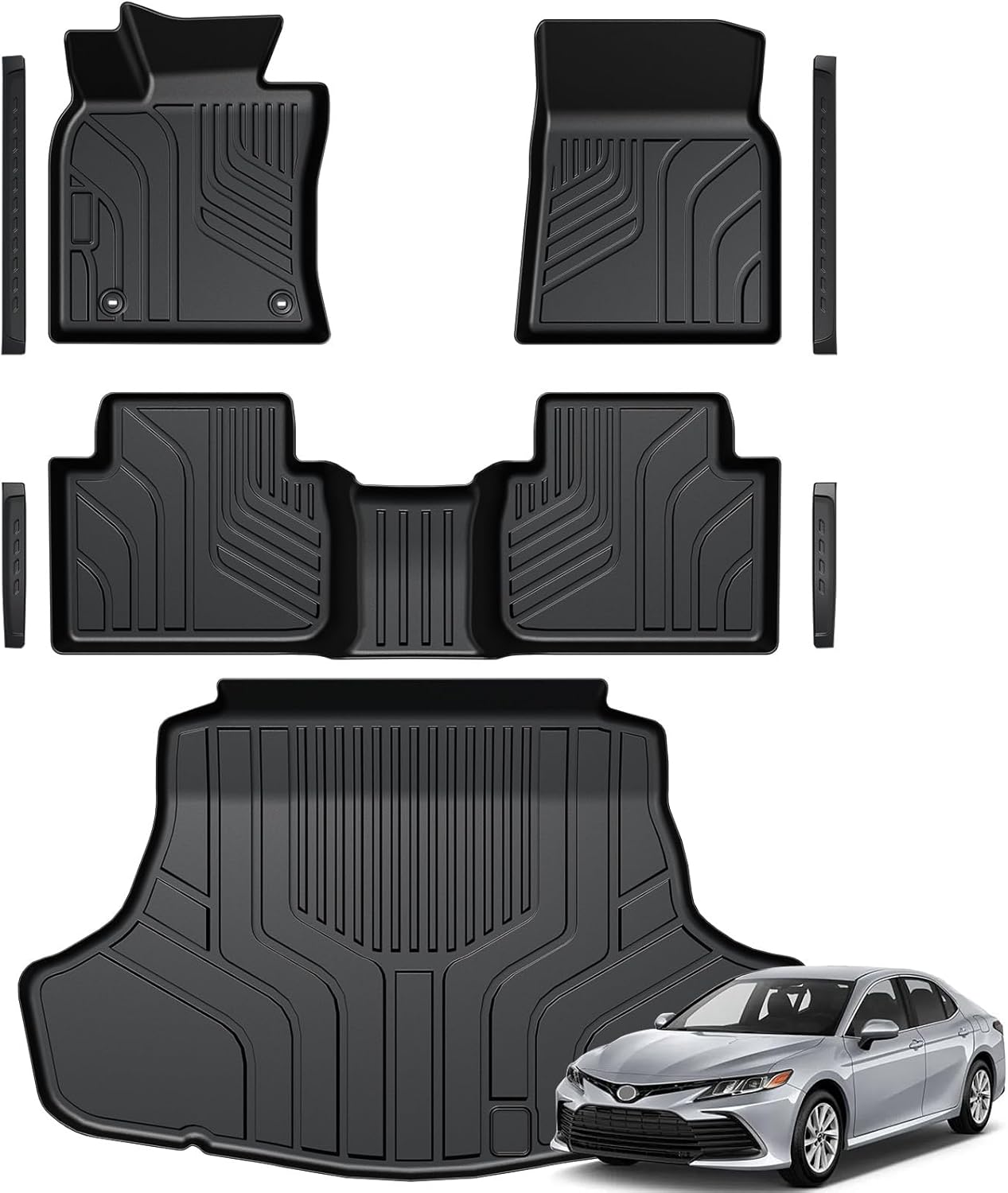
Custom-fit floor mats and accessories designed for 2018-2024 Toyota Camry gas FWD models provide full-coverage protection for the cabin, trunk, and door sills. Built with all-weather materials and raised edges, they help block dirt, spills, and debris while staying securely in place for everyday driving. The set is easy to install, simple to clean, and made to keep your vehicle looking neat and protected.
When Should You Measure the Camry Wheelbase Yourself?
Most owners never need to measure wheelbase during normal maintenance. A physical check becomes useful when the dimension itself matters.
- You are verifying that the physical car matches the published specification.
- You are inspecting a used Camry with known or suspected collision repairs.
- The vehicle has had subframe, suspension, or structural repair.
- You need an axle-to-axle reference for custom fabrication or transport planning.
- You are comparing left- and right-side axle placement after repair work.
- You are documenting vehicle dimensions for a project where factory specifications alone are not enough.
If you are simply checking whether the Camry fits inside a garage or parking bay, measure the vehicle’s overall length and available space instead. Wheelbase omits the body ahead of the front axle and behind the rear axle.
Is Camry Wheelbase the Same as Length, Width, or Track?
No. These dimensions describe different parts of the vehicle. Using the wrong one can produce a bad garage-fit, parking, transport, or chassis calculation.
| Measurement | What It Means | Use It For |
|---|---|---|
| Wheelbase | Front axle center to rear axle center | Axle spacing and chassis geometry |
| Overall length | Full front-to-rear body length | Garage and parking depth |
| Overall width | Side-to-side body width under the stated measurement convention | Body and side-clearance planning |
| Track width | Left-to-right wheel-center spacing on one axle | Stance and chassis geometry |
| Ground clearance | Published clearance between the ground and the relevant low point | Driveway and road-clearance checks |
| VIN / OEM part number | Vehicle identity and component application | Replacement-part fitment |
For the U.S.-market 2026 Camry, the 111.2-inch wheelbase is about 57.5% of the published 193.5-inch overall length. The remaining 82.3 inches are the combined front and rear portions of the body beyond the axle-to-axle wheelbase.
Frequently Asked Questions
Are all 2026 Toyota Camrys the same wheelbase?
For the U.S. market, published 2026 Camry specifications list a 111.2-inch wheelbase across LE, SE, Nightshade, XLE, and XSE. Check market-specific specifications if the vehicle was originally sold outside the United States.
Does AWD change the 2026 Camry wheelbase?
No. Current U.S. specification data lists the 2026 Camry wheelbase at 111.2 inches for both front-wheel-drive and Electronic On-Demand AWD configurations.
Is wheelbase the same as overall length?
No. Wheelbase is the distance between the front and rear axle centers. Overall length measures the full vehicle from front to rear. The U.S.-market 2026 Camry is listed at 111.2 inches of wheelbase and 193.5 inches of overall length.
Can I find the Camry wheelbase on the door sticker?
Do not rely on the door-jamb certification label for wheelbase. It is useful for vehicle identification, VIN, weight-rating, and tire-related information. Use Toyota’s published specifications for the factory wheelbase.
How do I measure the wheelbase on a Toyota Camry?
Park on level ground with the front wheels straight. Identify the front and rear hub centers on the same side, transfer those reference points to the ground if needed, and measure straight between them. Repeat the measurement before comparing it with the 111.2-inch factory figure.
Do I need the wheelbase to order a Camry fuel pump?
No. Use the VIN, model year, trim, drivetrain, exact component description, and correct Toyota part number or verified cross-reference. Wheelbase does not establish fuel-pump compatibility.
Why would my measured wheelbase differ from 111.2 inches?
Common causes include using tire edges instead of hub centers, measuring diagonally, using an uneven surface, leaving the front wheels turned, or transferring the reference points inaccurately. Recheck the setup and both sides before treating a difference as evidence of damage.
Conclusion
The U.S.-market 2026 Toyota Camry has a 111.2-inch wheelbase. Measure from front hub center to rear hub center on the same side if you need to verify the physical car. Use the 193.5-inch overall length for garage or parking-depth calculations, and use the VIN plus Toyota’s fitment data when ordering replacement parts.
The simplest rule is: wheelbase for axle geometry, overall length for vehicle footprint, VIN and OEM data for parts fitment.
Sources
- Toyota 2026 Camry Specifications — primary reference for the 111.2-inch factory wheelbase.
- Toyota 2026 Camry Overview — confirms the current U.S. trim lineup, hybrid powertrain, and available Electronic On-Demand AWD.
- Toyota Genuine Parts Official Online Store — supports VIN and vehicle-based parts lookup and lists common VIN locations.
- NHTSA: Federal Certification Label Requirements — identifies required certification-label information such as VIN, GVWR, and GAWR.
- Kelley Blue Book: 2026 Toyota Camry Specifications — current cross-check for trim-level dimensions and wheelbase.