You should pick Full‑Range Dynamic Radar Cruise for urban stop‑and‑go control, standard Dynamic Radar Cruise for steady highway following, and basic cruise when you want simple constant speed. FR‑DCC handles 0 mph jams and reduces driver inputs in dense traffic, while DCC maintains safe gaps at higher speeds but struggles below about 19–25 mph with sluggish reacceleration. Controls can be awkward and drivers often disable it in heavy stop‑and‑go; keep going to see detailed trim and safety tradeoffs.
Quick Verdict: Which Radar Cruise Should You Choose for RAV4?
Which radar cruise should you pick depends on where you drive most: choose Full Range Dynamic Radar Cruise Control (FR‑DCC) if you regularly face stop‑and‑go urban traffic, and standard Dynamic Radar Cruise Control (DCC) or even basic cruise if your routes are primarily steady‑speed highways. If you want operational freedom in dense corridors, FR‑DCC’s 0 mph capability and stop‑and‑go handling give you adaptive features that reduce clutching the pedals in traffic. For long, consistent-speed commutes, DCC maintains safe following gaps without the complexity of full-range control; basic cruise is simplest where traffic’s predictable. Be aware Toyota’s DCC shows inconsistent performance across RAV4 variants and can struggle to resume acceleration after stops, so compare responsiveness against competitors before committing. You’ll favor FR‑DCC when urban driving dominates and you need liberation from constant inputs; choose DCC or basic cruise when you prioritize steady-speed stability and minimal intervention on open roads.
What Radar Cruise vs Standard Cruise Actually Do
Think of radar cruise as a smart manager for your speed while standard cruise is a steady metronome: Dynamic Radar Cruise Control (DRCC) uses radar and camera inputs to automatically adjust speed and maintain a set following distance from the vehicle ahead, whereas standard cruise holds a constant speed and leaves all spacing and braking decisions to you. You’ll notice radar advantages in traffic: DRCC responds to slower vehicles, reduces the need for manual braking, and—when equipped as Full Range—covers stop-and-go scenarios down to 0 mph. Standard cruise control, by contrast, enforces a fixed velocity and requires you to intervene when conditions change. Both systems have trade-offs: DRCC can struggle maintaining speed downhill without a preceding vehicle, while standard cruise’s rigidity creates clear cruise limitations in variable flow. For drivers seeking liberation from micromanagement, DRCC offloads routine speed control; if you prefer deterministic, unassisted behavior, standard cruise keeps control squarely in your hands.
Which RAV4 Trims Have Radar Cruise or Standard Cruise
Curious how cruise control is distributed across the 2025 RAV4 lineup? You’ll find that DRCC (Dynamic Radar Cruise Control) is standard on every RAV4 trim, including the base LE, as part of Toyota Safety Sense 2.5. That means no trim relies on legacy, non-adaptive cruise control—RAV4 trims uniformly adopt an active, adaptive approach.
Comparatively, Full Range Dynamic Radar Cruise Control (FR‑DCC), which functions down to 0 mph, is reserved for the XSE and Hybrid Limited trims. So if you want a stop‑and‑go capable system for liberated, low‑speed traffic scenarios, those two trims provide expanded capability. Otherwise, the standard DRCC across all trims adjusts speed relative to the vehicle ahead, reducing fatigue and enhancing safety in highway and congested driving. In short: every 2025 RAV4 includes advanced radar‑based cruise control; FR‑DCC is the differentiator for XSE and Hybrid Limited.
How Radar Cruise Works: Sensors, Speed Ranges, Limits
Now that you know which RAV4 trims include DRCC or FR‑DCC, here’s how those systems actually operate: Dynamic Radar Cruise Control pairs a forward‑facing radar sensor with a camera to hold a set speed while automatically matching the speed of the vehicle ahead, functioning reliably above about 25 mph but losing effectiveness below roughly 19–25 mph and on unassisted downhill grades; Full Range DRCC adds 0‑mph capability so it can follow in stop‑and‑go traffic and bring the car to a complete stop. You’ll see that sensor functionality combines radar range sensing and visual classification to detect vehicles and calculate safe following distances. Compared to standard cruise, which fixes throttle to a set point, DRCC continuously performs speed adjustment based on relative velocity and gap settings, reducing collision risk. Limitations include reduced performance at low speeds, downhill scenarios without a lead vehicle, and potential camera occlusion. You remain responsible for oversight; alerts prompt you to retake control when automation reaches operational limits.
Radar Cruise in Traffic: Highway, Stop‑and‑Go, Jam Performance
Although radar cruise systems handle steady highway speeds reliably, their behavior differs markedly in dense traffic: you’ll find Dynamic Radar Cruise Control (DCC) effective above 25 mph but limited in stop‑and‑go conditions, particularly on SE models where traffic responsiveness degrades. Full Range DCC improves jam performance by operating from 0 mph and holding stops, giving you smoother integration in queues. Compared to Ford and Tesla, Toyota’s DCC shows weaker responsiveness to slow-moving vehicles and reported lapses in acceleration consistency after stops, which can feel jerky and reduce confidence during prolonged congestion. You’ll also note potential edge cases where DCC stops don’t trigger brake lights, introducing a safety gap in close traffic. If you prioritize liberation from driving tedium, FR‑DCC is the better option: it minimizes manual intervention in jams and offers a more continuous control envelope. Still, you should remain ready to assume control when sensors or control logic can’t match human anticipation.
Braking & Acceleration: Regen, Engine Braking, and Brake Lights
When you’re relying on DCC or FR‑DCC, braking and acceleration combine engine braking, regen (on hybrids), and automated braking logic to control speed and gaps, but their effectiveness varies by system and scenario. You’ll find FR‑DCC more consistent in stop‑and‑go: it tracks to a complete stop and resumes better, improving braking efficiency and reducing driver load. DCC can stop the vehicle but sometimes hesitates to reaccelerate from standstill, degrading perceived engine performance and causing frustration in traffic.
Hybrids leverage regenerative benefits to recapture energy during deceleration, enhancing overall efficiency and smoothing torque delivery when cruise systems modulate speed. Engine braking supplements downhill control when no lead vehicle exists, yet it can’t substitute for adaptive gap control. Note safety concerns: reported instances where DCC doesn’t trigger brake lights in certain stop scenarios may confuse following drivers. You should weigh braking efficiency, regenerative benefits, engine performance, and these safety concerns when choosing between systems.
Safety Systems That Work With Radar Cruise (TSS, LTA, PCS, RSA)
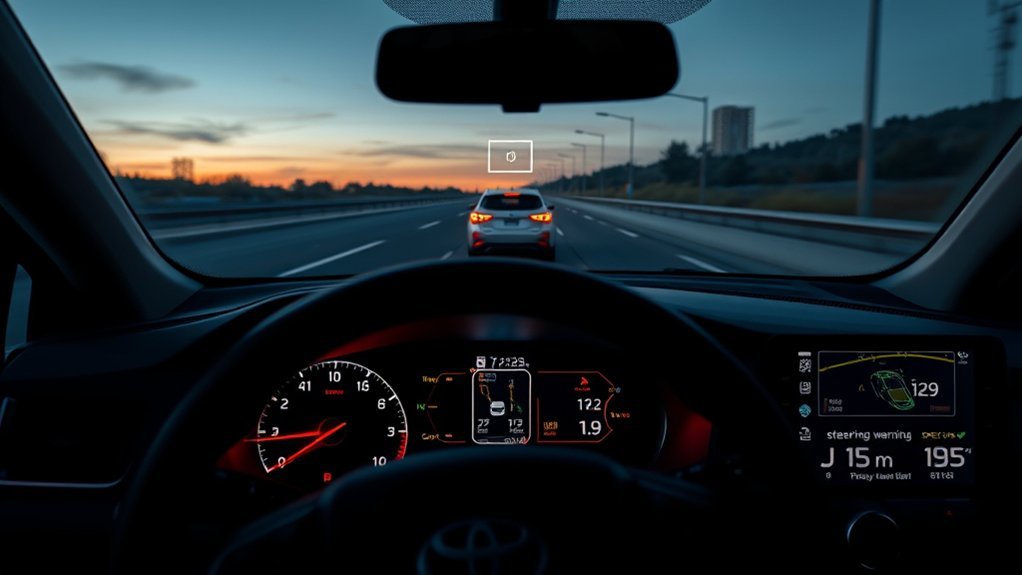
Because Dynamic Radar Cruise Control (DRCC) integrates with Toyota Safety Sense (TSS) components, you get a coordinated suite of systems—Lane Tracing Assist (LTA), Pre‑Collision System with Pedestrian Detection (PCS w/PD), Road Sign Assist (RSA), and Proactive Driving Assist (PDA)—that share sensor data and decision logic to improve adaptive cruise performance and safety. You’ll notice TSS features streamline inputs: radar and camera feeds inform longitudinal control and lateral guidance, reducing conflicting commands. LTA benefits appear as centered lane following when markings are clear, lowering sustained steering effort compared with standard cruise. PCS functionality supplements DRCC by detecting obstacles and initiating automatic braking if you don’t react, tightening safety margins in sudden scenarios. RSA importance lies in presenting speed limits and signs to the driver, helping you maintain compliant set speeds while cruise is active. PDA role is subtle but significant: it provides light steering and braking adjustments to preserve safe gaps in variable traffic, enhancing the adaptive logic beyond simple distance-based cruise control.
Common Owner Complaints and Real Limitations
You’ll notice three recurring limitations when comparing RAV4 cruise systems: slow stop-and-go acceleration, inconsistent low-speed detection, and a control interface that many owners find unintuitive. These issues translate into delayed acceleration from stops, unreliable responses below about 19 mph, and extra driver input or confusion in urban driving. Evaluating these shortcomings side-by-side helps determine whether adaptive cruise meets your everyday traffic needs.
Slow Stop-And-Go Acceleration
Although DCC will bring a RAV4 to a full stop in traffic, its low-speed behavior often feels sluggish: the system struggles to maintain and promptly resume speeds below about 19 mph, causing noticeable lag in stop-and-go scenarios compared with more responsive systems from some competitors. You’ll notice degraded stop and go performance and a user experience that can feel constrained; acceleration after stops is often delayed, prompting many drivers to prefer manual control in urban settings. Objectively, competitors (e.g., Ford, Tesla) demonstrate quicker resume profiles and tighter speed hold below 19 mph, improving flow and confidence.
| Metric | RAV4 DCC | Competitors |
|---|---|---|
| Resume delay | High | Low |
| Low-speed hold | Inconsistent | Reliable |
| Urban usability | Limited | Superior |
Inconsistent Low-Speed Detection
Following the sluggish stop-and-go acceleration described above, many owners report that RAV4’s Dynamic Radar Cruise Control (DCC) also struggles to reliably detect and react to very slow-moving vehicles, which can produce abrupt, unexpected braking events. You’ll notice DCC will bring the car to a full stop but won’t hold speeds below about 19 mph, so in dense urban driving you’re left compensating for gaps in automation. Reported inconsistencies include missed detections, uneven re-acceleration after stops, and sensitivity to transient targets. Compared with Ford and Tesla systems, Toyota’s solution shows limited low-speed robustness. The owner’s manual flags highway use as ideal and recommends sensor calibration and driver vigilance; you shouldn’t rely on DCC for liberating autonomy in heavy, slow traffic.
Control Interface Frustrations
When you try to engage Dynamic Radar Cruise Control, many owners say it often takes multiple button presses and awkward hand movements before the system actually activates, producing both frustration and occasional inadvertent adjustments while driving. You’ll notice the button layout lacks tactile differentiation compared to prior models, so engaging cruise control can feel imprecise. Ergonomic placement forces compensatory motions, reducing control fluidity and raising the need for constant driver awareness. Familiarity helps, but user feedback shows persistent preference for manual override capability. The system’s automation can create complacency; you should treat it as an assist, not a substitute. Compare tactile design, activation steps, and feedback clarity below to evaluate real limitations.
| Aspect | Current RAV4 | Previous models |
|---|---|---|
| Tactility | Low | High |
| Activation steps | Multiple | Fewer |
| Feedback clarity | Limited | Clear |
How to Use Radar Cruise Safely : When to Turn It Off
When comparing driving modes, you should turn off Dynamic Radar Cruise Control in heavy, stop‑and‑go traffic because it struggles to maintain low speeds and may not stop fully without a lead vehicle. You should also disable it on steep descents where the system can fail to control speed and may allow unsafe acceleration. In both scenarios, stay alert and be ready to take manual control immediately.
Turn Off In Heavy Traffic
Although radar-based cruise aids can handle steady highway flow, you should switch them off in heavy, stop-and-go traffic where Dynamic Radar Cruise Control (DCC) stops working below about 19 mph and may hesitate or accelerate slowly as gaps reopen. You want freedom from tech that underperforms amid dense traffic conditions; relying on manual control restores immediate responsiveness and reduces risk from delayed acceleration.
- DCC limits — it won’t maintain speeds under ~19 mph, forcing disengage in congestion.
- Hesitation risk — DCC may fully stop but accelerate slowly when flow resumes.
- FR-DCC note — Full Range systems work from 0 mph but still demand vigilance.
- Fatigue factor — repeated adaptive engagement in stop-and-go traffic increases driver fatigue; opt for manual control to stay alert and autonomous.
Disable On Steep Descents
Having turned off DCC in heavy, stop-and-go traffic to regain immediate control, you should also disable radar cruise on steep descents because the system may fail to hold speed and allow unwanted acceleration. When descending, DCC relies on forward-vehicle detection and limited engine braking; without a lead car it can’t reliably modulate speed on grades. You’ll find manual control offers predictable braking and throttle response compared with radar-managed inputs that can be inconsistent on slopes. Reports show variable downhill braking performance, so disengage DCC before steep sections, downshift if available, and apply steady, controlled braking. Consult the owner’s manual for grade-specific guidance, but prioritize manual control for safety and the freedom to manage the vehicle’s behavior.
Competitors Compared & Buying Advice: When to Choose XSE vs SE
If you spend most of your driving time in stop-and-go urban traffic, the XSE’s Full Range Dynamic Radar Cruise Control (FR-DCC) is the clearer choice over the SE’s DCC, since FR-DCC can bring the car to a complete stop and resume automatically from 0 mph while DCC only operates reliably above about 25 mph. You’ll appreciate XSE advantages in congested commuting; it reduces manual intervention and stress, supporting mobility that feels liberating.
- Compare control: FR-DCC handles 0–highway speeds; DCC has SE limitations below ~25 mph.
- Real-world use: XSE users report smoother resumes and less braking input in traffic.
- Competitors: Ford and Tesla offer stronger adaptive systems; if pinnacle ACC matters, weigh rivals.
- Buying advice: choose XSE for daily urban commuting and convenience; choose SE to save cost if highway-only driving dominates.
Frequently Asked Questions
Can Radar Cruise Be Used in Heavy Rain or Snow?
You can, but you shouldn’t fully rely on it in heavy rain or snow; safety concerns increase as sensors degrade. Compare sensor performance across weather conditions, maintain manual control, and prioritize liberation through informed, cautious choices.
Does Radar Cruise Affect Fuel Economy?
Yes — radar cruise can improve fuel efficiency slightly. For example, a commuter saving stop–start fuel by 6% over month; you’ll get smoother throttle, better driving comfort, and marginally lower consumption compared with standard cruise.
Will Aftermarket Sensors Interfere With Radar Cruise?
Yes—you’ll risk interference: aftermarket compatibility varies, and poorly integrated sensors can disrupt radar cruise. You’ll need proper sensor calibration, manufacturer-verified parts, and comparative testing to maintain reliable adaptive behavior and preserve your driving autonomy.
How Does Radar Cruise Handle Motorcycles or Bicycles?
Radar cruise can detect some motorcycles and bicycles but often struggles with small, agile targets; you’ll notice reduced detection ranges and occasional misses, so prioritize bicycle safety and maintain manual vigilance for reliable, liberated control.
Can Radar Cruise Be Overridden by Manual Pedal Input?
Like pulling a steering wheel free, yes — you can override radar cruise with pedal input; sensor accuracy and emergency braking still operate, but manual input regains control immediately, offering comparative freedom and technical assurance.
Conclusion
In short, radar cruise gently ups the sophistication compared with standard cruise—think of it as an attentive co‑pilot rather than a blunt autopilot. You’ll get smoother highway pacing, adaptive braking in traffic, and tighter integration with safety suites; standard cruise stays simpler, cheaper, and more predictable. If you spend lots of time in congested or variable-speed conditions, pick radar cruise; if you mostly drive steady highway miles and prefer fewer interventions, standard cruise will do the job.