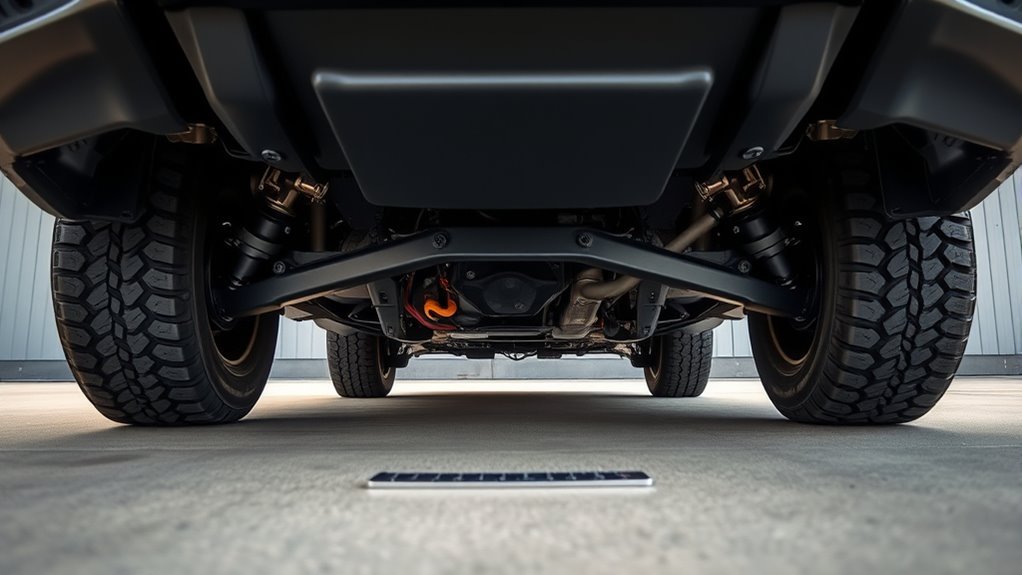
Ground clearance is the vertical gap between your vehicle’s lowest hard point and the ground; it determines whether you’ll scrape the undercarriage, clear obstacles, and achieve desired approach, departure, and breakover performance. You’ll commonly measure axle and suspension clearance, plus consider bumper and skid-plate positions. To measure, park level, identify the lowest point, and measure perpendicular to the ground with the vehicle unladen. Manufacturer figures can vary from real-world values, and below you’ll find practical measurement, reporting caveats, and modification tradeoffs.
What Is Ground Clearance and Why It Matters
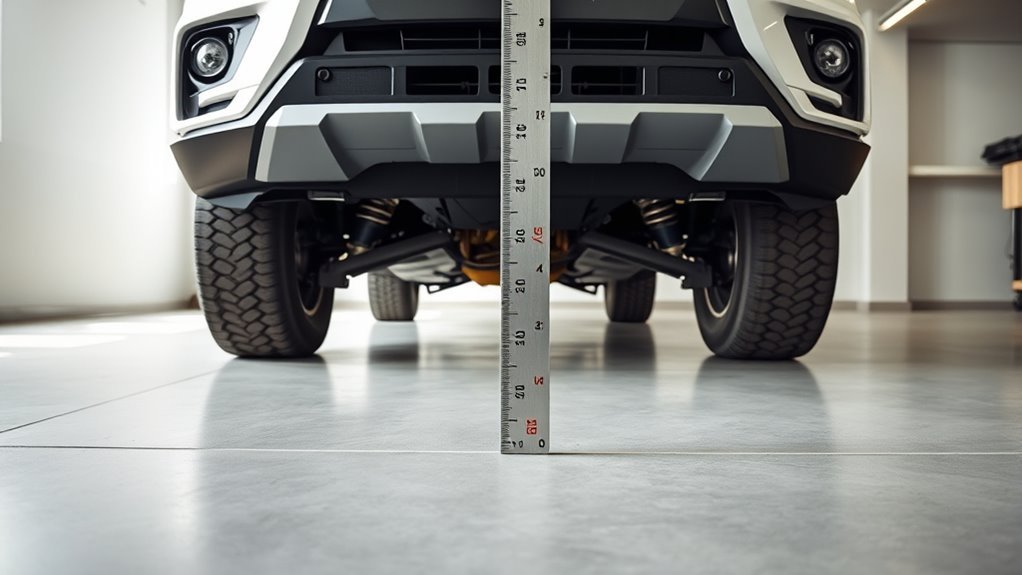
Ground clearance is the vertical distance between your vehicle’s lowest undercarriage point and the ground, and it determines whether you can clear obstacles without contact. You assess ground clearance significance by measuring that minimum gap to avoid undercarriage strikes, which compromise components and mobility. For effective off road performance, manufacturers and builders target 7.5–9 inches or more, balancing obstacle negotiation against center-of-gravity and handling changes. You’ll also monitor approach, departure, and breakover angles to predict contact points, but you’re focusing here on the clearance value itself. You can raise clearance with lift kits or larger tires; doing so increases obstacle clearance but alters suspension geometry, steering response, and rollover propensity. Measure clearance on level ground, with normal load and tire pressure, and repeat after modifications. As someone seeking freedom on unpaved routes, you’ll use objective clearance figures to choose or modify a vehicle that reliably traverses terrain without sacrificing controllability or safety.
Types of Ground Clearance (Axle, Suspension, Approach, Departure, Breakover)
Clearance types break the single “ground clearance” concept into specific measurements you can use to evaluate and modify a vehicle for intended terrain. You’ll assess axle clearance—the vertical gap between the differential and ground—to prevent drivetrain strikes on rocks or ruts. Measure suspension clearance as the lowest point of linkages, control arms, or skid plates; it governs component protection and dynamic travel. Approach angle describes the steepest ramp your front end can climb without bumper contact, so improving it frees you from restrictive lines. Departure angle is the rear equivalent, letting you exit obstacles without dragging the bumper. Breakover angle quantifies your ability to span a crest without grounding the belly; it’s a function of clearance and wheelbase, so longer vehicles usually have smaller breakover angles. Use these discrete metrics to target upgrades—lift, shorter overhangs, or reinforced suspension—so you can liberate your vehicle’s off-road envelope with predictable, measurable changes.
How to Measure Your Vehicle’s Ground Clearance : Step by Step
Park your vehicle on a flat, level surface and make sure it’s unladen before you start measuring. Position yourself with clear access to the undercarriage and gather measurement tools: a rigid tape measure or ruler and a flashlight. Identify the vehicle’s lowest hard points—differential housing, suspension arms, skid plates—and choose one as your initial reference.
Place the tape measure vertically from the ground to the chosen lowest point, ensuring the tape is perpendicular to the surface. Read and record the distance. Repeat at multiple locations along the undercarriage to capture variations. Log each value and note component location.
Apply accuracy tips: use a calibrated tape, avoid slack, and take measurements twice. If surface irregularities exist, move the vehicle to a different flat spot. Finally, compare your recorded values with manufacturer specifications to validate results and inform any modifications you plan for greater freedom off-road.
How Manufacturers Report Ground Clearance (And Why Figures Can Mislead)
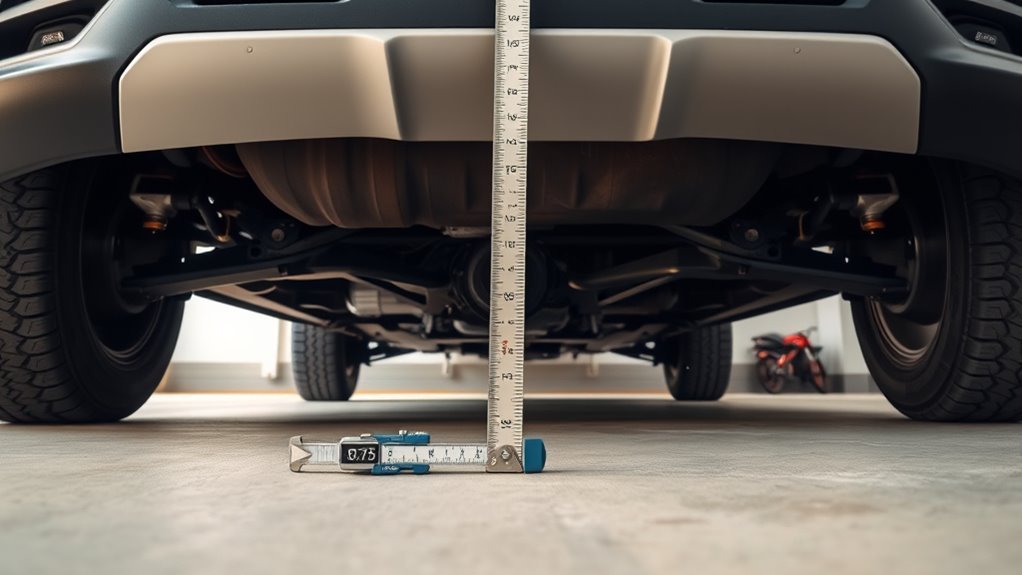
Although manufacturers aim to standardize specifications, the way they measure and report ground clearance varies, so the figure you see on a spec sheet may not reflect real-world conditions. You should know reported values often come from design specs that ignore tire compression, load, or suspension sag, creating measurement discrepancies between stated and actual clearance. Some firms quote “maximum” clearance under ideal setup, which can mislead your expectations on rough terrain.
You can act to reclaim accurate information:
- Measure clearance yourself under typical load to verify claims and gain independence.
- Cross-check reliable third-party reviews to expose inflated numbers and protect your choices.
- Demand transparency from manufacturers; insist on standardized test conditions.
Maintain consumer awareness: prioritize verified, context-rich figures over headline specs. That precision frees you to choose vehicles that match real needs rather than marketing.
When to Change Ground Clearance : Lift Options, Tradeoffs, and Safety Tips
If you plan to spend serious time off-road or carry heavier loads, raise ground clearance only after evaluating tradeoffs: lifts and larger tires improve approach, departure, and breakover angles but also raise the center of gravity and can degrade on-road stability. You should choose lift kits and tire combinations that match your vehicle’s geometry and intended terrain; suspension lifts change articulation and track width, while body lifts give clearance without altering suspension kinematics. Prioritize tire compatibility—diameter, width, and load rating—to prevent rubbing, drivetrain strain, or speedometer errors.
Assess off road performance needs versus daily handling; incremental lifts preserve stability better than maximal lifts. After installation, test braking, steering response, and cornering at controlled speeds and inspect mounting points, alignment, and steering components. Document changes and be prepared to add stabilizers, regear axles, or upgrade brakes. These safety considerations protect you and maintain the freedom to push terrain limits responsibly.
Frequently Asked Questions
How Do They Measure Ground Clearance?
You measure ground clearance by placing the vehicle on level ground, identifying the lowest undercarriage point, and measuring vertical distance to the ground with a ruler; account for suspension impact and vehicle design variations when verifying figures.
What’s a Good Ground Clearance?
A good ground clearance is 10 inches or more for robust off road performance; you’ll gain vehicle stability and obstacle clearance, while 8–9 inches suits light off-roading, preserving agility and efficiency for liberated mobility.
How to Calculate Ground Clearance?
Imagine your car tiptoeing over rocks; you measure from its lowest underbody point to the ground on level surface. You’ll account for suspension design, unladen weight, and modifications—this affects vehicle performance and clearance readings.
What’s Considered a High Clearance 4×4?
A high clearance 4×4 is typically 10+ inches of clearance, giving you superior off road capabilities; you’ll want robust suspension types like long-travel or solid-axle setups, enabling articulation, larger tires, and liberated trail confidence.
Conclusion
You now know what ground clearance is, how it’s measured, and why it matters. You can compare axle, suspension, approach, departure, and breakover figures; you can measure clearance accurately; you can spot misleading manufacturer claims; and you can choose lifts or mods with tradeoffs and safety in mind. Use precise measurements, prioritize critical clearances, balance performance against risk, and maintain your vehicle to keep clearance reliable and predictable.