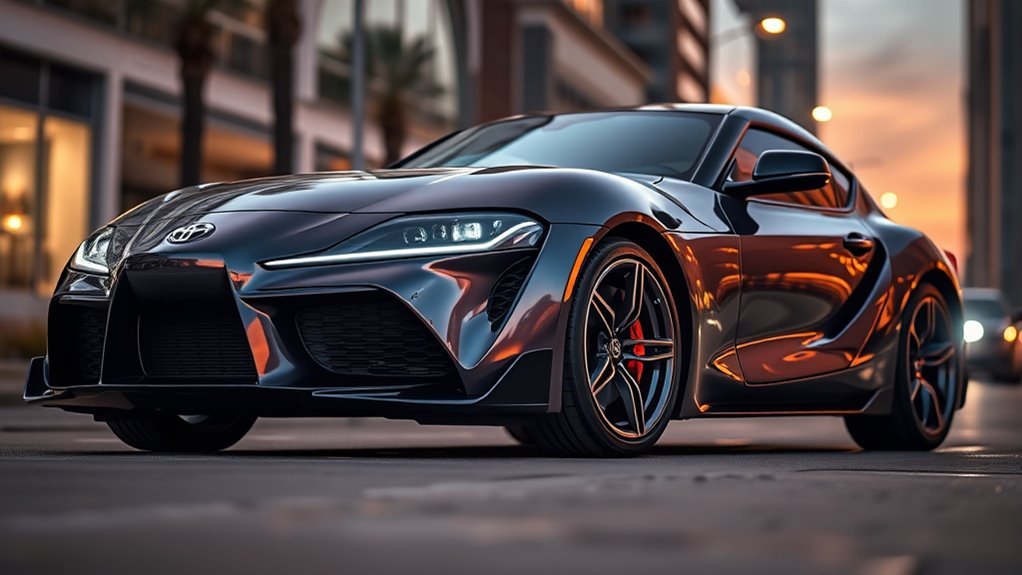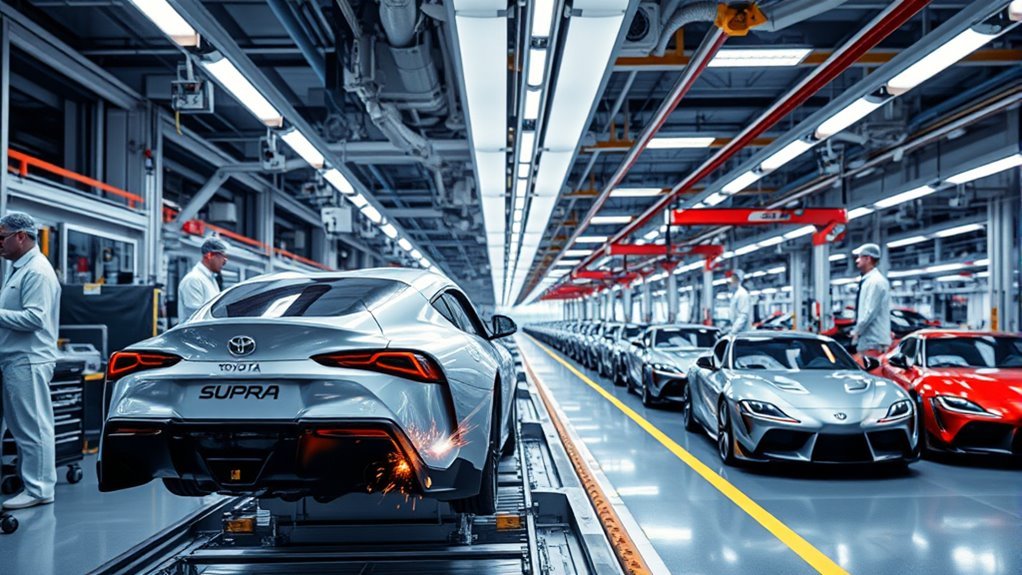
You’ll find the Toyota GR Supra built at Magna Steyr’s Graz plant in Austria, where low‑volume, high‑precision assembly shares a line with the BMW Z4. You’ll get BMW‑sourced engines, chassis bits and tight tolerance assembly under rigorous quality controls and robotic welding, with manual audits ensuring brand‑specific fit and finish. Production runs through March 2026 with Final Edition tweaks for stiffness and drivability, and if you keep going you’ll learn more about parts, service and market impacts.
Where the Toyota GR Supra Is Built

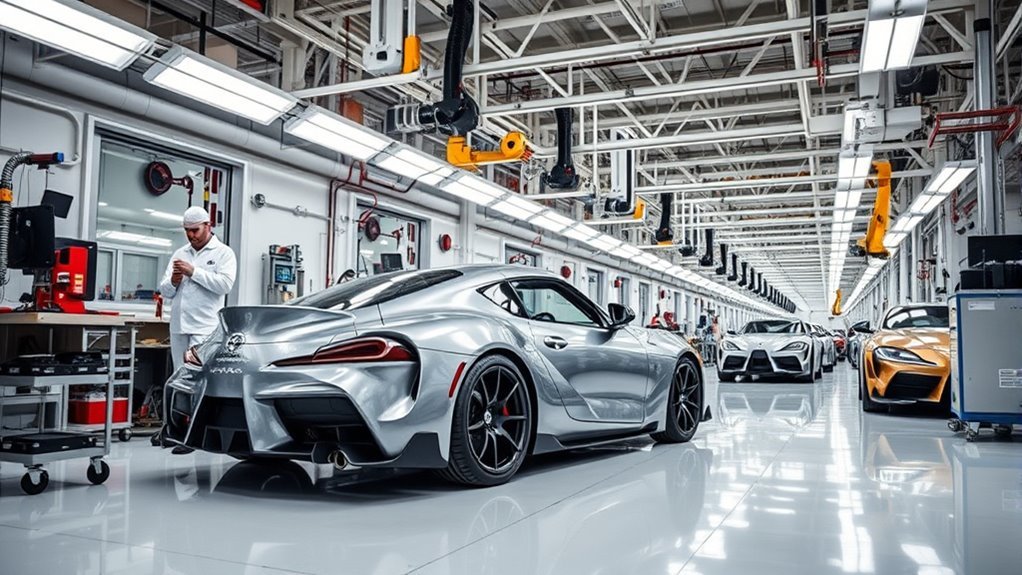
Where is the GR Supra built? You’ll find it at Magna Steyr’s Graz facility in Austria, a site whose Graz history anchors decades of contract manufacturing expertise. You inspect a production line where the GR Supra and BMW Z4 share tooling and platforms, a deliberate choice that tightens tolerances and reduces variability. Since production began in 2019, the assembly process has demonstrated manufacturing excellence through consistent quality control, unified logistics, and cross-model workflow efficiency. You’ll appreciate that platform commonality with BMW streamlines parts flow without compromising Toyota’s performance targets. Production runs continue through March 2026, giving you a clear window to assess build integrity. This setup liberates engineering constraints, letting you focus on driving dynamics rather than provenance.
Why Toyota Chose Magna Steyr in Graz, Austria
Having seen the Supra roll off Magna Steyr’s line in Graz, it’s clear why Toyota picked that plant: you get a facility optimized for low-volume, high-performance builds with rigorous quality controls and specialized tooling. You’ll appreciate the production reasons grounded in manufacturing excellence and proven expertise. Magna Steyr lets Toyota access advanced techniques without diluting the Supra’s character, enabling focused craftsmanship and technical fidelity.
- Proven low-volume capability: repeatable processes tuned for niche sports cars.
- Quality systems: tight inspection regimes and specialized tooling for precision.
- Advanced technologies: flexible manufacturing cells that support performance engineering.
- Strategic partnership: leverages Graz expertise to free Toyota to pursue design and brand goals.
The choice liberates Toyota to deliver a distinct, high-quality sports car.
How the Supra and BMW Z4 Share the Graz Production Line
You’ll see the GR Supra and BMW Z4 coming off the same Magna Steyr assembly line in Graz, where a shared platform and common parts like chassis and drivetrain streamline production. The line’s tooling and process controls are calibrated to switch between model-specific assemblies without sacrificing fit-and-finish. Inspectors use unified quality-control protocols to verify both cars meet each brand’s performance and interior standards.
Shared Assembly Line
At Magna Steyr’s Graz plant, Toyota and BMW run a single, integrated assembly line that builds the GR Supra and the Z4 side by side, leveraging a common platform and shared components to tighten tolerances and simplify logistics. You see how shared technology and production efficiency converge: the line blends Toyota and BMW engineering standards, uses automated cells, and enforces unified quality checkpoints so each car meets precise specs. That coordinated setup lets you expect consistent fit, finish, and repeatable cycle times while reducing waste and cost. The arrangement also liberates capacity for model variations without rebuilding the line. Evaluate these operational strengths:
- Unified quality control protocols
- Automated assembly cells with flexible tooling
- Streamlined material flow and logistics
- Cross-manufacturer engineering oversight
Platform And Parts Sharing
Because they share a common platform and many core components, the GR Supra and BMW Z4 roll down the Graz line as near-siblings, which lets engineers and technicians treat assemblies, tolerances, and test points as interoperable rather than model-specific. You’ll see platform compatibility realized in shared suspension geometry, electronic differential hardware, and the BMW-sourced 3.0-liter turbo inline-six used in the Supra and Z4 M40i. This engineering collaboration reduces unique part counts and speeds setup changes on the Magna Steyr line, freeing you from wasteful complexity. Parts commonality lets teams reassign tooling, swap modules, and maintain consistent calibration baselines. Evaluatively, that tradeoff preserves distinct driving identities while maximizing manufacturing efficiency and resource allocation for both brands.
Quality Control Processes
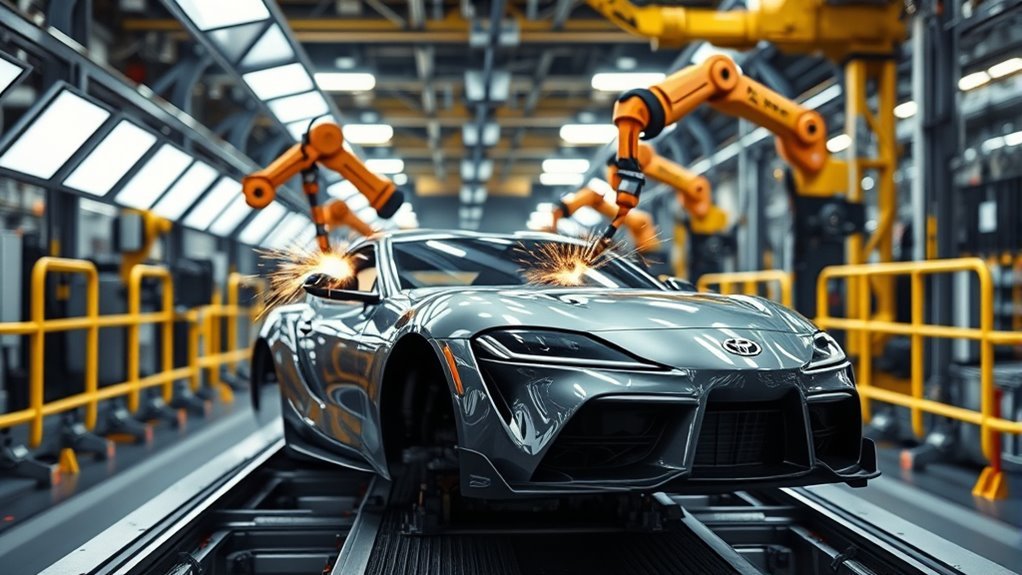
Shared platforms and common parts make more than manufacturing efficient; they let quality control be unified across the Graz line. You’ll see quality assurance and inspection protocols applied identically to the GR Supra and BMW Z4, trimming variability while preserving brand-specific calibrations. Robotics deliver repeatable welds and torque sequences; skilled technicians validate tactile fit and finish. Continuous feedback loops from Toyota and BMW drive iterative updates to tests and tooling.
- Standardized inspection protocols for engines and transmissions guarantee interchangeability.
- Robotic measurement systems verify chassis rigidity and alignment to micron tolerances.
- Manual audits assess assembly ergonomics and cosmetic criteria beyond sensor limits.
- Cross-brand data sharing accelerates corrective actions and liberates production from recurring defects.
Magna Steyr’s Role and Build Quality for the Supra

When you look under the Supra’s skin, Magna Steyr’s Graz plant is the technical backbone, applying advanced manufacturing processes and tight tolerances that give the car its remarkably stiff chassis and consistent assembly quality. You’ll see design innovations and production efficiency embedded in tooling, welding, and bonding methods that Toyota and BMW refined together. That shared expertise yields a car that meets rigorous performance and durability criteria without sacrificing the freedom to modify or personalize. You can trust measured quality: dimensional accuracy, material joins, and final inspections all reflect Magna Steyr’s high standards. For a driver seeking liberation through precision, the Graz-built Supra delivers confidence—its build quality is a deliberate outcome of collaborative engineering and disciplined manufacturing.
Key Toyota vs BMW‑Sourced Supra Parts
Although Toyota stamped its styling and final calibration into the GR Supra, many of the car’s critical mechanical and electronic systems come straight from BMW, so you should read the Supra as a hybrid of design philosophies: you get Toyota’s design identity and tuning over a core of BMW-sourced hardware that defines engine performance, chassis design, suspension technology, and interior features.
- Engine performance — the BMW 3.0‑liter inline-six (335–429 hp) determines power delivery, torque curve, and service architecture.
- Chassis design — BMW engineering provides a stiff, responsive structure without carbon fiber, shaping rigidity and mass distribution.
- Suspension technology — M-derived components and electronic differential sharpen handling and feedback.
- Infotainment system and interior features — BMW controls and UX underpin cabin function while Toyota preserves a distinct visual identity.
Production Timeline: 2019 Start to March 2026 End
You’ll note the GR Supra’s production runs from 2019 through a planned end in March 2026, giving it a defined seven-year lifecycle. Assembly has been concentrated at Magna Steyr in Graz, Austria, using a BMW‑shared platform that influences both engineering and component sourcing. Evaluate how that concentrated assembly location and finite timeline affected build continuity, parts logistics, and the final‑edition rollout in Europe starting spring 2025.
Production Start And End
Because Toyota restarted the Supra line in collaboration with BMW and Magna Steyr in 2019, the A90/A91 generation entered production at Graz and reached global markets quickly—Japan on May 17 and the U.S. on July 22, 2019—establishing a clear seven-year manufacturing window that concludes in March 2026. You’ll assess the production timeline decisively: start, evolution, final edition and termination. You can read this as a planned lifecycle that balances brand ambition with pragmatic limits. Expect discrete technical learnings and transparent decisions, and recognize how assembly challenges informed configuration and runout strategy. The A90 Final Edition caps the program. Key points:
- Start: 2019 Graz line activation.
- Market rollout: May–July 2019.
- Lifecycle: ~7 years.
- End: March 2026.
Assembly Location Details
When you track the GR Supra’s assembly from 2019 through its planned March 2026 close, the key fact is simple: all A90/A91 units were built at Magna Steyr’s Graz, Austria plant on the same line that also assembles the BMW Z4. You’ll find assembly insights in the shared-line strategy: Toyota and BMW components are integrated with tight tolerances, enabling consistent build quality. You can expect manufacturing protocols that prioritize precision welding, calibrated torque application, and rigorous final inspections—each step tuned for performance fidelity. This arrangement boosts production efficiency by leveraging a flexible platform and skilled workforce, reducing changeover time without diluting identity. For someone seeking liberation from uncertainty, the plant’s documented processes give you clear assurance of continuity and quality through 2026.
What the A90/A91 Final Edition Changes in Graz Mean
Although the A90/A91 Final Edition is built alongside the BMW Z4 at Magna Steyr in Graz, its revisions give you a measurably stiffer, more focused Supra: you get clear Performance Enhancements without altering the BMW-sourced 3.0-liter inline-six (429 hp, 369 lb-ft). The strengthened body increases torsional rigidity, sharpening steering feedback and cornering precision. The revised chassis and optimized active differential control refine traction and stability under load, so you can exploit the power confidently. This Final Edition crystallizes the platform’s strengths and liberates the driver with firmer control.
A stiffer, sharper Final Edition Supra—same BMW 3.0L I6, enhanced chassis and differential for confident, focused performance.
- Stiffer body structure — improved torsional rigidity and feedback
- Unchanged powertrain — same 3.0L I6, 429 hp/369 lb-ft
- Optimized active differential — better stability and turn-in
- Chassis tweaks — more focused, track-capable demeanor
Availability Implications for the US, Japan, UK, and Australia

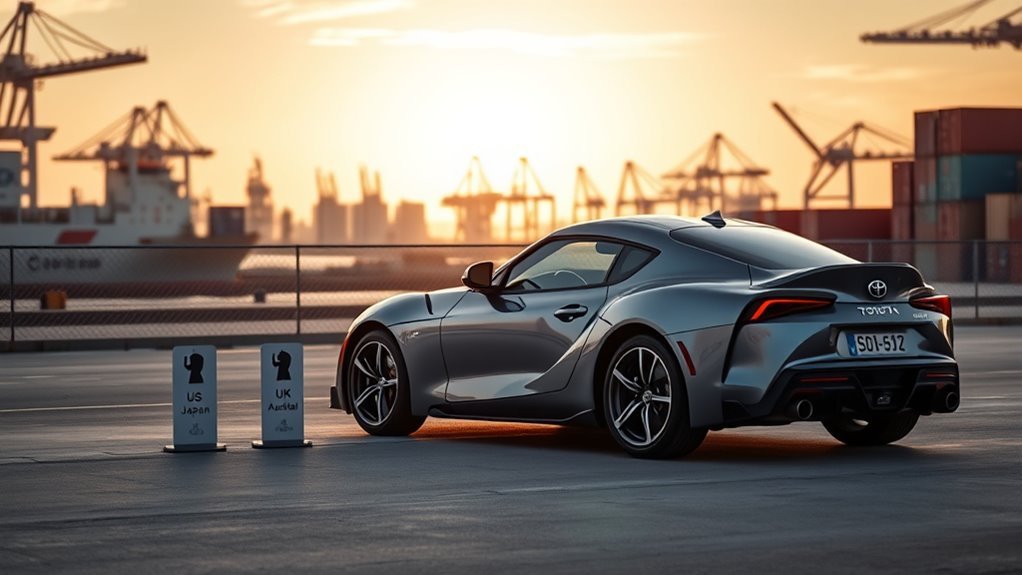
With Graz as the single production source, you’ll see U.S. allocations shaped by export capacity and compliance specs, which can constrain annual imports. In Japan you’ll assess direct-market pricing and limited domestic allocations since sales began in May 2019, while UK and Australia supplies hinge on right‑hand‑drive configuration priorities and regional demand. Given production ends in March 2026, you should evaluate remaining inventory, final-edition allocations, and potential used-market premiums.
U.S. Market Availability
One clear implication for U.S. buyers is production continuity: the GR Supra’s assembly at Magna Steyr in Graz, Austria, and Toyota’s confirmation of production through March 2026 mean you can expect ongoing U.S. availability and factory-supported parts for several more years. You’ll find both 2.0L I4 and 3.0L I6 configurations in showrooms, so choose per performance preference and ownership goals. Market demand and sales trends since the July 2019 U.S. launch—initial base price $49,990—show robust interest, limiting allocations at times.
- Continued production supports parts supply and warranty coverage.
- Diverse powertrains broaden buyer access and aftermarket potential.
- Strong demand can create short-term allocation constraints.
- Dealers may leverage scarcity for pricing and option strategies.
Japan Sales And Imports
Having covered U.S. production continuity and market implications, let’s look at how Japan sales and international imports shape availability across the US, Japan, UK, and Australia. You’ll note the GR Supra entered the Japanese market May 17, 2019, giving domestic buyers early access while Austria-built units flowed to export markets. With production ending March 2026, allocation tightens and you’ll see prioritized shipments.
| Market | Launch | Supply Pressure |
|---|---|---|
| Japan | May 17, 2019 | Domestic demand stabilizes |
| US | July 22, 2019 | Price-driven uptake affects stock |
| Exports | UK/AUS confirmed | Import regulations and allocation |
Evaluate import regulations and export quotas; they’ll determine leftover inventory you can source, so act decisively to secure liberation through ownership.
UK & Australia Supply
Three market factors—Austria-only production, shared Magna Steyr capacity with the BMW Z4, and impending March 2026 end of build—directly constrain UK and Australian supply, so you’ll see availability driven largely by export allocation rather than local demand. You should expect allocations to prioritize larger or strategically important markets (U.S., Japan), reducing marginal UK availability and pressuring Australia pricing.
- Limited Graz throughput: finite units force continent-level prioritization affecting UK demand fulfillment.
- BMW Z4 competition: shared lines create variable monthly quotas that shift allocation curves.
- End-of-production taper: remaining inventory becomes fungible global stock, traded by dealer networks.
- Dealer pricing dynamics: with scarcity, Australia pricing will reflect transport, tariffs, and residual demand.
You can leverage this to negotiate or seek displaced stock from other regions.
How Contract Manufacturing Affects Supra’s Successor Plans
Because Toyota outsources GR Supra production to Magna Steyr in Graz, the company’s successor planning is tightly coupled to external capacity, costs, and partner strategy; you can’t treat a next-generation Supra purely as an internal program when tooling, line expertise, and shared BMW Z4 capacity dictate lead times and unit economics. You’ll need a successor strategy that acknowledges production challenges: limited Graz capacity if Z4 volume drops, retooling windows, and rigid contract terms. You’ll evaluate partnership importance against control loss — leveraging Magna’s expertise reduces capital outlay but creates cost implications and scheduling constraints. For market adaptation, you’ll prioritize modular platforms and flexible specs to shorten ramp-up and shift volumes. In short, freedom to innovate hinges on negotiated flexibility, clear contingencies, and aligned incentives with your contractor.
Ownership Impact: Service, Parts, and Resale for Graz‑Built Supras
While the GR Supra is built in Magna Steyr’s Graz plant and shares systems with the BMW Z4, you’ll find service and parts dynamics that differ from Toyota models made in Japan. You get ownership benefits from BMW-compatible networks and a healthy aftermarket, yet you’ll face resale challenges tied to European provenance and buyer perceptions.
- Service access: Graz-built Supras often route through BMW-trained technicians, expanding reliable service options beyond typical Toyota dealers.
- Parts sourcing: You can source both Toyota and BMW components, improving repair flexibility and cost control.
- Aftermarket support: Collaboration with BMW fosters robust tuning and upgrade ecosystems, enhancing customization freedom.
- Resale considerations: Unique heritage can boost desirability for some buyers while confusing others, creating mixed valuation outcomes.
Frequently Asked Questions
Does the Toyota Supra Have a BMW Engine?
Yes — you’ve got a BMW-sourced engine in the Supra: the B58 inline-six or B48 inline-four, tuned via design collaboration to enhance engine performance, and you’ll appreciate the liberated, technically precise evaluation of that partnership.
Conclusion
You’re looking at a Supra that’s hand‑assembled in Graz by Magna Steyr, not a massed Toyota plant, and that matters: contract manufacturing gives you BMW mechanical kinship, Toyota oversight, and build quality that’s surprisingly meticulous—almost obsessively precise. That mix affects parts sourcing, service networks, and future successor strategy, so factor provenance into ownership, resale and long‑term support expectations; Graz origins aren’t a drawback, they’re a defining, engineered advantage.