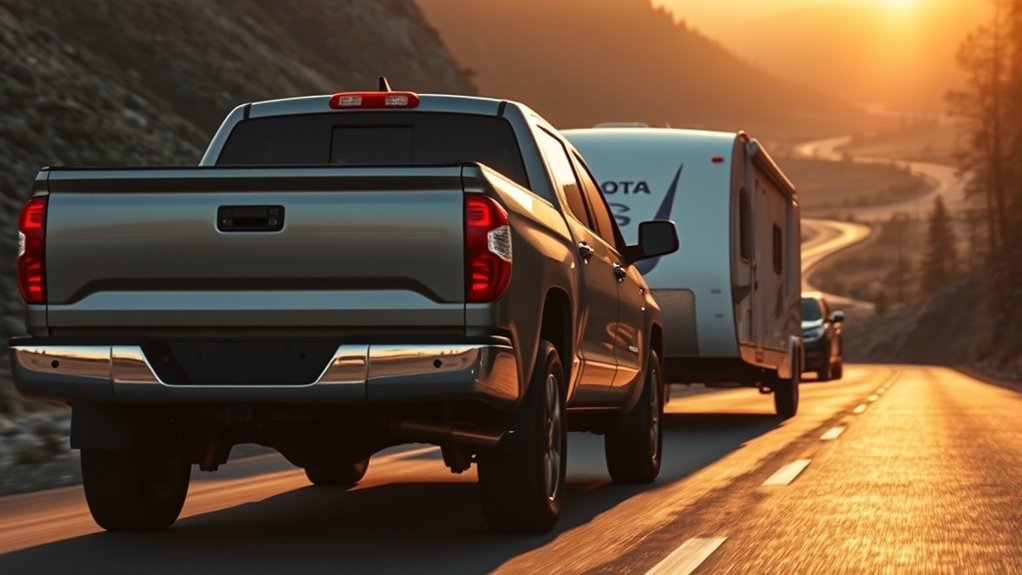
Use Tow/Haul in your Tundra whenever you’re towing to stabilize shifts and throttle response, especially for trailers above about 3,000–5,000 lbs or high‑profile loads. It holds lower gears longer, cuts gear‑hunting, improves engine braking on grades, and can boost fuel efficiency under load. For heavy trailers over 5,000 lbs or steep descents, prefer Tow Plus and use Manual S5 for stronger engine braking. Keep it on as a routine—more specific mode and terrain tips follow.
Choose Tow Haul or Tow Plus: A Quick Decision Rule
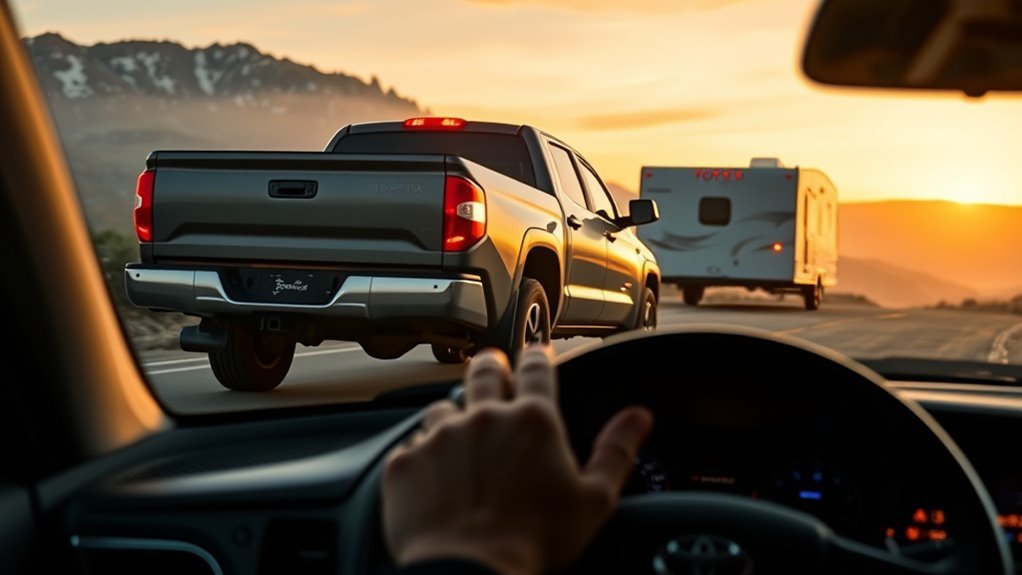
When deciding between Tow Haul and Tow Plus, assess your trailer’s gross weight first: you’ll use Tow Haul for loads under 5,000 lbs and Tow Plus for loads over 5,000 lbs. You perform a Load assessment to confirm trailer weight, then select the mode that matches operational demands. Tow Haul holds gears longer and refines shifting for controlled acceleration and fuel efficiency; it’s suitable for lighter trailers and allows manual S5 selection on hilly terrain to improve engine braking. Tow Plus boosts power, stability, and braking for substantial trailers, maintaining speed and control on steep inclines. Your Towing techniques should prioritize safety margins: verify tongue weight, axle loads, and braking capacity before departure. If weight is near 5,000 lbs, err toward Tow Plus for added reserve. You’ll gain liberation through decisive, rule-based selection—measure, choose, and drive with confidence rather than uncertainty.
How Tow Haul Works on a Toyota Tundra
When you engage Tow/Haul on a Tundra, the transmission shift strategy changes to hold lower gears longer and reduce unnecessary upshifts for stronger, more consistent pull. At the same time the engine throttle mapping becomes more responsive, giving crisper throttle-to-torque response under load. These coordinated changes prioritize control and reduced gear hunting, at the cost of some fuel economy except in optimized towing conditions.
Transmission Shift Strategy
Because Tow/Haul remaps throttle response and alters shift logic, you get quicker, more controlled acceleration and longer gear holds that reduce unnecessary upshifts while towing. You’ll notice improved shift responsiveness and purposeful load management: the transmission delays upshifts to keep RPMs in the torque band, preventing hunting between gears under load. When climbing or descending grades, the strategy maintains gear selection to stabilize speed and reduce brake wear. You can engage Tow/Haul anytime without harming the drivetrain; tradeoffs are primarily fuel economy due to optimized throttle application. For steep terrain, manually selecting S5 complements Tow/Haul by locking a lower gear to avoid lugging and preserve control when hauling heavy trailers or traversing demanding routes.
Engine Throttle Mapping
Although it operates primarily through software, Tow/Haul changes the Tundra’s throttle mapping to give you more immediate engine response and tighter drive-by-wire control when towing. You’ll notice sharper throttle response and reduced pedal lag, which helps you modulate power under load and maintain momentum on grades. The system holds gears longer and shifts torque bands to keep the engine in a usable power range, improving control when hauling over 3,000 lbs. It also adjusts fuel injector duty cycles to balance power and economy, so higher RPMs don’t always mean waste. You can enable Tow/Haul anytime across varied driving conditions without harming the powertrain, giving you confident, liberated control over acceleration and engine behavior while towing.
When to Use Tow Haul for Light Towing (Common Examples)
Think of Tow/Haul as a practical gear for everyday light towing — use it whenever you’re hauling under about 5,000 lbs (U-Haul trailers, jet skis, motorcycles) to get more responsive acceleration, longer gear holds, and improved control. When you hook up a small trailer or load recreational gear, engage Tow/Haul to optimize throttle mapping and power delivery; that reduces transmission hunting and preserves engine life. You’ll notice steadier speeds on grades, crisper downshifts for engine braking, and reduced brake reliance—benefits that directly support towing safety and correct load distribution. Activate it anytime; there’s no damage risk from using it regularly, so treat it as a routine control for short hauls, boat ramps, or weekend moves. For liberation-minded drivers, Tow/Haul removes micromanagement: it simplifies gear selection and stabilizes performance so you can focus on route decisions, vehicle positioning, and safe arrival without fighting shifting or uneven power under light loads.
When to Pick Tow Plus or Manual S5 for Heavy Loads
When you’re hauling heavier loads—especially above roughly 5,000 lbs—select Tow Plus to prioritize torque delivery, transmission cooling, and trailer stability; switch to Manual S5 on steep or sustained grades so you can hold a lower gear for engine braking and consistent power without waiting on automatic shifts.
You’ll use Tow Plus when mass and trailer dynamics demand optimized driveline behavior. Tow plus benefits include firmer throttle response, longer gear holds under load, and improved stability for large trailers like RVs; these reduce drivetrain strain and help braking control. For hilly or mountainous routes, engage Manual S5 to exploit manual control: manual s5 advantages are deliberate gear selection, sustained engine braking, and avoidance of shift lag that can compromise control on descents or during overtakes. For loads above roughly 3,000–5,000 lbs, toggle modes based on terrain—Tow Plus for highway, Manual S5 for climbs/descents—to preserve mechanical integrity and keep you free to focus on navigation, not transmission behavior.
How Tow Haul Affects Shifts, Throttle, and Fuel Economy
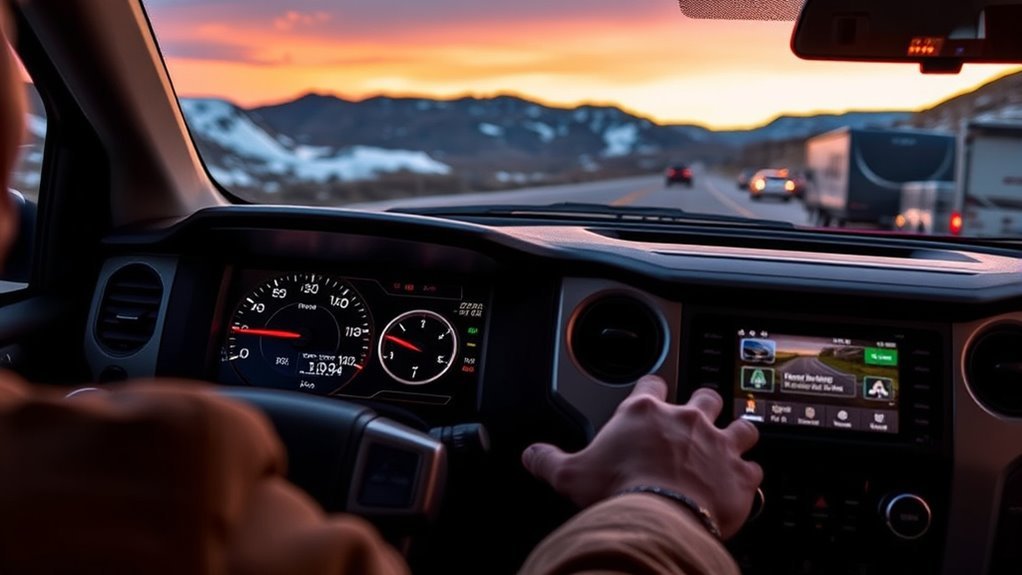
Because tow/haul reprograms throttle mapping and shift logic, you’ll get crisper pedal response and longer gear holds that keep the transmission in its ideal powerband while towing. You’ll notice improved throttle response and consistent shifting performance as the system raises RPM thresholds to prevent lugging under load. That keeps torque available when you need it—accelerating onto highways, climbing grades, or recovering speed after descending.
Because gears stay engaged longer, the transmission shifts more deliberately, which reduces hunting between ratios and gives you predictable control of vehicle momentum. Fuel economy can improve in this state: optimized power delivery and steadier RPMs yield more efficient injector cycles and lower transient fuel use on extended trips. Although higher RPMs might seem counterintuitive, they prevent inefficient lugging and can raise MPG in many towing scenarios. Use these dynamics to reclaim control and move deliberately, with power and efficiency aligned to your objective.
When to Turn Tow Haul On : Practical Rules
If you’re towing at all, flip on Tow/Haul to sharpen throttle response and hold gears longer so the transmission stays in its ideal powerband; this reduces lugging and gives you steadier control whether you’re hauling a light load or a heavy trailer. Turn Tow/Haul on every time you tow—regardless of weight—to optimize throttle mapping and shift logic for consistent load management and towing safety. For loads above 3,000 lbs or high-profile trailers, engagement becomes critical: it stabilizes power delivery and improves trailer control. On flat roads you can rely on Tow/Haul alone; it often improves fuel efficiency by preventing unnecessary gear hunting. Avoid treating it as optional when towing; it prevents low-RPM lugging that compromises drivetrain health. When terrain demands precise engine braking or higher gears, supplement Tow/Haul with manual shift selection, but don’t disable it wholesale. Adopt this rule-based habit to maximize control, reduce mechanical strain, and free yourself to focus on the road and the freedom that competent load management affords.
Towing on Hills, Wind, and Highways: Mode Tips
Although hills, crosswinds, and sustained highway speeds each stress drivetrain and braking systems differently, engaging Tow/Haul keeps the transmission in a higher RPM range to preserve powerband access and reduce gear hunting. You should use Tow/Haul for towing techniques that demand steady torque—especially with loads over 3,000 lbs—because it improves responsiveness when you encounter steep grades and strong gusts. Manually selecting S5 within Tow/Haul gives you precise control for hill navigation during descents and accelerations. Monitor gross weight and load distribution; the mode optimizes throttle mapping and can prevent lugging that stresses the engine and brakes. On windy highways it holds gears longer to stabilize speed and make corrective inputs predictable.
Use Tow/Haul to hold gears, preserve powerband, and use S5 for precise engine braking on steep, windy grades.
- Use Tow/Haul on sustained climbs to maintain RPM and avoid hunting.
- Shift to S5 for controlled engine braking on steep descents.
- Engage mode when crosswinds require steady throttle responses.
- Confirm payload under 3,000+ lbs before relying solely on transmission.
- Combine monitoring with deliberate towing techniques for freedom and safety.
How Mods and Trailer Types Change Mode Choice
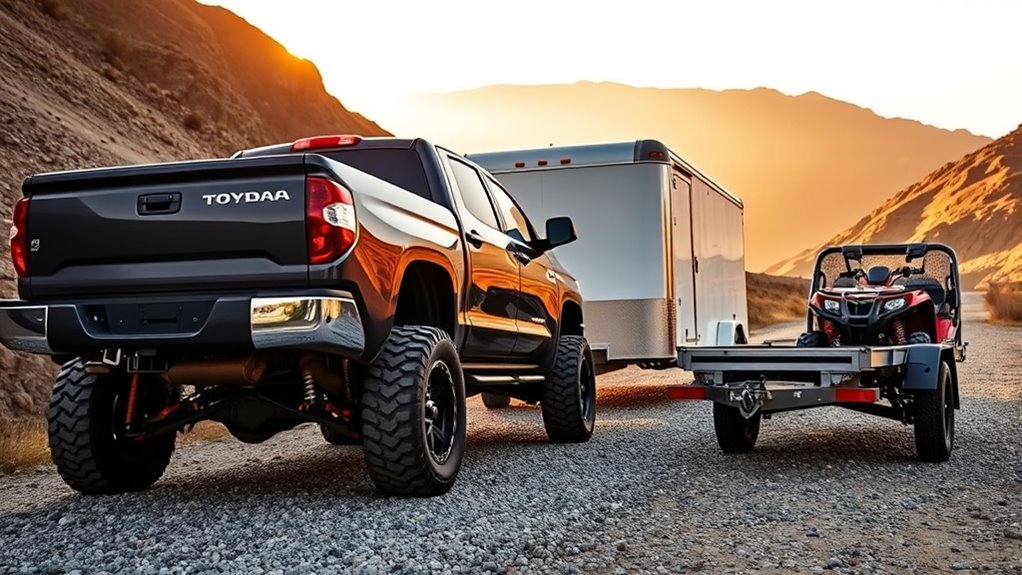
After addressing hills, wind, and highway use, you should next account for how vehicle mods and trailer types alter which drive mode you pick. Assess trailer weight first: use Tow/Haul for loads under 5,000 lbs, and switch to Tow Plus when you exceed that threshold. Recognize that vehicle modifications—larger tires, added accessories, or extra cargo—change towing dynamics by increasing rolling resistance and inertia; those changes often push you toward Tow Plus for better stability and braking authority.
High-profile or aerodynamically inefficient trailers raise wind loading and can demand Tow Plus to maintain control and power efficiency. In hilly terrain, manual downshifts in Tow/Haul help, but if mods or trailer characteristics amplify mass or drag, defaulting to Tow Plus reduces transmission strain. Regularly reassess your setup after any vehicle or trailer change; small alterations to weight or aerodynamics materially affect mode choice and safe, liberated towing performance.
Troubleshoot Poor MPG, Harsh Shifts, or Drive Feel
Start troubleshooting by isolating symptoms—poor MPG, harsh shifts, or an altered drive feel—and then test Tow/Haul engagement under representative loads and terrain to determine if mode change corrects the issue. You’ll run transmission diagnostics and observe fuel efficiency with and without Tow/Haul engaged, focusing on loaded conditions above 3,000 lbs and hilly stretches. Note RPM behavior, shift timing, and responsiveness.
- Compare MPG on similar routes and loads to quantify gains when Tow/Haul is active.
- Record shift quality: soft, firm, delayed, or clunking to correlate with transmission diagnostics.
- Test manual S5 selection on hills to prevent lugging and hold higher RPM for control.
- Observe throttle response and gear-hold behavior to assess powerband utilization.
- If harsh shifts persist despite mode use, escalate to professional transmission diagnostics and drivetrain inspection.
You’ll liberate your driving by using empirical tests to confirm when Tow/Haul improves efficiency and driveability, then act on objective data.
Pre-Trip Checklist: Pick the Right Mode Before You Tow
Before you leave, confirm the trailer weight and choose Tow/Haul when the load exceeds 3,000 lbs, or engage Tow/Haul anyway to optimize throttle and shift behavior. Inspect the hitch, safety chains, wiring, and coupler to guarantee secure mechanical and electrical connections. Finally, verify the vehicle display shows the selected towing mode and, for hilly routes, be prepared to use manual S5 within Tow/Haul for better control.
Confirm Trailer Weight
A reliable bathroom scale won’t help here—confirm the trailer’s gross vehicle weight (GVW) before you hitch up so you can pick the proper Tow Haul setting: use Tow Haul for loads over 3,000 lbs up to about 5,000 lbs for better control and fuel economy, and switch to Tow Plus for loads above 5,000 lbs to maximize power, stability, and braking; also verify the trailer weight doesn’t exceed your Tundra’s towing capacity and activate Tow Haul mode prior to departure to guarantee correct throttle response and gear holding. You’ll measure GVW at a certified scale, compare it to your Tundra’s limit, and factor cargo distribution. Proper trailer weight directly affects towing safety and vehicle longevity—don’t guess.
- Weigh trailer at public scale
- Check tongue weight
- Verify axle loads
- Confirm vehicle towing capacity
- Engage Tow Haul before leaving
Select Appropriate Mode
Decide which drive mode fits your load and route before you hitch: use Tow Haul for most loads under 5,000 lb and switch to Tow Plus for heavier trailers, always engage Tow Haul to sharpen throttle response and hold gears, and verify the selected mode on the vehicle display so the transmission and engine mapping match the expected weight and terrain. You’ll choose based on confirmed trailer weight and desired control. For loads over 3,000 lb or high-profile trailers, Tow Haul gives stability; use Tow Plus above 5,000 lb. Manually select S5 on steep grades to prevent lugging and aid engine braking. Confirm mode on the display, check load distribution, and lock the setting for consistent towing safety.
| Scenario | Recommended Mode |
|---|---|
| Light <3,000 lb | Tow Haul |
| Medium 3,000–5,000 lb | Tow Haul |
| Heavy >5,000 lb | Tow Plus |
| Hilly terrain | Tow Haul + S5 |
| High-profile trailer | Tow Haul |
Inspect Hitch & Connections
Inspection of the hitch and connections is essential: check for cracks, corrosion, loose bolts, and proper weld integrity so the trailer stays securely attached. You perform a hitch inspection and connection checks before selecting Tow Haul or Tow Plus, confirming the hitch’s weight rating matches the trailer and load. Test electricals—brake lights, turn signals—so you don’t compromise safety. Verify the coupler fits the hitch ball, engage locks, and secure safety chains crossed beneath the tongue. These steps free you from avoidable risk and let you choose the correct mode with confidence.
- Verify hitch weight rating matches trailer and load
- Inspect for cracks, corrosion, loose bolts, poor welds
- Test brake lights and turn signals
- Confirm coupler seats snugly and locks engage
- Attach and cross safety chains correctly
Frequently Asked Questions
When Should I Turn on Tow Haul Mode?
Turn it on whenever you’re towing to optimize towing capacity and engine performance; engage for varied driving conditions, steep grades, or heavy loads so transmission efficiency improves, giving you confident, liberated control over power and stability.
Conclusion
You’ve got the rule: use Tow Haul for typical towing, switch to Tow Plus or manual S5 for heavier, steeper, or sustained loads. But don’t wander off autopilot—pick the right mode before you hitch, watch shifts, and expect some fuel penalty. If MPG plunges or shifts get violent, troubleshoot gearing, brakes, and trailer setup. Now imagine you ignore that last check—one hill could turn routine into a costly lesson. Choose deliberately; tow smart.