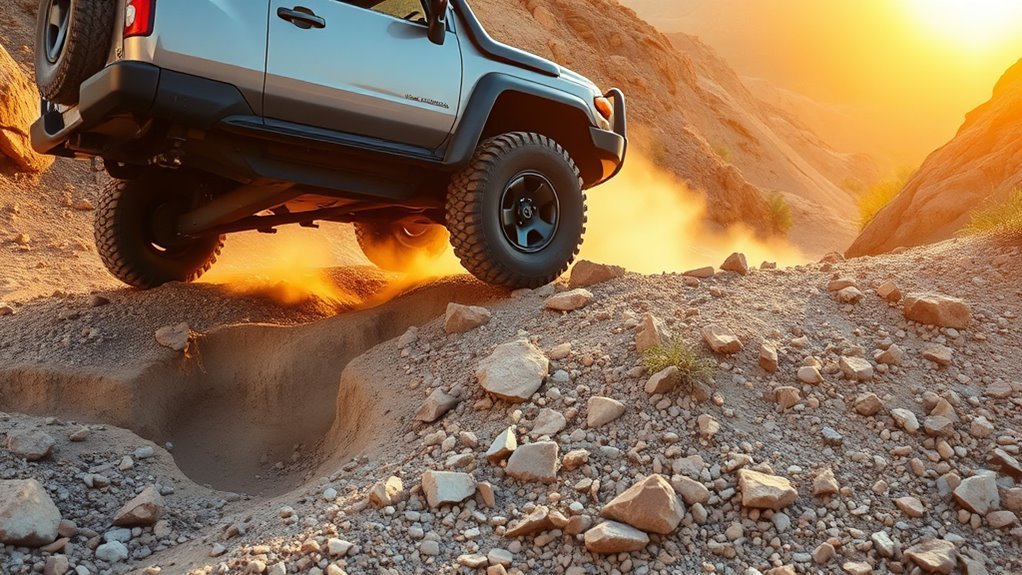
Use A‑TRAC when a spinning wheel or three‑wheeling on steep rock, deep mud, sand, or snow is stopping your forward momentum and you need brake‑based torque redistribution at low speed. You’ll start in MTS for general trails and only switch to A‑TRAC for moderate to difficult climbs, technical crawls, or recovery bursts in 4LO. Watch brake feel and heat, keep throttle measured, and return to MTS once traction’s restored — more detailed tactics follow below.
Quick Decision: When to Choose A‑TRAC vs MTS
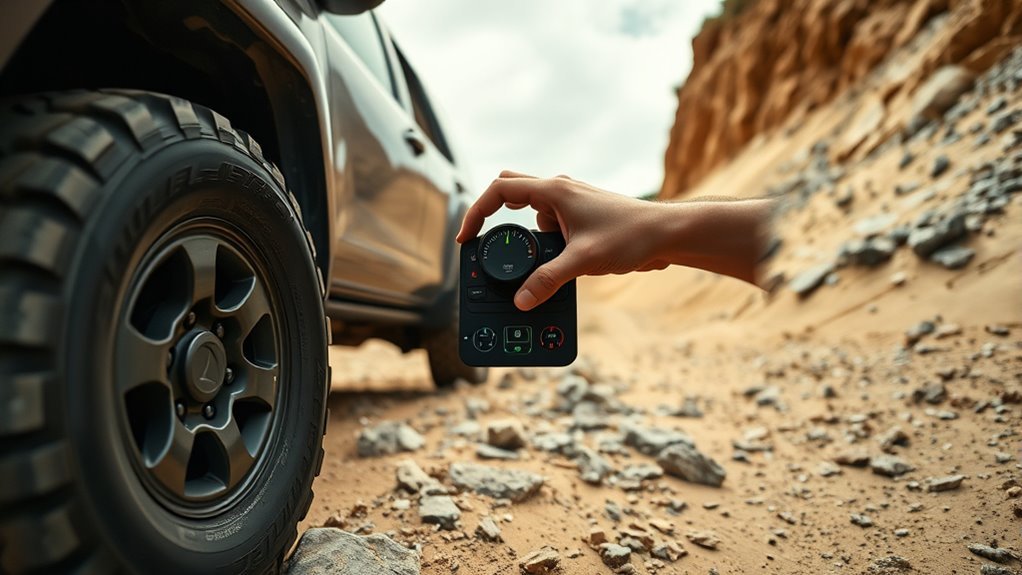
When should you pick A‑TRAC over MTS? You’ll start with MTS for general off‑roading because it preserves sensitive throttle control and minimizes drivetrain strain; that’s the baseline for light to moderate hill climbing. Shift to A TRAC advantages when you face moderate to difficult climbs, get stuck from a stop, or encounter rock crawling and three‑wheeling—A‑TRAC applies brakes to free‑spinning wheels to force torque where it’s needed. You’ll use A‑TRAC for immediate traction needs, not as a default, because it engages more aggressively and can overheat brakes with prolonged use. Recognize MTS limitations: it’s less effective at resurrecting traction from a dead stop or during extreme articulation. In practice, progress with MTS until wheels slip beyond recovery; then enable A‑TRAC to regain bite, then return to MTS to avoid thermal stress. This workflow gives you liberated control—precise, decisive, and protective of vehicle systems.
[Products Worth Considering]
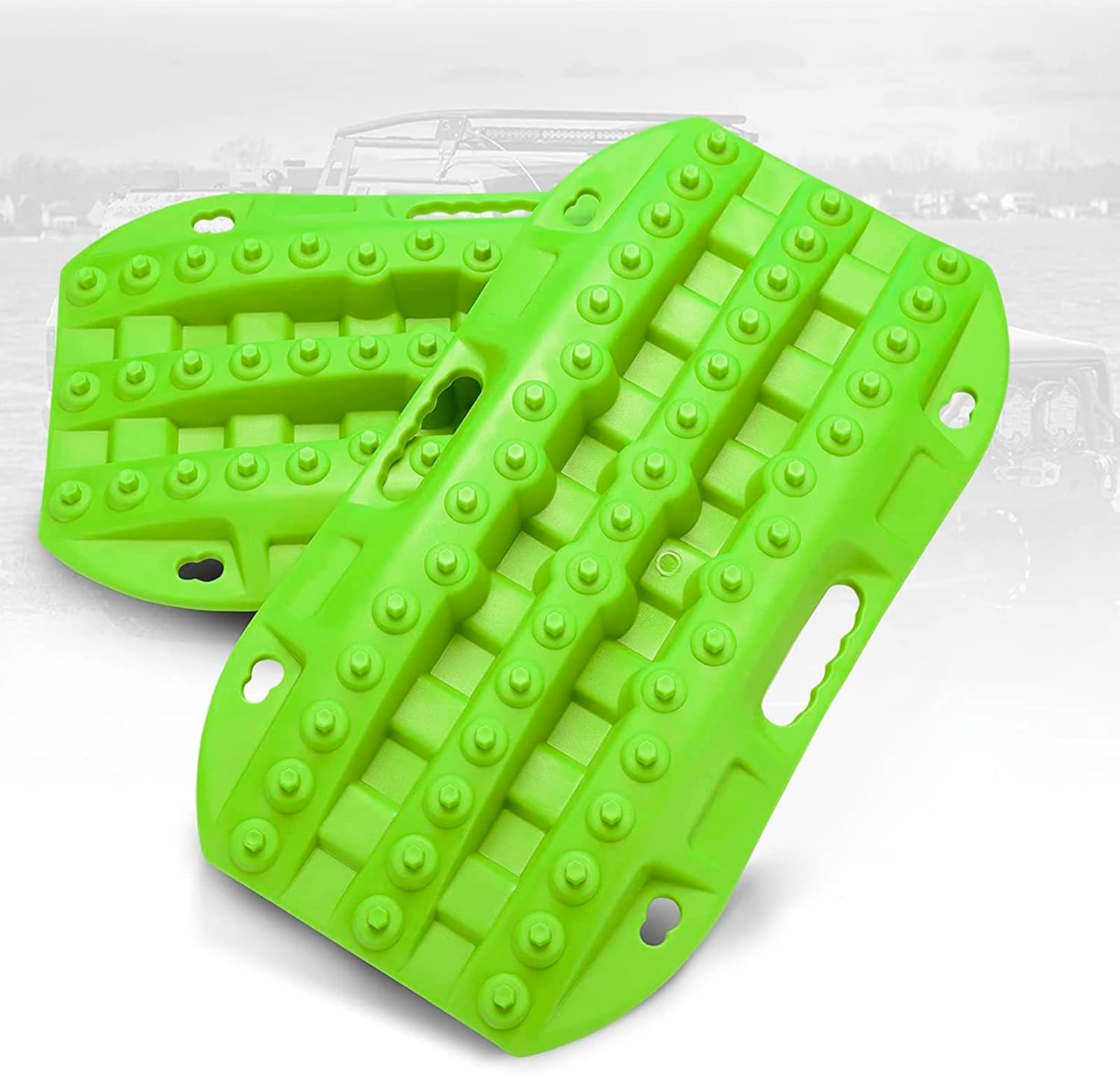
These short recovery traction boards are designed to help ATVs, UTVs, and other off-road vehicles regain grip in mud, sand, and snow. Built with strengthened teeth and a durable polypropylene construction, they provide reliable traction, easy handling, and year-round performance in tough conditions. Their nested, space-saving design and integrated shovels make them practical for carrying and using on remote adventures.

These X-BULL recovery traction tracks help drivers get unstuck from sand, snow, mud, or ice with a stable U-shaped elastic design and a wavy ramp that makes tire entry easier. Built from reinforced nylon, they are flexible, impact-resistant, and designed to perform in extreme temperatures while providing reliable emergency traction for a wide range of vehicles.

These off-road traction boards are designed to help vehicles recover from mud, sand, and snow with reliable grip and easier ramp-up. Their double-sided diamond construction, cross-shaped teeth, and contoured ramps improve traction while the durable polypropylene build stays flexible in harsh conditions. Convenient mounting points, ergonomic handles, and a visible leash make them practical to carry, store, and retrieve when recovery is needed.
A‑TRAC Basics: What It Does and Why It Matters
One clear way to think about A‑TRAC is as a brake‑based, electronic faux locker that forces torque to the tires that still have traction; it senses wheelspin and applies individual brakes to the slipping wheel(s) so the driveline can push the vehicle forward. You’ll rely on A‑TRAC features when three‑wheeling, in deep mud, snow, or technical rock sections—especially in 4LO where it’s calibrated to manage low‑speed torque. The A TRAC benefits are immediate traction recovery, controlled torque distribution, and minimized drivetrain shock compared with mechanical lockers. It’s not a cure‑all for extreme extraction, but it buys you momentum and choice.
| Situation | Effect |
|---|---|
| Rock crawling | Redirects torque to planted wheels |
| Deep mud | Prevents free‑spinning wheels |
| Snow | Stabilizes forward progress |
| Hill climb | Maintains steady torque delivery |
| Three‑wheeling | Restores traction to moving wheels |
Use it to liberate movement through terrain you can control, not to replace strategic recovery tools.
How to Engage A‑TRAC (4LO) and Driving Technique
Start by stopping the vehicle and shifting the transfer case into neutral; only then engage 4LO to activate A‑TRAC—this sequence safeguards the transfer case and guarantees proper engagement. When engaging A TRAC, confirm the vehicle is fully stopped, place the transmission in neutral, then shift the transfer case into 4LO; the four‑wheel drive system will engage and A‑TRAC will begin applying brakes to spinning wheels. Use steady, measured throttle input—avoid abrupt revs—to let the system modulate brake application and redirect torque to wheels with grip. Apply short bursts of A‑TRAC during steep climbs, uneven sections, or rock steps; prolonged use risks overheating the brakes. Monitor brake feel and wheel behavior; if brakes heat or engagement becomes erratic, pause and allow cooling. These driving techniques are practical, controlled, and liberating: they give you predictable traction control without overreliance, letting you push terrain limits safely while protecting drivetrain components.
When A‑TRAC Helps You Get Unstuck in Mud, Sand, or Rock
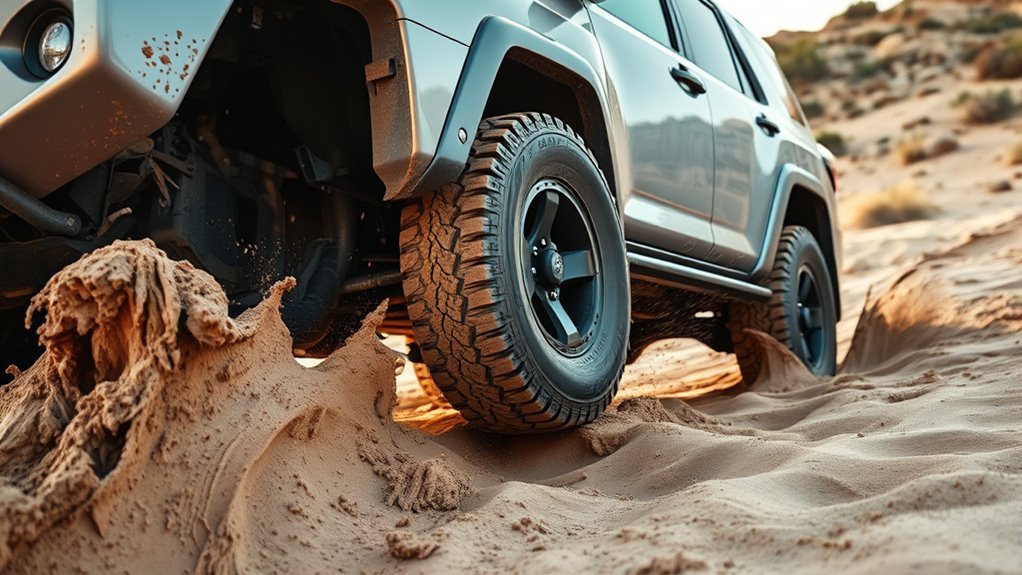
When you’re stuck in mud, sand, or on uneven rock, A‑TRAC uses brake-based traction aid to retard spinning wheels and force torque to those with grip. Use it in 4LO so the system has the low-speed torque transfer needed to push through soft material or crawl over obstacles without blipping the throttle. Engaging A‑TRAC at a controlled crawl increases your recovery odds by maintaining momentum and preventing individual wheels from digging in.
Brake-Based Traction Aid
Although A‑TRAC only works in 4LO, it’s a reliable brake-based traction aid that you’ll want to engage the moment a wheel starts to spin in mud, sand, or on uneven rock, because it applies brakes to the slipping wheel and redirects torque to wheels with grip. You’ll gain immediate brake efficiency by arresting spin and converting wasted power into usable drive at loaded wheels. Use A‑TRAC with measured throttle and steady inputs so the system can modulate braking pulses without overheating components. It’s practical for regaining momentum in deep mud or snow and for preventing lateral slide on uneven rock. For liberation-focused off-roaders, A‑TRAC’s traction management gives you predictable control, reduces recovery needs, and preserves vehicle and environment.
Low-Speed Torque Transfer
Brake-based traction aids like A‑TRAC pair naturally with low-speed torque management, and that’s where you’ll see the system earn its keep for getting unstuck in mud, sand, or rock. You’ll rely on A‑TRAC’s low speed performance to stop wheelspin and transfer torque to tires with grip, especially useful off-camber or when weight’s uneven. Engage A‑TRAC in 4LO for maximum controlled torque; the system senses slippage and applies brakes to spinning wheels, preserving forward momentum through deep mud or soft sand. Monitor temperatures—prolonged use risks brake overheating. Use this tool deliberately to free your 4Runner while minimizing damage and maintaining vehicle control.
- Feel empowered by predictable traction shifts.
- Trust precise torque management when stakes are high.
- Know limits to avoid overheating brakes.
A‑TRAC vs Electronic Locker: Which to Use When
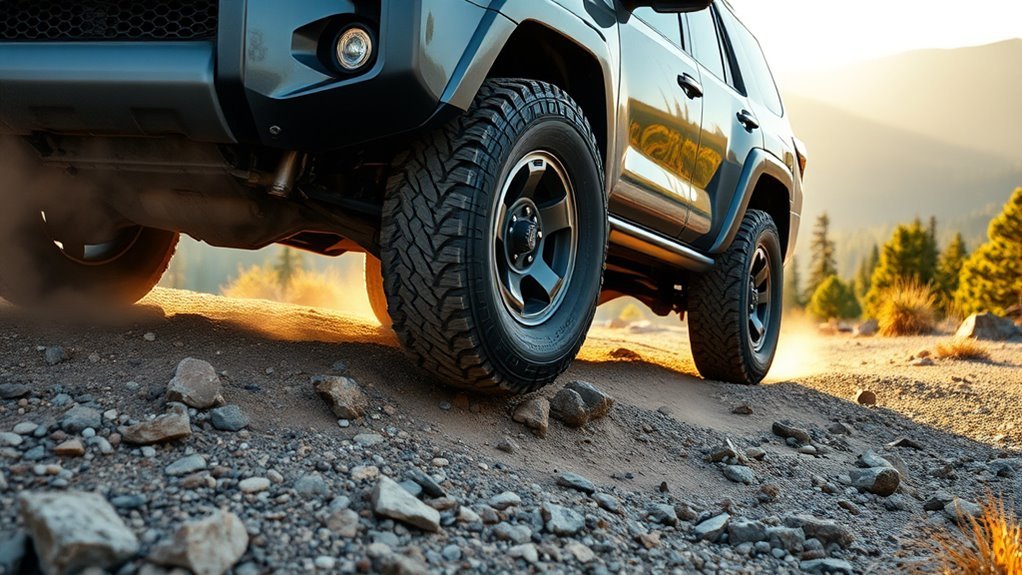
You’ll usually start with A‑TRAC because it uses selective braking to mimic a limited‑slip differential, giving effective, controlled traction on uneven rock, steep climbs, and moderate mud or sand. Use the Electronic Locker when surface grip is extremely low—deep mud, snow, or situations requiring both rear wheels to turn together—because it hard‑locks the axle for maximum traction but can damage driveline components on high‑traction surfaces. In practice, engage A‑TRAC in 4HI or 4LO for general and technical obstacles, then switch to the locker in 4LO only when you need consistent, uncompromising power to both wheels.
[Products Worth Considering]
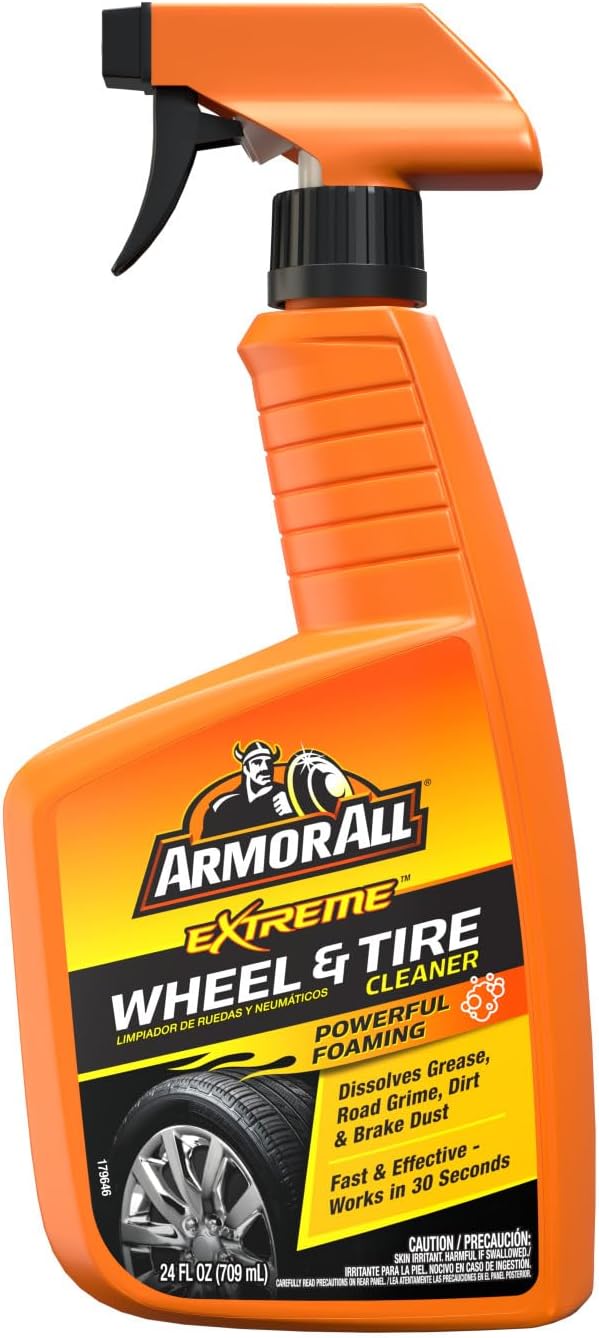
Armor All Extreme Wheel and Tire Cleaner is a powerful spray designed to cut through stubborn dirt, grease, tar, and brake dust on wheels and tires. It is safe for use on factory and aftermarket finishes, including alloy, steel, chrome, and plastic wheel trims, while its fast-acting formula works in just seconds. The deep-cleansing action helps reach hard-to-clean areas and leaves wheels looking clean and shiny.

BUNKER INDUST off-road traction boards help vehicles regain grip in mud, sand, and snow with a double-sided diamond array and cross-shaped teeth for improved bite and stability. Built from upgraded automotive-grade polypropylene, they resist UV damage, cold-weather brittleness, and wheel-spin heat while remaining flexible enough to handle demanding recovery situations. Contoured ramps, ergonomic handles, and multiple mounting points make them practical to use, store, and retrieve when adventure turns into recovery.
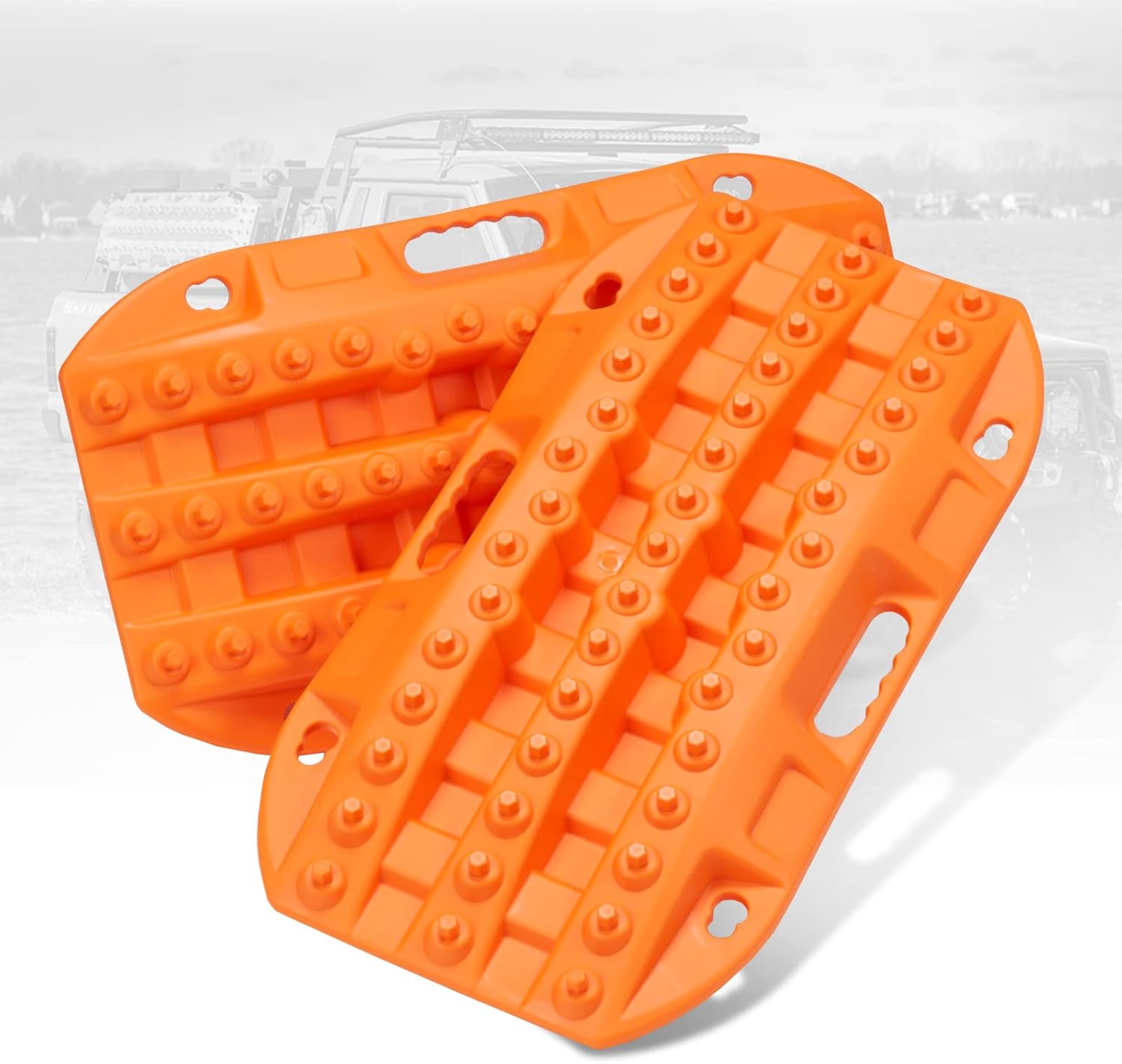
These short off-road traction boards are designed to help ATV and UTV drivers recover from mud, sand, and snow with added convenience and portability. Built with strengthened teeth and a stable bottom channel design, they help prevent wheel slip and improve traction in tough terrain. Made from durable automotive-grade polypropylene, they are lightweight, easy to clean, and suited for year-round use in extreme temperatures. Built-in shovels, ergonomic handles, and nesting storage make them practical for compact vehicle setups.
A‑Trac Strengths vs Lockers
When deciding between A‑TRAC and an electronic locker, think regarding control versus constant output: A‑TRAC detects wheel slip and applies brakes to transfer torque, giving you adaptive traction on moderate to difficult trails, while an electronic locker mechanically ties both wheels to deliver continuous power regardless of slip. You’ll value A TRAC advantages when you want nuanced intervention—off‑camber recovery, three‑wheeling correction, and cleaner steering feel. Lockers win in extreme, low‑speed crawl or sustained high‑load runs where A‑TRAC can overheat or kill momentum.
- Choose A‑TRAC for responsive, brake‑based control that preserves agility and liberation on mixed terrain.
- Choose a locker for uncompromising forward motion and simplicity in extreme obstacles.
- Weigh locker comparisons against heat, momentum, and terrain demands.
When To Choose Locker
Pick the locker when you need guaranteed, constant torque to both rear wheels: in deep sand, thick mud, loose scree, or steep crawl sections where maintaining momentum and avoiding differential wind‑up matter more than nuanced steering feel. You’ll choose an electronic locker for extreme surfaces because it forces equal torque, countering wheelspin that A‑TRAC’s brake-based method can’t always manage. Locker advantages include predictable traction, simpler inputs (often with traction control off), and better escape from substrate that buries a single wheel. Locker disadvantages are reduced steering finesse, potential drivetrain stress, and less modulation than MTS or A‑TRAC in mixed terrain. Use lockers when liberation matters most—when you must power through without guesswork—and revert to A‑TRAC or MTS for sensitive control.
A‑TRAC Limits: Overheating, Momentum Loss, and When to Stop
Although A-TRAC boosts traction by modulating brakes at slipping wheels, it has practical limits you need to monitor during prolonged or extreme off-road use. You must balance overheating concerns and momentum management: continuous A-TRAC engagement raises brake temperatures, risks temporary shutdown, and can erode your forward progress when wheels need slight slip to trigger the system. Monitor brake temps and feel for repeated bogging; if braking fades or momentum stalls, disengage A-TRAC.
- Recognize heat buildup — sustained brake modulation in rock or mud generates thermal stress; a temporary system cutoff protects components but leaves you exposed.
- Watch momentum loss — intermittent wheel lock correction can sap speed on climbs or in deep ruts; losing momentum forces harder recovery maneuvers.
- Know when to stop — if temperatures climb or you can’t maintain steady advance, stop, cool brakes, and switch strategies to preserve freedom of movement.
Act deliberately: prevent damage, preserve control, and keep your trail options open.
How A‑Trac Interacts With VSC, TRAC Off, and Crawl Control
A-TRAC works together with Toyota’s stability systems to give you controlled traction: it activates in 4WD and applies brakes to spinning wheels while VSC monitors yaw and brake distribution to keep the vehicle stable, so you’ll get aggressive wheel-stop intervention for immediate grip without losing directional control. You’ll appreciate A TRAC benefits when you need rapid, selective braking to transfer torque to grounded tires; VSC coordination prevents unintended rotation during those interventions. If you press TRAC Off, you disable both traction control and VSC, which frees the driveline for deliberate slip in deep sand or mud—useful when you want momentum over electronic correction. Use A-TRAC with Crawl Control to pair automatic speed control on steep, technical terrain with targeted brake application for traction—engage 4LO then A-TRAC for maximum bite. Know that A-TRAC is more aggressive for immediate recovery, while VSC remains your baseline safety net in normal 2WD or 4WD High operation.
Quick Checklist and Escalation: MTS, Lockers, Winches, and Recovery Gear
Now that you know how A-TRAC, VSC, TRAC Off and Crawl Control work together on difficult terrain, you should pair that systems knowledge with a clear escalation plan and a concise gear checklist before you go further off-road. You’ll start MTS for general off-roading and light to moderate climbs—select the mode matching Terrain Types to limit wheel slip and keep momentum. If you hit loose, low-traction surfaces, engage the rear locker to force equal power to both rear wheels. Reserve A-TRAC for stubborn rock crawling or steep pitches where brake-based torque redistribution helps.
Your practical, liberation-focused escalation and kit:
- Winch and rated tow straps — confidence when mud or sand stops you.
- Shackles, shovel, and gloves — basic Recovery Techniques that free you quickly.
- Checklist: MTS mode, locker status, battery/anchor points, and communication device.
Treat this as your compact rule-set: escalate systems before digging, and carry gear that converts risk into freedom.
[Products Worth Considering]

Rhino USA D Ring Shackles provide a dependable recovery connection for off-road and towing setups, with a high break strength designed for demanding use. They fit most aftermarket bumpers and universal shackle mounts, and the included rubber isolator kit helps reduce noise, vibration, and wear. Built from chromoly steel with an anti-rust powder-coated finish, these shackles are made for long-lasting performance in harsh conditions.

This Nilight LED light bar set delivers bright spot and flood combo lighting for off-road driving, work sites, and rugged trails. Built with high-intensity LEDs, an aluminum housing for better heat dissipation, and IP67 waterproof protection, it is designed for reliable performance in demanding conditions. The included wiring harness kit and mounting brackets make installation straightforward and secure.

This synthetic soft shackle set is designed for safer, easier off-road recovery with a simple loop-and-tighten setup that helps make vehicle pulls more straightforward. Built as a lightweight alternative to traditional metal shackles, it uses anti-scratch synthetic fiber to help protect your vehicle during recovery tasks. The two-pack format adds convenience for trail use, and Rhino USA backs the product with lifetime replacement support.
Frequently Asked Questions
Should I Turn off Traction Control When Off-Roading?
Yes—you’ll often turn off traction control off road; use off road techniques and traction management to permit controlled wheel slip in sand, mud, or rocks, letting you modulate momentum, braking, and recovery for freer, competent driving.
What Does a Trac Do on 4runner?
Like a mechanical guardian, it applies brakes to spinning wheels and redirects torque so you’ll keep moving; A TRAC benefits include improved grip and controlled climbs, while A TRAC operation activates in 4LO, aiding low-traction freedom.
What Does Trac off Mean in 4runner?
TRAC off means your 4Runner’s traction control is disabled; you’ll gain A TRAC benefits like freer wheel slip for momentum but also face A TRAC limitations—reduced stability and disabled VSC—so re-enable for normal roads.
Conclusion
Use A‑TRAC when traction’s dicey but you want smooth, controlled torque transfer without harsh binding; flip it on in 4LO for mud, sand, or rocky ruts where wheel slip is intermittent. It’s great for maintaining momentum and steering precision, but don’t overwork it—watch temps and back off when you’d be better with an MTS, locker, or winch. When in doubt, follow the checklist, escalate stepwise, and let the system do the heavy lifting—measure twice, cut once.