
You should rotate your Toyota Tundra’s tires every 5,000–7,500 miles under normal driving, and at about 5,000 miles or as soon as you notice uneven wear when you tow frequently or carry heavy loads. Use a front-to-back pattern for non-directional tires; use X-pattern only for specific uneven wear and never for directional tires. Check tread depth, wear bars, pressure, and alignment at each stop, and follow torque and safety steps if you do it yourself—more guidance follows.
When to Rotate Your Tundra’s Tires: The Short Answer (5,000–7,500 Miles)

Routine upkeep: rotate your Tundra’s tires every 5,000–7,500 miles to promote even wear and maximize tire life. You’ll follow Toyota’s front-to-back rotation method—no crossover—unless you’re using non-directional tires, which you can also swap side to side. Track mileage and mark intervals; that discipline prevents the uneven wear patterns that show up fast when rotations are missed. Inspect tread depth and wear at each rotation, noting anomalies tied to towing or aggressive driving habits. If you tow regularly or use OEM Michelin LTX tires, expect specific wear tendencies and address them proactively. Use a torque wrench to meet spec when reinstalling wheels and record the service for accountability. Consistent tire maintenance preserves handling, improves safety, and frees you from avoidable replacements. You’ll keep control of performance by pairing routine rotations with mindful driving habits, ensuring the Tundra serves your long-term mobility and independence.
Choose the Right Rotation Interval for Your Driving and Towing
Consider the driving conditions you subject your Tundra to—rough roads and frequent short trips accelerate tire wear and may require rotations sooner than the manual’s baseline. If you tow regularly or haul heavy loads, tighten your schedule to the manufacturer’s 5,000-mile recommendation or sooner, focusing on front-to-back swaps to counteract rear/right-side wear. Also monitor tire pressure and alignment at each service to confirm the interval is effective for your usage.
Drive Conditions Matter
Because driving and towing conditions change how your Tundra’s tires wear, pick a rotation interval that matches your use: follow Toyota’s 5,000-mile recommendation as a baseline, shorten it when you regularly tow heavy loads or drive on rough terrain, and inspect for side-to-side or corner-specific wear (passenger-side bias is common) to trigger earlier rotations. You’ll act methodically: check tire pressure and assess load distribution before and after trips, document wear, then rotate.
- Inspect: measure tread depth at four corners, note passenger-side bias, record pressure.
- Adjust: correct tire pressure, redistribute cargo to improve load distribution, fix alignment if needed.
- Rotate: shorten interval when rough roads or heavy use accelerate uneven wear; repeat monitoring.
Towing Frequency Impact
If you tow frequently, rotate your Tundra’s tires every 5,000 miles and inspect wear patterns each service interval to prevent accelerated rear-axle and shoulder wear. You’ll follow a front-to-back rotation pattern recommended for towing to balance load-induced wear; consider cross-rotation only if you observe pronounced shoulder wear. Check tire pressure before every trip and document tread depth at each rotation to quantify towing stress effects and adjust intervals if rear tires wear faster. When you detect uneven wear, relocate tires per the documented pattern and recheck alignment and suspension for contributing faults. These procedural steps preserve tire longevity, maintain handling under load, and free you from avoidable replacements—empowering safer, cost-effective towing.
Manufacturer Interval Guidance
1 clear rule: follow Toyota’s recommended 5,000-mile rotation interval to maintain even wear and extend tire life. You’ll prevent concentrated tire wear and avoid the common rotation myths that suggest “wait longer” or “only rotate when worn.” When you tow, stick to the interval—heavy loads accelerate uneven wear unless you rotate on schedule.
- Inspect pattern: check tread depth and sidewall condition every 5,000 miles; note uneven wear and address alignment or load issues.
- Execute pattern: perform the front-to-back rotation Toyota specifies; for non-directional tires, swap sides as allowed.
- Record service: log dates, miles, and towing conditions to refine intervals for your use.
Follow this procedural approach to maximize longevity and maintain freedom on the road.
Which Rotation Pattern to Use for Your Tundra’s Tires (Front-to-Back vs. X-Pattern)
Start with the factory-recommended front-to-back rotation: move the front tires straight to the rear and the rear straight to the front to preserve the Tundra’s intended wear pattern. Consider an X-pattern only if you’re seeing accelerated edge wear from heavy towing, since crossing tires can equalize wear but may conflict with directional tire limitations. Always confirm your tire type—directional or OEM Michelin LTX—and maintain correct alignment and pressures before rotating.
Front-To-Back Basics
Choose the front-to-back rotation pattern for your Tundra unless you’ve fitted directional tires or a different OEM recommendation, because Toyota specifies swapping the front tires straight to the rear and the rear straight to the front without crossing sides. You’ll follow factory guidance to limit liability and preserve handling.
- Inspect tires every 5,000 miles and rotate front-to-back to prevent accelerated tire wear; omitting rotation led to marked rear-right degradation by 16,000 miles.
- Don’t assume rotation myths; X-patterns aren’t Toyota’s standard and can conflict with Michelin LTX directional characteristics fitted to many Tundras.
- Maintain a strict schedule, especially if you tow, to equalize load-induced wear and keep you free from premature replacement.
Execute this pattern for predictable longevity and liberated ownership.
X-Pattern Advantages
If you run non-directional tires and tow frequently, the X-pattern can help even out wear by moving rear tires to the front and swapping sides, reducing shoulder cupping that straight front-to-back rotations may miss. You’ll use the X pattern to redistribute load-induced wear; it’s a deliberate, mechanical step to extend tire life. Follow a 5,000-mile rotation interval, inspect tread depth, and record orientation each service. Remember Toyota’s manual prefers front-to-back, but X pattern benefits appear under heavy towing when cross-swapping mitigates asymmetric wear. Use X only with non-directional tires and track results.
| Step | Action | Purpose |
|---|---|---|
| 1 | Check tire type | Confirm non-directional |
| 2 | Measure tread | Detect uneven tire wear |
| 3 | Rotate X-pattern | Redistribute load |
| 4 | Torque lugs | Safety |
| 5 | Record mileage | Monitor effectiveness |
Directional Tire Limits
Why does tire direction matter? You need to respect tire design and its performance impact to keep your Tundra safe and efficient. Follow the manual: non-directional tires use a front-to-back rotation, keeping each tire on the same side unless specified.
- For non-directional tires, rotate front-to-back every 5,000 miles to balance wear and extend life; avoid side-to-side crosses unless tires permit.
- Directional tires carry arrows and must stay on the same rolling direction; never cross them during rotation to prevent performance loss.
- X-pattern rotations can mitigate shoulder wear when towing, but they clash with Toyota’s OEM guidance and aren’t recommended for stock Tundra tires.
How to Spot Immediate Rotation or Replacement Needs: Tread Depth, Wear Bars, and Uneven Wear
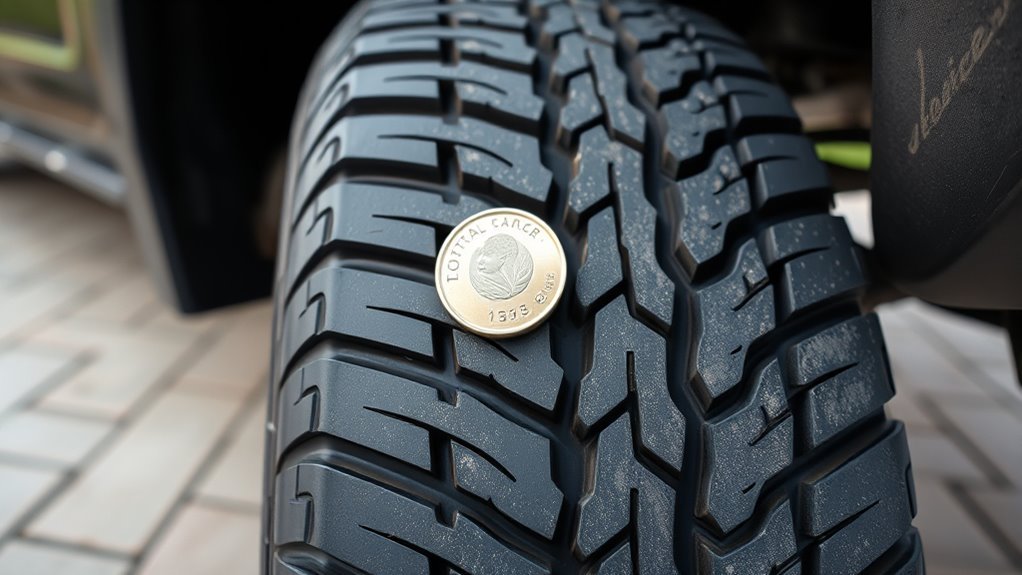
When you inspect your Tundra’s tires, check tread depth, wear bars, and for uneven patterns to decide whether immediate rotation or replacement is required. You’ll use tread indicators and wear patterns as objective triggers: measure depth with a gauge, confirm 2/32″ minimum, and note where wear bars sit flush with tread. If any tire hits 2/32″ or shows flush bars, replace it. If one tire shows localized wear—rear right heavily worn after 16k without rotation—plan immediate service.
| Check | Signal | Action |
|---|---|---|
| Tread depth | ≤ 2/32″ | Replace |
| Wear bars | Flush with tread | Replace |
| Side-to-side wear | Passenger vs driver mismatch | Inspect alignment |
| Single tire excess | One tire >> others | Rotate or replace set |
Rotate every 5,000 miles to prevent uneven wear patterns. Address alignment or suspension faults to reclaim control and freedom on the road.
How Towing, Payload, and Alignment Change Rotation Frequency
You inspected tread and wear patterns; now adjust your rotation schedule based on load and alignment. You’ll use objective checks to counter towing effects and apply payload considerations so wear stays even and predictable. Follow these steps:
- Monitor: log towing weight, trip miles, and payload. Heavy trailers shift load rearward, increasing rear tire wear; expect rotations sooner than the 5,000-mile baseline.
- Adjust interval: if you routinely tow heavy or exceed recommended payload, shorten rotations to 3,000–4,000 miles. That prevents premature rear wear and preserves handling and traction.
- Inspect alignment: misalignment creates asymmetric wear on one side; correct alignment immediately and re-evaluate rotation frequency based on new wear patterns.
You’ll prioritize measured data over guesswork. Track patterns, tighten intervals when towing or overloading, and restore alignment promptly. These procedural steps free you from reactive maintenance and extend tire life while keeping your Tundra safe and ready.
DIY Rotation Checklist: Tools, Safety, and Torque Specs for a Tundra
Before you lift the Tundra, gather a lug wrench, jack, jack stands, torque wrench, chalk or stickers, and a tire pressure gauge so the job goes smoothly and safely. Position the truck on a level surface, engage park and parking brake, and chock opposing wheels. Loosen lug nuts slightly before raising; support the axle with rated jack stands before removing wheels. Mark each tire with chalk or stickers to record original positions.
Check tire pressure and adjust to the vehicle-spec PSI before mounting to normalize wear patterns. Follow Toyota’s rotation pattern: move front tires straight back and rear tires straight forward—do not cross side-to-side with non-directional OEM Michelins. Hand-start lug nuts, then torque in a star pattern to 80 ft-lbs with a calibrated torque wrench. Recheck torque after a short drive.
These maintenance tips keep you independent, safe, and precise—liberating you from unnecessary shop visits while preserving tire life and handling.
What to Record at Each Rotation and When to Bring Your Truck to a Shop
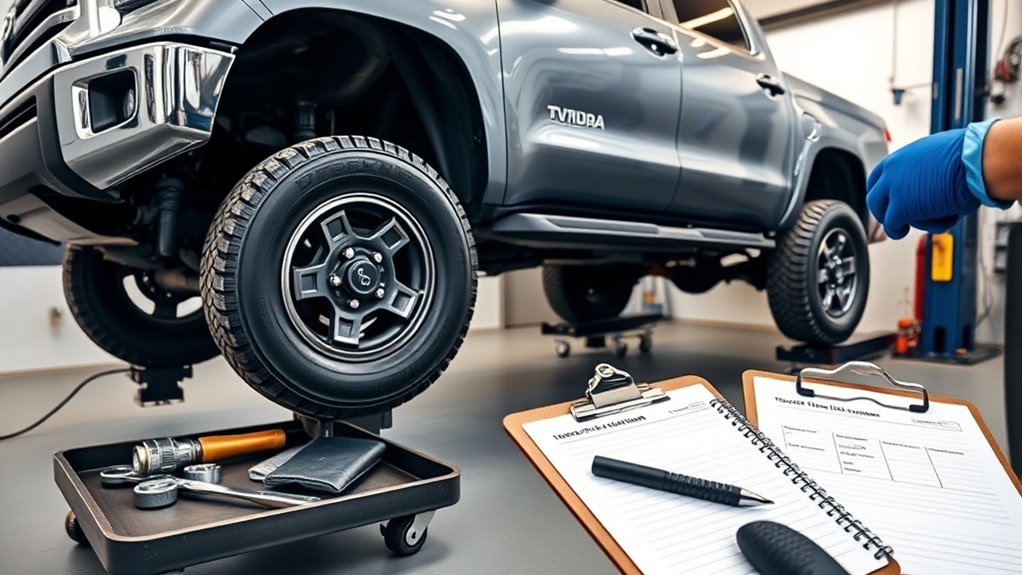
At each rotation, record the truck’s odometer reading, individual tire tread depths, observed wear patterns, and the exact pressure for each tire so you can spot trends and decide when to seek professional help. Use mileage tracking to verify you’re rotating roughly every 5,000 miles and log values in a dedicated file or app. Note any passenger-versus-driver differences and cupping.
- Record: odometer, tire position, tread depth (mm or 32nds), and PSI per tire.
- Inspect: visual wear patterns, cuts, bulges; flag irregularities for alignment or suspension checks.
- Thresholds: consider shop evaluation if tread depth nears or drops below 4/32″, if cupping appears, or if pressures can’t stabilize.
Keep entries dated and signed; liberation comes from control—accurate records let you challenge poor service and prolong tire life. If you see significant asymmetry or rapid decline between rotations, bring the truck to a shop for professional assessment.
When to Replace Two Tires Versus All Four: Matching Tread and Safety Limits
If two tires still have near-new tread while the others are below about 4/32″, you’ll usually want to replace all four to avoid mismatched handling and traction; if you must fit only two, install the new pair on the rear axle to preserve stability in wet or slippery conditions. Check tread depth across all tires and record measurements. If the difference exceeds manufacturer recommendations or varies notably, replace all four to eliminate tire wear asymmetry and unpredictable handling. When fitting two, choose identical size, load rating and tread pattern; mount them rearward. Prioritize rear fitment to reduce oversteer and hydroplaning risk. Address uneven wear patterns—camber, alignment, or inflation errors—before new tire installation to prevent repeat replacement. Log rotation intervals (every 5,000 miles) and note wear trends to delay full-set replacement when possible. You’ll mitigate safety concerns by matching tread depths and specifications, maintaining predictable traction, and preserving your control and independence on variable roads.
Frequently Asked Questions
Is It Okay to Rotate Tires Every 10,000 Miles on a Toyota?
No — you shouldn’t wait 10,000 miles; you’ll risk uneven tire wear. Rotate every 5,000 miles with each oil change, adjusting for driving conditions, to preserve performance, extend life, and maintain control and freedom on the road.
Is It Okay to Rotate Tires Every 7500 Miles?
You can, but you shouldn’t: rotating every 7,500 miles risks uneven tire wear versus the recommended maintenance schedule of 5,000 miles. Follow the 5,000-mile rotation to maintain balanced performance, safety, and liberation through reliable upkeep.
What Does Toyota Recommend for Tire Rotation?
Like clockwork, you’ll follow Toyota’s recommendation: rotate every 5,000 miles using front-to-back and back-to-front patterns, avoid crossing directional tires, monitor tread wear, and prioritize tire maintenance to keep your vehicle free and reliable.
Conclusion
Rotate your Tundra’s tires every 5,000–7,500 miles as a baseline, adjusting sooner if you tow, haul heavy payloads, or see uneven wear. Use front-to-back rotations for directional tires and an X-pattern for non-directional sets. Inspect tread depth, wear bars, and sidewalls at each service; replace tires when tread hits 2/32″ or when uneven wear compromises safety. Keep records of miles, pattern, torque specs, and alignment checks—like a maintenance log guiding future decisions.