If your Toyota Tundra’s traction-control/ABS light stays on, start by disconnecting the negative battery for 30 minutes, reconnect, turn the wheel fully left and right twice, and verify the brake-light switch works. Check stop-lamp fuses, relays, and wiring for power and continuity. Use a scan tool for ABS codes and live wheel-speed data, then test wheel-speed sensors and the steering-angle sensor. Follow this order to isolate faults quickly — keep going for step-by-step tests and repair options.
Quick Reset for a Toyota Tundra Traction-Control/ABS Light (Battery, Steering, Safety Checks)
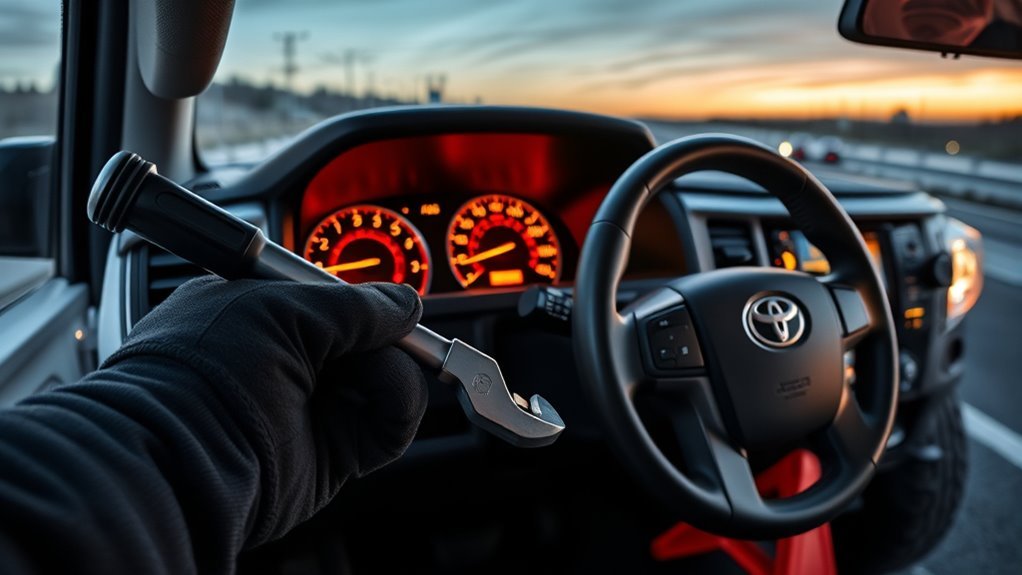
If your Toyota Tundra’s traction-control or ABS light comes on, start with a quick reset: disconnect the negative battery terminal for at least 30 minutes to clear the modules, reconnect and then turn the steering wheel fully left and right twice to help the ABS/steering sensors recalibrate, and drive the truck for about two minutes while watching the dash—also verify the brake light switch is working, since a faulty switch can trigger both warnings; if the lights remain, plug in a diagnostic tool to read fault codes. You’ll perform a controlled battery disconnection to force electronic modules to reset. After reconnection, complete steering recalibration by steering fully left and right twice; this aligns the steering angle sensor with the ABS module. Drive briefly to let the modules reinitialize and observe the dash. If warnings persist, capture fault codes with a scanner to guide targeted repairs. This methodical approach gives you straightforward control and moves you toward resolution without unnecessary steps.
Test the Brake-Light Switch at the Pedal (Fast Checks and Simple Fixes)
Locate the brake-light switch mounted at the top of the brake pedal arm and verify its mounting is secure. Inspect the switch and surrounding area for sand, debris, or corrosion that could block the plunger. Manually actuate the switch while an assistant watches the brake lights to confirm proper operation and replace the switch if it fails.
Locate The Brake Switch
1 quick check you can do is inspect the brake light switch mounted near the pedal: it’s small, usually plastic, and sits where the pedal arm meets the firewall. Locate the brake switch visually and by feel; you’ll see a plunger actuated by pedal travel. Use basic troubleshooting techniques: verify connector seating and harness condition before testing. With a multimeter, probe the switch terminals and press the pedal to confirm continuity changes—closed when depressed on most circuits. Note that a failed switch can trigger ABS and traction control warnings and disable shift lock. If continuity fails or signals are intermittent, prepare for replacement. After swapping the switch, recheck connectors and relevant fuses to restore complete system functionality and regain control.
Inspect For Debris
After you’ve checked switch continuity and connector seating, inspect the switch body and surrounding area for debris or corrosion that can impede its plunger or electrical contacts. You’ll free the pedal’s signal path and reduce false traction control warnings by cleaning or removing obstructions. Use contact cleaner, a soft brush, and compressed air; avoid aggressive tools that damage the brake switch. If visible corrosion remains, note wiring for further inspection. Maintain notes so you can liberate future troubleshooting from repeat checks.
| Item inspected | Action |
|---|---|
| Plunger | Brush, air, cycle pedal |
| Contacts | Spray contact cleaner, dry thoroughly |
| Wiring harness | Visual for breaks; secure connectors |
If cleaning doesn’t restore normal signals, proceed to wiring checks.
Test Switch Operation
If you suspect the brake-light switch is causing traction control or ABS warnings, have an assistant press the brake pedal while you observe the rear brake lights—this quick functional check confirms whether the switch is completing its circuit. If lights fail, you’ll know the brake switch isn’t signalling the system. Visually inspect the switch and plunger for debris or corrosion; clean contacts with electrical cleaner and retract the pedal to test movement. Adjust the switch position so the plunger engages fully when released and closes the circuit when depressed. If cleaning and adjustment don’t restore function, replace the switch—don’t gamble with ABS or traction control integrity. A functioning brake switch restores control and frees you from avoidable dashboard warnings.
How to Test Stop-Lamp Fuse Power, Relays, and Wiring
Now check stop-lamp fuse power, relay operation, and related wiring before moving on. Use a voltmeter on the 15A stop fuse with the ignition ON — you should see ~12V — and verify continuity on the 7.5A ECU‑IG No.1 fuse. If fuses test good, confirm the brake-light relay clicks under activation and inspect the brake-switch wiring and connector for damage, corrosion, or lack of input voltage when the pedal’s depressed.
Stop-Lamp Fuse Power
Because the stop-lamp circuit feeds multiple systems, you’ll methodically verify fuse power, relays, and wiring before moving on to component testing. Use a voltmeter at the 15A stop-lamp fuse to confirm switched voltage when the brake pedal is pressed. Check the 7.5A ECU-IG No.1 fuse for continuity and correct supply. Verify brake light switch connections; a faulty switch can disable lights and upset ABS/traction control. Perform wiring inspection and continuity checks to find breaks or shorts; pursue fuse replacement only if a fuse is blown and the cause addressed.
- Measure voltage at the 15A stop fuse during pedal activation.
- Test continuity to the brake light switch.
- Inspect ECU-IG No.1 fuse condition.
- Replace fuses and repair wiring to restore freedom.
Relay And Wiring Checks
Start by isolating the stop-lamp circuit and verifying power at the 15A stop fuse with a voltmeter—press the brake pedal and confirm a switched 12 V at the fuse terminal; absence of voltage points to an upstream fault. Next perform relay diagnostics: with an assistant pressing the pedal, listen for the brake light relay click and probe coil and contact terminals for voltage and continuity. If the relay fails to click or shows no continuity under activation, replace it. Conduct wiring inspection from the fuse to the brake light switch and rear lamps—look for chafing, breaks, corrosion, or poor connectors. Check related fuses including the 7.5A ECU-IG No. 1. Log any recent electrical modifications; they often reveal the true cause.
When to Use a Scan Tool and Which ABS/Traction Codes to Read
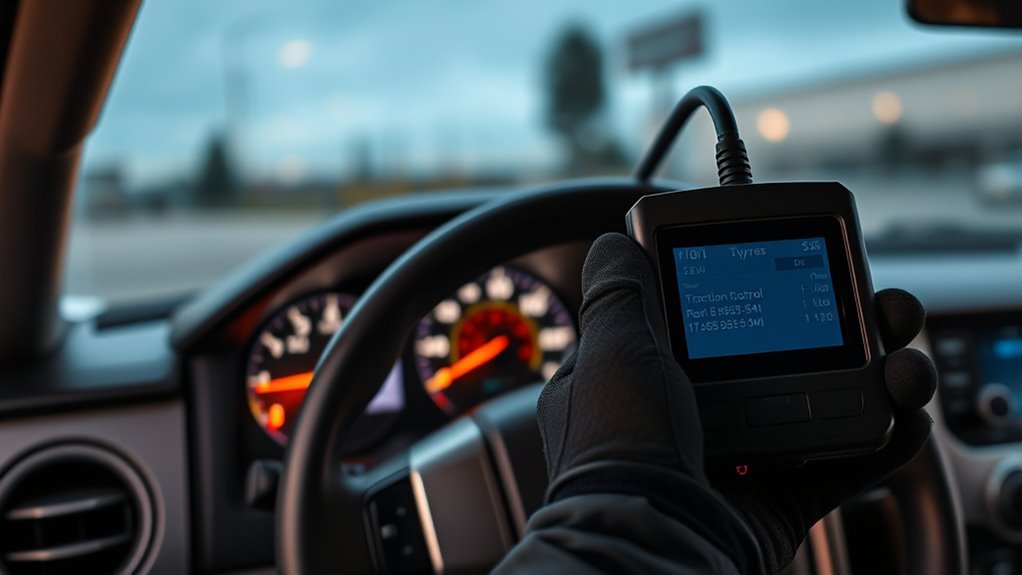
If your ABS or traction control lights stay on after basic checks, use a scan tool to pull stored and pending codes so you can pinpoint the fault instead of replacing parts at random. Scan tool benefits include targeted diagnostics, real-time data streaming, and avoiding needless expense. You’ll get clear fault code interpretation to guide repairs and restore control.
Use the scan tool when:
Use a scan tool when warning lights persist, faults recur, or live ABS data is needed for diagnosis.
- Warning lights persist after visual relay and wiring checks.
- Intermittent faults appear or codes return after clearing.
- You need live wheel speed and ABS module data to confirm symptoms.
- Preventive diagnostics are part of routine maintenance.
Read codes like C0210 (wheel speed sensor) and C1201 (brake light switch) first; they directly affect ABS/traction logic. Interpret stored, pending, and history codes to differentiate transient glitches from hard failures. This methodical approach liberates you from guesswork and focuses effort on proven fixes, saving time and money.
Test Wheel-Speed Sensors and Wheel Harnesses
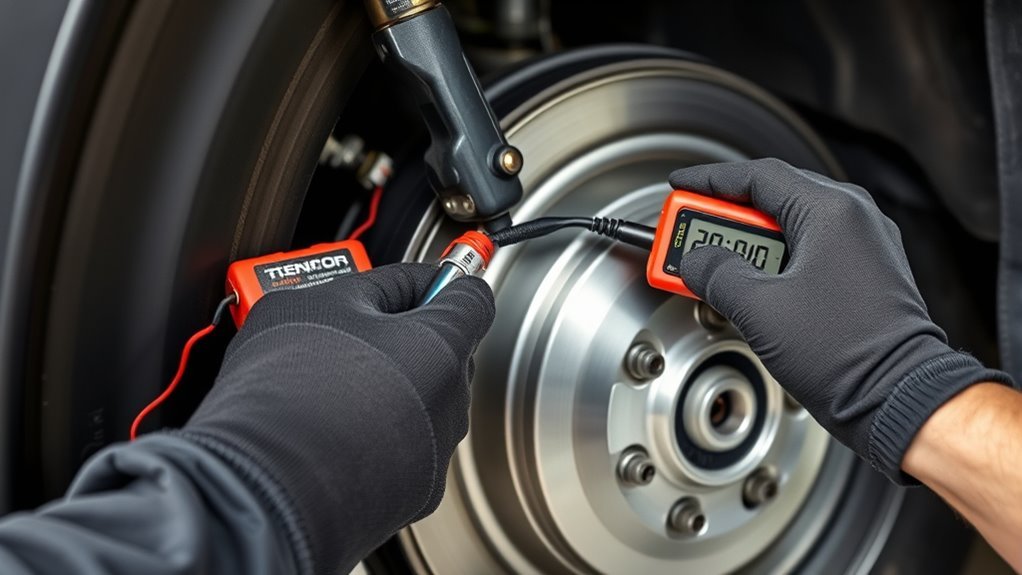
With codes pointing at wheel-speed issues or after live-data shows an erratic wheel signal, check the wheel-speed sensors and their harnesses next. You’ll start with a visual harness inspection: lift the wheel, secure the vehicle, and trace the wiring from sensor to connector. Look for chafing, fraying, corrosion, or broken wires that cause intermittent loss of data. Clean corroded connectors and reseat them; replace damaged sections and secure routing to prevent future wear.
Next, measure sensor resistance with a multimeter. Disconnect the sensor, set the meter to ohms, and record the reading; functioning sensors typically show about 1,000–2,000 ohms. Readings far outside that range indicate a failed sensor. If you find a bad sensor, replace it with an OEM unit to maintain system integrity. Re-test after replacement and clear codes. This methodical approach frees you from guesswork and restores reliable ABS and traction control feedback.
Diagnose ABS Module and Steering-Angle Sensor Faults
Because the ABS module and steering-angle sensor work together to interpret wheel speed and steering input, you should first pull diagnostic trouble codes and live data to determine which component is at fault. Use diagnostic tools that read ABS-specific codes and stream wheel speed and steering-angle values while you turn the wheel and spin each wheel. Compare live data against expected ranges to isolate inconsistent sensors.
Inspect connectors and wiring for corrosion, breaks, or loose pins; faults often show intermittent signals rather than steady failures. If the fault code implicates the steering-angle sensor, check its alignment and confirm sensor calibration after any replacement or battery reset.
- Read ABS module codes and record live wheel-speed traces.
- Verify steering-angle sensor output during lock-to-lock rotation.
- Inspect harnesses and grounds for damage or high resistance.
- Perform sensor calibration per manufacturer procedure when signals normalize.
Work methodically, reclaim control of safety systems, and avoid assumptions—data guides repair decisions and restores operational freedom.
Cost-Effective Fixes vs. Professional Repair: Parts, Labor, and Next Steps
Having isolated whether the ABS module or steering-angle sensor is at fault, you can weigh cost-effective DIY fixes against professional service. Do a brief cost analysis: replace a brake light switch for $20–$50 in parts and under an hour of your time; basic diagnostic scanners run $50–$150 and let you read fault codes before committing. Inspect wiring and fuses first—regular maintenance prevents escalation.
List repair options clearly: 1) DIY minor fixes — switch replacement, connector cleaning, fuse checks; low parts cost, minimal labor, immediate control. 2) Semi-professional — buy or borrow a scanner, verify codes, attempt sensor cleaning or reseating. 3) Professional service — expect $100–$300 depending on diagnostics and labor for ABS module or sensor replacement.
If warning lights persist after resets and minor repairs, get professional help to avoid cascading failures. Choose freedom: invest your time and tools when feasible, but don’t delay expert repair when complexity or risk rises.
Frequently Asked Questions
Why Is My Traction Control Light Staying on My Toyota?
Your traction control light stays on because traction control issues like a faulty brake light switch, ABS wheel speed sensor, or steering angle sensor need diagnostic troubleshooting; you’ll run scans, free yourself from uncertainty, then repair the identified fault.
Conclusion
You’ve walked through quick resets, pedal and fuse checks, sensor tests, and when to plug in a scan tool — now act. Start with battery, brake-light switch, and wheel-speed sensors; trace wiring before ordering expensive modules. Treat faults like a checklist: rule out simple power and harness issues first, then escalate to ABS module or steering-angle diagnostics. Think of the process like tuning an instrument — methodical steps get you back in harmony without wasting parts or cash.