You can fit a 2019 CrewMax Tundra into many garages, but you’ll need precise measurements and adjustments. Measure overall length (231″) and total height including lifts, tires, racks and a 2″ safety margin. Backing in and using bumper retraction or markers gains useful inches. Check posted clearance heights and interior bay depth; allow ~24’–30′ depth for comfortable two‑car layouts. Use vertical storage and parking aids to optimize space — continue for detailed fit tests and layout tips.
Quick Fit Check: Will Your Tundra Fit?
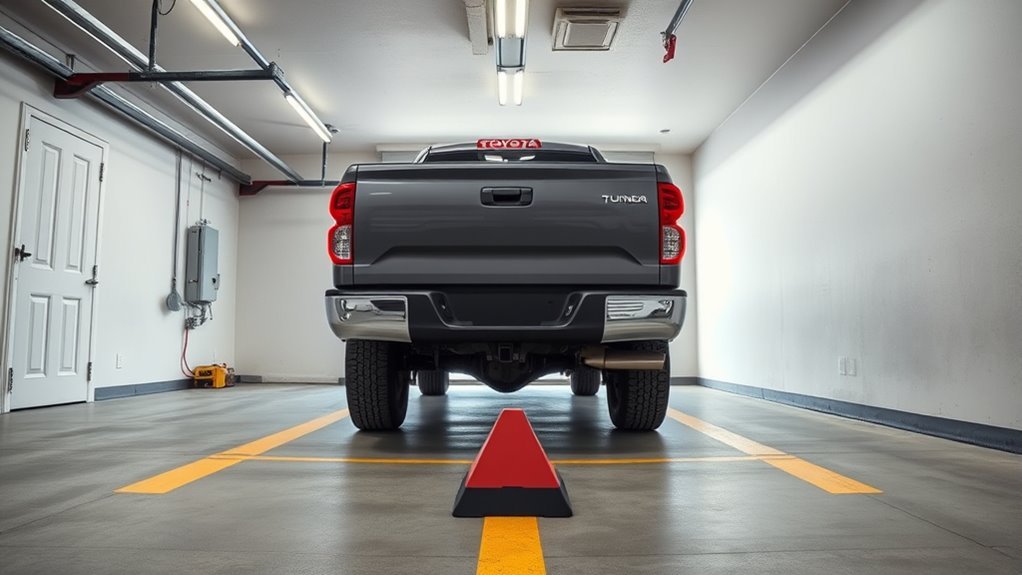
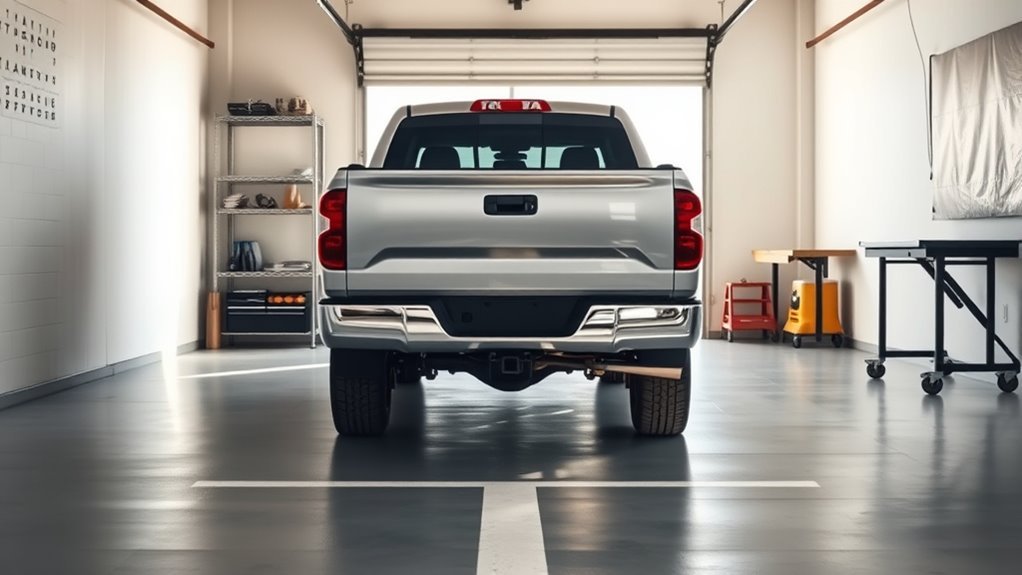
Wondering if your Tundra will fit in your garage? Start by comparing the 2019 CrewMax’s 231-inch length to your bay: a 231-inch garage is effectively a tight match. You’ll usually need to back in to maximize usable clearance; many owners adopt simple parking strategies like tennis-ball markers or painted stop lines to stop within inches of the wall. Measure available clearance behind the bumper—sometimes you’ll only have a few inches, so precision matters.
Plan for layout: a two-car garage often leaves little room for a second vehicle or storage unless you rearrange regularly. Consider low-profile Tundra accessories—bed racks or toolbox placements—that don’t lengthen the footprint. If you’ve lifted your truck, factor lift height against overhead limits; a 6-inch lift can push you over some garage height restrictions. Use these checks to make a decisive, liberated choice about fit and necessary adjustments.
Measure Your Tundra: Height, Lift, and Tires
Measure your Tundra by taking the stock height and adding any lift height to get the baseline overall vehicle height. Then calculate tire diameter impact by comparing your new tire radius to stock — extra inches in tire height directly raise the vehicle. Always leave at least a 2-inch safety margin below the garage clearance to prevent contact.
Measure Overall Vehicle Height
Start by noting your Tundra’s stock height—about 6 ft 4 in on average—then add any lift and larger tire dimensions to compute the overall height you’ll need to clear garage limits. For accurate height measurement, park on level ground, measure from ground to highest point (include antennas, light bars, roof racks) and record vehicle modifications that affect clearance. Add lift height and the effective tire radius increase to the stock figure to get overall height. Compare that against posted garage clearances and maintain at least a 2-inch safety margin. If your combined height approaches or exceeds common 7-foot limits, you’ll need alternate parking or removable accessories. Keep a written spec sheet for quick checks before each entry.
Account For Lift Height
Because lifts and tires directly change your Tundra’s vertical profile, you should record the stock height, add the measured lift height, and include the effective tire radius increase to calculate the new overall height before entering any garage. Start with your model’s baseline—around 6’4″ for many Tundras—then add the lift kit options’ nominal rise (e.g., a 6-inch lift approaches ~7′ total). Factor in tire upgrades: larger tires raise ride height beyond lift alone. Include accessories like light bars or roof racks that add vertical inches. Maintain at least a 2-inch clearance margin under garage limits. Measure after installation, on level ground, with normal load and tire pressure. Document results and choose parking spots that respect your liberated truck’s verified profile.
Calculate Tire Diameter Impact
Now that you’ve accounted for lift height and accessories, you’ll need to quantify how tire diameter changes the overall profile. Use the stock baseline (≈6’4″) plus lift height plus half the tire diameter increase to estimate new height. For example, a 6″ lift with 33″→35″ tires adds 6″ + 1″ = 7″. Measure after modifications; lift effects vary by kit and tire size. Maintain a minimum 2″ clearance margin versus garage limits to avoid contact from uneven surfaces or snow. You deserve freedom on the road—confirm limits before entry.
| Baseline | Lift (in) | Tire delta/2 (in) |
|---|---|---|
| 76″ | 6 | 1 |
| 76″ | 4 | 0.5 |
Check Garage Clearances: Signs and Common Limits
Check the entrance height signs before you drive in—they usually list a maximum clearance, with common limits around 7′ for standard spaces and 8’2″ for van-accessible spots. Compare that posted height to your Tundra’s total height including lift, tires, and roof accessories. Maintain at least a 2″ safety margin since pavement variations or snow can reduce effective clearance.
Entrance Height Signs
When you approach a garage entrance, read the posted clearance sign and compare it to your truck’s overall height—including roof accessories, lift, and larger tires—so you don’t risk a collision. Entrance height and clearance markings vary; garages often post 7′ for standard spaces and 8’2″ for van-accessible bays, but many deviate. You must add lift height and tire-size change to the stock height to calculate your effective height. Maintain at least a 2-inch safety margin to account for sag, ramps, or snow. Verify each garage’s posted limit before entry; do not assume consistency between structures. If your modified Tundra approaches or exceeds posted limits, seek alternative parking or use surface lots to preserve mobility and avoid costly damage.
Typical Clearance Limits
Most parking garages post clearances around 7 feet, with van-accessible bays often at about 8’2″, so you should always compare the posted limit to your Tundra’s total height—including roof racks, lift, and tire changes—before driving in. Check entrance signs: some sections drop below 7 feet. Measure your truck including accessories and keep at least a 2-inch safety margin to account for uneven pavement or snow buildup. Clearance challenges for lifted Tundras are real; a single misread sign can cost bodywork. Use deliberate parking strategies: scout the entrance, map taller bays, and fold or remove roof-mounted items when feasible. Record your vehicle’s certified standing height and review it before parking to maintain freedom of movement without risking damage.
Calculate Total Vehicle Height (With Margin)
Start by adding your Tundra’s stock height—about 76 inches—to the lift height and any increase from larger tires to get the vehicle’s raw height; for example, a 6-inch lift plus 35-inch tires typically brings the truck to roughly 82 inches (6’10”). You’ll then add any permanent roof-mounted gear—light bars, racks, antennae—to create a true maximum height. Maintain at least a 2-inch safety buffer between that measured height and the garage clearance to avoid scraping or damage. Many garages max out near 7 feet; van-accessible bays can be about 98 inches (8’2″), so compare your final number against posted limits before entering. Measure physically with the truck on level ground and the suspension settled; use a tape from ground to highest hard point. Record lift height and tire size for future checks after modifications. This method frees you to choose setups that fit your garages without sacrificing mobility or risking confinement.
Home Garage Fit Tests: Length, Bumper Retraction, Tennis‑Ball Trick
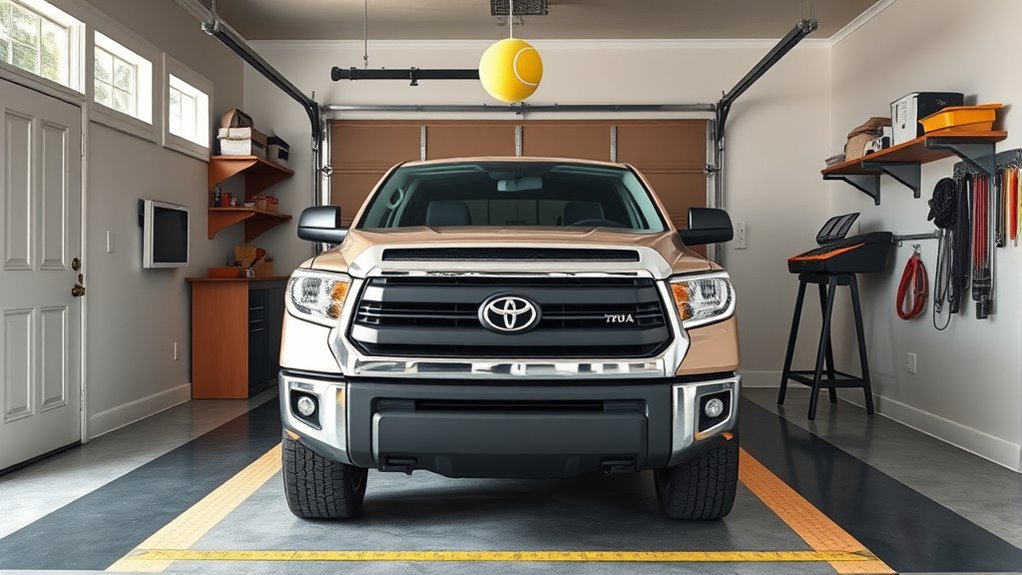
Although your CrewMax stretches to 19’1″, you can still reliably fit into tight garages by running a simple set of fit tests: measure the bay, account for door swing and storage, and use bumper retraction and the tennis‑ball guide to position the truck precisely. First, measure interior bay length; 19’3″ bays are marginal for a 19’1″ Tundra, so mark the required clearance lines on the floor and door. Account for shelving and doors that reduce usable length.
Next, engage bumper retraction benefits: retracting both bumpers nets roughly 1 foot of total clearance (6″ each), improving approach angles and reducing required forward setback. Combine that gain with a tennis ball techniques guide hung from the ceiling aligned with the rear bumper; back until the ball touches to achieve about 8″ front clearance. Finally, reorganize storage and use floor markers for repeatable positioning. These technical checks free you from guesswork and make tight-garage parking consistent.
Parking Garage Tactics for Lifted Tundras
If your garage fit tests showed tight clearances for length, don’t forget to run the same rigor on vertical space when your Tundra is lifted — a few inches of suspension and larger tires can put you over common 7–8 ft height limits. You’ll calculate overall height by adding lift height and tire diameter change to the stock height, then aim for at least a 2-inch buffer under the garage limit. Use hanging markers or height guides at the entrance to validate clearance in real time and prevent costly contact.
Account for variables that raise ride height: snow, jack stands, or uneven flooring. Measure after every suspension or tire modification and document the result. If you need more room, explore garage modifications focused strictly on vertical clearance — raising door tracks or trimming header obstructions where permitted. Apply these parking techniques systematically so you retain freedom to build and drive the Tundra you want without compromising structure or mobility.
Garage Design & Door Specs That Work for Tundras
When designing a garage for a Toyota Tundra, plan dimensions and door specs around the truck’s 19’1″ length and possible modifications so you’ll have reliable clearance and maneuvering room. You should target at least a 26-foot width; 30′ x 20′ gives you true freedom to move, open doors, and store gear without squeezing the truck. Depth needs a minimum of 24 feet to avoid bumper-to-wall stress; that preserves access and reduces reversing errors.
Specify doors at least 9 feet wide, 10 feet preferred for full-size trucks to prevent dings and simplify entry. Heights should be no less than 7 feet; 8 feet is better if you lift the Tundra or add roof gear. Ceiling height of 9 feet improves ventilation, heating efficiency, and allows future lifts. Choose durable door materials—steel or insulated composite—for security and thermal control. Align your garage layout, clearances, and door materials with these specs to keep your mobility uncompromised and maintenance minimal.
Maximize Two‑Car Garage Space: Layout and Storage Tips
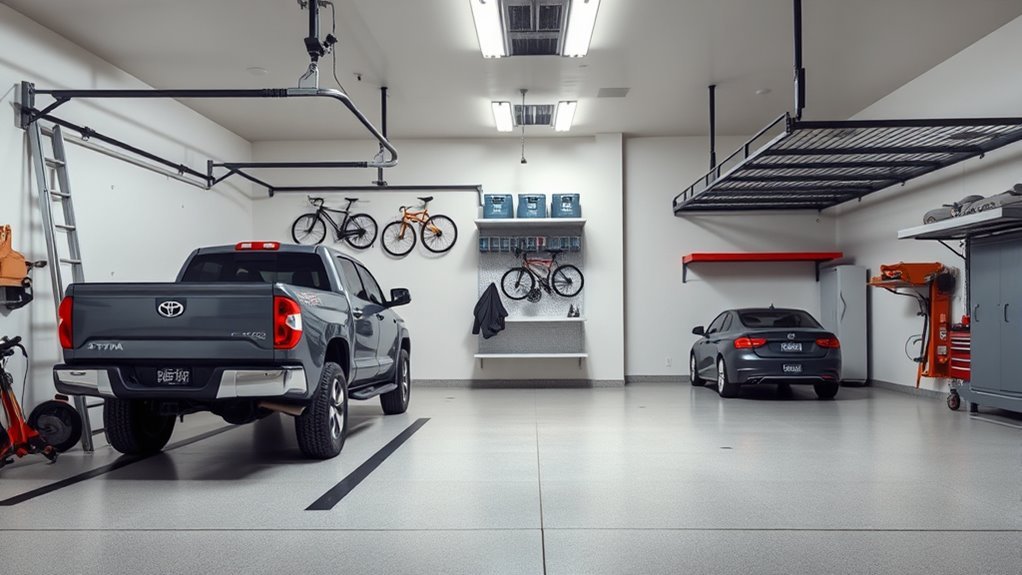
Start by treating your two-car garage as a modular workspace: reserve at least a 26′ width and 24′ depth so a Tundra fits without blocking the opposite bay, then plan vertical zones—floor clearance for vehicle access, a midwall band (48–60″ high) for hooks and pegboards, and upper shelving above 84″ for seasonal or infrequent items. You’ll use storage solutions and vertical organization to reclaim floor area, keep toolsets accessible, and allow the Tundra to park without reshuffling. Mount a slim workbench on drawer slides to stow when not in use. Add tire stops or a hanging tennis ball to guarantee consistent front clearance—about 8″—so both bays coexist.
- Install wall-mounted rails and pegboards in the midwall band.
- Use high-capacity shelving above 84″ for infrequent gear.
- Fit rolling cabinets under the midwall workband for mobile storage.
- Apply clear parking aids and a shared parking protocol.
These measures free movement, simplify maintenance, and liberate your garage workflow.
Frequently Asked Questions
How to Tell if a Truck Will Fit in the Garage?
Measure your truck’s length, width, and height, then compare those measuring dimensions to your garage clearance (length, door width, and overhead). Account for lifts, tires, and door swing so you’ll confidently free yourself from parking doubt.
Conclusion
You’ve got the tools to decide if your Tundra fits: measure its total height with lift and tires, add clearance margin, and test garage length and door swing. For example, a neighbor with a 3-inch lift and 35-inch tires measured 81.5 inches total, left a 3-inch safety gap, and trimmed overhead shelving to park comfortably. Use precise measurements, a tennis‑ball clearance test, and adjust storage to guarantee reliable daily access.