Toyota Tundra fuel tanks vary by year and trim: base SR/SR5 models (around 2022) use roughly 22.5 gallons, mid/high trims commonly carry ~32–32.2 gallons, some 2019 SR5s offered a 38-gallon option, and aftermarket tanks can reach ~46 gallons. Usable fuel is typically less than rated—expect ~25–26 usable from a 32‑gal unit—with reserve lights at ~6–8 gallons. Gauge and MTE readouts can lag; continue for verification, testing, and upgrade details.
What Fuel Tank Sizes Does the Toyota Tundra Have?
Fuel tank capacity varies across Toyota Tundra model years and trims, ranging from about 22.5 gallons on base 2022 SR/SR5 trucks to roughly 32–32.2 gallons on higher 2022–2023 trims (Limited, Platinum, 1794, TRD Pro, Capstone), with earlier models like the 2019 offering 26 gallons and an optional 38-gallon package on upgraded SR5s; reserve capacity typically sits between 6 and 8 gallons. You’ll choose between discrete capacities—22.5, 26, 32, 32.2, and 38 gallons—based on trim and optional packages, which directly affect driving range and refueling cadence. Understand that larger tanks reduce stops and enhance range, aiding your autonomy, while smaller tanks save weight and slightly improve fuel efficiency when unloaded. For optimized performance, you’ll perform scheduled tank maintenance: inspect filler neck, seals, and venting; replace filters and monitor for contamination. Accurate awareness of your tank size lets you plan long trips, manage fuel consumption, and assert control over logistics, freeing you from unnecessary constraints and unexpected refueling delays.
Which Trims and Years Use 22.5 Vs 32.2‑Gal Tanks?
You’ll get a clear model-year and trim breakdown showing which Tundras use the 22.5‑gal versus 32.2‑gal tanks. Focus on 2022 SR/SR5 (22.5 gal) and higher trims like Limited, Platinum, 1794, and TRD Pro (32.2 gal), plus similar 2023 hybrids and Capstone with ~32 gal. Then I’ll explain how to verify tank size by VIN, owner’s manual, and fuel-filler label.
Model-Year And Trim Breakdown
Across model years and trims the Tundra’s fuel capacity shifts considerably, so you’ll want to match tank size to your driving needs: You’ll find smaller tanks on base trims and larger tanks on premium or off‑road variants, which directly affects fuel efficiency and driving range. For 2022, SR and SR5 use 22.5 gal; Limited, Platinum, 1794 and TRD Pro use 32.2 gal. The 2023 Limited TRD Off Road Hybrid and Capstone sit near 32 gal. Older models vary—2019 has 26 gal, with an optional 38 gal on upgraded SR5 packages. Choose trim by balancing refueling frequency, payload, and autonomy.
| Year | Trim Examples | Tank (gal) |
|---|---|---|
| 2019 | SR5 (opt) | 26 / 38 |
| 2022 | SR / SR5 | 22.5 |
| 2022+ | Limited/Capstone/TRD Pro | 32–32.2 |
How To Identify Tank Size
Want to know which Tundras come with the smaller 22.5‑gallon tank versus the 32–32.2‑gallon unit? Check trim and year: 2022 SR and SR5 use 22.5 gal; 2022 Limited, Platinum, 1794 and TRD Pro use 32.2 gal. The 2023 Limited TRD Off Road Hybrid also has a ~32‑gal tank. Older 2019 models standardize at 26 gal, with an SR5 upgrade offering a 38‑gal option (not with a bench seat). Use tank identification tips: consult the owner’s manual, VIN build sheet, dealer spec sheets, or the label inside the fuel door. Verify fuel gauge accuracy after refilling; gauges can misread when tanks differ from expected capacity. Confirm capacity by model-year and trim before planning long trips.
How Much Usable Fuel Is in the Tank?
You’ll see a difference between the rated 32‑gal capacity and the roughly 25–26 usable gallons most owners actually get when topping off near empty. The reserve light and gauge behavior aren’t perfectly calibrated—some drivers report only 20–22 gallons despite an empty reading—so expect a 6–8 gallon reserve and variability from driving conditions. To protect the fuel pump, fill at or before the 1/4–1/2 tank mark rather than relying on the reserve.
Usable Gallons Versus Rated
While the Tundra’s spec lists a 32-gallon tank on some trims, you’ll often be able to add only 25–26 gallons when near empty because a 6–8 gallon reserve and tank geometry keep some fuel unavailable to the pump; user reports even show 20–22 gallons added in tanks rated at 26, so treat the rated capacity as a maximum rather than the usable volume. You should expect usable fuel discrepancies driven by reserve volume, baffling, and filler neck placement. Tank calibration issues and manufacturing tolerances also shift what the pump can reach. Monitor fills after long drives to quantify your truck’s real usable liters (gallons). Adjust your habits: plan refueling before critical range, and use empirical fill data to reclaim operational freedom.
Reserve Light And Reality
Although the yellow fuel warning light is meant to warn you with about 6–7 gallons remaining, real-world fills show a larger conservative reserve: many owners only add 20–22 gallons to a tank rated at 26, and manufacturing tolerances, baffling and sensor calibration can leave 6–8 gallons unreachable even when the gauge reads empty. You should expect reserve confusion: the system intentionally underreports usable volume to prevent you from stranding. Trust the warning light over DTE readouts; fuel gauge accuracy varies with tilt, load and driving style. Practically, plan on 20 usable gallons for route planning and refueling freedom. If you demand certainty, verify your vehicle’s true usable capacity by controlled fill tests and log results to overcome electronic ambiguity.
Why Miles‑to‑Empty and Your Fuel Gauge Can Mislead?
Because DTE is computed from recent fuel use and the fuel gauge reads from a sender that can stick or float, both can give misleading readings when conditions change, so you shouldn’t rely on either as exact. You’ll see fuel gauge inaccuracies and DTE fluctuations when driving style, load, or terrain shifts; the reserve light typically triggers at ~6–7 gallons, which is a firmer warning than DTE. Trust measurements, not illusions.
- DTE fluctuates: calculated from past MPG, sensitive to transient consumption.
- Sender faults: sender arm can stick or float, producing erratic gauge swings.
- Reserve light: activates with about 6–7 gallons—use as conservative baseline.
- Tank fill variance: reported 20–22 gallon fills on 26-gallon specs indicate usable vs. theoretical capacity.
- Manual tracking: log miles and gallons to compute realistic range.
You deserve control: combine reserve-light rules, manual calculations, and conservative refueling habits to break dependency on unreliable indicators.
Tundra Owner Fill‑Ups: Real‑World Gallons Added
Many owners report adding about 25–26 gallons to a 2023 Tundra Limited TRD Off‑Road Hybrid after roughly 500 miles of mixed driving, even though the tank’s nominal capacity is 32 gallons; this gap reflects unusable reserve fuel and gauge/reporting variances. You’ll observe that the yellow fuel warning lights at about 6–7 gallons, which is a more consistent trigger than DTE readouts. In practice you’ll plan fills around the warning or between 1/4 and 1/2 tank to protect the pump and maintain operational freedom.
Expect variance: some drivers only add 20–22 gallons when the gauge reads empty, indicating calibration differences or trapped fuel. Track your actual gallons per refill to quantify fuel efficiency under your driving habits. Use measured fill volumes and odometer distance to calculate real MPG and range; that empirical approach frees you from optimistic instrument estimates and lets you manage range with precision.
How Driving Style and Payload Change Range and MPG
Now that you’ve seen how reported fill volumes and warning thresholds affect practical range, consider how driving style and payload shift those numbers. You’ll notice your MPG varies with measurable inputs: acceleration patterns, speed, terrain, and loaded weight. Apply efficient driving techniques to reclaim range; avoid hard launches and maintain steady speeds. Track conditions and modifications to quantify losses.
- Smooth acceleration and deceleration reduce fuel use; aggressive inputs cut MPG considerably.
- Lower cruising speeds on level terrain improve efficiency; terrain and weather still alter outcomes.
- Towing and heavy payloads increase engine load and fuel consumption; quantify payload impact before trips.
- Modifications (lift kits, all-terrain tires) raise aerodynamic and rolling resistance, lowering MPG.
- Monitor trip data and adapt driving techniques to maximize liberated range and predict refueling needs.
You’ll liberate range by treating MPG as a controllable variable and optimizing driving behavior and payload management.
Safe Fueling Practices to Protect the Pump and EVAP
When you top off at the pump or run the tank near empty, you risk shortening fuel-pump life and upsetting the EVAP system—so aim to refill around the 1/4-tank mark, stop fueling when the nozzle clicks, and use steady, controlled fueling to avoid spills and vapor-system exposure. You’ll protect fuel pump protection by keeping the tank sufficiently submerged; liquid fuel cools and lubricates the in-tank pump, preventing overheating and premature wear. Avoid topping off after the automatic shutoff—excess fuel floods vapor lines and can compromise the EVAP system’s valves and sensors. Fuel slowly near the end of a fill to limit aeration and splashing that can introduce vapors to EVAP components. Monitor the gauge regularly to plan fills before the quarter-tank threshold; that habit preserves pump life and operational freedom. In short: top up at ~1/4, stop at the click, fuel steadily, and you’ll maintain reliability and minimize emissions-system damage.
How to Test Your Truck’s True Tank Capacity and Gauge?
Keeping your tank between about a quarter and a half full protects the pump and EVAP, but you’ll also want to confirm how much fuel your Tundra actually holds and how accurate the gauge is. Run until the engine stalls or quits, record gallons added at refill — owners commonly report ~25–26 gallons after ~500 miles. Note yellow light activation near 6–7 gallons; treat it as a more reliable reserve cue than DTE.
Apply systematic tank testing and gauge calibration steps to free yourself from guesswork:
Apply systematic tank testing and gauge calibration to eliminate guesswork and get reliable, repeatable fuel data.
- Start from a full fill; reset trip and odometer for baseline.
- Drive normal routes and note fuel added when the vehicle quits.
- Log when yellow light illuminates to quantify reserve volume.
- Compare consumed gallons to trip miles for real MPG and consumption patterns.
- Use repeated tests under varied loads (towing, city) to validate gauge calibration.
Use this data to plan fueling, extend pump life, and refuse misleading range estimates.
Aftermarket Long‑Range Tanks and Replacement Options
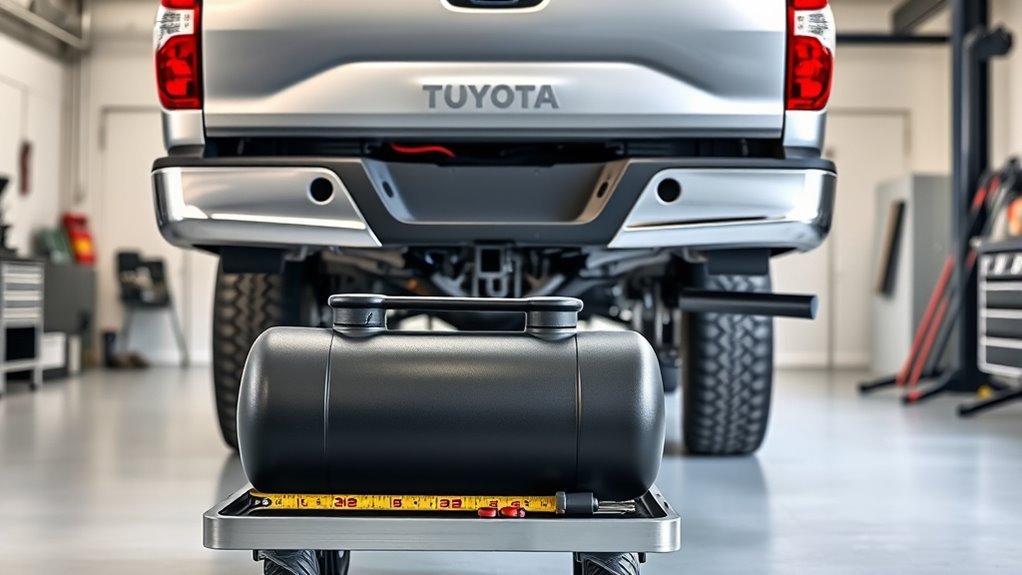
If you’re after considerably more range, aftermarket replacement tanks—such as Long Range Automotive’s 46‑gallon units—drop in for 2007–2021 Tundras and use the factory sender so your gauge stays accurate after install. You’ll gain ~20 gallons over the stock 26‑gal tank, compatible with 4.6L and 5.7L V8s. Long Range Automotive has manufactured tanks since 1989 and backs them with a warranty. Note: California sales are prohibited; shipping goes to freight terminals or via paid home delivery.
| Feature | Value | Impact |
|---|---|---|
| Capacity | 46 gal | Extended range |
| Compatibility | 4.6L/5.7L | Direct fit |
| Sender | Factory | Accurate gauge |
Installation typically takes ~4 hours by a certified mechanic and requires removal of auxiliary parts for fitment. For liberation on the road, weigh aftermarket benefits against shipping limits and legal restrictions. Follow installation tips: verify sender seating, torque straps to spec, and test for leaks before road use.
Frequently Asked Questions
How Many Gallons Is a Toyota Tundra Gas Tank?
You’ve got between about 22.5 and 32.2 gallons depending on trim; older models ranged 26–38 gallons. Consider towing capacity and engine options when calculating range, since load and powertrain affect real-world fuel use and reserve.
Conclusion
Like a calibrated instrument, your Tundra’s tank capacity and usable fuel determine real-world range—know whether you’ve got 22.5 or 32.2 gallons, account for roughly 90–95% usable volume, and factor in driving style, payload, and onboard inaccuracies in miles‑to‑empty readouts. Test fill and gauge behavior to confirm actual capacity, maintain proper fueling practices to protect the pump and EVAP, and consider certified aftermarket tanks only when you need verified extra range.