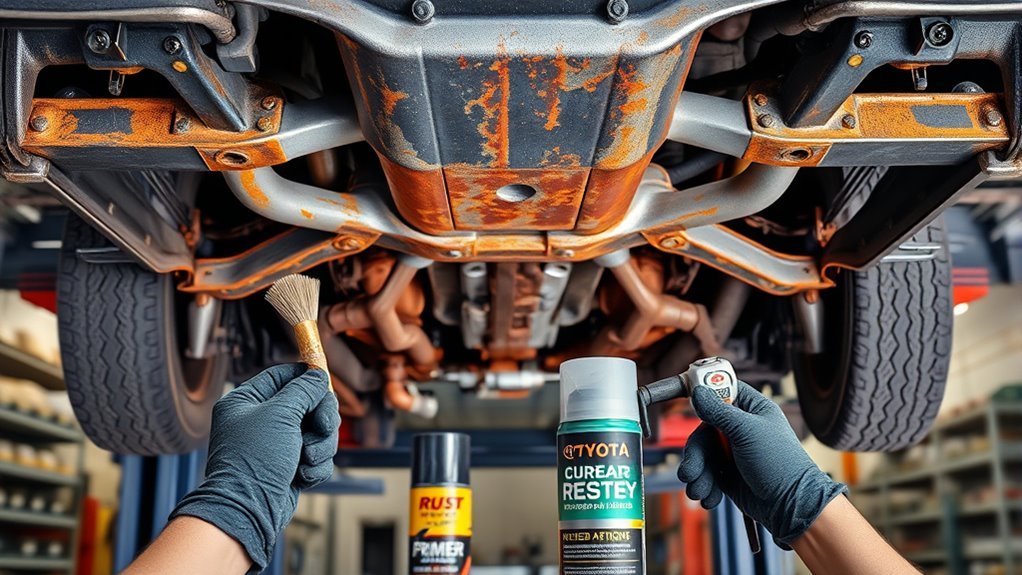
Toyota Tundra Frame Rust Repair: What to Do First
By Ryker Calloway · Document review against Toyota and NHTSA records
Last updated: July 31, 2026. Toyota and NHTSA frame-program records, campaign remedies, historical deadlines, warranty distinctions, and VIN-lookup limitations were rechecked for this revision.
Toyota Tundra frame rust repair depends on whether the corrosion is surface-only, advanced, or structural. Thin discoloration on solid metal may qualify for cleaning and protection after inspection. Thick scale, swollen seams, or deep pitting needs closer evaluation before coating. Holes, cracked or separated welds, distorted rails, soft metal, or weakness around suspension, steering, cab, bed, crossmember, brake-line, or fuel-tank mounting points require a qualified frame or collision-repair inspection.
Do not hide scale, perforation, or weakened mounts with paint, filler, patch plates, or undercoating. Avoid towing, hauling, off-road driving, or lifting the truck by a suspect section. Arrange towing when corrosion may affect braking, steering, suspension attachment, fuel-tank support, or the truck’s ability to be lifted safely.
Quick Answer
Inspect the rear crossmember, spare-tire area, fuel-tank supports, brake-line area, suspension and steering mounts, cab and bed mounts, frame rails, welds, seams, and factory drain openings. Surface discoloration with solid metal may qualify for cleaning and coating. Flaking layers, deep pits, holes, split welds, distorted rails, or damaged mounting points require professional inspection before continued heavy use. Toyota had historical programs for certain 2000–2003, 2004–2006, and 2007–2008 Tundras, but the limited campaigns and warranty periods had deadlines. Any currently open safety recall is VIN-specific.
Key Takeaways
- Rust location and remaining metal strength matter more than the total rusty area.
- DIY treatment is limited to confirmed surface corrosion on solid metal.
- Holes, deep pitting, cracked welds, soft metal, and weak mounts need professional inspection.
- Toyota’s frame programs had different eligibility, remedies, and deadlines.
- A clean online VIN result does not show every completed, expired, or older campaign.
How this guide was verified: Historical campaign statements were checked against Toyota documents filed with NHTSA and Toyota’s current recall and campaign lookup guidance. The inspection and repair framework is document-based. It does not claim a hands-on inspection of your truck and cannot certify any frame as safe.
Tundra Frame Rust at a Glance
| What You Find | Likely Level | Next Step | Driving and Towing Guidance |
|---|---|---|---|
| Thin orange or brown film, intact shape, no scale, pits, holes, or swelling | Possible surface corrosion | Clean, dry, inspect, and protect the solid metal with a compatible system | Normal use only after the frame and mounting points are confirmed solid |
| Bubbling coating, thick scale, swollen seams, or visible pitting | Advanced corrosion | Have the area cleaned enough for a qualified inspection before coating it | Avoid towing, heavy payloads, and rough use until the extent is known |
| Hole, soft metal, split weld, cracked rail, failed mount, or frame distortion | Structural concern | Stop DIY coating and arrange a frame or collision-repair inspection | Do not tow or haul; tow the truck if braking, steering, suspension, or fuel support may be affected |
| Fresh thick coating, hidden seams, inaccessible boxed sections, or uncertain prior repair | Condition unknown | Request inspection photos, coating-edge checks, and access to hidden areas where practical | Do not assume a clean-looking coating proves structural integrity |
What’s in This Article
- Before You Begin: Tools, Safety, and Preparation
- How Can You Tell Whether Tundra Frame Rust Is Structural?
- What Should a Professional Frame Inspection Include?
- DIY Tundra Frame Rust Treatment: Steps and Limits
- Which Undercoating Works for a Tundra Frame?
- Professional Rust Removal and Inspection
- Can a Rusted Tundra Frame Be Repaired or Must It Be Replaced?
- Drainage Holes and Skid Plates
- Cost, Warranty, Campaigns, and Timing
- Post-Repair Maintenance
- Frequently Asked Questions
Before You Begin: Tools, Safety, and Preparation
A visual frame check may be possible in a driveway, but only when the truck has a verified, solid lifting or support point. When you cannot confirm a safe factory lifting point, do not crawl underneath. Ask a shop to place the truck on a suitable professional lift and inspect the frame before anyone supports the vehicle by a corroded section.
Gather these items for a surface-level inspection:
- Bright work light or headlamp
- Safety glasses and cut-resistant gloves
- Dust-rated respirator when brushing or scraping corrosion
- Wheel chocks
- Hand scraper and wire brush for loose scale
- Small pick or screwdriver for gentle checking only
- Flexible borescope for viewing through existing factory openings where access is safe
- Degreaser, clean water, and drying towels or compressed air
- Phone or camera for an inspection record
- Model-specific Toyota service information when removing plugs, shields, or hardware
Warning: Never work under a truck supported only by a floor jack. Do not place stands on metal that is perforated, deeply pitted, swollen, cracked, or shedding thick layers.
Make hand scraping and wire brushing your default. Powered grinding can remove sound metal, throw sparks, damage nearby wiring or hoses, and create risk around fuel-system parts. Use powered tools only after confirming that the corrosion is superficial and protecting every nearby component.
A borescope may reveal scale or debris inside a rail through an existing opening. It cannot measure remaining wall thickness or certify that the hidden metal is strong. Do not drill an access hole or remove a factory plug without model-specific repair information.
For broader service planning, use the site’s Tundra maintenance schedule and then confirm the instructions for your exact model year.
[Products Worth Considering]

This smart color coded tire tread depth gauge makes it easy to check tread wear at a glance with clear red, yellow, and green ranges. Calibrated from 0 to 1 inch in 1/32 inch increments, it helps you quickly assess tire condition for safer driving and timely replacements. The pocket clip design makes it convenient to carry and use on trucks, motorcycles, cars, and other passenger vehicles.

This 6 pack wire brush set helps remove rust, corrosion, paint, spatter, and scale from metal surfaces with ease. It includes cup, wheel, and pen brushes with a quick-change hex shank for use on most drills and die grinders. Designed for smooth operation and hard-to-reach areas, it is a practical choice for garage, workshop, and restoration tasks.

This color coded tire tread depth gauge helps you quickly check tire wear and monitor when replacement is needed. Calibrated in easy-to-read 32nds with clear red, yellow, and green ranges, it offers fast visual results for cars, trucks, motorcycles, and other passenger vehicles. The pocket clip makes it simple to keep on hand for routine maintenance and safety checks.
How Can You Tell Whether Tundra Frame Rust Is Structural?
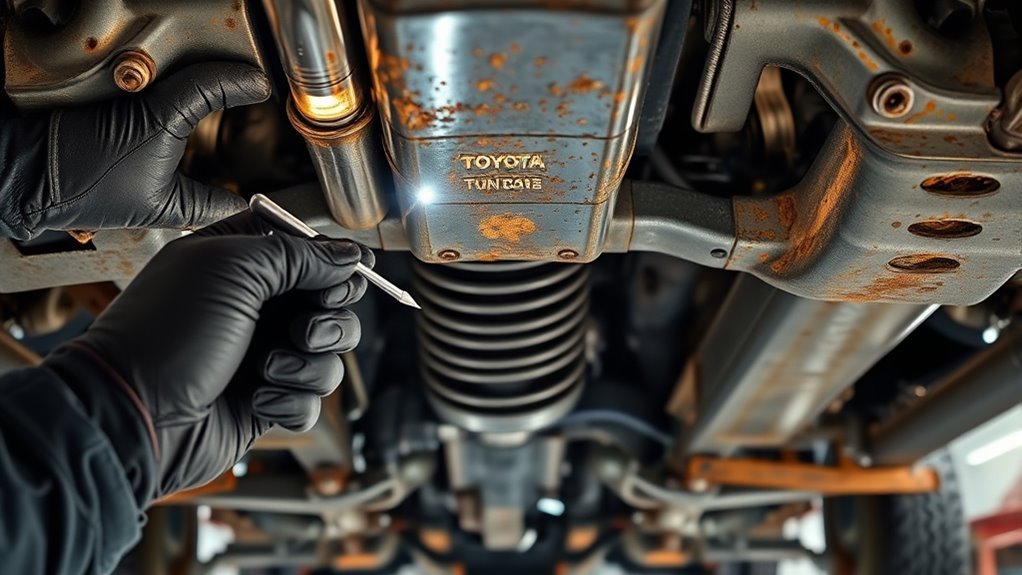
Start with the locations that carry loads or historically trapped road salt and moisture. Inspect the rear crossmember and spare-tire area, fuel-tank supports, brake-line area, suspension spring and shock mounts, steering attachment points, cab and bed mounts, frame rails, crossmembers, welds, seams, skid-plate mounting points, and existing factory drain openings.
Surface rust usually appears as a thin orange or brown film while the metal keeps its original shape and thickness. More serious corrosion produces raised scale, bubbling coating, swollen seams, deep pits, layers that break away, or edges that feel thin.
A hole is not required before rust becomes structurally important. Severe section loss around a mount, flange, frame web, or weld can be critical before full perforation appears.
Use a small hand tool only to dislodge loose scale gently. Do not hammer, punch, or grind aggressively while you are still trying to determine the frame’s condition. If the surface is hidden by thick paint, rubberized material, or a fresh coating, inspect the edges, seams, bolt areas, and openings for lifting, bubbles, trapped debris, or rust bleeding through.
Do not use sound as a safety certificate: A hammer or tapping test is not a reliable pass-or-fail inspection by itself. Frame shape, coating thickness, access, internal corrosion, and nearby brackets can change the sound. Forceful tapping can also damage thin metal or nearby lines. Use visual access, gentle scale removal, records, and qualified inspection instead.
Priority Tundra Frame Inspection Points
- Rear crossmember and spare-tire area: Check the crossmember, spare-tire support, and surrounding metal.
- Fuel-tank mounting system: Inspect supports, straps, brackets, and nearby frame sections.
- Brake-line area: Look for frame scale near lines and mounting hardware without bending or scraping the lines.
- Suspension and steering mounts: Check spring, shock, control-arm, steering, leaf-spring, shackle, and axle attachment points.
- Cab and bed mounts: Look for swelling, cracked welds, distorted brackets, and missing metal.
- Rails and crossmembers: Inspect the upper, lower, inner, and outer surfaces wherever access permits.
- Boxed or hidden sections: Use existing access points where practical and treat unseen internal corrosion as an unresolved condition.
- Skid plates and shields: Look behind removable covers when they can be removed safely.
Toyota’s historical 2000–2003 campaign Q&A advised owners in road-salt areas to consider at least an annual frame inspection. A practical photo record before and after winter can make changes easier to spot.
Can Driving Symptoms Reveal Frame Damage?
Driving symptoms cannot diagnose frame corrosion, but they can signal movement, distortion, or a failed attachment point. Warning signs include a new creak or pop over bumps, a persistent alignment change, unusual tire wear, altered cab-to-bed gaps, a door that suddenly binds, or a visible change in ride height.
Do not perform hard braking, sharp steering, heavy loading, or rough-road tests to reproduce a symptom. If a symptom appears with visible frame corrosion, have the truck inspected before towing, hauling, or continued heavy use.
Create a Repeatable Frame-Rust Record
- Photograph the same frame locations from the same angle.
- Include a ruler or another fixed-size reference near pits or damaged coating.
- Record the date, mileage, road-salt exposure, and any cleaning or coating work.
- Note whether scale, pitting, cracking, staining, or coating bubbles have changed.
- Keep shop inspection photos, invoices, and written repair recommendations with the truck’s records.
If you find perforation, several layers of lost metal, a cracked or separated weld, a damaged mounting point, or frame distortion, stop treating the job as cosmetic. Avoid towing, heavy hauling, and rough-road use until a qualified frame or collision-repair technician evaluates it.
What Should a Professional Frame Inspection Include?
A useful inspection should produce more than a verbal statement that the frame is “good” or “bad.” Ask for a written or photographed record that identifies:
- The exact rail, crossmember, mount, weld, or bracket affected
- Whether coatings and loose scale were removed far enough to expose the condition
- Visible perforation, pitting, cracking, distortion, or section loss
- Findings inside accessible boxed or hidden areas
- Whether braking, steering, suspension, cab, bed, tank, or lifting support is affected
- Whether frame or body alignment measurement is needed
- Any temporary driving, towing, payload, or lifting restrictions
- The proposed repair area and how the work will extend to verified solid metal
- Post-repair alignment, inspection, coating, and warranty steps
Ask whether the shop regularly performs structural frame work, vehicle measurement, corrosion removal, fabrication, welding, major disassembly, and post-repair alignment. A shop that does not perform the needed work should identify the specialist or facility that will.
DIY Tundra Frame Rust Treatment: When It Works and Where It Stops
DIY treatment is appropriate only after the affected area is confirmed to be surface corrosion on solid metal. It is not a structural repair. Do not weld, cap, plate, fill, or conceal a weakened frame rail, crossmember, or mounting point without a repair plan based on the truck’s condition and applicable structural-repair information.
- Document the condition: Photograph each affected area before removing loose material.
- Protect nearby components: Shield fuel, brake, electrical, rubber, and painted parts from debris and chemicals.
- Remove loose contamination: Use a hand scraper and wire brush without thinning solid metal.
- Clean the surface: Remove grease, salt, mud, dust, and treatment residue as the product directions require.
- Dry the frame completely: Pay extra attention to seams and boxed sections where water can remain.
- Apply the treatment system: Use converter, primer, paint, or a soft-film inhibitor only in the sequence approved by the product maker.
- Inspect the result: Confirm that the coating did not block factory openings or cover newly exposed structural damage.
Stop the DIY job if cleaning exposes a hole, split seam, cracked weld, soft edge, missing flange, or weakened mounting point. Coating that area will not restore its designed strength.
Which Undercoating Works for a Toyota Tundra Frame?
The best protection depends on the frame’s condition, the surface preparation, and whether you need a coating that creeps into seams or forms a harder exterior film. No undercoating repairs perforation or replaces lost metal.
| Protection Type | Best Use | Main Limitation |
|---|---|---|
| Soft-film or oil/lanolin-style inhibitor | Seams, cavities, and surfaces that need a flexible, renewable barrier | Can wash or wear away and requires inspection and renewal |
| Primer and chassis paint system | Clean, prepared exterior metal with verified surface corrosion only | Prep and cure conditions must match the product instructions |
| Hard or rubberized film | Clean, dry, corrosion-free or correctly prepared surfaces needing chip resistance | Can hide active corrosion or trap moisture when applied over damp metal, scale, or rust |
Degrease the frame, remove loose material, follow the required converter or primer steps, and let the metal dry. Several controlled coats are usually easier to inspect than one heavy layer. Keep existing drain openings, identification marks, fasteners, brake components, exhaust components, and moving suspension parts free of inappropriate coating.
Note: A fresh black coating is not proof of a healthy frame. Ask what preparation was completed and request before-and-after photographs when evaluating prior work.
[Products Worth Considering]

This body repair kit provides the essential tools for dent removal, panel shaping, and sheet metal work on automotive projects. With three hammers, four precision dollies, and a storage case, it offers a complete and organized solution for smoothing surfaces and restoring body panels. The fiberglass handles help deliver a comfortable grip and improved shock resistance for dependable use in garages or home workshops.

These heavy-duty running board side steps are designed to improve access to your Toyota Tundra without reducing ground clearance. Built for Double Cab and CrewMax front door applications, they offer practical convenience for everyday entry, roof loading, and off-road use. The durable iron construction and easy no-drill installation make them a reliable upgrade for rugged driving.

This LUMITECO tire tread depth gauge set makes it easy to monitor tire wear and maintain safer driving performance. The color-coded scale provides quick, easy-to-read measurements, while the compact pocket-size design and included clip make it convenient to keep in your vehicle or toolbox. Suitable for cars, trucks, motorcycles, and more, it offers a simple reusable way to check tread depth whenever needed.
How Much Does Professional Tundra Frame Rust Repair Cost?
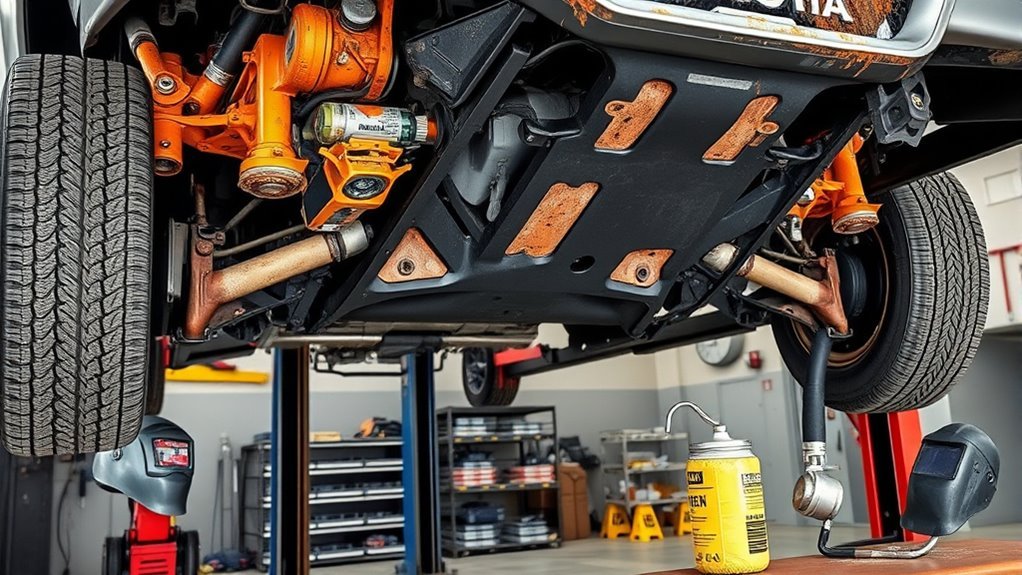
There is no defensible national flat price for Tundra frame rust repair. The quote depends on what the shop finds after loose corrosion and concealing coatings are removed. Inspection and protection of solid surface-rusted metal is the lowest-complexity path. Localized structural fabrication costs more. Extensive section or full-frame replacement requires the most labor, disassembly, parts, alignment work, and related repairs.
A professional shop can remove enough corrosion and coating to expose the true metal condition, inspect structural areas, measure alignment when necessary, and decide whether the truck needs surface protection, localized structural work, section replacement, or complete frame replacement.
Common preparation methods include controlled abrasive blasting, mechanical wire brushing, hand scaling, and product-specific chemical treatment. The correct method depends on metal thickness, nearby components, coating type, access, and whether the shop is preparing the frame for inspection or for a final protective finish.
[Products Worth Considering]

This rivet nut tool kit provides a complete set of metric press-fit nuts along with a manual installer for creating strong threaded connections in a wide range of projects. Built from durable steel with galvanized rivet nuts, it is designed for reliable use in furniture, automotive, marine, sheet metal, and home improvement applications. The organized storage box and labeled compartments make selection, transport, and storage simple.

Aujen silicone license plate frames are designed for U.S. plates and help protect your tag from rust, scratches, and everyday wear. The flexible, weather-resistant design reduces rattling, supports drainage, and offers a clean matte finish that stays durable over time. With a street-legal, low-obstruction profile, these frames are a practical upgrade for everyday drivers.

This dial type tire tread depth gauge helps you quickly check tread wear on motorcycles, cars, trucks, and buses with easy-to-read 1/32-inch increments. Its colorful zone markings make it simple to assess tire condition for safer driving in different weather, while the durable zinc cast body and legible dial provide dependable everyday use.
What Drives the Repair Quote?
| Scope | Main Cost Drivers | What the Written Quote Should Include |
|---|---|---|
| Inspection and exposure | Lift time, shield removal, coating removal, cleaning, hidden-area access, and photographs | Areas inspected, access limits, condition findings, and safe-use restrictions |
| Surface preparation and protection | Degreasing, scale removal, drying, converter or primer steps, coating system, cavity access, and cure time | Products, preparation method, covered areas, excluded areas, cure requirements, and renewal schedule |
| Localized structural repair | Disassembly, corrosion removal, repair design, fabrication, welding, nearby lines or brackets, coating, and alignment checks | Repair boundaries, material and method, removed parts, alignment work, corrosion protection, and workmanship warranty |
| Section or full-frame replacement | Frame availability, shipping, cab and bed removal, drivetrain or suspension transfer, seized hardware, lines, mounts, and final alignment | Frame source and compatibility, transferred parts, replacement hardware, related repairs, coating, alignment, and warranty terms |
Do not use a national flat-price estimate as a quote. Ask at least one qualified shop to identify the affected frame section, show the damage after cleaning, describe the proposed repair method, list related parts and alignment work, and provide warranty terms in writing. For structural work, a second qualified opinion may help confirm whether the proposed scope is reasonable.
Can a Rusted Tundra Frame Be Repaired or Must It Be Replaced?
The answer depends on the damage location, remaining metal, load path, number of affected sections, prior repairs, alignment, and whether a qualified shop can restore the structure without simply covering weakened material. A small perforation near a suspension or steering mount can matter more than a larger patch of shallow surface corrosion elsewhere.
When Localized Structural Repair May Be Considered
A shop may consider localized structural repair when the damage is limited, the surrounding metal is sound, the repair can extend to verified solid material, and the completed work can preserve mounting geometry and load transfer. That decision requires direct inspection after corrosion and coatings are removed from the repair area.
When Section or Full-Frame Replacement May Be Safer
Replacement becomes more likely when corrosion affects several rails or crossmembers, reaches multiple suspension or cab mounts, has distorted the frame, surrounds prior patches, prevents safe support of the truck, or leaves too little solid metal for a defensible localized repair.
- Multiple perforations or long areas of section loss
- Cracks through frame flanges or webs
- Separated welds or deformed mounting brackets
- Failure around suspension, steering, cab, bed, or fuel-tank supports
- Unsafe lifting points or widespread hidden corrosion
- Alignment that cannot be restored within acceptable repair limits
If replacement involves a new, used, or donor frame, do not match it by model year alone. Require VIN-based part verification and confirm the cab, wheelbase or bed configuration, two-wheel-drive or four-wheel-drive layout, tank and mounting configuration, and market specification. The shop should also inspect the replacement frame before installation and document its source and condition.
Do not choose reinforcement or replacement by a fixed percentage of rusty area. A qualified shop should base the decision on structure, location, sound metal, repair access, and the truck’s overall condition.
Drainage Holes and Skid Plates: Prevent Rust From Coming Back
Inspect existing factory drain openings, frame holes, plugs, shields, and skid-plate areas for packed mud, salt, leaves, and coating buildup. Clean only the openings intended to remain clear, and follow model-specific Toyota information before removing or replacing any plug.
- Remove loose debris from accessible factory openings without pushing it deeper into boxed sections.
- Remove skid plates or shields only when the truck is supported safely and the hardware can be handled without damaging nearby parts.
- Inspect the hidden metal, mounting holes, brackets, and fasteners before reinstalling the cover.
- Replace failed hardware with the correct specification rather than forcing heavily corroded bolts back into damaged mounts.
- Do not drill new drainage holes or alter the frame without approved repair information.
Wash road salt and beach residue from the underbody as soon as practical, then allow the frame and seams to dry. Recheck repaired or coated areas after winter, off-road mud, beach driving, or any event that chips the protective finish.
Cost, Warranty, Campaigns, and Timing: Choose the Safe Repair Path
Surface preparation and protection are normally the least complex option. Structural fabrication, section replacement, and full-frame replacement require progressively more labor, disassembly, hardware, alignment work, and related repairs. Compare written estimates by repair scope rather than choosing only by the lowest total.
Does Toyota’s Rust-Through Warranty Cover the Tundra Frame?
Toyota’s historical frame-program Q&A states that its general rust-perforation coverage was 60 months with unlimited miles for body panels or sheet metal. It also states that the separate frame on a body-on-frame vehicle was treated as a chassis component under the New Vehicle Limited Warranty rather than as a body panel. See the Toyota/NHTSA 2000–2003 Tundra campaign Q&A.
Do not assume the standard body-panel corrosion warranty covers a Tundra frame. For more detail on ordinary factory terms, read the Toyota Tundra warranty coverage guide. The exact warranty booklet for the truck’s model year, original in-service date, and market controls ordinary coverage.
Which Tundra Years Had Toyota Frame-Corrosion Programs?
| Tundra Model Years | Historical Toyota Action | Important Distinction | What to Do Now |
|---|---|---|---|
| Certain 2000–2003 | Safety Recall 09V-444 plus separate Limited Service Campaign A0F | The safety recall addressed specified rear-crossmember, rear-brake-line, and fuel-tank-mounting concerns. A0F separately addressed qualifying frame perforation and required repairs to be completed by April 30, 2012. | Check the VIN for an open safety recall and ask Toyota or a dealer for campaign-completion and frame-repair history. |
| Certain 2004–2006 in listed cold-climate states | Limited Service Campaign D0D | A qualifying truck was inspected. Toyota’s materials called for CRC application when significant rust perforation was not found and frame replacement when it was found. The inspection and CRC deadline was July 31, 2015, with limited additional repair time after a qualifying pre-deadline inspection. | Treat the campaign as historical. Verify the VIN, state eligibility, and completed work through Toyota records. |
| Certain 2004–2006 outside the D0D cold-climate states | Limited Service Campaign DSD | DSD provided inspection for covered vehicles outside the D0D states. A frame that passed required no further action under DSD; qualifying significant perforation led to frame replacement. The inspection deadline was July 31, 2015. | Do not assume present coverage. Ask for the inspection and replacement history associated with the VIN. |
| Certain 2007–2008 | Warranty Enhancement Program ZH7 and Limited Service Campaign H0F under the 2017 settlement | ZH7 applied the court-ordered Rust Perforation Standard and provided coverage until the later of 12 years from the vehicle’s date of first use or May 21, 2018. The separate H0F CRC campaign for qualifying cold-climate vehicles expired May 21, 2019. | Use the VIN and dealer records to determine inclusion, date of first use, inspection history, CRC application, or prior frame replacement. |
Official historical documents: A0F · D0D · DSD · ZH7 and H0F summary.
Current VIN check: Toyota’s Safety Recalls and Service Campaigns lookup provides information on open Toyota recalls and service campaigns released since 1999. Toyota explains that Limited Service Campaigns are offered for a specified period and may expire.
The NHTSA VIN lookup does not show safety recalls that were already repaired, manufacturer customer-service campaigns, and generally does not show safety recalls more than 15 years old. Therefore, a clean online result does not prove that a truck was never included, that historical work was completed, or that its frame is rust-free. Ask Toyota or a dealer for campaign-completion and repair history, then obtain a physical inspection.
Repair Time and Scheduling
Cleaning and coating verified surface corrosion requires preparation, full drying, application, and cure time. Structural work takes longer because the shop may need to remove the bed, tank, suspension parts, lines, mounts, or drivetrain components before it can reach sound metal and restore alignment.
- Request a written inspection result before approving structural work.
- Ask whether the quote includes disassembly, seized hardware, brake or fuel lines, alignment, coating, and reinspection.
- Confirm whether the shop repairs frames in-house or sends the work to a specialist.
- Get the workmanship warranty and corrosion-protection plan in writing.
- Plan alternate transportation before authorizing a section or frame replacement.
Post-Repair Maintenance Plan to Extend Your Tundra Frame’s Life
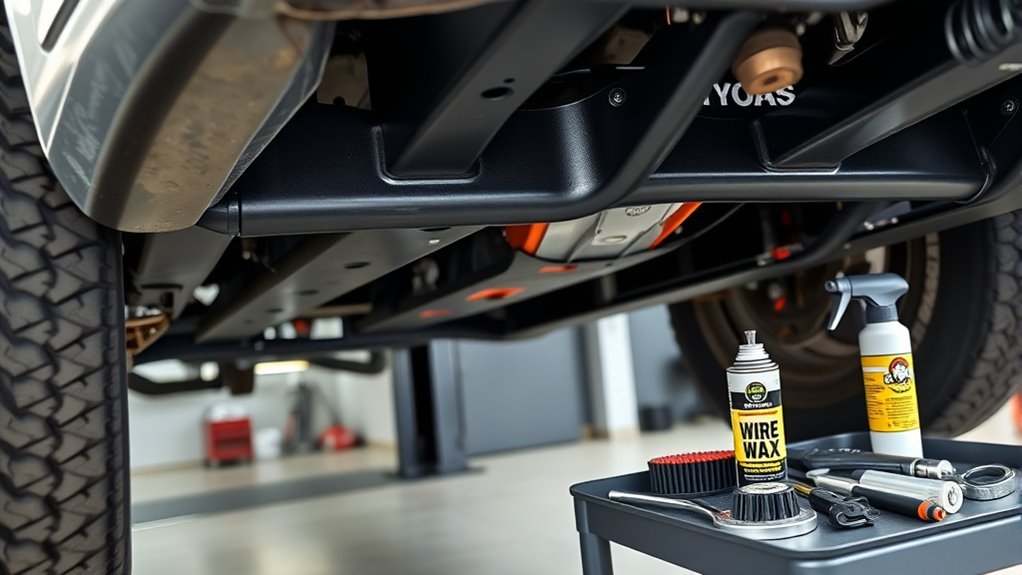
Inspect the repaired area, adjacent seams, coating edges, mounting points, and factory openings on a fixed schedule. At minimum, check annually and after major salt, mud, beach, floodwater, or off-road exposure. Owners in winter-salt areas may benefit from matching photographs before and after each winter season.
Clean road salt and packed mud before they remain in frame pockets. Let the frame dry, then repair chips or worn protective material according to the coating maker’s instructions. Do not simply spray over a new bubble, crack, stain, or lifted edge. Inspect what caused it first.
Keep every inspection photo, invoice, repair diagram, alignment record, and coating record. These documents help future technicians evaluate changes and help a buyer understand what was repaired. The site’s Tundra generations guide provides broader used-truck inspection context.
Frequently Asked Questions
What Toyota Tundra years had frame-corrosion programs?
Toyota issued different programs for certain 2000–2003, 2004–2006, and 2007–2008 Tundras. The 2000–2003 actions included Safety Recall 09V-444 and separate Limited Service Campaign A0F. Certain 2004–2006 trucks were covered by D0D or DSD. Certain 2007–2008 trucks were included in Warranty Enhancement Program ZH7 and Limited Service Campaign H0F under the 2017 settlement. Eligibility, remedies, deadlines, and completed work must be checked by VIN and service history.
How can you tell surface rust from structural frame rust?
Surface rust is usually a thin film that has not changed the metal’s shape or apparent thickness. Thick scale, swollen seams, deep pits, flaking layers, soft edges, holes, cracks, separated welds, distorted rails, and damage around suspension, steering, cab, bed, crossmember, or fuel-tank mounts indicate a more serious condition. A professional inspection is necessary when the remaining strength is uncertain.
Can a rusted Tundra frame be repaired?
Some localized damage can be repaired when a qualified shop can remove the weakened material, reach verified solid metal, preserve mounting geometry, and restore the load path. Widespread perforation, several failed mounts, distorted rails, unsafe support points, or corrosion around prior patches may make section replacement or complete frame replacement safer.
Is Tundra frame rust covered by a Toyota warranty or recall?
Do not assume Toyota’s normal body-panel rust-through warranty covers the separate chassis frame. Older Tundras had specific safety recalls, Limited Service Campaigns, and Warranty Enhancement Programs with VIN, model-year, location, inspection, and time-limit rules. Use Toyota’s VIN lookup and ask a dealer for the truck’s campaign-completion and warranty history.
Will Toyota still replace my Tundra frame for free?
The historical A0F, D0D, DSD, ZH7, and H0F programs had eligibility rules and published time limits. Those limited programs should not be assumed to provide current coverage. An unrepaired safety recall is different and remains VIN-specific. Check Toyota’s current lookup and ask a dealer for campaign-completion history before paying for work, but do not delay a safety inspection while investigating coverage.
How much does Tundra frame rust repair cost?
There is no reliable national flat price. Inspection and protection of verified surface corrosion is the lowest-complexity path. Localized structural fabrication costs more because it may require disassembly, corrosion removal, welding, coating, and alignment checks. Section or full-frame replacement is the highest-complexity path because major components, lines, mounts, and hardware may need to be transferred or replaced. Use a written, itemized quote based on exposed damage.
Can you drive a Tundra with a rusted frame?
Surface discoloration alone does not prove the frame is unsafe, but a quick visual check cannot certify structural strength. Do not tow, haul, drive off-road, or continue heavy use when the frame has deep pitting, holes, cracked welds, distortion, soft metal, or damaged mounting points. Tow the truck for inspection when corrosion may affect braking, steering, suspension, fuel-tank support, or safe lifting.
Does undercoating stop existing frame rust?
Undercoating can slow new corrosion only after the surface is cleaned, prepared, dried, and confirmed suitable for the selected product. It cannot restore missing metal or repair cracks, holes, failed welds, or weak mounts. Thick hard coating applied over moisture, loose scale, or active corrosion can hide the problem and make later inspection harder.
Should you buy a Tundra with frame rust?
Do not buy based only on a clean-looking coating or a seller’s statement that the rust is superficial. Obtain an independent inspection of the rails, crossmembers, suspension and steering mounts, cab and bed mounts, brake-line area, fuel-tank supports, and hidden sections. Verify the VIN and campaign history. Walk away or price the truck only after a qualified shop defines any structural repair, replacement, alignment, and related costs in writing.
Safety Disclaimer: This article is for general information and document-based guidance. It does not certify any frame as safe and does not replace inspection by a qualified mechanic, collision-repair technician, structural frame specialist, or authorized Toyota dealer. Do not drive, tow, lift, sell, or repair a truck with suspected structural damage without appropriate professional evaluation and disclosure.
Conclusion
Start by classifying the corrosion, not by choosing a coating. Thin surface oxidation on solid metal may qualify for cleaning and protection. Deep pitting, scale, perforation, failed welds, distorted rails, and damaged mounts require professional inspection before the truck returns to towing, hauling, or hard use.
Check the VIN and service history before paying for major work, but remember that historical campaign coverage and current structural condition are separate questions. Document the frame, obtain an itemized repair scope, preserve factory drainage and access points, and inspect repaired areas regularly.
References
- Lookup Safety Recalls and Service Campaigns — Toyota
- What warranty coverage do I have on my Toyota vehicle? — Toyota Customer Service
- Certain 2000–2003 Tundra Frame Rust Corrosion Perforation: Limited Service Campaign Q&A — Toyota / NHTSA
- Limited Service Campaign A0F: Certain 2000–2003 Tundra Frame Rust Corrosion Perforation — Toyota / NHTSA
- Limited Service Campaign D0D: Certain 2004–2006 Tundra Vehicles — Toyota / NHTSA
- Limited Service Campaign DSD: 2004–2006 Tundra Frame Inspection — Toyota / NHTSA
- Warranty Enhancement Program ZH7 and Limited Service Campaign H0F: Frame Corrosion — Toyota / NHTSA
- Vehicle Safety Recall Lookup and VIN Search Limitations — National Highway Traffic Safety Administration