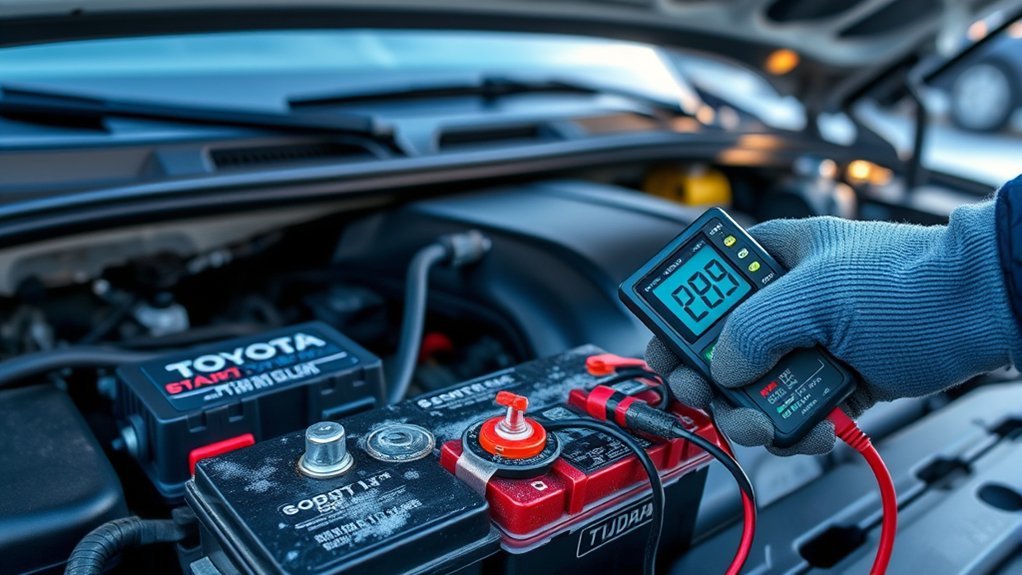
You need roughly 800 CCA (or higher) in a Group 27F battery for most Toyota Tundra V6/V8 applications to guarantee reliable cold starts and support accessory/tow loads. CCA measures the amps a battery can deliver for 30 seconds at 0°F while staying above 7.2V, so higher CCA reduces starter strain and voltage sag in extreme cold. Choose AGM or high‑CCA lead‑acid for durability, keep terminals clean, and follow proper installation — more specifics follow.
Quick Answer: What CCA Your Toyota Tundra Needs
Wondering what CCA your Toyota Tundra needs? You should choose a battery that delivers at least 800 cold cranking amps (CCA) to guarantee reliable starts in extreme temperatures. You’ll most often find Group Size 27F batteries specified for Tundras; they’re engineered to meet those high CCA demands while fitting the tray and terminal layout. Check your owner’s manual for exact CCA guidance tied to model year and engine variant before purchasing. Opting for a higher CCA than the minimum increases starting assurance in a cold climate and reduces the risk of failed starts. That choice also supports battery longevity by reducing strain during repeated cold starts. When you prioritize CCA appropriately, you reclaim control over winter reliability and avoid being sidelined by preventable failures. Balance the required CCA, physical fit, and quality; that precision secures dependable performance without unnecessary excess.
What CCA Measures (And Why It Matters for Tundras)
Cold Cranking Amps (CCA) quantifies the current a battery can deliver for 30 seconds at 0°F (−18°C) while remaining above 7.2 volts, which is the standardized test for cold-start capacity. You should care because CCA directly correlates with the starter torque available during cold starts—undersized CCA risks slow cranking or failure in low temperatures. For a Tundra, that means selecting a battery with sufficient CCA (typically 800 or higher) to guarantee reliable starter torque and reduce strain on the battery and starter motor.
CCA Definition And Testing
Although often quoted as a single number, Cold Cranking Amps (CCA) specifically quantifies the amps a battery can supply for 30 seconds at 0°F (–18°C) while holding at least 7.2 volts, and that measurement tells you how reliably a battery will turn over a Tundra’s engine in frigid conditions. You need CCA to evaluate battery performance in a cold climate and to choose a unit—800 CCA or higher is recommended for the Tundra. Testing uses a calibrated load tester that imposes a specified current draw while recording voltage and amps; pass/fail criteria compare measured voltage to the 7.2 V threshold under load. Use test data to liberate your choices and avoid underperforming batteries.
- CCA: defined metric, 30 s at 0°F
- Threshold: ≥7.2 V under load
- Recommended: ≥800 CCA for Tundra
- Test tool: calibrated load tester
- Outcome: select higher CCA for reliability
Cold Starts And Torque
Because engine cranking in freezing temperatures demands high instantaneous torque, CCA directly represents the battery’s ability to deliver the current needed to spin a Tundra’s starter motor fast enough to ignite the engine, and you should treat the CCA rating as a torque proxy when sizing a battery for cold climates. You rely on CCA to predict performance during cold start techniques and to guarantee sufficient engine torque under load. For a Tundra, target ≥800 CCA; higher CCA adds margin for extreme cold and accessory loads. Choose batteries that sustain ≥7.2V at 0°F for 30s. This lets you start freely, without compromise.
| Parameter | Recommendation |
|---|---|
| Minimum CCA | 800 |
| Test condition | 0°F for 30s |
Tundra CCA by Model and Engine (Including Group 27F Stock Values)
You’ll start by reviewing the stock Group 27F specifications—including reserve capacity and the typical ~800 CCA baseline—so you know what the factory expects. Then compare CCA requirements across engine types (standard V6/V8 and the i-FORCE MAX hybrid) to identify any model-specific deviations noted in the owner’s manual. Finally, evaluate cold-weather performance ratings and recommend higher CCA options where towing or low-temperature reliability is critical.
Stock Group 27F Specifications
Most Tundras use a Group 27F battery, and you should expect Cold Cranking Amps (CCA) requirements to center around 800 CCA as the baseline for reliable cold starts. You’ll find Group 27F balances size, terminal layout, and CCA to match Tundra electrical systems. Consider battery types and environmental impact when selecting replacements; higher CCA improves cold performance but may affect recyclability and manufacturing footprint. Check your owner’s manual for model-specific mandates—hybrid variants may need beefier units.
- Stock Group 27F fits Tundra tray and hold-down specifications.
- Typical CCA range: ~750–1,000 across brands.
- Minimum practical CCA: 800 for most models.
- i-FORCE MAX hybrids can require higher CCA.
- Confirm exact CCA per model/engine in the manual.
CCA By Engine Type
When selecting a replacement battery for your Tundra, match the Cold Cranking Amps (CCA) to the engine specification—standard V6 and V8 models typically call for a Group 27F with around 800 CCA as the baseline, while i-FORCE MAX hybrid variants often require higher CCA to accommodate the additional electrical load; consult your owner’s manual for the exact value for your model and climate conditions.
You’ll prioritize engine compatibility to guarantee consistent start-up and protect on-board systems. Group 27F batteries meet the higher CCA demands of larger engines, delivering robust cranking power. For i-FORCE MAX, select a higher-rated CCA to account for hybrid auxiliary loads. Correct CCA selection improves battery longevity by reducing strain and deep discharge cycles. Verify specs for your model and operating environment before purchase.
Cold-Weather Performance Ratings
Having matched CCA to your engine type, you should now check cold-weather performance ratings to guarantee reliable starts at low temperatures. You need at least 800 CCA for ideal Tundra starts in a cold climate; Group 27F is the common stock size that meets this threshold on most models. Use the owner’s manual to confirm model-specific CCA and prioritize higher CCA for marginal conditions. Higher ratings improve starting reliability and support accessory loads, which preserves battery longevity by preventing deep-discharge cycles.
- Most Tundra models ship with Group 27F batteries rated near 800 CCA
- Confirm CCA per engine and model in the manual
- Choose higher CCA if you frequently drive in subzero temperatures
- Higher CCA reduces starter strain and accessory draw
- Proper sizing extends battery longevity
How CCA Affects Cold Starts, Towing, and Accessory Loads
Because cold cranking amps (CCA) measure the current a battery can deliver at low temperatures, you should choose at least 800 CCA for a Toyota Tundra to guarantee reliable starts in extreme cold. In cold weather the battery’s chemical activity falls, so a higher CCA preserves starting torque and prevents repeated starter draws that degrade the battery. When you tow near the truck’s towing capacity the engine requires robust starting current and stable voltage margins; insufficient CCA increases starter strain and raises failure risk during repeated stop-start cycles.
Accessory loads—lights, winches, HVAC, and infotainment—further tax the battery before and after engine start. You’ll maintain performance and autonomy by selecting a battery with surplus CCA to buffer voltage sag and support sustained accessory current. In practice, prioritize CCA above minimal ratings to secure consistent cold starts, reliable towing launches, and uninterrupted accessory operation under demanding conditions.
CCA vs CA, MCA, HCA, and Peak Amps : What Tundra Owners Should Know
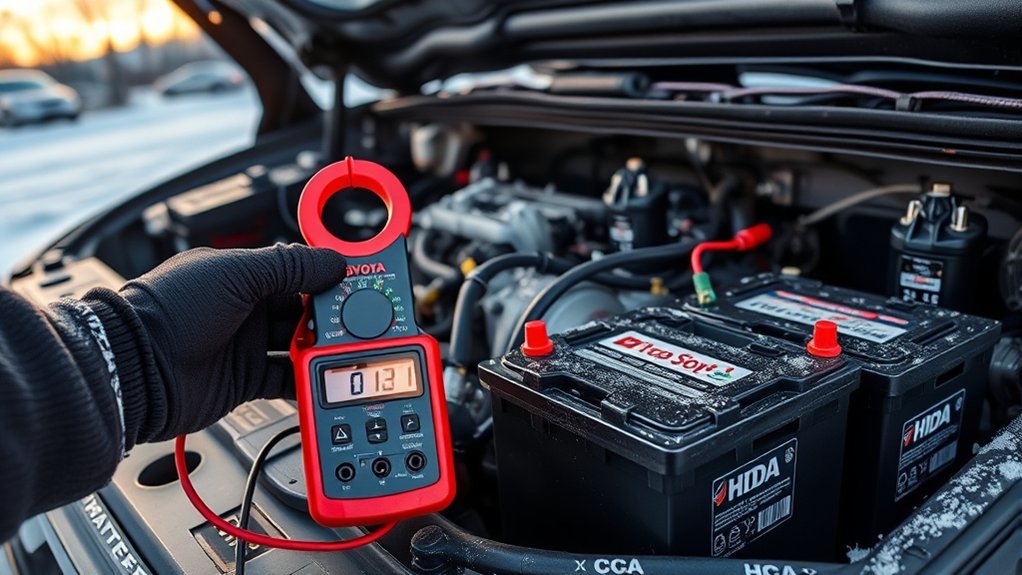
You’ve seen why CCA matters for cold starts and heavy use; now compare it to other amp ratings so you pick the right battery for your Tundra’s operating temperatures and usage. You’ll prioritize CCA importance because it measures starting ability at 0°F, and Tundra owners in cold regions should target ~800 CCA for reliable ignition and preserved Battery longevity. Other ratings provide context but don’t replace CCA for cold starts.
- CCA: Rated at 0°F, critical for cold-weather starts and repeatability.
- CA (or MCA): Measured at 32°F; useful for moderate climates but less decisive for cold-bound Tundras.
- MCA: Marine context; higher numbers at 32°F, helpful if you use the truck near water.
- HCA: Measured at 80°F; shows warm-weather starting power, rarely the primary spec for Tundra selection.
- Peak Amps: Short burst capability for jump-starts; don’t substitute for sustained CCA performance.
Choose by climate and usage to maximize starting reliability and Battery longevity.
Which Battery to Choose for Your Tundra: AGM, Lead‑Acid, or Lithium?
Which battery suits your Tundra depends on how you use the truck and the environments you drive in. If you tow heavy loads or face extreme temperatures, AGM Advantages matter: sealed construction resists vibration, tolerates wide temperature swings, and delivers stable cranking and reserve capacity under load. Standard lead‑acid (Group Size 27F) remains the cost‑effective baseline; you get predictable starting power and simple replacement at lower upfront cost, provided you meet the minimum ~800 CCA in cold climates. Choose lithium if weight savings and deep cycling matter—Lithium Longevity yields repeated discharge/charge cycles with less capacity loss and faster recovery, useful for extended off‑road accessory use. Factor warranty and free replacement policy as a functional requirement: a stronger warranty reduces lifecycle cost and risk. Match capacity, CCA, and physical fit to factory specs. You’ll prioritize durability and consistent starts for liberation on remote routes; select the chemistry that aligns with your operational profile and warranty expectations.
Tundra Battery Installation, Heat, and Maintenance Tips to Extend Life
When replacing your Tundra’s battery, disconnect the negative terminal first and secure the battery tray and hold‑down to prevent movement; improper installation risks shorts and accelerated wear from vibration. You’ll prioritize installation safety, guarantee firm terminal torque, and route cables away from heat sources. Manage AGM heat: avoid high-rate charging after heavy use and allow cooling before charging to prevent capacity loss. Practice strict battery maintenance: clean corrosion, apply dielectric grease, and verify CCA meets or exceeds 800 for cold reliability. Use a smart battery tender during storage to maintain ideal state of charge without overcharging.
- Inspect and tighten terminals; confirm installation safety with proper torque.
- Clean terminals and trays; remove acid deposits and apply protective grease.
- Use a temperature‑aware charger; prevent AGM thermal stress during charging.
- Employ a quality battery tender for long idle periods; sustain charge and health.
- Monitor CCA and load‑test periodically; replace if below specification.
These steps free you from avoidable failure, extending service life and preserving vehicle readiness.
Picking a Replacement: CCA, Group Size, Warranty, and Real‑World Brands
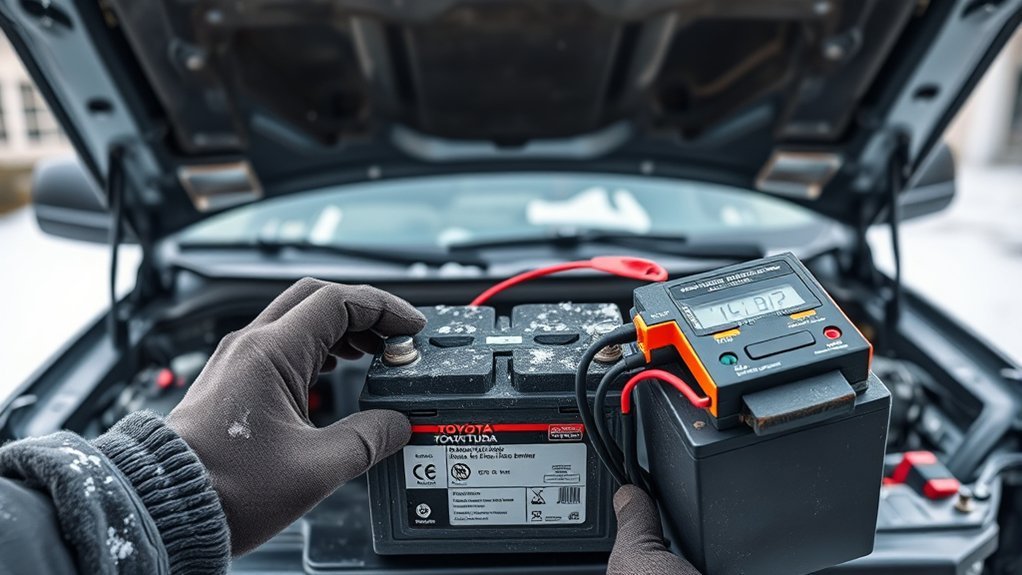
Selection of the right replacement battery for your Tundra hinges on three measurable factors: CCA, group size, and warranty terms. You should choose a battery with at least 800 CCA to guarantee reliable starts in extreme cold; inadequate CCA produces starting failures and undermines freedom to travel. Confirm Group Size 27F for proper fit, terminal orientation, and secure mounting—fit equals consistent performance and fewer electrical issues. Prioritize warranties that include free replacement within a reasonable period; that lowers total cost over the battery lifespan and protects you against early failure. For performance upgrades or heavy accessory loads, consider AGM or high-density options from proven brands. Optima and Odyssey are frequently recommended in real-world use for their high starting power and durability under load. Evaluate vendor reputation, return policy, and documented field results before buying so you gain resilient starting performance, maintain vehicle independence, and minimize downtime.
Frequently Asked Questions
How Many Cold Cranking Amps Do I Need to Start My Truck?
You need about 800 CCA to start your truck reliably. You’ll boost battery performance and truck maintenance confidence by choosing Group Size 27F or higher, matching climate demands, and consulting your owner’s manual for specifics.
How to Explain Cold Cranking Amps?
Cold cranking amps clearly quantify starting power: you’ll know how many amps a battery supplies for 30 seconds at 0°F, so you can choose battery performance that guarantees reliable starts and frees you from winter frustration.
Conclusion
You now know what CCA your Tundra needs, why it matters, and how choices—AGM, lead‑acid, or lithium—impact cold starts, towing, and electronics. Pick a battery with the correct CCA, Group 27F fit, and solid warranty, and install or maintain it properly to avoid premature failure. Treat battery selection like mission‑critical gear: a reliable CCA rating is the difference between smooth ignition and roadside frustration. Stay proactive to extend life.