Toyota’s WS ATF is a mineral‑based, controlled‑viscosity fluid formulated to protect your Tacoma’s automatic transmission with friction modifiers, antiwear agents, detergents, and seal conditioners. It starts at about 5.4 cSt (100°C), darkens and loses lubricity by ~30,000 miles, and needs regular drain‑and‑fill—more often for towing or off‑road use. Use genuine WS, monitor viscosity and wear metals, fit a cooler/filters for harsh duty, and follow proactive service intervals to avoid costly wear; more practical service steps follow.
What “WS” Means for Your Tacoma (Toyota WS ATF Explained)
WS” stands for “World Standard,” a specific Toyota ATF formulation engineered for its automatic transmissions, including the Tacoma’s; it’s not a synthetic oil and needs periodic changes rather than being treated as lifetime fluid. You’ll rely on WS for consistent friction characteristics and controlled shear response that preserve shift quality and Tacoma performance, but you won’t ignore maintenance. Change intervals are practical rules: roughly every 30,000 miles under normal use, and closer to 60,000 miles when towing or off-roading—conditions that stress fluid life and thermal capacity. You’ll inspect color and odor: used WS darkens and loses lubricity and cooling effectiveness, signalling service. Know that aftermarket WS-like products from chemical houses can’t fully replicate Toyota’s formula; that distinction matters for long-term drivetrain health. Embrace scheduled service to keep shift timing, clutch engagement, and torque conversion sharp. That disciplined approach frees you from avoidable failure and keeps your Tacoma responsive and reliable.
WS ATF: Composition, Viscosity Specs, and Performance Limits
You’ll review WS ATF’s base fluids and targeted additive package—detergents, anti-wear agents, seal conditioners, and friction modifiers—and how they preserve hydraulic control and sealing in your Tacoma. You’ll check the specified kinematic viscosity (~5.4 mm²/s at 100°C), note that used fluid rising to ~5.9 mm²/s signals degradation or contamination, and consider how those changes limit shift quality and component life. Finally, you’ll weigh WS’s non-synthetic formulation and service interval (≈30,000 miles, shorter under severe use) against synthetic alternatives when evaluating performance limits.
Composition And Additives
Although formulated from a mineral base rather than full synthetic stocks, Toyota’s WS ATF combines a controlled-viscosity carrier (about 5.4 cSt at 100°C when new) with targeted additives—friction modifiers, antiwear agents, detergents, dispersants, seal swell compounds, and corrosion inhibitors—to meet Toyota’s specific clutch engagement, longevity, and seal performance requirements. You’ll rely on those additive benefits to preserve frictional properties and protect gear surfaces under load, while detergents and dispersants keep contaminants suspended to avoid deposits. Phosphorus-containing antiwear chemistry raises wear protection but can accumulate. Monitor fluid degradation: measured viscosity drift (e.g., toward 5.9 cSt used) and darkening signal diminishing lubrication and additive depletion. You should change WS ATF per Toyota’s intervals to maintain designed seal swell, clutch feel, and corrosion resistance.
Viscosity And Performance Limits
Because viscosity governs film strength and clutch modulation, you need to track WS ATF’s 5.4 cSt (100°C) spec and its drift toward ~5.9 cSt with age to understand performance limits. You’ll monitor viscosity impact as additives deplete and cSt rises, reducing hydrodynamic film and altering clutch feel. Temperature range (-40°F to 194°F) masks internal degradation; under towing or off-road stress, performance factors accelerate. Change fluid every 30,000 miles or sooner, and use periodic analysis to detect trends.
| Parameter | Effect |
|---|---|
| New viscosity | 5.4 cSt (100°C) |
| Aged viscosity | ~5.9 cSt |
| Temp range | -40°F to 194°F |
| Recommendation | 30,000 miles / severe-use sooner |
Real‑World Lifespan & When to Change WS ATF (Street, Towing, Off‑Road)
When you use Toyota WS ATF in real driving—street, towing, or off‑road—it typically begins to degrade by about 30,000 miles, losing lubricity and darkening visibly, so you should plan on changing it around that interval (sooner under heavy towing or severe off‑road conditions) to prevent accelerated wear and internal damage. Monitor fluid degradation through color and periodic analysis; driving conditions drive the schedule. On normal street use, a 30k change interval is conservative but justifiable to maintain control over wear metals and clutch friction characteristics. If you tow frequently or expose the transmission to high heat, shocks, or mud, shorten intervals; elevated wear metals at ~45,614 miles indicate accumulated debris that threatens components. Don’t rely on “lifetime” claims—WS ATF loses effectiveness. Change fluid and filter, inspect pan contents, and reset your maintenance mindset toward proactive replacement. That simple regimen preserves transmission life and frees you from catastrophic failures tied to neglected fluid.
Toyota WS ATF vs. Synthetic ATF: Key Differences and Why They Matter
Now compare the chemical makeup and additive packages: Toyota WS uses specific, non‑synthetic additives tuned for Toyota valve bodies, while synthetic ATFs typically use more advanced dispersants, anti‑wear agents, and thermal stabilizers. You’ll see these compositional differences translate into performance gaps—synthetics resist thermal breakdown and maintain lubricity longer, reducing wear under high load. That difference matters for service intervals and transmission longevity, since using the wrong fluid or ignoring shorter WS change intervals can accelerate component fatigue.
Composition And Additives
Although Toyota WS ATF was developed to meet specific transmission demands, its non‑synthetic base and targeted additive package deliver different durability and thermal behavior than full synthetic ATFs. You’ll see additive benefits like anti‑wear agents and friction modifiers that preserve gear engagement and reduce immediate wear, but the package isn’t a substitute for synthetic base‑stock stability. WS’s additives slow fluid degradation, yet the oil’s viscosity at 100°C (~5.4) and narrower thermal window mean additives work under tighter limits. You should plan on more frequent service intervals (around 30,000 miles) to prevent chemistry breakdown. If you push the vehicle—towing, off‑road, or high heat—know that synthetic ATFs pair similar additives with inherently superior thermal and viscosity resilience.
Performance And Longevity
Because Toyota designed WS as a non‑synthetic ATF with a specific additive package, you’ll need to treat its service life differently than you would a full synthetic fluid: you should change WS around 30,000 miles under heavy use to protect transmission health. WS shows measurable fluid degradation—viscosity can rise (e.g., 5.4 to 5.9 cSt at 100°C), reducing lubrication and increasing wear. If you delay service, contaminants and metal particles accumulate, accelerating internal damage and shortening longevity. Synthetic ATFs resist oxidation and thermal breakdown better, preserving viscosity and offering longer intervals when appropriate. For liberation from avoidable failures, adopt a proactive schedule: monitor fluid condition, prioritize early changes where duty is severe, and consider synthetic options to extend service life and stabilize performance without compromising reliability.
Interpreting Fluid Analysis: Viscosity, Metals, Contaminants & Action Steps
When you review a transmission fluid report, focus first on viscosity, wear metals, and contaminants since small shifts can precede major issues; a 100°C viscosity of 5.9 versus virgin WS at 5.4 signals slight degradation and merits maintenance planning. You’ll track fluid degradation by comparing measured viscosity to baseline; small increases reduce film strength and change friction behavior. Monitor wear indicators: elevated iron, copper, or aluminum—even within limits—mean accelerated component loss and justify earlier intervention. Check contaminants: absence of water/coolant is good, but a visible 70‑micron particle indicates localized wear or debris ingress and requires immediate diagnostic attention. Act decisively: log results, increase sampling frequency toward 30,000‑mile intervals or sooner, inspect filter and torque converter for debris, and plan a controlled service window. Your objective is operational freedom—catch trends early, act on quantitative signals, and prevent compounding damage that would limit the truck’s capability.
How to Do an Early Drain & Fill and a Full Service (Step‑by‑Step)
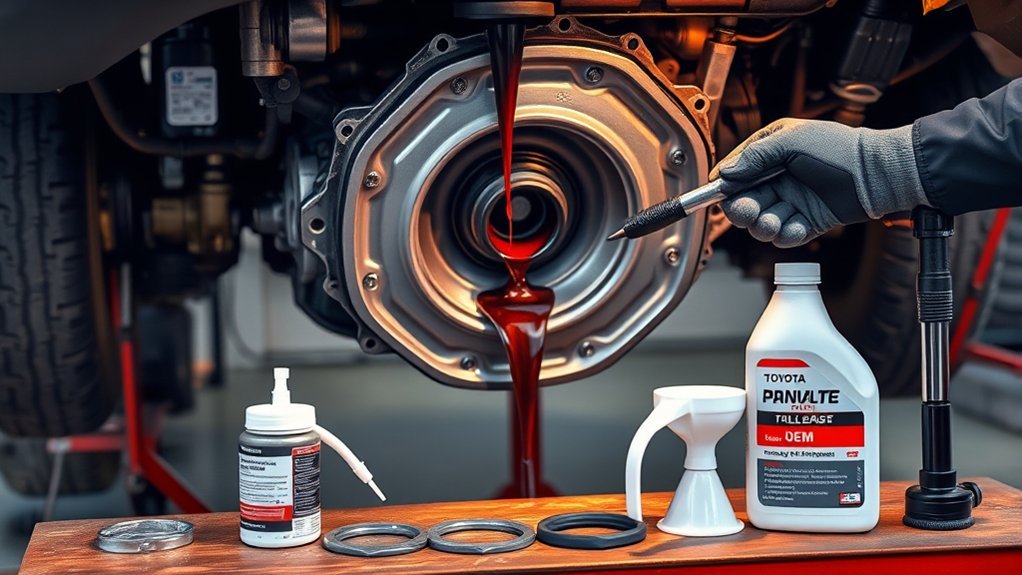
You’ve reviewed the lab numbers—now act on them with a clear service plan. Position the 2016 Tacoma on level ground, lift and secure with jack stands. For an early drain & fill, remove the drain plug and let WS ATF flow until clear; use a reusable hand pump to aid fluid extraction and capture waste. Fit a new drain-plug gasket, torque to spec, then refill through the fill/dipstick tube with fresh WS ATF using a funnel.
Run the engine several minutes to reach operating temperature, cycle gears, then park level and recheck level with the dipstick; add until at the correct mark. Document mileage and date—aim for service every 12–18 months or 15,000 miles. For a full service, follow dealer procedures: complete fluid replacement, pan drop if applicable, replace gasket and filter where accessible, and verify no leaks. Keep records, apply regular maintenance tips, and free yourself from avoidable transmission wear.
WS ATF Care for Hot, Dusty & 4×4 Use: Coolers, Filters, and Monitoring
If you run a 2016 Tacoma TRD OR in hot, dusty, or frequent 4×4 conditions, treat the WS ATF as a component that needs active thermal and contamination management. You’ll install cooling solutions—preferably a large secondary transmission cooler—to drop operating temperatures and slow viscosity rise and additive depletion. Lower fluid temperature directly reduces wear and extends service life.
You’ll also protect the fluid with upgraded fluid filters or periodic element replacement to limit abrasive dust and break‑in metal circulation. Monitor fluid condition: track viscosity and wear metals to spot accelerated degradation. Follow a proactive interval for drain and fill under severe use, and pair that with fluid analysis to make informed decisions. These steps liberate you from reactive repairs, keep shift quality stable, and preserve the transmission’s mechanical margin when heat, grit, and 4×4 loads combine.
Maintenance Plan: Testing Frequency, Costs, and Replacement Triggers
Although Toyota recommends a drain-and-fill of WS ATF every 12–18 months or about 15,000 miles, your maintenance plan should combine that baseline with scheduled fluid analysis and clear replacement triggers to catch accelerated wear. You’ll perform a drain-and-fill at the Toyota interval for consistent fluid maintenance, but you’ll also run lab analysis every 30,000 miles to assess wear metals and additive depletion. Expect WS ATF at about $8.80 per quart; budget for a reusable hand pump (~$10) to streamline changes and lower long-term service costs.
Use wear monitoring data to trigger early replacement: elevated iron, copper, or chromium after the 5–10k break‑in is a hard trigger. Visual darkening and contamination near 30,000 miles is a soft trigger prompting replacement. Combine periodic visual checks, scheduled lab tests, and the Toyota interval to form a liberation-minded plan that prevents metal accumulation, preserves shift quality, and optimizes long-term transmission life.
Frequently Asked Questions
What Does WS Stand for in Toyota ATF?
WS stands for “World Standard.” You’ll use this Toyota fluid to maintain consistent transmission performance; don’t assume it’s synthetic or permanent, and you’ll schedule regular changes to protect your transmission and preserve driving freedom.
Is Toyota WS Transmission Fluid Lifetime?
No — you shouldn’t assume lifetime performance; change WS fluid regularly. You’ll preserve gears, prevent wear, and protect warranties. Check fluid compatibility, follow intervals based on use, and act proactively to maintain transmission freedom.
How Often Should ATF WS Be Changed?
You should change ATF WS every 30,000 miles for normal use; consider 60,000 miles for towing/off‑road, or 15,000 miles (12–18 months) in harsh conditions. Follow fluid replacement intervals and maintenance tips to preserve transmission.
Conclusion
You’ve got the playbook: treat WS like a precision lubricant, not generic oil. Like tuning a piano before concert night, check viscosity, metals, and contamination on a schedule, and favor early drain-and-fill when duty’s heavy. Fit a cooler and fresh filter for towing or dusty trails, monitor temps and fluid color, and swap at measured intervals. Do that, and your Tacoma’s gearbox will stay sharp, responsive, and reliable.