
Your Tacoma’s charging system is the battery, alternator, and regulator working together: the alternator turns engine torque into 13.6–13.8V power while the regulator trims output based on battery state and temperature. That “smart” control helps efficiency but can undercharge AGMs or lithium packs, which need higher, specific profiles or a DC‑DC charger and BMS. Watch for dim lights or charging warnings and test voltage under load; keep going to learn practical fixes and upgrade choices.
Quick Answer: What to Do for AGM or Lithium Upgrades
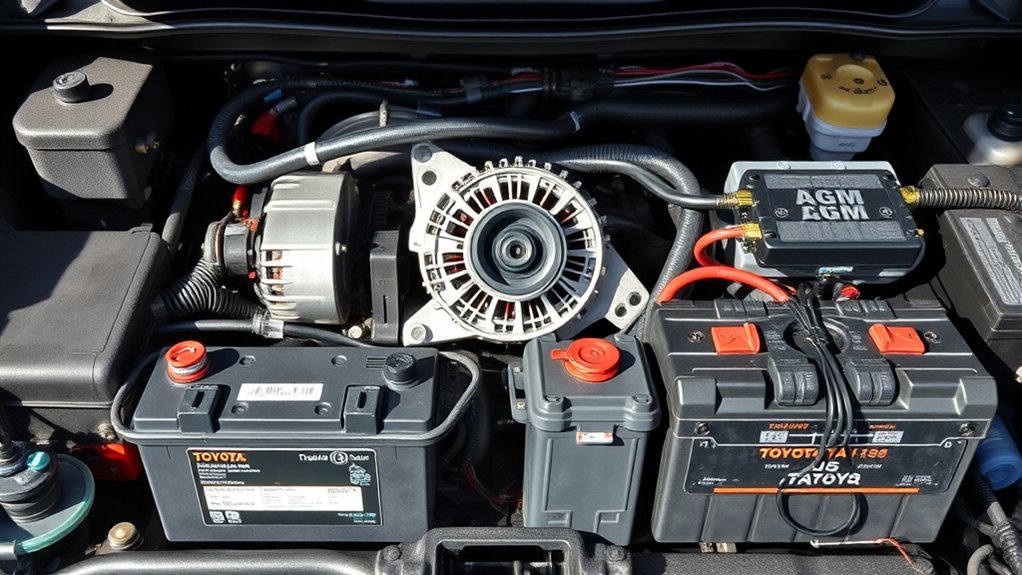
If you’re upgrading your Tacoma to AGM or lithium batteries, don’t assume the stock charging system will suffice—AGM needs about 14.1–14.7 V to fully charge and lithium chemistry requires strict charge profiles and a BMS to avoid damage or thermal runaway. Start by identifying your battery type and intended use (towing, off-road, daily). For AGM upgrades, verify the alternator or add a DC-DC charger to reach and hold 14.1–14.7 V; stock systems often top out near 13.8 V and won’t fully charge AGMs. For lithium management, install a dedicated BMS and choose a charger or DC-DC unit that supports lithium charge profiles and a stable 14.4 V boost when needed. Use voltage meters to monitor state of charge during operation and storage. Select batteries rated for your load profile and confirm compatibility with added charging hardware. Execute these steps to free yourself from undercharged batteries and preserve system reliability.
How the Tacoma Charging System Works (Battery, Alternator, Regulator)
Because the charging system ties the battery, alternator, and voltage regulator into a single loop, understanding how each part interacts lets you diagnose faults and optimize charging for different batteries. You’ll see the alternator convert engine torque into 13.2–14.8 V electrical power to feed accessories and top the battery. The regulator holds voltage steady, compensating for temperature to prevent overcharge and preserve battery life. You’ll monitor charging efficiency by comparing measured voltage under varying electrical load to expected targets.
Understanding the charging loop—battery, alternator, regulator—lets you diagnose issues and optimize safe charging across battery types.
- Battery: stores energy, supplies cranking current, accepts charge based on chemistry; AGM needs higher setpoints.
- Alternator: produces current proportional to RPM and field excitation; limits exist at idle and heavy load.
- Voltage regulator: controls field current to maintain voltage window, adjusts for ambient temperature.
- Diagnostic checks: inspect belts, terminals, measure system voltage under load, and consider DC‑DC charging for nonstandard batteries.
What “Smart Alternator” Means on Third‑Gen Tacomas
On third‑gen Tacomas, the smart alternator performs battery‑aware voltage control, raising or lowering output based on real‑time battery state to optimize efficiency and prevent overcharging. You should know it relies on LIN communication with the ECM to receive state data and commands, so alternator behavior depends on that network and module logic. Because output can be limited under high accessory load, you’ll want to verify charging at ~2000 RPM when diagnosing voltage drops or planning upgrades.
Battery-Aware Voltage Control
The third‑generation Tacoma uses a battery‑aware, or “smart,” alternator that varies its output voltage based on battery state of charge and real‑time load demands to optimize fuel economy and prevent overcharging. You’ll see battery management and voltage optimization drive charging behavior: the alternator raises voltage when the battery is low or loads spike, and lowers voltage to avoid overcharge once capacity is reached. This reduces fuel use and prolongs component life, though complexity can raise repair costs. Test charging at 2000 RPM to verify performance under load.
- Monitor battery state to allow adaptive charging.
- Use voltage optimization to balance economy and longevity.
- Conduct load tests at recommended RPM.
- Expect higher diagnostic complexity and potential costs.
ECM Communication Dependency
When the Tacoma’s smart alternator links to the ECM over the LIN bus, it lets the vehicle actively regulate charging based on real‑time inputs like battery state, engine RPM and accessory load. You rely on ECM signals to command the alternator’s regulator, enabling adaptive charging that raises or lowers output voltage to preserve battery health and improve fuel economy. Monitor RPM‑linked voltage shifts: they reveal how the system balances charge against mechanical load. Be aware the alternator can intentionally limit output to reduce strain, which may leave you with marginal charge at idle under heavy accessory use. That dependency increases system complexity, maintenance cost, and repair barriers, so if you value simplicity and independence consider alternatives that decouple charging from ECU control.
Why 13.6–13.8V Is Insufficient for AGM and Lithium Charging
Because your Tacoma’s alternator holds voltage around 13.6–13.8V, it won’t reliably finish or maintain a full charge on AGM or lithium batteries that demand higher, controlled charge profiles; AGMs need roughly 14.1–14.7V to accept a full charge without sulfation or capacity loss, and lithium chemistries require precise, often >14V regulation and charge-stage management to avoid overheating or imbalance.
You need to recognize limits and act to liberate performance. The ECU-controlled alternator clamps output, so it can’t provide AGM charging or the strict Lithium requirements. Relying on the stock system yields partial charge, accelerated wear, or unsafe conditions for lithium cells.
- Alternator ceiling: 13.6–13.8V — insufficient for AGM ideal absorption.
- AGM risk: undercharging leads to sulfation and capacity loss.
- Lithium risk: needs controlled (>14V) multi-stage charging to avoid imbalance/heat.
- Solution: add DC-DC charger or dedicated regulator to deliver proper voltage and charge profiles.
Symptoms and Dashboard Warnings to Watch For
Watch the dashboard for the “Check Charging System” or battery warning light—that’s the first indicator your charging system needs attention. You’ll also notice starting problems, frequent jump-starts, dim or flickering lights, and voltage fluctuations under accessory load when the alternator or regulator is failing. Monitor alerts promptly and diagnose voltage at idle and under load to isolate battery versus alternator faults.
Dashboard Warning Lights
If your Tacoma displays the “Check Charging System” light with the ignition on and engine off, don’t ignore it—this indicator points to low system voltage, a weak or failing battery, or an alternator that isn’t charging properly. You’ll want to treat dashboard alerts as actionable intelligence: they guide immediate electrical diagnostics and maintenance to preserve freedom from roadside failure.
- Inspect battery voltage and terminals for corrosion; low voltage or corroded cables often cause the warning.
- Check the alternator output with a multimeter; consistent undercharge signals alternator trouble.
- Examine the serpentine belt for slip or wear; a slipping belt reduces alternator performance.
- Address dim or flickering dash lights promptly; they’re early signs that electrical components need service.
Act decisively; liberation depends on system reliability.
Starting And Charging Symptoms
When your Tacoma shows charging-system anomalies—dim or flickering lights, the battery warning lamp, or repeated need for jump-starts—you should treat them as diagnostic clues pointing to the battery, alternator, wiring, or serpentine belt. You’ll see the “Check Charging System” warning with ignition on or engine off; don’t ignore it. Track battery health and watch for voltage drops under load and at idle. Inspect terminals for corrosion, test resting and running voltages, and verify alternator output with a multimeter. Check the serpentine belt for glazing or slack that reduces alternator performance. Corroded cables or poor connections can mimic alternator failure. Act promptly: monitoring dashboard alerts and addressing faults preserves electrical components and keeps you free from roadside dependency.
Quick Multimeter and 2,000 RPM Load Tests You Can Run
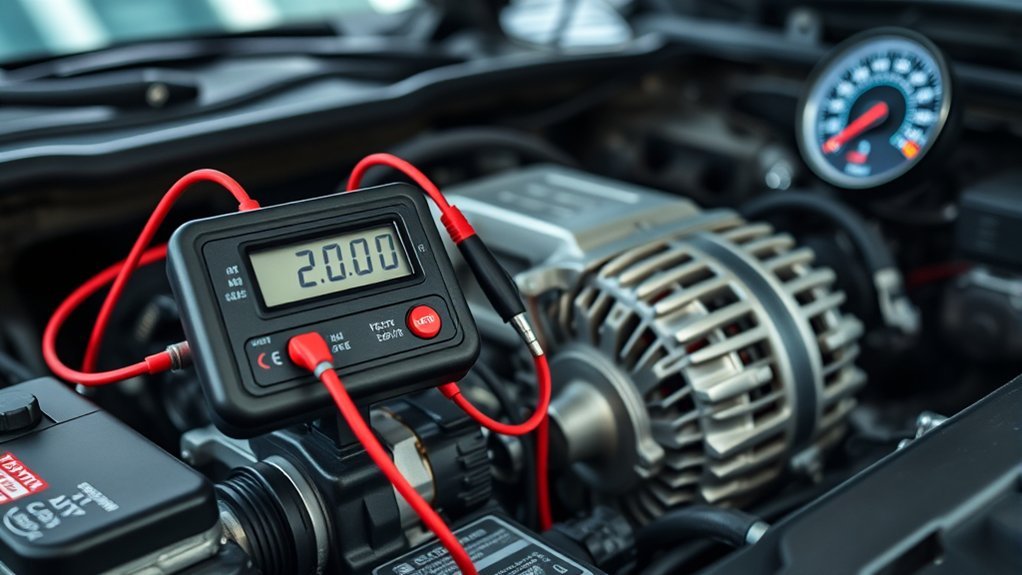
Although it’s a quick check, you’ll get meaningful data by combining a multimeter test with a 2,000 RPM load test: connect your multimeter to the battery terminals with the engine running and expect about 13.2–14.8 V for proper alternator output, then rev to roughly 2,000 RPM and add electrical load (lights, A/C, blower) to confirm voltage stays stable—ideally above 13.6 V; a significant drop below 13.2 V or a battery voltage falling under 9.6 V during cranking, or more than 0.200 V drop between the alternator and battery, indicates charging or connection issues that need further diagnosis. Use disciplined multimeter testing and focus on voltage stability while you work; the goal is clear: verify alternator capacity and wiring integrity so you can act with confidence. Follow this concise procedure:
- Measure resting and running voltages at battery terminals.
- Rev to ~2,000 RPM, enable major electrical loads.
- Note voltage under load; watch for drops <13.2 V.
- Check alternator-to-battery voltage drop; it must be ≤0.200 V.
Upgrade Options: DC‑to‑DC Chargers, High‑Output Alternators, Isolators
Because stock charging often can’t keep up with modern accessories, upgrading your Tacoma’s charging system is a practical step to guarantee reliable power for auxiliary loads and house batteries. Choose alternator upgrades when you need sustained higher output; high‑output units hold voltage above stock 13.8V to meet AGM and other battery types that require 14.1–14.7V, improving charging efficiency and accessory performance. Add a DC‑to‑DC charger for lithium or multi‑chemistry banks — DC charger benefits include proper charge profiles, voltage regulation, and isolation from alternator variability. Use isolator features, such as a Renogy 200A unit, to protect the starting battery and manage power distribution between packs without complex wiring. Integrate solar for redundant energy and to reduce alternator burden; pair solar integration with a DC‑to‑DC charger or a combined charge controller to harmonize sources. Plan wiring, fusing, and power management deliberately: match component ratings to load, prioritize battery health, and preserve mobility and independence on extended off‑grid trips.
Real‑World Dual‑Battery and Accessory Load Examples (Isolator Cycling)
How does your dual‑battery system behave under real accessory loads? You’ll observe dual battery dynamics that hinge on isolator thresholds and alternator capacity. Initial voltages (Red Top 12.42V, Yellow Top 12.34V) tell you battery state before loading. Under heavy accessory impact—fridge or inverter at idle—the alternator can be overloaded, causing voltage sag and isolator cycling to protect the start battery.
- You run a heavy load; voltage drops below 12.4V and the isolator opens to isolate the start battery.
- With reduced load, alternator recovers; at ~13.3V the isolator reconnects, sharing charge.
- After cycling, voltage stabilizes near 13.6V for ~15 minutes as the system rebalances and charges both batteries.
- Repeated cycles show the system handles transient overloads but require real-life testing to verify behavior and liberation from unexpected failures.
Monitor voltages and loads methodically to understand your system’s true accessory impact.
Maintenance Checklist and Practical Recommendations
Start with a quick visual and electrical inspection: check battery terminals for corrosion and tightness, verify serpentine belt condition for wear or slipping, and test alternator output at about 2000 RPM to confirm 13.2–14.8 V under load. Next, perform routine battery maintenance: clean terminals, tighten clamps, and apply dielectric grease to prevent re‑corrosion. Every 12 months or 12,000 miles, run a battery load test—ensure cranking voltage stays above 9.6 V; replace cells that don’t meet spec.
If the battery warning light illuminates, follow an alternator troubleshooting sequence: verify belt tension, measure open‑circuit battery voltage, then measure charging voltage under known accessory load. Check voltage regulator function and harness/connectors for damage or looseness. Keep records of tests and replacements to identify patterns and avoid being stranded. These methodical steps let you maintain electrical autonomy and reduce failure risk while empowering you to diagnose and act decisively.
Frequently Asked Questions
Can I Reprogram the ECU to Raise Alternator Voltage Output?
Yes — you can reprogram the ECU to raise alternator voltage output, but you’ll need ECU tuning that adjusts voltage regulation; combine careful alternator upgrades and testing to improve charging efficiency while avoiding electrical stress and warranty risks.
Will Higher Alternator Output Void My Vehicle Warranty?
Yes and no: you might keep basic coverage, but warranty implications jump if alternator upgrades or ECU reprogramming cause failures; you’ll need proof of unrelated damage, documented procedures, and insurer or dealer approval to avoid denial.
Can AGM Batteries Suffer From Undercharging if Vehicle Is Stored Long-Term?
Yes — AGM batteries can suffer undercharging during long term storage. You’ll need AGM battery maintenance: use a smart charger/maintainer, periodically top up charge, disconnect parasitic loads, and store at moderate temperature to preserve capacity and life.
Are Jump-Start Procedures Different With AGM or Lithium Starters?
Curious whether procedures differ? Yes — you’ll adjust jump start techniques: AGM batteries need correct polarity and controlled charging, lithium batteries demand strict charging safety and compatible chargers; follow manufacturer steps, use isolation, and avoid overcurrent.
How Does Cold Weather Affect Alternator Charging and Battery Health?
Cold weather reduces battery performance and forces your alternator to work harder, lowering charge acceptance and increasing internal resistance; you’ll see slower cranking, higher discharge rates, and need proactive charging, insulation, and load management to stay free.
Conclusion
You’re not doomed if your Tacoma’s charging system flirts with 13.6–13.8V — but don’t act like that’s enough for AGM or lithium setups. Treat the alternator, battery, and regulator as a matched system: test at idle and 2,000 RPM, watch smart‑alternator behavior, and add a DC‑to‑DC charger or high‑output unit if you run accessories or dual batteries. Ignore it and your lithium will sulk; upgrade smartly and it’ll hum like a Swiss watch.