
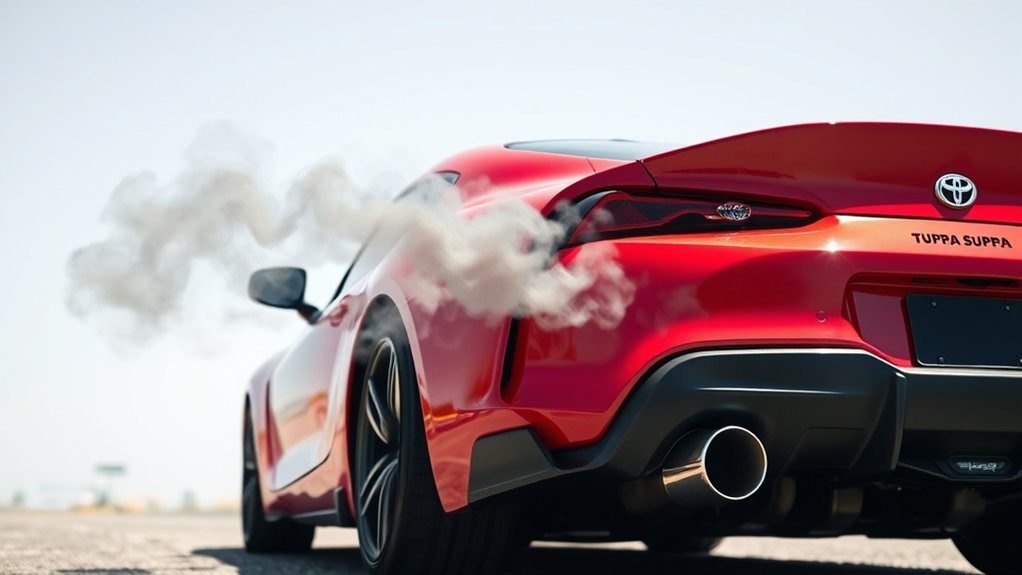
Supra smoke from exhaust pipes means different things by colour: white smoke that lingers after warm-up usually means coolant is burning, blue or grey smoke means oil is burning, and black smoke means the engine is running rich on fuel. Thin white vapour on a cold start that clears in a few minutes is normal condensation. Note the colour, when it appears, and check your coolant and oil levels before driving further.
The colour guide applies to every Supra. Turbo-related causes differ by generation: the Mk4 (A80) Turbo has twin sequential turbos on the 2JZ-GTE, while the GR Supra 3.0 (2020 on) uses a single turbo and a water-cooled charge-air cooler.
Supra Smoke From Exhaust: Colour Guide
| Colour | Likely cause | Other clues | Urgency |
|---|---|---|---|
| Thin white vapour, clears when warm | Normal condensation | Drips of water from tailpipe | None |
| Thick white, sweet smell | Coolant entering cylinders | Coolant level dropping, overheating, bubbles in reservoir | High: stop and diagnose |
| Blue / grey | Oil burning | Oil level dropping, oily tailpipe, smoke on boost or after idling | Medium to high |
| Black | Rich fuel mixture | Fuel smell, sooty tailpipe, poor economy, possible misfire codes | Medium |
White Smoke: Coolant Burning
If white smoke continues after the engine is warm and smells sweet, coolant is getting into the combustion chamber. Check the coolant level when cold and watch the temperature gauge.
- Head gasket failure (any generation), often after overheating or high boost on modified cars.
- Cracked head or block, usually after severe overheating.
- Charge-air cooler leak (GR Supra): the B58 uses a water-cooled intercooler in the intake, so an internal leak can let coolant into the engine.
A shop can confirm with a cooling-system pressure test and a combustion-gas (block) test.
Blue Smoke: Oil Burning
- Turbo seals: smoke under boost or on lift-off; oil in intercooler piping. Aged Mk4 twin turbos are a common source.
- Valve stem seals: a puff of blue smoke at start-up or after idling.
- Piston rings: smoke under load plus low compression and high oil use.
- PCV / crankcase pressure: a stuck PCV valve or blocked breather can push oil into the intake.
- Overfilled oil: check the level is not above the maximum mark.
Black Smoke: Running Rich
- Leaking or sticking fuel injectors
- Faulty air-flow, oxygen or other sensors
- Restricted air filter or intake
- Fuel pressure regulator fault (older cars)
- Aggressive aftermarket fuel tuning
A rich-running engine often smells of fuel too; see our guide to a Supra fuel smell in the cabin. If black smoke comes with sluggish acceleration, our loss of power on acceleration guide walks through fuel and air delivery checks.
How to Diagnose Exhaust Smoke: Step by Step
- Observe. Note the colour, smell, and when it happens: cold start, idle, boost, or lift-off.
- Check fluids. Coolant (engine cold) and oil level. A falling level confirms which fluid is burning.
- Scan for codes. Misfire, fuel trim, and sensor codes help explain black smoke.
- Inspect intake piping. Oil pooling in the intercooler pipes points to turbo seals or crankcase pressure.
- Check the PCV system for a stuck valve or cracked hoses.
- Professional tests. Compression and leakdown tests check rings and valves; a block test confirms head gasket problems.
When to Get Professional Help
- Thick white smoke with coolant loss or overheating: stop driving.
- Oil consumption you have to top up between changes.
- Blue smoke under boost (possible turbo failure).
- Check-engine light flashing (active misfire): reduce load and get it checked.
- The GR Supra is under warranty: let the dealer diagnose before any DIY work.
Prevention Tips
- Change oil at the scheduled interval and check the level regularly.
- Use the coolant type Toyota specifies and fix small leaks early.
- Replace the air filter on schedule.
- Let a turbo engine idle briefly after hard driving before switching off.
- On modified cars, have tuning and fuel changes done by a reputable shop.
Frequently Asked Questions
Is white smoke from a Supra exhaust on a cold morning normal?
Thin white vapour that disappears within a few minutes of warming up is usually water condensation and is normal. Thick, sweet-smelling white smoke that continues after warm-up points to coolant burning and needs checking.
What does blue smoke from a Supra mean?
Blue or grey smoke means oil is being burned. Common sources are turbocharger seals, valve stem seals, piston rings, or excess crankcase pressure pushing oil into the intake.
Why is my Supra blowing black smoke?
Black smoke means the engine is running rich, burning more fuel than it can use. On stock cars look at injectors, sensors and air intake; on tuned cars an aggressive fuel map is a common cause.
Can I keep driving with smoke from the exhaust?
Not with heavy white smoke, a rising temperature gauge, or a fast-dropping oil level, as these can damage the engine quickly. Light, occasional smoke should still be diagnosed soon.
How much does it cost to fix exhaust smoke?
It depends entirely on the cause. A PCV part or sensor is a small job, while a head gasket, turbo or engine internals can be a major repair. Get a diagnosis and written estimate before deciding.
Bottom Line
Exhaust smoke colour tells you which fluid is burning. Check coolant and oil levels first, scan for codes, and treat thick white smoke or rapid oil loss as a stop-driving warning.

[…] If the smell comes with black smoke from the tailpipe, the engine may be running rich. See our guide to Supra exhaust smoke colours. […]