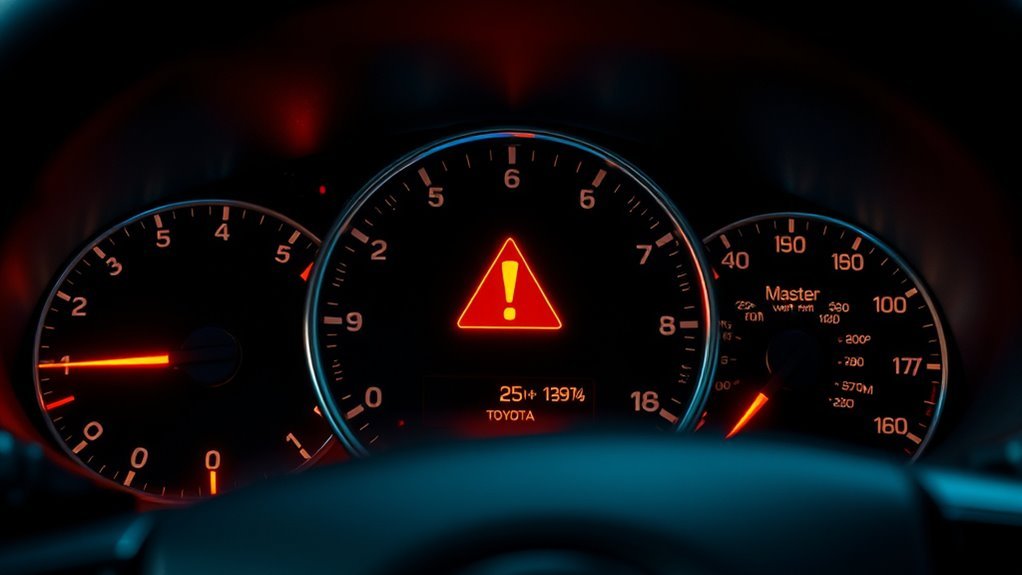
When your Toyota RAV4’s yellow triangle master warning light comes on, treat it as a detected system fault that needs immediate assessment. Check the dash for accompanying icons or messages, secure doors and seatbelts, verify tire pressure and fluid levels, and inspect the battery and gas cap. A steady light signals a condition; a flashing light indicates urgency. If the light persists after basic checks and a restart, get professional diagnostics—keep going for detailed causes, checks, and next steps.
Quick Answer: What to Do When the RAV4 Master Warning Light Flashes
What should you do when the RAV4 Master Warning Light flashes? You immediately treat it as a detected malfunction demanding assessment. Scan the dashboard indicators for supplemental messages that narrow the fault—tire pressure, seat belt, or open-door alerts are common and fixable. Address any obvious cause: inflate tires to spec, buckle occupants, or close doors; these steps often extinguish the light. If it still flashes after a full restart, proceed with structured warning light troubleshooting: consult the Owner’s Manual for code guidance, then run basic system checks or diagnostic scans. Don’t delay—ignoring the signal risks further damage and constrains your mobility. If you can’t resolve the alert, contact a qualified technician to perform a professional diagnosis and repair. You deserve control over your vehicle; act decisively, use precise checks, and reclaim safe operation rather than tolerate persistent, unresolved faults.
RAV4 Master Warning Light: What It Looks Like and When It Appears
You’ll recognize the Master Warning Light as a triangle with an exclamation mark centered on the dash. It normally illuminates briefly at startup as a self-check and can reappear alongside other indicators to pinpoint issues. If it stays on or returns after being cleared, consult the owner’s manual or get a professional diagnosis.
Appearance And Iconography
The Master Warning Light on a Toyota RAV4 shows as a yellow/orange triangle with an exclamation mark and comes on during startup as part of the system check; it also illuminates or flashes (sometimes with an audible chime) whenever the vehicle detects issues ranging from low tire pressure or open doors to faults in safety systems, and you should read accompanying dashboard messages or the Owner’s Manual to pinpoint the cause.
You’ll see a compact, high-contrast icon designed for immediate icon visibility and warning clarity. It sits on the instrument cluster where your eyes naturally scan. Steady illumination signals a condition; flashing or chimes indicate elevated urgency. The symbol’s color and shape conform to automotive standards so you can quickly identify a general fault and seek details via displayed messages or documentation.
Typical Activation Scenarios
Although it can light during the startup system check, the RAV4’s Master Warning Light also activates whenever onboard systems detect issues—common triggers include low tire pressure, an unlatched door or seatbelt, and faults in safety or powertrain sensors. You’ll see the triangle with an exclamation mark and must scan the dash for specifics. Environmental extremes can cause sensor misreads, so don’t ignore transient alerts. Check tire pressure and seatbelt status first; then consult the Owner’s Manual for required actions or diagnostics. If multiple systems report faults, address the highest-priority warning immediately or seek qualified service to regain control.
| Trigger | Typical response |
|---|---|
| Low tire pressure | Inflate, reset TPMS |
| Seatbelt status | Fasten, verify sensor |
| Open door | Close, verify latch |
| Sensor fault | Scan codes |
| Extreme temps | Re-check sensors |
Common Causes: Why the Master Warning Light Comes On
You’ll see the Master Warning Light if electrical system faults occur, such as battery, alternator, or wiring issues that disrupt sensor communication. It also comes on for door and sensor issues—open or misaligned doors, faulty latch sensors, or seatbelt switch errors can trigger the alert. Check accompanying indicators and the Owner’s Manual to prioritize electrical diagnostics versus simple door/sensor fixes.
Electrical System Faults
When electrical faults occur, your RAV4 will often illuminate the Master Warning Light to signal issues like a weak battery, alternator failure, or intermittent charging. You should treat that lamp as an urgent prompt to inspect charging voltage and perform battery maintenance: test state-of-charge, terminals, and load capacity. Alternator failure or belt issues produce low-voltage symptoms that degrade electronics and drivetrain controls. Wiring shorts, corroded connectors, or intermittent grounds generate false signals; don’t ignore sporadic alerts. Extreme temperatures exacerbate component wear and can create temporary faults that mimic permanent failures. Run systematic electrical diagnostics with a multimeter and OBD-II scanner to isolate faults before they cascade. Taking control through decisive checks preserves your freedom from roadside breakdown and costly repairs.
Door And Sensor Issues
If a door sensor misreads an open or unlatched door, the Master Warning Light will often come on immediately, so check the dashboard for accompanying door-ajar indicators and physically confirm each latch. You should perform sensor troubleshooting and door maintenance to eliminate false alerts. Cold and temperature swings can freeze or degrade sensors; frequent use of the driver’s door accelerates wear. Intermittent activations may not log codes, so don’t rely solely on scans.
- Inspect striker and pin alignment; a misaligned latch trips sensors.
- Test sensor continuity and connector corrosion; replace faulty switches.
- Lubricate latches and protect sensors from moisture and ice.
Act decisively: fix or replace worn parts to reclaim control and prevent nuisance warnings.
Assess Urgency: Urgent vs. Minor (How to Tell)
Although the master warning light is a general alert, you should immediately scan the dashboard for accompanying lights to judge urgency. Look for urgent indicators: red lights mean stop and secure control—engine, brakes, or airbag faults demand immediate action and often safe shutdown. Yellow or amber signals usually flag minor issues you can address soon—low tire pressure, seat belt reminders, or maintenance notices. You’ll use the color and combination of lights to prioritize: red + master = high risk; amber + master = scheduled attention. Don’t ignore patterns or repeated flashes; they can escalate. Check voltage and basic systems if you can do so safely; if not, pull over, shut the engine, and call for service. The owner’s manual maps exact meanings and recommended responses; carry it mentally. You want freedom on the road—treat red as a cessation command, amber as a maintenance waypoint, and act decisively to keep control and move on.
Read Dashboard Messages and Icons (What Accompanying Alerts Mean)
Because the master warning triangle only signals that something needs attention, you should read any accompanying dashboard messages and icons immediately to identify the specific fault. You’ll see the master warning paired with dashboard icons and text warning messages that narrow the problem—low tire pressure, open door, or system fault. Note color: yellow flags important checks; red demands immediate intervention. Don’t ignore the hierarchy.
Consult the Owner’s Manual for precise definitions and recommended actions tied to each icon and message. Treat yellow alerts as prompt maintenance items; treat red alerts as critical failures that can risk operation. Reading the message gives you direction: what system, what severity, and whether you can continue driving. Respond deliberately and reclaim control of your vehicle’s safety.
- Yellow tire icon + “TPMS” warning messages = check pressure, inflate to spec.
- Red brake icon + text = stop safely; seek service.
- “Door Open” text + icon = secure before moving.
Quick On-Road Checklist: Immediate Steps to Stay Safe
When the master warning light comes on while you’re driving, pull over to a safe spot and stop so you can assess the issue. You’ll follow a tight checklist: verify additional warning lights or dashboard messages, confirm doors and seat belts are secured, and scan for obvious leaks or low-fluid indicators. Take safety precautions: use hazard lights, set the parking brake, and position the vehicle out of traffic.
| Step | Action | Goal |
|---|---|---|
| 1 | Check dashboard icons | Identify specific faults |
| 2 | Secure doors/seat belts | Eliminate common triggers |
| 3 | Inspect fluids/tires visually | Spot urgent maintenance needs |
If you correct an obvious issue, restart the engine and watch warning lights. If the master warning light returns, don’t improvise—get professional diagnostics. You deserve mobility and control; act decisively and refuse to accept unsafe conditions.
Home Checks When No Codes Are Stored: Battery, Doors, Tires, Fluids
After you’ve pulled over and ruled out obvious hazards, run a focused set of home checks before calling for diagnostics. You can resolve many master warning triggers yourself if no fault codes are stored. Start with a battery inspection: confirm terminals are tight and free of corrosion; a poor connection can mimic electrical faults. Check door closure on every door and the hatch—an ajar sensor will illuminate the master warning without logging a code. Measure tire pressure with a gauge and inflate to spec; low tire pressure can register as a general fault.
After pulling over, run quick home checks—battery, doors, and tire pressure—before calling for diagnostics.
- Verify fluid levels: coolant, engine oil, and washer fluid are within manufacturer ranges.
- Tighten the gas cap and inspect for damage; a loose or degraded cap can trigger the light.
- Recheck battery terminals and confirm interior lights go off when doors close.
If all home checks pass and the light persists, proceed to diagnostics. These steps free you from unnecessary service stops and keep control in your hands.
Drive, Roadside, or Tow: When to Seek Professional Service and Typical Repair Costs
If the Master Warning Light comes on while you’re driving, pull over safely and assess whether other indicators—like low oil pressure, ABS, or engine temperature—are illuminated; those combinations usually mean you need professional service immediately. You decide whether to drive, wait roadside, or tow based on symptoms: if the car runs normally and no critical icons show, you can cautiously drive to a shop; if performance falters, fluids leak, or temperatures spike, stop and call for help. Contact a tow truck and discuss tow truck options to avoid compounding damage. Expect repair estimates to span roughly $100–$1,000 depending on diagnostics and parts—simple sensor or fluid fixes sit lower, while ABS, oil pressure, or engine repairs climb higher. Always consult a qualified technician with proper scan tools who’ll provide precise fault codes and a definitive plan. You retain agency—choose safe transport and insist on clear estimates before authorizing work.
Frequently Asked Questions
Can the Master Warning Light Reset Itself After Restarting the Car?
Yes, it can: you’ll see the master warning extinguish if the fault clears on restart, but don’t assume permanent repair; perform diagnostics and fix the root cause so the light reset isn’t temporary or misleading.
Does the Master Warning Light Affect Vehicle Warranty Coverage?
Think of the light as a flag: yes, warranty implications can arise if you ignore required repairs. You’ll get better outcomes by prompt light diagnosis and documented service; don’t delay, keep records to protect coverage.
Will a Low Key Fob Battery Trigger the Master Warning Light?
Yes — a weak key fob battery can trigger messages and fault indicators. You’ll perform key fob maintenance by replacing the battery promptly, then follow warning light troubleshooting steps to clear alerts and regain functional freedom.
Can Aftermarket Electronics Cause the Master Warning Light to Illuminate?
Yes — you can blame your rebel aftermarket installations: they’ll sometimes cause electrical interference that trips the master warning light. You’ll want proper grounding, shielding, and professional integration to avoid false alerts and regain control.
Is It Safe to Drive Long Distances With the Master Warning Light On?
You shouldn’t; driving safety’s compromised when warning indicators show unresolved faults. You’ll risk breakdowns or cascading failures—stop, diagnose with proper tools or a technician, and don’t keep driving long distances until it’s cleared and verified.
Conclusion
When the RAV4’s master warning light flashes, don’t ignore it: 74% of drivers cite dashboard warnings as their first clue to a problem, so act fast. Check the dash for messages and icons, pull over safely if gauges or smells are abnormal, and run the quick on-road checklist (park, hazards, battery/doors/tires/fluids). If codes appear or symptoms persist, get professional diagnostics—minor fixes cost less, but towing and repairs can rise quickly.