By: AutoReviewNest Technical Editorial Team [VERIFY: add real author/byline]
Last updated: August 30, 2026
Editorial basis: This guide uses Toyota technical service information, factory repair manuals (TIS) across 2.4L (2AZ-FE), 2.5L (2AR-FE/A25A), 3.5L (2GR-FE/2GR-FKS), and Hybrid synergy drive platforms, alongside current U.S. EPA and state inspection program regulations. Exact monitor enable criteria vary by model year, engine family, and emissions calibration.
To get a Toyota Camry ready for an emissions inspection, you must resolve all active diagnostic trouble codes, avoid resetting the system, and confirm that all required OBD-II monitors display as Complete or Ready under the scanner’s “Since DTCs Cleared” menu. Turning off the check engine light is not enough; the Engine Control Module (ECM) requires specific operating conditions—including coolant temperature, vehicle speed, deceleration fuel-cut, and an uninterrupted key-off soak—to complete its internal diagnostic routines.
Quick Answer: The 4-Step Camry Readiness Protocol
- Fix underlying faults: Repair any active issues, record all stored/pending codes, and ensure the gas cap is tightly sealed.
- Stabilize fuel & battery: Keep the fuel tank between 1/4 and 3/4 full (under 85%) and ensure the 12-volt battery maintains stable voltage above 12.4V.
- Execute the drive pattern: Perform a cold start, idle for 3 minutes, cruise steadily at 45–55 mph for 10 minutes, and complete 3 to 5 closed-throttle decelerations without braking.
- Complete the EVAP soak: Park the car and leave it completely off for at least 6 to 8 hours in moderate temperatures (40°F–95°F) to let the key-off EVAP vacuum pump test run.
Key Takeaways
- A cleared check engine light (MIL off) does not mean the vehicle is ready for inspection.
- Clearing DTCs or disconnecting the 12V battery immediately resets all non-continuous monitors to “Not Ready.”
- Readiness must be verified under “Since DTCs Cleared,” not the temporary “This Drive Cycle” menu.
- Catalyst and O2/AF sensor monitors require steady highway speeds followed by closed-throttle coasting (deceleration fuel-cut).
- Modern Toyota EVAP monitors run via a key-off canister pump module 5–6 hours after engine shutdown, not while driving.
- Federal EPA standards allow 1 incomplete monitor on 2001+ vehicles, but state regulations (such as California and Texas) enforce specific exceptions.
At a Glance
| Time Required | 30–45 minutes of mixed driving plus a 6–8 hour uninterrupted overnight key-off soak. |
| Difficulty | Easy (OBD-II scanner readiness check); Moderate (diagnosing stubborn incomplete monitors). |
| Tools Needed | Standard OBD-II / EOBD scanner capable of displaying I/M Readiness, live Engine Coolant Temp (ECT), and Permanent DTCs. |
| Ready to Test When | MIL is commanded OFF, required “Since DTCs Cleared” monitors show “Complete,” and no pending/permanent fault codes block compliance. |
How Do You Get a Toyota Camry Ready for an Emissions Test?

Begin by checking the Malfunction Indicator Lamp (MIL), commonly known as the check engine light. Turn the ignition to ON (engine off): the MIL must illuminate for the bulb check, then turn off immediately once the engine starts. On a Camry Hybrid (such as the Hybrid LE, SE, or XLE), the gasoline internal combustion engine (ICE) may stop while the vehicle is in READY mode; always verify the instrument cluster light rather than relying on engine sound.
Next, connect your OBD-II scan tool to the 16-pin diagnostic port located under the driver’s side dashboard. For a full walkthrough on navigating diagnostic menus, see how to read OBD-II codes on a Toyota Camry. Evaluate the four essential OBD-II data parameters:
- Stored / Confirmed DTCs: Active emissions faults that have occurred across two consecutive drive cycles and commanded the MIL on.
- Pending DTCs: Single-trip faults detected during the current or previous trip. A pending code will prevent its associated readiness monitor from reaching “Complete.”
- Permanent DTCs (PDTCs): Hardened codes stored in non-volatile memory that cannot be erased with a scanner or battery disconnect. The ECM clears them only after completing the factory drive pattern and confirming the fault is resolved.
- I/M Readiness Status (“Since DTCs Cleared”): The cumulative monitor readiness register used by official state inspection computers. Avoid looking only at “This Drive Cycle,” which resets every time the key is turned off.
What Your Scan Result Usually Means
| Scanner Result | Likely Meaning | Required Action |
|---|---|---|
| MIL ON or Commanded ON | Active emissions system failure detected | Diagnose and repair the root cause; do not clear codes before fixing. |
| All/Most Monitors Incomplete | Codes were recently erased, 12V battery was disconnected, or driving has been too brief | Verify battery terminals are secure, maintain 1/2 tank of fuel, and perform the drive cycle. |
| Only EVAP Monitor Incomplete | Vehicle has not completed the required 5–6 hour key-off cold soak in the proper temperature range | Ensure fuel is between 1/4 and 3/4 tank, park overnight in moderate ambient temps, and do not interrupt soak. |
| Catalyst / O2 Incomplete | Engine Coolant Temp below 167°F or no closed-throttle deceleration occurred | Drive 10 minutes at steady 50 mph, then perform 3 to 5 smooth decel coasts down to 20 mph. |
| Required Monitors Ready & MIL OFF | Emissions diagnostic self-tests successfully satisfied | Confirm state-specific permanent code rules and proceed to the inspection station. |
Warning: Never clear codes in the parking lot of an inspection station to extinguish the MIL. Clearing codes resets every readiness monitor back to “Not Ready” and will guarantee an immediate test rejection for incomplete readiness.
Inspect the fuel filler cap. Toyota owner documentation confirms that a loose, missing, or damaged fuel cap seal allows fuel vapor venting, triggering diagnostic trouble codes (such as P0440, P0442, or P0455) and aborting EVAP monitor self-tests.
[Products Worth Considering]

The TOPDON VeriDiag X800 BT is a wireless bidirectional automotive diagnostic scanner designed for full-system troubleshooting, active testing, and advanced service resets. It supports broad vehicle coverage, live data viewing, AutoVIN identification, and lifetime free updates to help DIYers and professionals diagnose issues faster and with greater confidence.

This enhanced OBD2 scanner helps drivers quickly diagnose check engine light issues, read and clear trouble codes, and check emissions readiness before a smog test. It also adds EVAP and O2 sensor testing, live data, freeze frame capture, and a one-click battery health check in a simple plug-and-play tool with a bright color screen.

FOXWELL NT201 is an easy-to-use OBD2 scanner designed to help drivers quickly read and clear check engine codes, view live engine data, and check emissions readiness. Its color screen, one-key I/M readiness test, and broad compatibility with most gasoline vehicles since 1996 make it a practical tool for everyday diagnostics and maintenance. With plug-and-play operation and lifetime free updates, it offers a simple way to understand vehicle issues without expensive shop visits.
What Driving Conditions Set Camry Readiness Monitors?
Readiness monitors operate independently when precise environmental and mechanical criteria are satisfied. The Toyota ECM monitors Engine Coolant Temperature (ECT), Intake Air Temperature (IAT), Mass Air Flow (MAF), vehicle road speed, throttle position angle, and calculated engine load. A short trip to the grocery store will not satisfy these pre-conditions.
1. Cold Soak Pre-Conditions
For emissions testing algorithms to initialize, the ECM must see a true cold start. The vehicle should remain parked with the engine off for at least 6 to 8 hours until the engine coolant temperature and intake air temperature are within 12°F (7°C) of each other, typically between 40°F and 95°F (4.4°C to 35°C). Avoid touching the accelerator pedal during start-up.
2. Mixed Urban and Highway Drive Cycle
To enable continuous and non-continuous system monitors, the drive cycle must simulate distinct real-world load profiles:
- Idle Phase: Allow the engine to idle smoothly in Park (or Ready mode) for 2 to 3 minutes with the A/C and rear defroster off.
- City Acceleration: Accelerate smoothly at light throttle (under 2,500 RPM) up to 25–35 mph, maintaining speed for 2 minutes before coming to complete stops.
- Highway Cruise: Merge onto an open road or highway and hold a steady speed between 45 and 55 mph for 10 to 15 continuous minutes. Avoid sudden accelerations or using cruise control on steep grades.
- Closed-Throttle Fuel-Cut Deceleration: While driving at 50–55 mph on a safe, level road, completely release the accelerator pedal and allow the vehicle to coast down to 20 mph without touching the brake pedal or shifting into neutral. This deceleration mode allows the ECM to sample unburned oxygen levels for oxygen and air-fuel ratio sensor testing.
Pro Tip for Camry Hybrids: In hybrid models, the gas engine frequently shuts off during low-load driving and coasting. To ensure the engine remains running long enough to reach full operating temperature (above 167°F) and complete the catalyst monitor, drive in Sport mode or select a fixed lower virtual gear (e.g., S3/S4) to maintain ICE operation.
What Is the Correct Toyota Camry Drive Cycle?
Toyota does not use a single universal drive pattern across all generations. Modern 2.5L 4-cylinder (2AR-FE, A25A-FKS) and 3.5L V6 (2GR-FE, 2GR-FKS) powertrains feature specific monitor triggers, as detailed in the service manual matrix below:
| Monitor System | Factory Service Enable Criteria | Common Failure / Incomplete Causes |
|---|---|---|
| Catalyst Monitor | ECT > 167°F (75°C); steady vehicle speed of 40–55 mph for 10–12 minutes; stable engine load (15%–35%). | Stuck-open thermostat, fluctuating throttle, pending misfire codes, or exhaust leak near upstream manifold. |
| A/F & O2 Sensor Monitors | ECT > 167°F; cruising speed 45–55 mph followed by closed-throttle coasting (fuel cut-off) from 50 mph to 20 mph for > 5 seconds. | Driver resting foot on brake during coasting, heater circuit resistance out of spec, or dirty MAF sensor. |
| Key-Off EVAP Monitor (2005+) | Vehicle parked/stationary; ignition OFF; 5 to 6-hour delay; fuel level 1/4 to 3/4 (under 85%); IAT/ECT 40°F–95°F; battery > 12.0V. | Fuel tank full (> 90%) or near empty (< 15%), ambient temperature below freezing, vehicle restarted during 6-hour soak, or canister pump failure. |
| Intrusive EVAP (Older Camrys) | Fuel tank 1/2 to 3/4; cold soak > 8 hours; highway cruise at 45–55 mph for 15 minutes followed by 5 minutes idle. | Loose gas cap, faulty purge/vent VSV solenoid, or small canister line fracture. |
When running a manual drive cycle on public roads, follow this safe, comprehensive sequence:
- Cold Start: Let the car sit overnight (at least 8 hours). Start the engine and idle with accessories off for 3 minutes until idle speed settles.
- City Driving: Drive for 5 minutes in moderate traffic at 25–35 mph with 3 to 4 complete stops (holding the brake for 15 seconds each stop).
- Highway Warm-Up: Accelerate smoothly onto the highway and maintain a constant 50–55 mph for 10 to 15 minutes. Keep throttle input smooth.
- Deceleration Coasts: On a clear stretch of road, let off the throttle completely and let the vehicle decelerate from 55 mph to 25 mph without braking. Repeat this deceleration sequence 3 times.
- Idle & Park: Return home, let the engine idle in Park for 2 minutes, and turn the ignition OFF.
- Overnight Key-Off Soak: Allow the Camry to sit parked, untouched, with the key out for 6 to 8 hours so the EVAP canister pump module can run its leak detection test.
- Scanner Verification: Plug in your OBD-II scanner and check the “Since DTCs Cleared” readiness monitor screen before scheduling your inspection.
Safety First: Never perform closed-throttle coasting in heavy traffic or where sudden speed drops endanger other drivers. Perform tests only where road conditions allow steady, safe driving.
[Products Worth Considering]

This replacement gas cap is designed for a wide range of Toyota and Lexus models, offering a direct-fit solution for restoring a proper seal at the fuel tank. It helps address check engine light issues related to the fuel cap while providing easy installation and dependable performance. Built from durable materials and rigorously tested before shipping, it is a practical replacement for worn or damaged fuel caps.

This replacement gas cap is designed to restore a tight fuel-tank seal, helping reduce vapor leaks, prevent check engine light issues, and maintain proper fuel system performance. Built in OE-style form for a wide range of Toyota and Lexus vehicles, it offers a direct DIY fix with durable materials for reliable, long-lasting use.

This WEJOWE OBD2 scanner helps drivers quickly identify check engine causes, read and clear trouble codes, and view live vehicle data with built-in DTC lookup. It also includes battery voltage testing, I/M readiness checks, freeze frame retrieval, and support for printing diagnostic reports to help simplify repairs and maintenance. Designed for most OBDII vehicles since 1996, it offers an easy-to-use solution for DIY car diagnostics.
What Do OBD-II Readiness Results Mean?
On-Board Diagnostic (OBD-II) readiness monitors act as self-running diagnostic checks designed to verify that the powertrain and exhaust components meet EPA clean air standards over time.
- Continuous Monitors (Run constantly): Misfire Monitor, Fuel System Monitor, and Comprehensive Component Monitor (CCM). These run immediately upon engine start.
- Non-Continuous Monitors (Run under specific conditions): Catalyst Monitor, Heated Catalyst, Oxygen Sensor, Oxygen Sensor Heater, Evaporative (EVAP) System, and Secondary Air / EGR (if equipped).
On your scan tool, completed self-tests display as Complete, Ready, or OK. Incomplete tests display as Incomplete, Not Ready, or INC. If a monitor displays Unsupported or N/A, that specific hardware is not installed on your Camry calibration and is ignored during testing.
Why “Since DTCs Cleared” Is the Only Screen That Matters
Most advanced scan tools offer two readiness menus: “This Drive Cycle” and “Since DTCs Cleared.” State inspection equipment connects exclusively to the cumulative “Since DTCs Cleared” register. “This Drive Cycle” only tracks tests completed since the key was last turned in the ignition and resets every time you shut off the engine.
Understanding Permanent Diagnostic Trouble Codes (PDTCs)
Introduced on 2010+ vehicles, Permanent DTCs prevent vehicle owners from erasing trouble codes right before an emissions test. Unlike standard active codes, a PDTC cannot be cleared with a scan tool or by disconnecting the 12V battery. The code clears automatically only after the vehicle completes its full drive cycle and the ECM confirms that the system has passed self-testing. California Smog Check rules, for instance, will fail a vehicle with an active PDTC unless the vehicle has completed at least 200 miles of driving and 15 warm-up cycles since the last code reset.
A Toyota Camry can have no active check engine light and still fail an emissions inspection if the required readiness monitors remain incomplete or if an active Permanent DTC is detected.
Why Won’t Camry Readiness Monitors Complete?
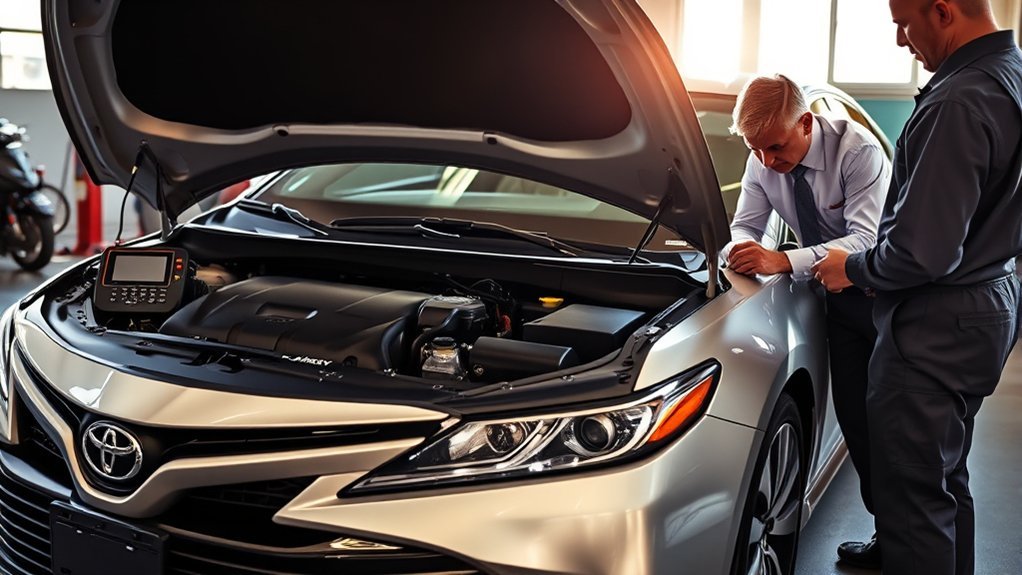
If your Camry has logged over 100 miles of mixed driving and one or more monitors remain “Not Ready,” do not keep driving aimlessly. Identify the specific system that is failing to run:
- Faulty Thermostat (Coolant Temp Too Low): If the engine coolant fails to reach 167°F (75°C) due to a stuck-open thermostat, the ECM will stay in open-loop warm-up mode and refuse to execute catalyst and oxygen sensor monitors.
- Improper Fuel Tank Level: The EVAP monitor requires fuel levels between 1/4 and 3/4 capacity (ideally 40%–75%). A full tank leaves no vapor space for pressure testing; an empty tank risks uncovering the fuel pump vapor sensors.
- Failing 12V Battery / Parasitic Drain: On modern Camrys, the EVAP vacuum pump activates 5 hours after key-off. If the 12V battery voltage drops below 11.8V during this period, the ECM aborts the EVAP self-test to preserve battery cranking power.
- Pending DTCs: A component fault (such as a lazy air/fuel ratio sensor) may log a pending code on trip 1. This pending status halts further monitor evaluation before the MIL is ever triggered.
- Exhaust or Intake Air Leaks: Minute leaks around the exhaust flex pipe, upstream manifold, or catalytic converter gaskets distort downstream O2 sensor feedback, blocking catalyst readiness. For lifespan details, explore our guide to Toyota Camry catalytic converter lifespan.
- EVAP Purge / Vent Valve Leaks: A sticky vacuum switching valve (VSV) or hairline fracture on the charcoal canister will abort the pressure drop test. Learn step-by-step diagnostic checks in our Camry EVAP leak code causes and fixes.
What Should You Do When One Monitor Stays Not Ready?
Target your troubleshooting to the specific monitor displayed as incomplete on your scanner:
If the EVAP Monitor Will Not Set
Verify that the gas tank is roughly half full. Inspect the gas cap rubber O-ring for dry rot, cracks, or grit. Reinstall the cap until it clicks firmly. Park the car overnight in a garage or driveway where temperatures remain above 40°F (4.4°C) for at least 6 consecutive hours without touching the key. If EVAP still will not run, consult our detailed Camry EVAP monitor not-ready fix guide.
If Catalyst or O2/AF Sensor Monitors Will Not Set
Use your scanner’s live data stream to verify that Engine Coolant Temperature (ECT) reaches at least 175°F–195°F during driving. Inspect Short Term and Long Term Fuel Trims (STFT / LTFT); combined fuel trims exceeding ±10% indicate an air/fuel metering issue that will lock out the catalyst monitor. Perform the closed-throttle coasting procedure down from 55 mph.
If All Monitors Remain Incomplete
Stop clearing codes with your scan tool. Test the health of your 12V battery and charging system; an alternator with high AC ripple voltage or an aging battery that drops voltage during cranking can reset ECM volatile RAM during engine startup.
When Professional Diagnostic Support Is Required
If a monitor remains unready after two complete drive cycles and overnight soaks, utilize an advanced scan tool with Mode $06 diagnostics. Mode $06 displays raw test values and manufacturer-defined thresholds, revealing whether a component is failing just below the threshold required to set a trouble code.
How Many Incomplete Monitors Can Pass an Emissions Test?
State inspection standards vary based on EPA guidelines, regional air quality attainment zones, and vehicle model year. Review the official compliance standards below:
| Jurisdiction / Standard | 1996–2000 Model Years | 2001 & Newer Model Years | Permanent DTC (PDTC) Rules |
|---|---|---|---|
| Federal EPA Guideline | Up to 2 incomplete monitors allowed | Up to 1 incomplete monitor allowed | Advisory baseline; determined by state. |
| California (BAR Smog Check) | All monitors complete (EVAP allowed unready on select models) | All monitors complete (Gasoline: EVAP allowed unready on older years; updated rules apply) | Fails if PDTC present unless 200 miles + 15 warm-ups completed. |
| Texas (DPS OBD-II) | Up to 2 incomplete monitors allowed | Up to 1 incomplete monitor allowed | MIL command status and monitor readiness enforced. |
| New York (NYVIP3) | Up to 2 incomplete monitors allowed | Up to 1 incomplete monitor allowed | Monitors must satisfy state software readiness criteria. |
In most states following federal EPA baselines, a 2001 or newer Toyota Camry can pass inspection with one incomplete non-continuous monitor (most commonly the EVAP monitor), provided the check engine light is commanded OFF and no trouble codes exist. Always verify current local testing rules with your state inspection authority before visiting the station.
What Maintenance Matters Before an Emissions Test?
Preventative vehicle maintenance directly influences OBD-II monitor readiness and catalytic efficiency:
- Maintain a Strong 12V Battery: Weak batteries cause memory drops and interrupt the key-off EVAP vacuum pump test. Clean terminals and verify charging voltage.
- Replace Worn Spark Plugs: Old Iridium plugs with widened gaps cause micro-misfires that prevent the catalyst monitor from completing.
- Clean the Throttle Body & MAF Sensor: Carbon build-up on the electronic throttle plate and dirty MAF sensor wires skew fuel calculation models.
- Inspect Upstream Exhaust Gaskets: Tiny exhaust leaks introduce outside air ahead of the Bank 1 / Bank 2 oxygen sensors, confusing ECM sensor testing.
- Use Quality Top-Tier Gasoline: Lower volatility fuels reduce carbon fouling and assist in smooth fuel trim evaluation.
[Products Worth Considering]

This OEM replacement fuel tank gas cap is designed for a wide range of Toyota, Lexus, and Scion vehicles, helping restore a proper seal for reliable everyday driving. It helps reduce fuel vapor leakage, may prevent check engine light issues caused by a faulty cap, and offers durable construction for long-lasting performance. Installation is simple with a direct-fit design that twists into place quickly.

This automotive test light combines a bright LED voltage display with quick polarity indication for fast, accurate circuit checks in a wide range of vehicle systems. It helps diagnose battery, charging, lighting, and fuse issues with a sharp stainless probe, long spring wire, and easy-to-use alligator clip for efficient troubleshooting.

This oxygen O2 sensor set is designed for select Toyota Camry and RAV4 models with 2.4L engines, providing upstream and downstream replacement coverage in one package. Built to OEM specifications for plug-and-play installation, it helps improve fuel efficiency, support accurate air-fuel monitoring, and restore reliable engine performance. The stainless steel and heat-resistant construction is made for long-lasting durability and stable operation.
When Is Community Advice Not Enough for OBD-II Support?
Online forums and community groups offer helpful model-specific insights, but they often share generic “drive 50 miles” advice that fails to address specific ECM calibration requirements. A 2007 Camry V6 requires different catalyst enable thresholds than a 2024 Camry Hybrid.
Turn to factory repair manuals (Toyota TIS) or professional diagnostic technicians whenever you encounter persistent pending codes, erratic fuel trims, or permanent DTCs that refuse to clear. Live scan-tool parameter analysis will always solve readiness issues faster than burning extra fuel on guesswork.
Frequently Asked Questions
How do I get my Toyota Camry monitors ready for emissions?
To set your Camry’s monitors: 1) Repair any active trouble codes without clearing memory right before testing, 2) Keep the fuel tank between 1/4 and 3/4 full, 3) Perform a cold start followed by 10 minutes of steady 50 mph cruising and 3 closed-throttle decelerations, and 4) Allow an uninterrupted 6 to 8-hour overnight cold soak for the EVAP pump test. Verify that all required monitors display complete under “Since DTCs Cleared.”
How long is a Toyota Camry drive cycle for emissions?
A complete driving cycle requires approximately 20 to 30 minutes of mixed city and highway driving (covering 15 to 20 miles). However, the key-off EVAP system requires an additional 5 to 6 hours of stationary engine-off soak time to execute its automated vacuum pump leak test.
Should I check “Since DTCs Cleared” or “This Drive Cycle”?
Always check “Since DTCs Cleared.” This is the permanent cumulative register read by state emissions inspection computers. “This Drive Cycle” only reflects monitors that ran during the active ignition cycle and resets every time the engine turns off.
Can I clear the check engine light to pass emissions?
No. Clearing codes immediately resets all OBD-II readiness monitors to “Not Ready” and will cause an automatic inspection rejection. You must diagnose and repair the mechanical fault, then complete the proper drive cycle to let the monitors verify the fix naturally.
Why is my EVAP monitor still not ready?
The EVAP monitor on 2005 and newer Camrys runs via an automated key-off vacuum pump 5 to 6 hours after engine shutdown. It will abort if the fuel tank is over 85% full or nearly empty, if ambient temperature is outside 40°F–95°F, if battery voltage drops below 12.0V, or if the car is started during the soak period.
Can a permanent DTC remain after the repair?
Yes. Permanent DTCs cannot be erased manually with a scan tool or battery disconnect. They remain in ECM memory until the system runs the monitor test and verifies the repair over normal driving (often requiring 100–200 miles and multiple warm-up cycles).
Can a Camry pass with one monitor not ready?
Yes, in most states adhering to federal EPA guidelines, a 2001 or newer vehicle can pass with one incomplete non-continuous monitor (typically the EVAP monitor). However, specific states like California have strict rules regarding catalyst and permanent DTC status.
Will disconnecting the battery help me pass emissions?
No. Disconnecting the 12V battery erases the ECM’s readiness memory, setting all monitors back to “Incomplete,” and does not remove Permanent DTCs. You will still have to complete the full drive cycle before your vehicle can be tested.
Conclusion
Preparing a Toyota Camry for state emissions inspection requires diagnostic verification rather than guessing by mileage. Verify that the check engine light is off, maintain a half-full gas tank, execute smooth highway cruising with closed-throttle deceleration, and allow a full 6 to 8-hour overnight key-off soak for EVAP self-testing. Only visit the inspection lane after confirming that your OBD-II scanner shows complete readiness under “Since DTCs Cleared.”
Sources
- Toyota Owners: 2025 Camry Hybrid Emission Inspection and Maintenance (I/M) Programs — Official Toyota guidance on OBD checks, readiness monitors, battery disconnect resets, and fuel cap sealing.
- California Bureau of Automotive Repair: On-Board Diagnostic Test Reference — Official standards for readiness monitors, permanent DTC verification, and vehicle testing exemptions.
- California Bureau of Automotive Repair: New OBD Readiness Monitor Regulations Explained — Outlines updated phased readiness regulations.
- U.S. Environmental Protection Agency: Vehicle Emissions Inspection and Maintenance (I/M) Information — Federal guidelines establishing incomplete monitor thresholds for 1996–2000 and 2001+ passenger vehicles.
- Texas Department of Public Safety: Ready or Not — Texas OBD-II vehicle readiness standards and inspection requirements.
- New York DMV: What Do You Mean My Car’s Not Ready? — Consumer overview of inspection readiness and drive cycles.
- Toyota Service Manual Reference: Readiness Monitor Drive Patterns — OEM technical parameters for catalyst, O2/AF sensor, and EVAP monitor completion.
- Toyota Camry Service Reference: Key-Off EVAP System Operation — Key-off canister pump module operational criteria, temperature parameters, and soak delay timing.