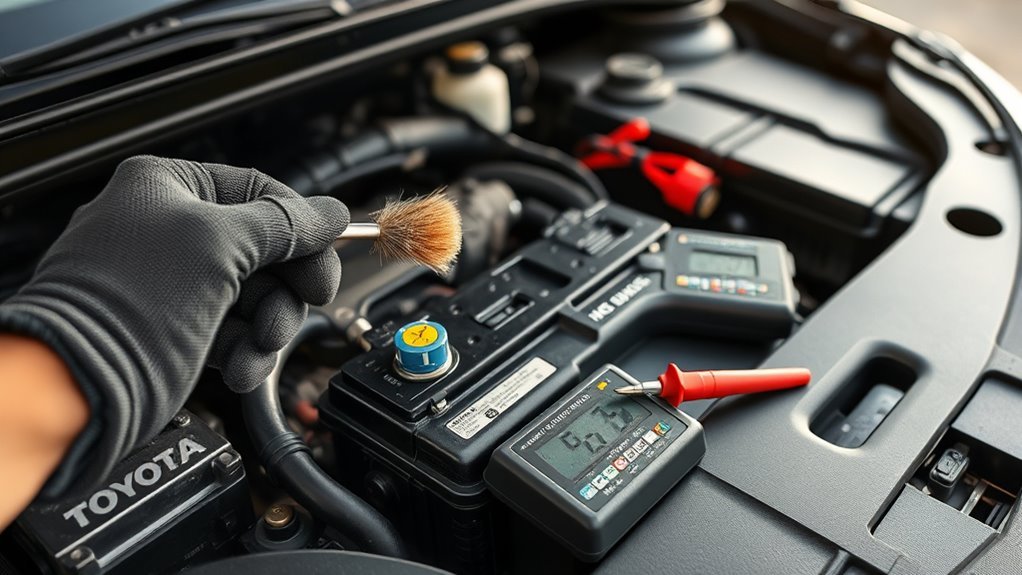
You should watch for slow cranking, flickering dash lights, corrosion, or a battery older than 3–5 years and test proactively. Perform a 5-step health check: inspect visually, verify manufacture date, monitor voltage indicators, tighten/clean terminals, and repeat biannually or every 6,000 miles. Match battery type, group size, and CCA to OEM specs, use proper tools and disconnect negative first during replacement, reset systems after install, and follow disposal rules—keep going to learn specific steps.
How to Tell When Your Camry Battery Needs Replacing
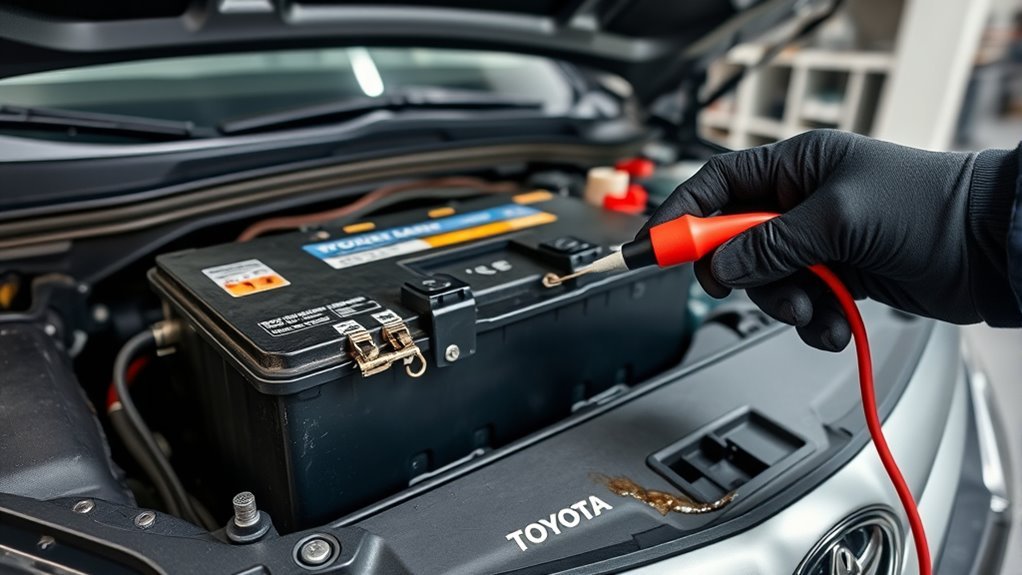
Wondering whether your Camry’s battery needs replacing? You’ll assess specific, measurable indicators methodically. If the engine turns over slower than normal, that slow cranking signals diminished charge capacity and could require replacement. Watch for flickering dashboard battery warning lights; they indicate voltage instability and intermittent output failure. Note battery age: once it’s over three to five years, its chemical reliability declines and you should plan replacement proactively. Inspect terminals for corrosion signs—white or green powder, crusting, or wet deposits—since leaks and poor connections compromise performance and accelerate failure. Early detection prevents being stranded; schedule checks at intervals you control, not when you’re helpless. Prioritize decisive action: replace a battery showing slow starts, persistent warning lights, age beyond recommended limits, or visible corrosion. That disciplined approach defends your mobility and liberates you from emergency breakdowns while keeping electrical systems reliable and predictable.
Inspect Your Camry Battery: 5‑Step Health Test
Start with a quick, methodical check: visually inspect the battery and terminals for corrosion or leaks, confirm the manufacture date to assess age (over 3–5 years warrants closer scrutiny), verify the dashboard charge indicator for unstable readings, guarantee terminal clamps are tight and free of buildup, and establish a routine to repeat this five‑step health test at least twice a year or every 6,000 miles. You’ll perform five focused steps: visual inspection, age assessment, charge monitoring, terminal tightness, and schedule verification. Do them in sequence to control risk and extend battery lifespan.
Start with a quick five-step battery health check — inspect, age, monitor, tighten, and schedule twice yearly.
- Check for white/green corrosion and perform terminal cleaning; remove buildup before testing.
- Read the manufacture date and replace cells beyond 3–5 years to avoid sudden failure.
- Monitor dashboard charge fluctuations; log anomalies and act quickly.
Be precise: wear gloves, disconnect negative first if you need to clean, and use a voltmeter if readings seem unstable. This methodical routine frees you from surprise breakdowns and preserves electrical autonomy.
Choose the Right Camry Battery: Type, Size & Specs
When replacing your Camry battery, pick the type that matches your model and driving patterns—standard flooded lead‑acid for conventional use or a hybrid/AGM if your vehicle or usage demands it. Confirm the group size from the owner’s manual so the case, terminals and hold‑down fit precisely. Compare CCA, reserve capacity and warranty (3–5 years preferred) to guarantee reliable starting and longevity.
Battery Type Selection
Because your Camry’s electrical system and fitment requirements vary by year and model, pick a battery type and size that matches Toyota’s specs rather than guessing on price or brand alone. You’ll choose between conventional lead-acid and higher-cost hybrid/AGM units; weigh battery lifespan against the performance impact for your driving patterns. Prioritize OEM-matching chemistry and terminal layout to prevent electrical faults.
- Match chemistry to usage: lead-acid for budget, AGM/hybrid for stop-start or heavy accessory loads.
- Confirm terminal configuration and secure mounting to avoid vibration-induced failures.
- Consider Toyota TrueStart® for OEM-equivalent reliability and longer service intervals.
Check state-of-health regularly and plan preventive replacement around three years to maintain freedom from roadside failure.
Size And Specifications
Although Camry models vary by year and powertrain, you should select a battery that strictly matches Toyota’s specifications for size, terminal layout, and electrical capacity. Verify battery dimensions—length, width, height—and terminal position to prevent fitment issues and wiring strain. Prioritize compatibility factors: group size (commonly Group 35 for many Camrys), CCA rating for reliable starts in cold climates, and chemistry (lead‑acid for ICE, NiMH for hybrids). Cross‑check model year requirements and OEM part numbers; mismatches can impair charging and safety systems. Assess warranty length (typically 3–5 years) as part of your risk mitigation. Choose a battery that conforms exactly to specs so you retain performance, freedom from unexpected failures, and control over maintenance.
Safely Replace a Camry Battery: Tools & Step‑By‑Step Procedure
Gather the required tools—wrench set, terminal cleaner, and safety goggles—and park your Camry on a flat surface with the engine off. Disconnect the negative terminal first, then methodically remove the hold‑down, lift out the old battery, clean the tray and terminals, and set the new battery in place. Connect the positive terminal first, tighten both terminals, verify secure connections, and dispose of the old battery per local regulations.
Required Tools And Safety
Before you begin work on your Camry’s battery, gather a wrench set, a battery terminal cleaner, and safety goggles, and park the car on a flat surface with the engine off. You’ll practice disciplined battery care and corrosion prevention from the first step. Wear goggles, work with gloves, and keep metal tools away from both terminals simultaneously.
- Wrench set: sized for terminal clamps and hold‑down hardware.
- Battery terminal cleaner: wire brush or chemical cleaner for tight, clean contacts.
- PPE: safety goggles and gloves to shield from acid and debris.
Disconnect negative first, then positive; reverse when reconnecting. Tighten terminals firmly but avoid over‑torque. Inspect for corrosion and looseness regularly to reclaim control over your vehicle’s electrical reliability.
Step‑By‑Step Removal/Installation
1. Park the Camry on a flat surface, shut the engine off, and engage the parking brake. Prioritize battery safety: wear gloves and eye protection.
Begin by disconnecting the negative terminal with a proper wrench, then the positive. Remove hold‑down hardware and lift the old battery straight out. Use a battery terminal cleaner to remove corrosion from cable ends and tray contact points; ascertain surfaces are dry and clean.
Place the new battery squarely in the tray, secure the hold‑down, then reconnect terminals—positive first, negative second—to minimize spark risk. Tighten clamps to manufacturer torque or firm snugness, and perform terminal cleaning inspection again.
Confirm tightness, start the engine to verify electrical function, and dispose of the old battery at a recycling facility.
After Installation: Reset Systems & Recycle the Old Battery
Once you’ve secured the new battery and reconnected the terminals, reset the Camry’s computer systems so sensors, clock, and battery management adapt to the new unit. Perform a battery reset per the manual: disconnect negative for a brief interval if specified, or use the infotainment/system menu to reinitialize settings. Verify the clock, radio presets, and driver-assist calibrations; run a short drive cycle so the ECU relearns idle and charge patterns.
- Confirm terminals are tight and corrosion‑free; loose connections defeat your work.
- Check the vehicle manual for model‑specific reset steps; follow them exactly.
- Use retailer recycling options to return the old battery; they handle hazardous materials and may offer credit.
You’ll free yourself from repeated faults and false alerts by methodically completing resets. Treat recycling options as part of the job—responsible disposal protects communities and closes the maintenance loop without compromise.
Maintain Your Camry Battery for Longer Life
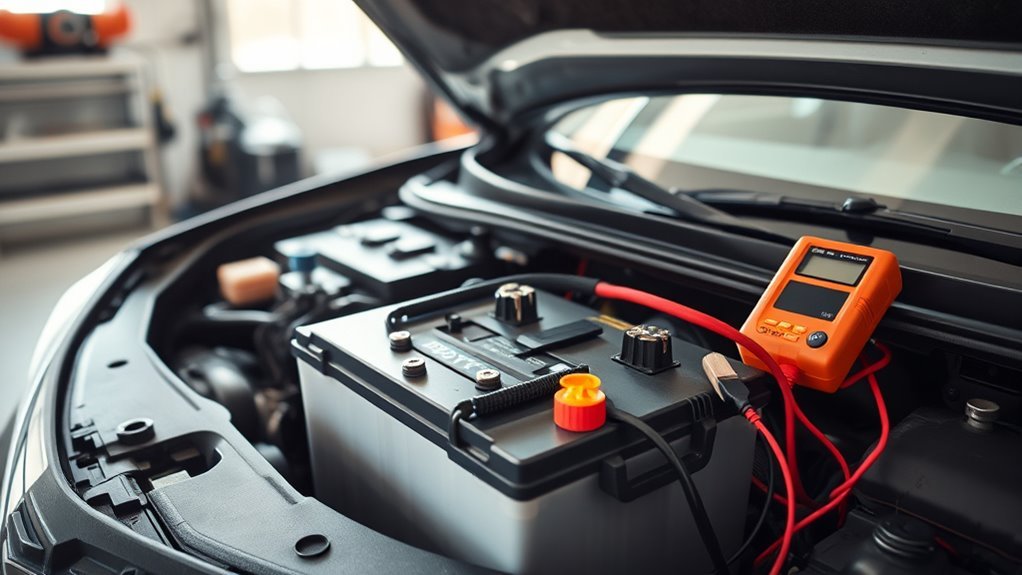
After you finish system resets and recycling, keep up a routine that protects battery health and performance. Inspect terminals regularly and perform battery cleaning with a brush and baking-soda solution to remove corrosion, improving conductivity. Run battery health tests during scheduled maintenance to detect weak cells or charging issues before they strand you.
Limit short trips and idle time so the battery can recharge fully; frequent deep discharge cycles shorten life. Park in a garage or covered area to mitigate extremes — proactive temperature management preserves capacity and reduces degradation. For hybrid Camrys, schedule annual checks of the cooling system to guarantee peak airflow and thermal control.
| Task | Frequency | Purpose |
|---|---|---|
| Terminal inspection & battery cleaning | Monthly | Maintain conductivity |
| Battery health test | Every service or annually | Detect faults early |
| Cooling system & temperature management check | Annually | Preserve hybrid battery life |
Adopt this disciplined, liberating regimen to extend performance and avoid unexpected failures.
Frequently Asked Questions
What Are the Best Practices for Battery Maintenance?
You should inspect terminals for corrosion prevention, test battery health regularly, shelter the vehicle from extremes, avoid frequent short trips, and schedule annual diagnostics; these steps extend battery lifespan and let you reclaim reliability and driving freedom.
How Often Should I Change My Camry Battery?
A fading odometer needle: you should replace your Camry’s battery every 3 years, watching battery lifespan and replacement signs like slow starts and corrosion; you’ll stay free from roadside bondage by testing twice yearly.
How to Prevent Car Battery From Dying When Not in Use Toyota?
You prevent your car battery from dying when not in use by using a maintainer or trickle charger, practicing storage techniques like garage shelter, periodic engine runs, minimizing accessory drain, and inspecting terminals to preserve battery health.
Conclusion
Like a trusted co‑pilot, your Camry’s battery needs regular checks, precise specs, and careful swaps to keep you moving. Follow the five-step inspection, pick the correct size and cold cranking amps, and use proper tools and safety steps when replacing. Reset electronic systems, recycle the old unit, and stick to routine maintenance—clean terminals, secure mounts, and monitor charge—to extend battery life and avoid roadside surprises.