
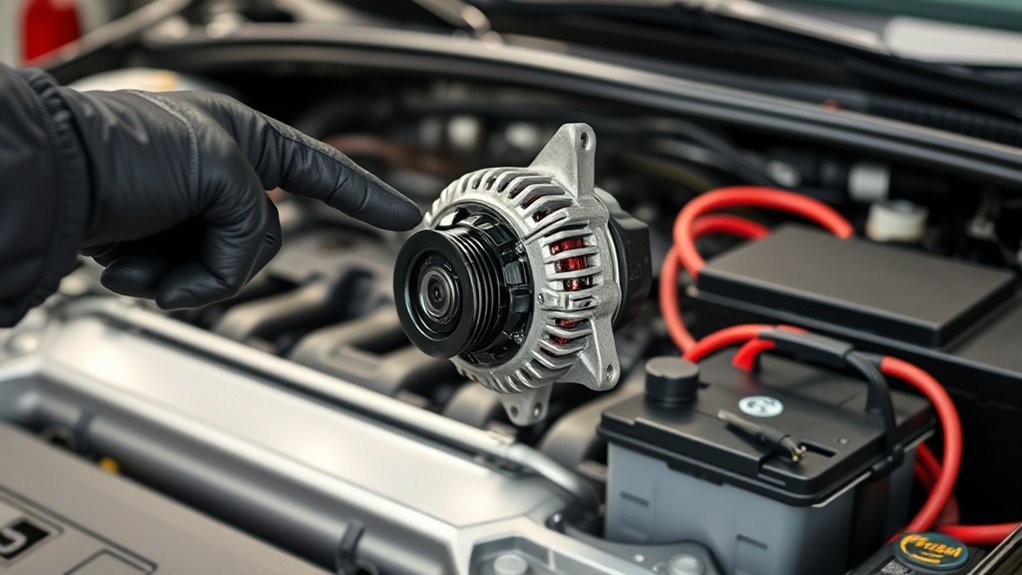
Last updated: August 17, 2026 — added byline line, alternator-problem symptom heading, charging fault-code guidance, parasitic-draw description, and aligned FAQ schema text with the visible answers.
Written by: [VERIFY: add real author name and relevant automotive-repair credentials before publishing]
Scope warning: This guide applies to non-hybrid gasoline Toyota Camry models with a conventional belt-driven alternator. Camry Hybrid models use hybrid motor-generators and a DC-DC converter instead of the alternator described here. The 2025 and 2026 U.S.-market Camry lineups are hybrid-only.
Toyota Camry alternator problems usually show up as a battery or charging-system warning light, dim or pulsing lights, repeated battery discharge, accessory slowdowns, or a whining or grinding noise that changes with engine speed. On a non-hybrid Camry, test the battery, drive belt, cables, grounds, charging voltage, and voltage drop before replacing the alternator. A low running-voltage reading alone is not enough unless the battery is charged and the test follows the specification for your exact model year and engine.
Quick Answer
For a quick screening test on a non-hybrid Camry, check a fully charged battery with the engine off, then test the charging system at about 2,000 rpm with accessories on. DENSO’s general charging-system guidance calls for roughly 13 to 15 volts at the alternator and battery, with no more than 0.2 volt drop on either the positive or negative side. Use the Toyota service information for your exact year and engine as the final specification. Current RepairPal data places average professional Camry alternator replacement at about $564 to $832 before taxes, fees, location adjustments, and related repairs.
Key Takeaways
- This procedure is for non-hybrid Camrys with a conventional alternator, not Camry Hybrid models.
- A battery warning light means the charging system needs diagnosis; it does not prove the alternator itself has failed.
- Test the battery, belt, cables, grounds, fuses or fusible links, and alternator circuits before buying parts.
- Under load, keep positive-side and negative-side charging-circuit voltage drop at 0.2 volt or less unless Toyota specifies otherwise.
- Never disconnect a battery cable while the engine is running as an alternator test.
What’s in This Article
- Does This Guide Apply to Your Camry?
- How a Camry Alternator Powers the Car
- Toyota Camry Alternator Problems: Quick Symptom Checks
- What You’ll Need Before Testing or Replacement
- Test the Charging System: Battery, Voltage, and Alternator Circuits
- Replace a Camry Alternator: Main Steps and Access Tips
- Verify Camry Alternator Charging After the Repair
- OEM vs Aftermarket Alternators for a Camry
- Common Mistakes to Avoid
- When to Get Professional Help
- Frequently Asked Questions
Does This Guide Apply to Your Camry?
Confirm the powertrain before testing or ordering an alternator. Toyota sold gasoline-only, V6, and hybrid Camry versions in different years and markets, and the charging hardware is not interchangeable.
| Camry Type | Charging Hardware | Use This Guide? |
|---|---|---|
| Non-hybrid gasoline Camry | Conventional belt-driven alternator | Yes, with model-specific service information |
| Camry Hybrid | Hybrid motor-generators and DC-DC converter | No |
| 2025–2026 U.S.-market Camry | All-hybrid powertrain | No |
If you are unsure, check the VIN, underhood emissions label, owner’s manual, or Toyota parts catalog before ordering. Do not work on orange high-voltage cables or hybrid-system components unless you are trained and equipped for high-voltage service.
How a Camry Alternator Powers the Car

On a non-hybrid Camry, the drive belt spins the alternator while the engine runs. The alternator supplies current for the lights, blower, infotainment, engine controls, and other electrical loads while recharging the 12-volt battery.
Inside the alternator, a rotating magnetic field produces alternating current. Rectifier diodes convert it to direct current, and the voltage regulator adjusts output as electrical demand and battery condition change.
A fully charged lead-acid battery commonly rests near 12.6 volts after surface charge has dissipated. During a charging-system test, voltage should rise above the engine-off reading. DENSO’s general test range is 13 to 15 volts at about 2,000 rpm, but the Toyota specification for the exact model remains the pass-or-fail standard.
If the alternator cannot support the load, the car may run on stored battery energy until voltage falls too low for the engine and control modules to keep operating.
Toyota Camry Alternator Problems: Quick Symptom Checks
Start with symptoms, then verify the cause. A dead battery by itself does not prove the alternator is bad. Battery condition, belt slip, a blown charging fuse or fusible link, corroded cables, poor grounds, and connector faults can produce similar symptoms. For a shorter pre-test symptom checklist, see our Camry alternator symptoms and lifespan guide.
| Quick Check | What It May Mean | Next Step |
|---|---|---|
| Battery or charging warning stays on while driving | Charging-system fault | Reduce electrical load and test promptly |
| Headlights pulse or dim with engine speed | Unstable output, poor connection, belt slip, or diode fault | Check belt, terminals, voltage, and ripple |
| Battery repeatedly goes flat | Weak battery, undercharging, or parasitic draw | Charge and test the battery, then test charging and key-off draw |
| Whine or grind follows engine rpm | Possible alternator bearing, pulley, or belt-drive problem | Inspect the belt drive and isolate the noise safely |
| Running voltage stays near the engine-off reading | Possible no-charge condition | Check output at the alternator, voltage drop, fuses, and control circuits |
Do not use the old “remove a battery cable while the engine runs” test. The battery must remain connected during normal alternator testing because disconnecting it can create damaging voltage spikes and is not a reliable diagnosis.
What You’ll Need Before Testing or Replacement
Use tools that match the diagnosis and the exact Camry engine layout. Replacement access, belt tensioning, fastener sizes, and torque values vary by generation and powertrain.
- Digital multimeter with DC voltage and millivolt settings
- Battery charger and a proper battery load or conductance tester
- Optional clamp ammeter or oscilloscope for output-current and diode-ripple diagnosis
- Standard socket set and extensions sized for your Camry
- Breaker bar, belt-tensioner tool, or long-handled ratchet as required
- Torque wrench covering the required fastener range
- Gloves and safety glasses
- Wiring diagram and Toyota service procedure for your exact model year and engine
Do not begin removal until you have the model-specific belt routing, connector pinout, access procedure, and torque specifications. A generic all-year guide cannot safely supply those values for every Camry.
How Do You Test a Toyota Camry Alternator?
Test the charging system in a fixed order: identify the powertrain, inspect the belt and connections, confirm battery condition, measure charging voltage, then perform positive-side and negative-side voltage-drop tests. This sequence prevents a weak battery or resistive cable from being misdiagnosed as a failed alternator.
Pro tip: Record every reading, engine speed, and electrical load. A voltage number without the test conditions is hard to interpret.
[Products Worth Considering]

The ANCEL BA101 helps diagnose 12V batteries quickly with clear readings for battery health, charge level, voltage, CCA, cranking, and charging system performance. Designed for a wide range of vehicles and battery types, it offers easy-to-read results, reliable clamp connections, and built-in protection to make testing safer and more convenient.
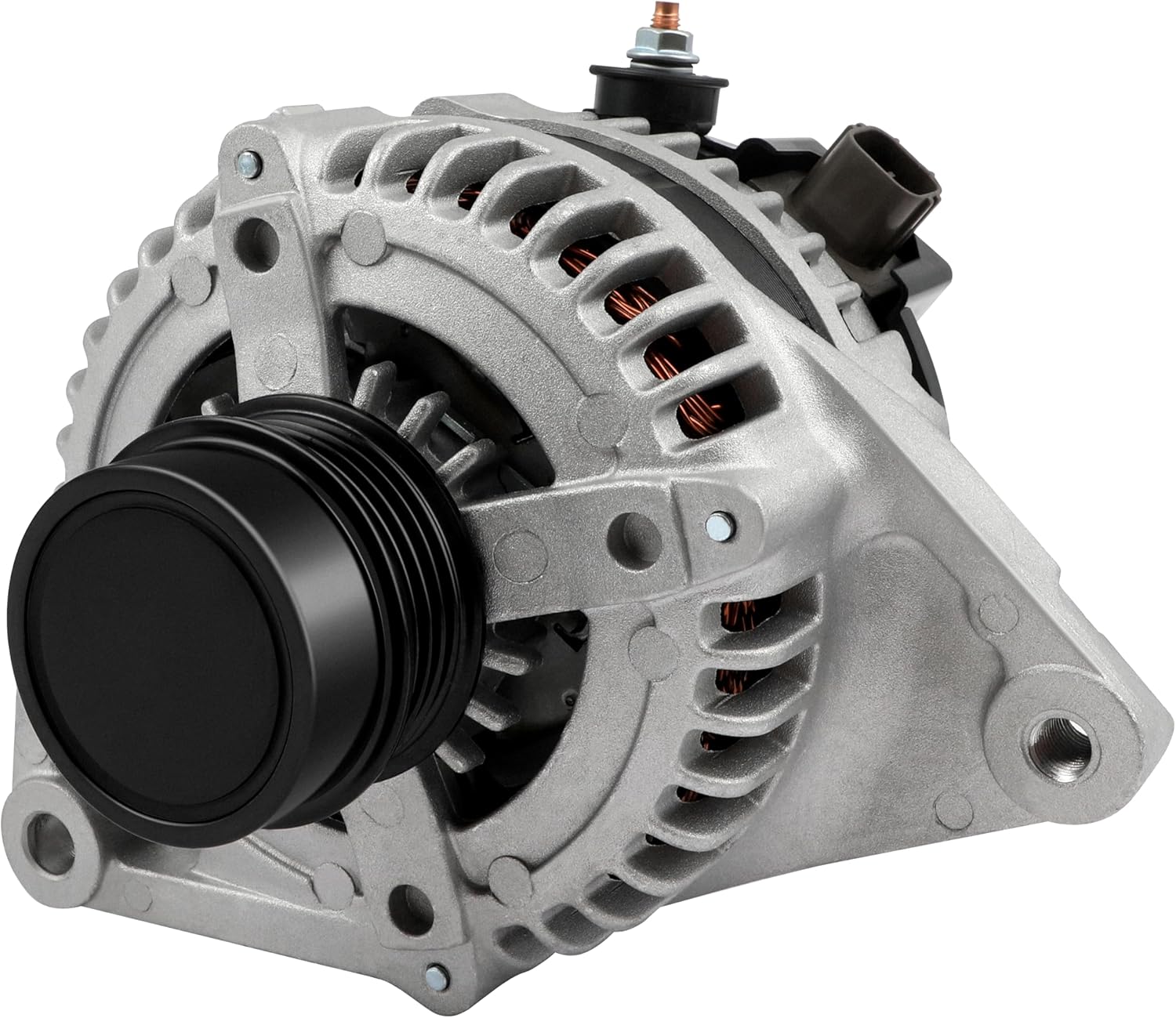
This high output alternator is designed to fit select Toyota, Scion, and RAV4 2.5L applications, delivering reliable charging performance for everyday driving. Built with a 12-volt, 100-amp design and precision-engineered components, it helps support battery recharge, stable electrical output, and consistent operation when your vehicle shows signs of charging issues.

The ANENG SZ301 digital multimeter is a versatile testing tool for measuring AC/DC voltage, current, resistance, continuity, diode, capacitance, and live wire detection. It features a clear display, precise readings, and built-in safety protections including double fuses and overload protection, making it useful for electronics, automotive work, and household electrical troubleshooting. The kit includes a protective silicone case, test leads, and pre-installed batteries for convenient use right out of the box.
1. Check Battery State First
Turn the engine and accessories off, let surface charge dissipate, and measure directly across the battery posts. A fully charged lead-acid battery commonly reads near 12.6 volts, but temperature, battery chemistry, and recent charging affect the number.
Clean and tighten the terminals before deeper testing. Charge a low battery and have it load- or conductance-tested. A battery that cannot accept or hold a charge can distort alternator-test results and may damage a replacement unit.
2. Test Charging Voltage Under Defined Conditions
Start the engine and measure at the battery posts. Then raise engine speed to about 2,000 rpm and switch on major loads such as the headlights, blower motor, and rear defroster. DENSO’s general guidance calls for 13 to 15 volts at both the alternator and battery during this test.
Use that range as a screening guide, not a universal Toyota specification. Regulator strategy, battery state, temperature, engine speed, and electrical demand can change the reading. If the value is low, high, or unstable, compare voltage at the alternator output stud with voltage at the battery before condemning the alternator.
3. Check the Output Cable and Ground Path
Voltage-drop testing finds resistance that a simple battery-terminal reading can miss. Perform the tests with the engine near 2,000 rpm and electrical loads on.
- Positive side: Place one meter lead on the alternator B+ output stud and the other on the battery positive post. DENSO specifies 0.2 volt or less.
- Negative side: Place one lead on the alternator case and the other on the battery negative post. DENSO also specifies 0.2 volt or less.
A higher reading means excessive resistance in a cable, terminal, fuse or fusible link, ground strap, fastener, or connection. Repair the resistance and retest before replacing the alternator.
Back-probe ignition, lamp, sense, or control circuits only with the correct Toyota wiring diagram and pinout. Do not pierce insulation or guess at connector terminals.
4. What If Voltage Looks Normal but Symptoms Remain?
A charging system can show acceptable average voltage and still have weak output under load, excessive AC ripple from a damaged diode, an intermittent connector fault, or a battery that fails after charging. Use a capable charging-system tester, clamp ammeter, oscilloscope, or professional bench test when symptoms continue despite normal basic readings.
Also scan for charging-system fault codes — for example P0562 (system voltage low) or P0561 (system voltage unstable) — and any related communication codes, when the vehicle uses computer-controlled generator circuits. Diagnose stored codes and circuit faults before replacing parts.
How Do You Replace a Camry Alternator?
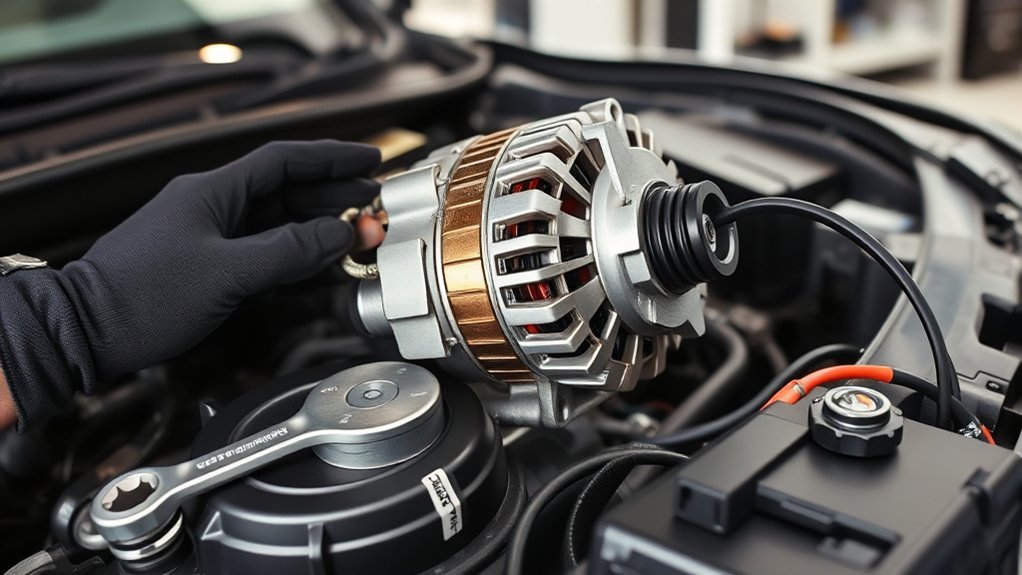
Warning: Disconnect the negative battery cable before alternator removal. Do not use this section as a substitute for the Toyota service procedure for your exact year and engine.
- Confirm the replacement part before disassembly. Match the VIN, engine, connector, pulley, output rating, mounting points, and part number.
- Park safely and let the engine cool. Set the parking brake, remove the key or disable the smart key, and keep tools away from the cooling fan.
- Record memory-sensitive settings if needed. Follow Toyota’s service guidance for battery disconnection and post-reconnection initialization.
- Disconnect the negative battery cable. Isolate it so it cannot spring back onto the terminal.
- Remove only the covers, ducts, brackets, or supports listed in the model-specific procedure. Keep fasteners organized.
- Photograph the belt routing. Inspect the belt and tensioner before releasing tension.
- Release belt tension and remove the belt from the alternator pulley. Move the tensioner slowly and keep fingers clear of pinch points.
- Disconnect the alternator wiring. Remove the connector and B+ cable without pulling on wires; cover the cable terminal after removal.
- Remove the mounting hardware in the specified order. Support the alternator and track any brackets, spacers, washers, or harness clips.
- Lift the alternator out without forcing nearby parts. If clearance is insufficient, recheck the service procedure instead of prying against hoses, wiring, radiator fins, or aluminum brackets.
- Compare the old and new units side by side. Confirm pulley alignment, connector clocking, mounting ears, and output-terminal location.
- Install the replacement and start fasteners by hand. Tighten and torque every fastener to the exact Toyota specification for the vehicle.
- Reconnect the wiring and route the belt correctly. Confirm the belt is centered in every pulley groove and all harness clips are restored.
- Reconnect the negative battery cable last. Complete any required initialization, then perform the verification tests below.
[Products Worth Considering]

The TOPDON BT100 helps you quickly check the health and charge status of 12V lead-acid batteries with clear analytical results, including state of health, state of charge, voltage, and cranking performance. It supports a wide range of battery types and vehicles, making it a practical tool for diagnosing starting and charging issues at home or in the shop. Compact and easy to use, it provides fast, reliable testing without needing to charge the device first.

This automotive test light combines a bright LED voltage display with quick polarity indication for fast, accurate circuit checks in a wide range of vehicle systems. It helps diagnose battery, charging, lighting, and fuse issues with a sharp stainless probe, long spring wire, and easy-to-use alligator clip for efficient troubleshooting.

This A-Premium serpentine belt drive kit is designed for compatible Toyota Camry, RAV4, and Scion tC models with a DOHC 2.5L L4 engine. It includes a serpentine belt and belt tensioner to help maintain smooth engine operation, reduce noise, and support reliable power transfer. Built for dependable replacement performance, it also comes with a one-year unlimited-mileage guarantee for added peace of mind.
How Do You Verify the Alternator Repair?
Do not treat successful engine startup as proof that the repair worked. A charged battery can start and run the car briefly even when the charging fault remains.
Resting Battery Voltage
With the engine off, measure and record battery voltage. If the battery is low, charge and test it before judging the replacement alternator. A discharged or damaged battery can overload the new unit and produce misleading results.
Running Charge Voltage
Start the engine, check for warning lights, and measure at the battery posts. Repeat the test near 2,000 rpm. Compare the reading with the model-specific Toyota specification and with voltage measured directly at the alternator output.
Voltage Under Load
Turn on the headlights, blower, rear defroster, and other normal loads. Confirm stable charging, then repeat both voltage-drop tests. Each side should remain at 0.2 volt or less under DENSO’s general guidance unless Toyota specifies a different limit.
Listen for belt squeal, rubbing, bearing noise, or electrical arcing. Recheck belt tracking, fasteners, terminal covers, and connectors after the initial run.
OEM vs Aftermarket Alternators for a Camry: Pros and Cons
Choose by verified fit, electrical output, rebuild quality, warranty coverage, and the cost of repeating the labor. “Fits Toyota Camry” is not enough because alternators can differ by year, engine, market, connector, pulley, and output rating.
| Aspect | Toyota Genuine or Toyota Remanufactured | Aftermarket New or Remanufactured |
|---|---|---|
| Fit and calibration | Designed for a specific Toyota application when matched by VIN | Quality and catalog accuracy vary by manufacturer |
| Output and connector match | Application-specific when the correct part number is selected | Must be checked against the original unit and vehicle requirements |
| Warranty | U.S. Toyota Genuine Parts generally carry 12-month coverage under Toyota’s stated terms | Depends on the brand, retailer, installer, and labor-coverage terms |
| Upfront cost | Often higher | Often lower, with wider quality variation |
| Best fit | Owners prioritizing application match and dealer warranty handling | Owners using a reputable supplier with confirmed fit and clear warranty terms |
Toyota states that U.S. Genuine Parts bought over the counter or online from an authorized dealer and installed by a third party carry a 12-month parts-only warranty. Parts purchased and installed by an authorized dealer carry 12 months regardless of mileage, or the remainder of the applicable new-vehicle warranty, whichever is greater. Read the exact terms for your market and purchase before ordering.
[Products Worth Considering]

This KAIWEETS digital multimeter is a versatile tool for measuring AC/DC voltage, DC current, resistance, continuity, and diodes in home, automotive, and electrical applications. It includes pre-installed batteries, a carrying case, test leads, data hold, backlight, and overload protection for easier and safer everyday testing. Built with double fuses and rated for broad household and light professional use, it helps users diagnose electrical issues with confidence.

This plug-and-play OBD2 scanner helps drivers quickly read and clear engine error codes while providing live data, freeze frame information, I/M readiness, and MIL status for more confident troubleshooting. It adds a built-in voltage test and clear status indicators to support electrical checks and faster diagnostics, making it a practical choice for home users, car enthusiasts, and repair professionals. Compatible with most OBDII vehicles since 1996 and designed with an easy-to-use interface, it offers broad coverage and simple operation in one compact tool.

The NOCO GENIUS5 is an all-in-one battery charging and maintenance solution for 6V and 12V lead-acid and lithium batteries. It features temperature compensation, dead-battery recovery, desulfation, and safe long-term maintenance to help extend battery life and performance. Compact and versatile, it works with a wide range of vehicles and comes with mounting accessories and a warranty.
Common Mistakes to Avoid
- Applying this guide to a Camry Hybrid. Hybrid models use different charging hardware and high-voltage safety procedures.
- Disconnecting a battery cable while the engine runs. This is unsafe for modern electronics and is not a valid alternator test.
- Replacing the alternator before testing the battery. A weak or sulfated battery can mimic a charging fault and overload the replacement.
- Using one voltage number as the whole diagnosis. Test under defined rpm and load, then compare alternator and battery readings.
- Skipping voltage-drop tests. A good alternator cannot overcome a high-resistance cable, fusible link, or ground path.
- Ordering by model year alone. Confirm VIN, engine, pulley, connector, output rating, and part number.
- Guessing torque values or belt routing. Use the Toyota service procedure for the exact vehicle.
- Failing to recharge and retest the battery. A deeply discharged battery can shorten alternator life and cause a comeback.
When to Get Professional Help
Stop and use a qualified technician if the vehicle is a hybrid, orange high-voltage components are involved, wiring is melted, a fuse repeatedly opens, voltage is excessive, or a burning smell appears. These conditions can damage control modules or create a fire and shock risk.
Professional diagnosis is also sensible when basic voltage is normal but the warning returns, the fault is intermittent, output-current or ripple testing is needed, or the charging circuit is computer-controlled. A technician can combine battery testing, scan data, circuit checks, current output, and waveform analysis instead of guessing from one meter reading.
If access requires forcing the alternator past hoses, radiator fins, wiring, or brackets, stop and obtain the exact removal procedure. Model-year-specific guides that rank for this topic commonly separate instructions by generation and engine because the extraction path and hardware differ.
Frequently Asked Questions
How Long Does a Camry Alternator Typically Last?
Toyota does not publish a universal mileage replacement interval for every Camry alternator. Service life depends on heat, bearing condition, belt load, battery health, electrical demand, contamination, and the quality of previous repairs. Replace it based on confirmed test results, noise, damage, or charging failure rather than mileage alone.
Can a Bad Alternator Drain the Battery Overnight?
Yes. A failed rectifier diode can allow key-off current flow, but an overnight drain can also come from lights, modules, accessories, wiring faults, or a weak battery. Fully charge and test the battery, then perform a proper parasitic-draw test — measuring current draw at the battery with everything off, doors closed, and the vehicle’s modules fully powered down — before replacing the alternator.
Does a Camry Hybrid Have a Conventional Alternator?
No. A Camry Hybrid uses motor-generators and a DC-DC converter within the hybrid power system instead of the conventional belt-driven alternator covered in this guide. The 2025 and 2026 U.S. Camry lineups are all-hybrid, so use hybrid-specific diagnostic information.
Is “Check Charging System” Normal When the Engine Is Off?
A charging warning may appear when the ignition is on but the engine is not running because a conventional alternator is not turning. It should clear after the engine starts if the system is operating normally. If the warning stays on while driving, reduce unnecessary electrical loads and diagnose the charging system promptly.
Are Alternator Repairs Covered Under Warranty?
Coverage depends on the vehicle warranty, part source, installer, market, and purchase date. In the U.S., Toyota states that Genuine Parts installed by an authorized dealer generally carry 12 months regardless of mileage, or the remaining applicable new-vehicle warranty, whichever is greater. Over-the-counter or online Genuine Parts installed by a third party generally carry a 12-month parts-only warranty. Confirm the written terms for your purchase.
How Much Does Professional Alternator Replacement Cost?
RepairPal’s current estimate places average Toyota Camry alternator replacement at about $564 to $832 [VERIFY: confirm RepairPal’s exact “last updated” date — not shown on the live page at time of this audit]. The estimate excludes taxes and fees and can change with model year, engine, location, labor rate, part choice, and related repairs.
Can You Drive With the Battery Warning Light On?
Do not assume the car will keep running. If the alternator is not charging, the vehicle may operate only until the battery voltage falls too low, then stall and fail to restart. Turn off unnecessary electrical loads, move to a safe place, and arrange diagnosis or towing rather than planning a normal trip.
Should You Replace the Battery With the Alternator?
Not automatically. Charge and test the battery first. Replace it if it fails the battery test, cannot hold a charge, is physically damaged, or has been harmed by prolonged undercharging or overcharging. A healthy battery can remain in service after the charging fault is repaired.
Can a Failing Alternator Damage Other Electrical Components?
Yes. Excessive voltage, unstable output, poor connections, or an unsafe battery-disconnect test can stress the battery, modules, sensors, wiring, and lamps. Stop testing if voltage rises outside the vehicle specification, wiring heats up, fuses open, or a burning smell appears.
Conclusion
For non-hybrid Toyota Camry alternator problems, diagnose the whole charging system before replacing the alternator. Confirm battery condition, inspect the belt and connections, test output under defined rpm and load, and keep positive- and negative-side voltage drop at 0.2 volt or less under DENSO’s general guidance.
If the alternator fails those checks, match the replacement by VIN and engine, follow the exact Toyota removal and torque procedure, then recharge the battery and repeat the charging and voltage-drop tests. Camry Hybrid owners should use hybrid-specific service information instead of this conventional-alternator procedure.
References
- Charging System Troubleshooting — DENSO Auto Parts
- Toyota Camry Alternator Replacement Cost Estimate — RepairPal
- Toyota Unveils the Purely Hybrid Next-Generation Camry — Toyota USA Newsroom
- 2026 Toyota Camry All-Hybrid Powertrain — Toyota
- Toyota Genuine Alternator Warranty Information — Toyota Genuine Parts
- Toyota Owner’s Manuals and Warranty Information — Toyota




[…] vibrating Toyota Camry at highway speeds isn’t just uncomfortable — it’s your car telling you something is […]
[…] Camry Low Oil Warning Light: What It Means and What to […]
[…] even when average voltage appears reasonable. For the full conventional charging procedure, see the Toyota Camry alternator testing guide. [VERIFY: confirm this internal URL is […]