If your Sonata stalls at idle, don’t drive it—inspect fuel, air, and ignition systems immediately. Start by scanning for codes, checking fuel pressure and injector spray, and visually inspecting intake hoses, MAF and wiring. Test the IAC/throttle control, ignition coils, and O2 response; perform a smoke test for vacuum leaks and check catalytic backpressure. Clean injectors and MAF first, replace failing pumps, sensors or coils as needed. Continue for step‑by‑step diagnostics and fixes.
Quick Answer: Why Your Sonata Stalls at Idle and Immediate Actions

If your Hyundai Sonata stalls at idle, don’t drive it—inspect immediately. You’ll check for stalling symptoms: rough idle, reduced engine power during acceleration, and jerking on throttle. Scan for a solid check engine light code; that narrows causes to fuel injectors, O2 sensors, or intake manifold air-flow faults. Do a procedural visual: inspect intake for leaks, listen for vacuum hisses, and check wiring/connectors at injectors and O2 sensors. If codes point to injectors, expect professional cleaning or replacement—repairs can cost several hundred dollars. Don’t ignore persistent faults; they degrade engine performance and risk further damage. Prioritize professional diagnostics to reclaim control and freedom; document codes and findings before authorizing repairs.
Is It Safe to Drive? When to Stop and Seek Inspection
If your Sonata stalls, you shouldn’t keep driving until you confirm the cause, because intermittent stalling can leave you stranded or cause a crash. Stop and seek inspection immediately if you experience a solid check engine light, persistent rough idle, repeated loss of power, or multiple stall events during low-speed maneuvers. A trained technician will perform a test drive, run engine diagnostics, and inspect intake, fuel, ignition, and transmission components to identify the fault.
When Driving Is Unsafe
When your Sonata stalls at idle or shows a solid check engine light, don’t drive it—stop immediately and arrange professional diagnostics. You’ll protect yourself and the car by recognizing stalling symptoms and acting on safety concerns without delay. Follow clear, procedural steps: power down, move to a safe area, warn others with hazards, and call a technician. Driving on is reckless; continued use risks greater engine damage and higher repair bills. You want freedom from uncertainty, so act decisively and refuse to gamble with safety.
- Engine cutting out at stoplights, leaving you stranded
- Sudden loss of power while merging or turning
- Constant illuminated check engine lamp signaling faults
- Rough idle causing jerky, unpredictable motion
When To Get Inspected
You’ve already been warned to stop driving if the Sonata stalls or shows a solid check engine light; now decide quickly whether to continue or seek inspection. Assess immediate risk: loss of idle stability, reduced acceleration, or recurring stalls demand you stop and request professional diagnostics. If symptoms are isolated, limp to a nearby shop; if stalling is frequent or unpredictable, pull over safely and arrange towing. Prioritize inspection frequency based on severity — single minor event may allow next-day service, repeated incidents or warning lights require same-day inspection. Expect roughly $95 for an initial check to identify causes like faulty fuel injectors. Acting fast preserves safety, prevents cascading damage, and frees you from dependence on uncertain, risky driving.
Fuel System Causes of Sonata Stalling at Idle (Injectors, Pressure, Pump)
Check the fuel system first: clogged injectors, low fuel pressure, and a failing pump each produce symptoms that can stall a Sonata at idle. You’ll want to test injector flow and spray pattern, verify fuel rail pressure against spec, and measure pump output under load. If any test fails or a solid check engine light is present, arrange professional diagnostics and repairs.
Fuel Injector Clogging
Inspect the fuel injectors for clogging, since restricted spray patterns or reduced flow can create an overly rich mixture that causes rough idle and stalling in a Hyundai Sonata. You’ll perform injector maintenance proactively: visually inspect for deposits, run a flow test, and log misfire or trim data. Use safe cleaning techniques—recommended ultrasonic or on-car chemical procedures—to restore atomization and balance cylinders. If symptoms persist, seek professional diagnostics; replacement can cost several hundred dollars and may be required.
- A spray tip coated in varnish disrupting a fine cone pattern
- A technician mounting an ultrasonic bath for batch cleaning
- A diagnostic rig measuring millisecond pulse and flow consistency
- A Sonata idling smoothly after balanced injector flow
Maintain freedom from breakdown through disciplined inspection.
Low Fuel Pressure
When low fuel pressure develops—often from a failing pump or partially clogged injectors—the engine can run rich or starve at idle, causing rough idle and occasional stalling; you should treat it as a primary fuel-system fault that demands measured diagnostics. Start by scanning for a solid check engine light and pulling codes. Measure rail pressure with a gauge at idle and under load; compare to spec. Inspect and replace the fuel filter if clogged, and test the pressure regulator for vacuum-side leaks or improper return pressure. Clean or replace injectors showing poor spray patterns; user reports tie clogged injectors to common low-pressure events and costly replacement averages. Prioritize diagnostics before parts replacement so you free yourself from repeat failures.
Failing Fuel Pump
Low rail pressure from clogged injectors or a faulty regulator often points to the pump as the root cause, so verify pump output next. You’ll measure static and dynamic fuel pressure against Hyundai Sonata specs; if pressure falls short, the pump is failing and fuel delivery is compromised. Perform fuel pump maintenance checks: inspect wiring, listen for pump operation, and confirm filter condition. Replace the pump if diagnostics show intermittent output or pressure below spec—replacement can cost several hundred dollars. Early inspections liberate you from roadside failures and keep control over vehicle reliability.
- Hear a whining from the tank during key-on ignition
- Observe rough idle and stalling under light load
- Check pressure gauge readings dropping at idle
- Visualize clogged filter starving injectors
Air & Exhaust Causes to Check Next (MAF, O2 Sensors, Intake, Catalytic)
Because air and exhaust sensors directly control fueling, you should next check the MAF, O2 sensors, intake tract, and catalytic converter for faults that could cause stalling at idle. Begin by visually inspecting the MAF sensor for contamination and verify its voltage/frequency output with a scan tool; replace if readings drift. Test oxygen sensors for correct switching and response time; slow or flat responses force rich/lean conditions. Pressure-test and smoke-test for intake leaks and clear any blockages in the manifold to restore proper airflow. Inspect fuel injectors for spray pattern and clean or replace clogged units as community-tested. Check catalytic converter backpressure to confirm exhaust flow; a clogged converter chokes idle and stalls. Document findings and proceed to controlled repairs to reclaim control.
Electrical and Ignition Causes That Cut the Engine (Wiring, IAC, Coils)
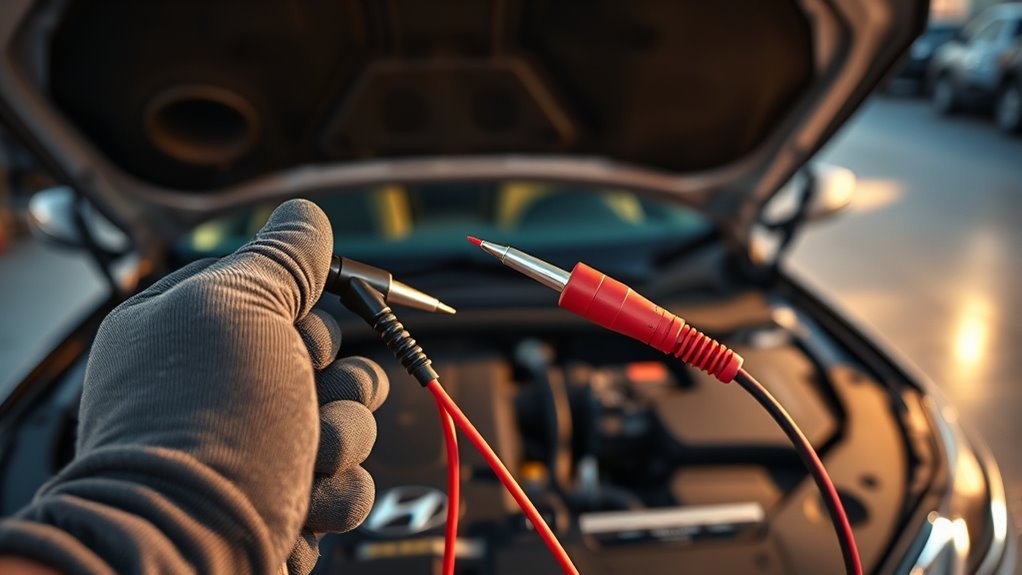
After checking air and exhaust sensors, shift focus to the electrical and ignition systems, since wiring faults and ignition component failures can abruptly cut the engine. You’ll verify wiring integrity first: inspect harnesses for corrosion, loose terminals, and chafing that cause intermittent loss of power to coils and modules. Next, test the idle air control (IAC) actuator for proper duty cycle to prevent RPM collapse at idle. Check ignition coils for signs of failure and use a scan tool to capture misfire codes and waveform anomalies. Regular inspections preserve ignition reliability and freedom from roadside failures.
- frayed ground straps sparking under load
- corroded connector heating and darkening
- sticky IAC pintle sticking at low RPM
- coil secondary arcing across boots
Repair Options, Cleaning vs Replacement, and Estimated Costs
Several targeted steps will help you decide between cleaning and replacing components when diagnosing stalling at idle. Start with a cost comparison: injector cleaning is cost-effective and can restore spray patterns, offering immediate repair benefits versus the ~515€ per injector replacement. If cleaning fails, replace injectors to reestablish correct air-fuel mixture. Next, test O2 sensors; replacing faulty O2 units often yields high repair benefits because they directly affect fuel trim and idle stability. Inspect the intake manifold for restrictions; minor buildup may be cleaned, severe damage requires replacement. Budget for professional diagnostics (~$95) to pinpoint faults before committing to parts. Proceed methodically: clean, reassess, then replace only when cleaning doesn’t resolve the stall.
How Mechanics Diagnose the Stall (Test Drive, Scan Tools, Live Data)
When you or a mechanic first address a stall at idle, they’ll perform a targeted test drive to reproduce the symptom while observing RPM behavior, throttle response, and any hesitation or surges; simultaneous use of an OBD-II scan tool lets them pull trouble codes and stream live data (RPM, fuel trims, O2 readings, MAF/VAF, throttle position, and manifold pressure) so anomalies can be correlated to specific events during the drive. You’ll note idle speed fluctuations, listen for abnormal sounds, and record conditions when the stall occurs. Scan tool utilization gives you freeze frames and PIDs; test drive techniques include steady idle, load changes, and varied throttle inputs. If live data points to a subsystem, you may disassemble components for inspection.
- Idle hunting on flat road
- Bogging during light throttle
- Sudden RPM drop to zero
- O2 sensor spike on scan tool
Frequently Asked Questions
What Causes an Engine to Stall While Idling?
You stall at idle because faulty idle air control, clogged intake, or disrupted fuel delivery (injectors, pump, O2 sensors) upset air-fuel balance, so you’ll inspect, clean, test, and replace components to regain control.
What Causes Rough Idle but Drives Fine?
You’re furious but empowered: diagnose idle vibration caused by imbalanced fuel mixture — check injectors, O2 sensor, intake leaks, and idle air control; clean, repair, or replace components, then test and recalibrate to restore smooth freedom.
How to Diagnose a Car Stalling Problem?
Start by test-driving to reproduce the stall, then scan for codes, check fuel delivery, inspect for vacuum leaks, verify ignition problems, and troubleshoot electrical issues; you’ll document findings, isolate faults, and perform targeted repairs for freedom.
What Sensors Can Cause a Rough Idle?
You might think it’s electrical, but the sensors that cause rough idle are Idle Airflow (IAC), Throttle Position, Oxygen Sensor, and Mass Airflow; you’ll test, clean, or replace them to regain engine control and freedom.
Conclusion
If your Sonata stalls at idle, don’t ignore it — you’ll want to act fast before trouble multiplies like wildfire. Start with safety: pull over and avoid driving if stalling is frequent. Have a technician run a live-data scan, inspect fuel pressure and injectors, test MAF/O2 sensors and IAC/idle control, and check ignition wiring and coils. Decide between cleaning and replacement based on failure codes, leakage, and measured values; expect diagnostics before repairs.