
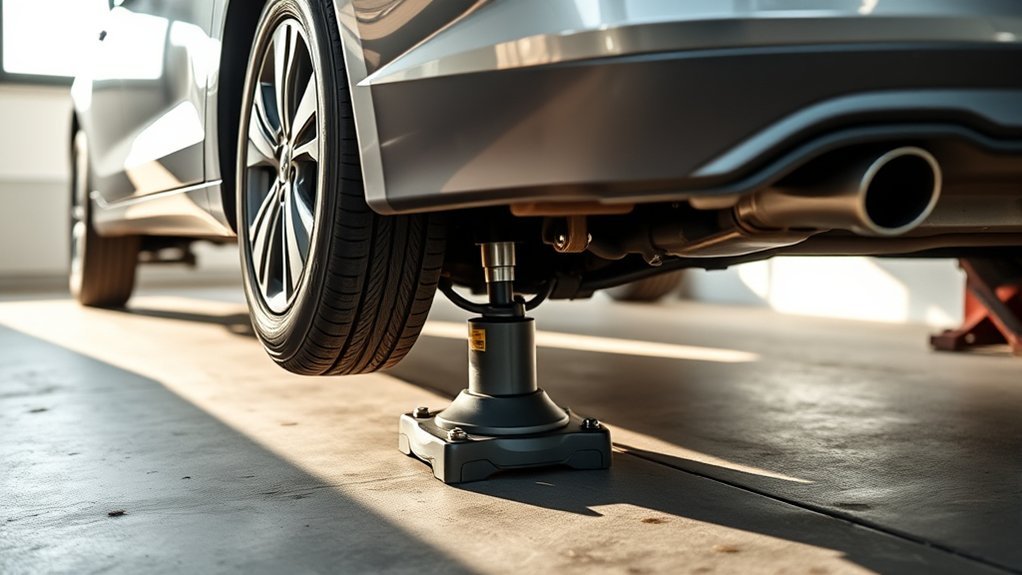
When lifting your vehicle for tire rotations, brake work, or oil changes, using the factory-designated Hyundai Sonata jacking points is essential for your safety and the car’s structural integrity. Every unibody Sonata relies on four reinforced rocker panel pinch welds near the wheels and heavy center subframe members beneath the front and rear suspension. Parking on a flat concrete surface, chocking the grounded wheels, and supporting the frame on rated jack stands prevents costly undercarriage damage and dangerous collapses.
Quick Answer
The primary Hyundai Sonata jacking points are the four reinforced pinch weld notches along the side rocker panels, positioned 4 to 8 inches behind the front wheels and ahead of the rear wheels. To lift an entire end with a hydraulic floor jack, use the front center engine subframe crossmember or the rear suspension crossmember, then place jack stands under the corner pinch welds or subframe hard points.
At a Glance
| Time Required | 15 to 20 minutes |
| Difficulty | Beginner to Intermediate |
| Tools Needed | 2-ton or 3-ton low-profile hydraulic floor jack, pair of 3-ton jack stands, slotted rubber pinch weld pad or 2×4 hardwood block, wheel chocks, torque wrench |
Why Safe Jacking Points Matter
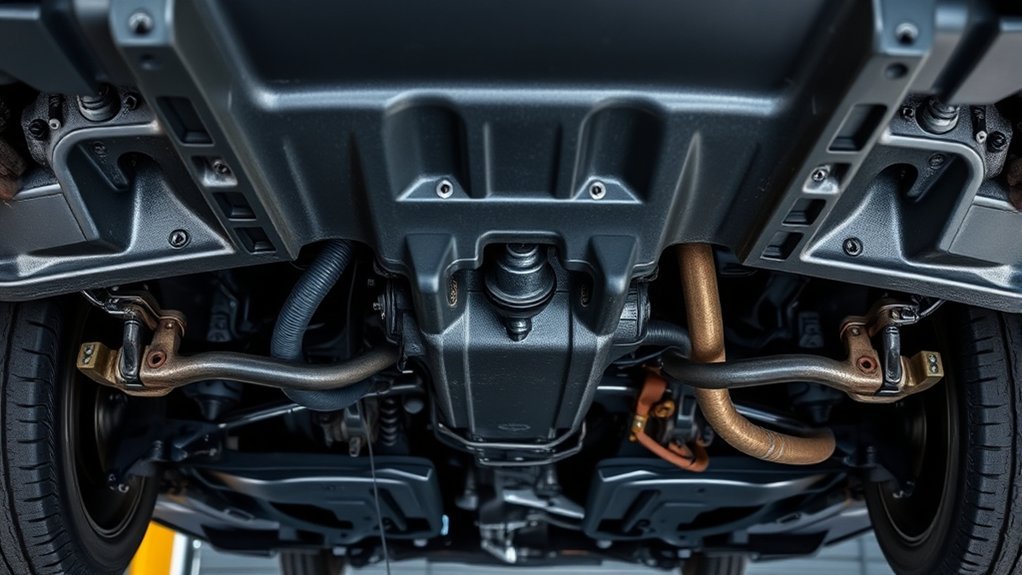
Knowing where to place your jack on a Hyundai Sonata protects both your life and your car’s unibody structure. Depending on the generation and trim, a Sonata weighs between 3,200 and 3,550 pounds, with roughly 60% of that weight resting over the front axle. Designated jacking points use multi-layered steel reinforcements to carry this load without flexing or buckling.
Placing a jack a few inches off target onto unreinforced floor pans, plastic rocker molding, the aluminum engine oil pan, or the transmission case can crush sheet metal, crack cast housings, or pinch the brake and fuel lines routed along the inner sill. Worse, lifting on thin metal or an angled suspension link can cause the jack saddle to slip and drop the vehicle.
Warning: Never place any part of your body underneath a vehicle supported only by a hydraulic floor jack or the factory emergency scissor jack. Hydraulic seals can fail without warning, and scissor jacks can tip sideways. Always transfer the vehicle’s weight onto locked, properly rated jack stands before working underneath.
Combining factory lift locations with level ground, wheel chocks, and matched jack stands gives you a rock-solid platform so you can perform repairs safely.
Identifying Safe Jack Points for the Hyundai Sonata
Your Hyundai Sonata has two types of lifting locations: four corner pinch weld points for single-wheel lifting or jack stands, and center structural crossmembers for raising the entire front or rear end with a floor jack. You can view the exact diagram for your model year in the Hyundai Owners Portal under the “If You Have a Flat Tire” section of your owner’s manual.
On the 2006–2010 Sonata (NF generation, including the 2009 model), the ideal primary front lifting point is the heavy steel frame brace (front subframe crossmember) located directly beneath the engine behind the radiator support. After raising the front end, set your jack stands under the reinforced corner pinch welds or at the boxed unibody hard points near the front lower control arm mounts.
On the 2011–2019 Sonata (YF and LF generations, including the 2016 model) and 2020–2026 Sonata (DN8 generation), look under the side rocker panels for two small notches or stamped triangle markings per side. For the 2016 Sonata, the reinforced pinch weld section is narrow—just wide enough for the factory scissor jack—so many DIYers lift at the front subframe crossmember or the thick inner mounting bosses of the lower control arms, leaving the reinforced pinch welds open for jack stands fitted with slotted rubber pads.
| Lift Point Location | Where to Find It | Best Used For |
|---|---|---|
| Front Pinch Welds (Left & Right) | 4 to 8 inches behind the front wheel wells between the two notches on the rocker seam | Single-wheel lifting (with slotted pad) or primary jack stand placement |
| Rear Pinch Welds (Left & Right) | 4 to 8 inches ahead of the rear wheel wells between the two notches on the rocker seam | Single rear wheel lifting or rear jack stand placement |
| Front Subframe Crossmember | Center steel frame brace beneath the engine, aft of the plastic splash shield edge | Lifting both front wheels at once with a hydraulic floor jack |
| Front Subframe / Control Arm Mounts | Heavy boxed steel brackets where the lower control arms bolt to the subframe | Secondary jack stand hard points or corner floor-jack lifting |
| Rear Suspension Crossmember | Central steel beam connecting the rear suspension links ahead of the spare tire well | Lifting the rear of the Sonata with a floor jack |
Stay Safe With Key Tips for Lifting Your Car
Safe vehicle maintenance starts before you pump the jack handle. Preparing your work surface, inspecting your gear, and positioning your supports properly eliminates the most common causes of garage accidents.
Essential Safety Precautions
Always park your Hyundai Sonata on a flat, solid concrete surface, shift the transmission into Park (or 1st gear/Reverse on manual models), and firmly engage the parking brake. Avoid lifting on dirt, gravel, or hot summer asphalt where stand bases can sink unevenly, and never lift on a sloped driveway. Follow AAA tire-changing safety guidelines by placing rubber or metal wheel chocks tightly in front of and behind the tires that will remain on the ground.
Before each lift, inspect your hydraulic floor jack for fluid leaks around the ram and check your jack stands for cracked welds, bent pawls, or worn locking pins. Use stands rated for at least 3 tons per pair (compliant with ASME PASE safety standards) and wear mechanics gloves and impact-rated safety goggles while working beneath the undercarriage.
Proper Jack Stand Placement
Position your jack stands in matched pairs at the same height notch so the car sits level from left to right. Raise the Sonata just high enough with the floor jack to slide the stands underneath the designated hard points—either the reinforced pinch weld notches or the boxed subframe rails near the wheels—without extending the stands past two-thirds of their maximum height.
Once the locking pawl and safety pin are fully engaged on both stands, slowly turn the floor jack release valve counterclockwise to lower the car onto the stands. Remove the jack’s load completely (or leave the jack saddle lightly touching the frame as a backup) and give the car a firm two-hand lateral push from the side before crawling underneath. If the car rocks or shifts, raise it immediately and reposition the stands.
Effective Lifting Techniques
Proper floor-jack technique prevents the jack from pulling the car sideways as it rises. Follow these three rules every time you lift your Sonata:
- Align the jack perpendicular to the car: Keep the floor jack’s wheels free to roll inward toward the vehicle’s centerline as the lifting arm arcs upward.
- Cushion the contact point: Place a slotted rubber pinch weld adapter on the jack saddle when lifting at the rocker seam, or use a short piece of hardwood (such as a 2×4 positioned across the grain) when lifting on the steel subframe crossmember.
- Clear nearby underbody lines: Check inside the pinch weld flange before lifting to ensure your jack pad does not pinch the plastic fuel line covers or brake lines running along the floor pan.
How to Lift Your Vehicle Safely
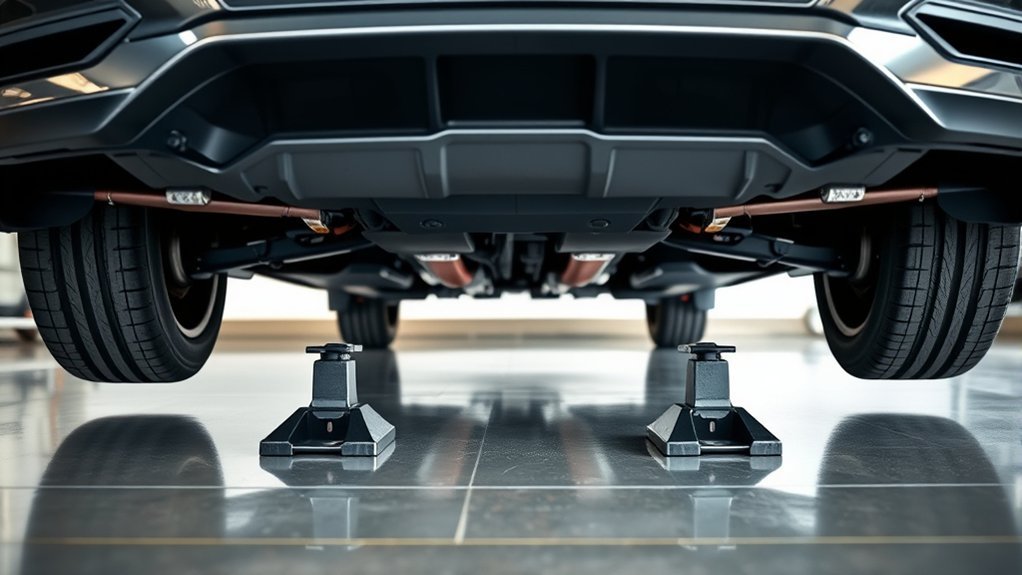
Lifting your Hyundai Sonata safely takes six deliberate steps from initial preparation to final lowering. If your job involves removing the wheels, always break the lug nuts loose by a half-turn counterclockwise with a breaker bar while the tire is still on the ground.
- Secure the vehicle: Park on level concrete, put the car in Park, set the parking brake, and place wheel chocks on both sides of the opposite tires.
- Position the floor jack and pad: Slide your hydraulic jack under the front center subframe crossmember (with a hardwood block) or the reinforced corner pinch weld (with a slotted rubber adapter).
- Raise the Sonata slowly: Pump the handle in smooth, full strokes while watching the saddle contact point to verify the metal is not bending or slipping.
- Set and lock the jack stands: Slide both jack stands under the reinforced corner pinch welds or subframe hard points, set them to identical height notches, and insert the safety locking pins.
- Lower onto the stands and test stability: Slowly open the jack release valve until the car’s full weight rests centered in the jack stand saddles, then perform a firm push test from outside the vehicle.
- Lower safely and torque the lug nuts: When finished, raise the car slightly to remove the stands, lower it smoothly to the ground, and torque the wheel lug nuts in a five-point star pattern to 65 to 79 lb-ft (88 to 107 N·m) on 2006–2019 models, or up to 79 to 94 lb-ft on 2020 and newer models (verify your exact specification in your owner’s manual).
| Step | Description |
|---|---|
| Engage Parking Brake & Chock Wheels | Shift into Park, engage the parking brake, and block the grounded tires with wheel chocks. |
| Use Lifting Tools & Pads | Position a hydraulic floor jack with a slotted pinch weld pad or 2×4 hardwood block under the designated lift point. |
| Secure Jack Stands & Push-Test | Place matched jack stands at the corner hard points, lower the vehicle onto them, and push-test for stability. |
Overcoming Common Jacking Challenges
Hyundai Sonata owners frequently run into two practical hurdles during home maintenance: low front-end ground clearance that blocks standard floor jacks from reaching the center crossmember, and narrow pinch weld slots where the floor jack and jack stand compete for the same space.
Identifying Safe Lifting Points
Modern Hyundai Sonatas have a minimum ground clearance of roughly 5.3 inches, and the front subframe crossmember sits deep behind the front bumper overhang. If a standard floor jack cannot slide far enough under the front bumper to reach the center brace or get enough handle swing:
- Drive onto wooden planks first: Place two 2-foot lengths of 2×8 or 2×10 lumber flat in front of the front tires and drive onto them. That extra 1.5 inches of height lets a low-profile floor jack roll straight to the center subframe crossmember.
- Use a two-stage corner lift: Lift one front corner at the inner lower control arm mounting bracket just high enough to slide a jack stand under that side’s reinforced pinch weld, then repeat on the opposite side.
- Verify unibody seam thickness: Run your fingers along the rocker seam before lifting; the reinforced pinch weld section has a noticeably thicker double-layer flange between the two factory notches.
Ensuring Jack Stability
Because the reinforced pinch weld notch on a Sonata is only a few inches wide, you cannot place a floor jack saddle and a jack stand on the same pinch weld simultaneously. Trying to squeeze a jack stand onto the unreinforced seam next to your floor jack will fold the sheet metal flange.
To keep both tools stable, lift from the center front subframe crossmember so both left and right corner pinch welds stay completely free for your jack stands. If you only need to lift one corner, place your floor jack under the heavy boxed subframe bracket where the lower control arm bolts to the chassis, then set your jack stand directly under the notched pinch weld.
Pro Tip: Invest in a slotted magnetic jack pad or cut a 1/2-inch wide, 1/2-inch deep groove across the center of a rubber hockey puck. It slips over the Sonata’s vertical pinch weld flange so the weight rests on the reinforced upper frame rail rather than crushing the thin weld edge.
Oil Change Tips and Maintenance Access
Once your Hyundai Sonata is safely elevated, changing the engine oil requires removing or unbolting the lower plastic engine splash shield (belly pan) on 2011 and newer models. This aerodynamic cover is held in place by several 10mm bolts and plastic push-pin clips; removing it gives you unobstructed access to the oil pan drain plug and spin-on oil filter.
- Check your engine’s exact oil capacity and viscosity: A 2009 Sonata takes 4.54 quarts (4.3 L) of SAE 5W-20 or 5W-30 for the 2.4L four-cylinder and 5.49 quarts (5.2 L) for the 3.3L V6. Later 2015–2019 2.4L engines take 5.1 quarts, while 2020 and newer models require full synthetic SAE 0W-20 (about 5.1 quarts for the 1.6L Turbo and 6.1 quarts for the 2.5L engine).
- Replace the drain plug crush washer: Install a new aluminum crush gasket at every oil change and tighten the oil drain plug to 29 lb-ft (39 N·m) to prevent oil pan leaks or stripped threads.
- Use a wide-mouth funnel and inspect for leaks: Pour in fresh oil cleanly, run the engine for 60 seconds, and check around the filter gasket and drain plug before reinstalling the plastic undershield.
If you are only performing an oil change and do not need to remove the wheels, composite drive-on service ramps (such as Rhino Ramps rated for at least 12,000 pounds gross vehicle weight) offer a fast, stable alternative to jacking. Simply align the ramps ahead of the front tires, drive up slowly until the tires rest in the top cradles, set the parking brake, and chock both rear wheels.
Community Tips for Safe Lifting
Experienced Hyundai Sonata owners and mechanics emphasize a few model-specific habits that prevent undercarriage damage over years of DIY service. Before placing a jack or stand on an older Sonata driven in northern road-salt states, tap and inspect the rocker panel pinch welds and rear subframe for flaking rust or corrosion that could weaken the lifting seam.
When lifting the front end on 2015–2019 LF Sonata models without a long-reach floor jack, community veterans favor lifting under the thick cast or stamped inner lower control arm pivot boss (never the middle of the control arm where it can bend) so the notched pinch weld remains open for a flat-top or V-groove jack stand. Finally, keep the factory trunk scissor jack stored strictly for roadside emergencies—its narrow base and threaded screw are not built for repeated garage maintenance.
Best Practices for Vehicle Maintenance
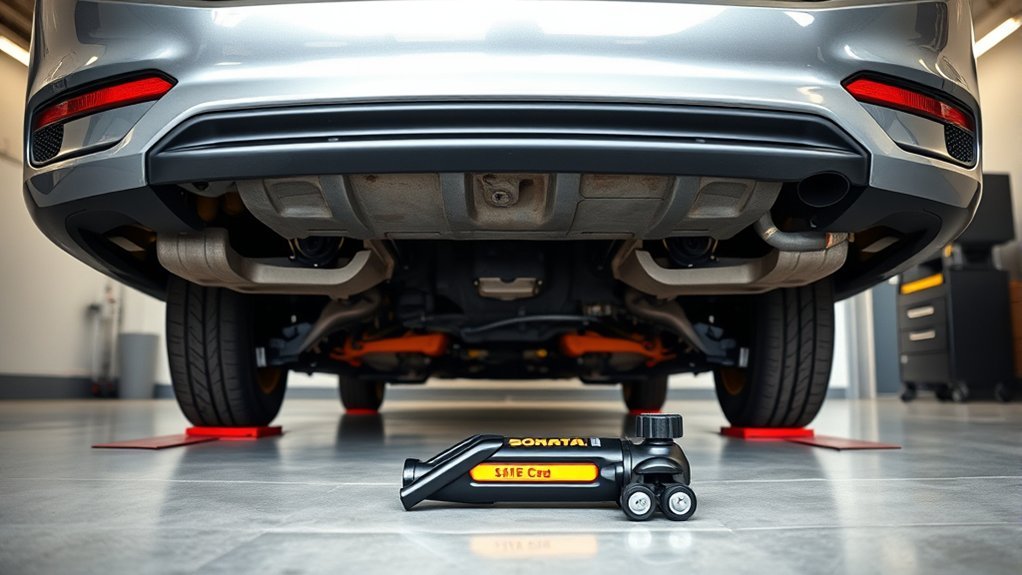
Pairing safe lifting habits with a consistent service schedule keeps your Hyundai Sonata reliable past 150,000 miles. Following the official Hyundai USA maintenance schedule alongside NHTSA tire safety guidelines helps you catch suspension, brake, and fluid issues early:
- Change engine oil and rotate tires every 5,000 to 8,000 miles: Service every 5,000 miles (or 6 months) if you drive in severe conditions (stop-and-go traffic, short trips, extreme heat or cold), or every 7,500 to 8,000 miles (12 months) under normal highway driving.
- Check cold tire pressure monthly: Maintain the factory pressure listed on your driver’s door jamb placard (typically 32 to 35 PSI for standard tires and 60 PSI for the compact spare tire).
- Flush the engine coolant on schedule: Inspect coolant levels every 15,000 miles. Factory Hyundai long-life ethylene glycol coolant is replaced first at 120,000 miles (or 10 years) on newer models and every 30,000 miles (or 24 months) thereafter, while older models or conventional coolants should be flushed every 2 years or 30,000 miles.
- Test and replace the 12-volt battery every 3 to 5 years: Clean any terminal corrosion during oil changes and load-test the battery before winter to prevent unexpected no-start failures.
Frequently Asked Questions
Can I use regular jack stands on Hyundai Sonata pinch welds?
You should not place bare metal U-shaped jack stand saddles directly onto your Sonata’s pinch welds without protection, as the narrow steel forks can bend the vertical weld seam and scrape off the anti-corrosion coating. Always fit a slotted rubber pinch weld pad over the jack stand saddle or use flat-top padded jack stands so the load is distributed evenly across the reinforced notch.
What tools do I need to lift a Hyundai Sonata safely?
To lift a Hyundai Sonata safely at home, you need a 2-ton or 3-ton low-profile hydraulic floor jack, a matched pair of 3-ton ASME-certified jack stands, two rubber wheel chocks, and a slotted rubber jack pad or 2×4 hardwood block. If you are removing the wheels, you will also need a 21mm socket, a breaker bar, and a calibrated torque wrench.
How do I prevent vehicle and jack corrosion when using jacks?
Prevent undercarriage rust on your Sonata by always using a rubber pinch weld adapter or wood block so the metal jack saddle never scrapes bare steel on the rocker seam. If paint or undercoating chips off a jack point, touch it up with rust-inhibiting primer, and wipe down your hydraulic jack and stands after each use before storing them in a dry garage.
Are there alternative lifting methods for the Hyundai Sonata?
Yes, drive-on service ramps (such as composite Rhino Ramps) and portable scissor or frame lifts (like QuickJack) are safe alternatives for lifting a Hyundai Sonata. Drive-on ramps are ideal for routine oil changes and underbody inspections when the wheels stay on, provided you use wheel chocks behind the rear tires and work on flat concrete.
What are the risks of incorrect lifting techniques?
Lifting a Hyundai Sonata at the wrong spot or without jack stands can cause the vehicle to slip off the jack, resulting in severe crushing injuries or death. Incorrect placement also bends rocker panels, cracks the aluminum engine oil pan or transmission case, and crushes fuel or brake lines routed along the floor pan.
What is the lug nut torque specification for a Hyundai Sonata?
Most 2006–2019 Hyundai Sonata models require a wheel lug nut torque of 65 to 79 lb-ft (88 to 107 N·m), while 2020 and newer DN8 Sonata models typically specify 79 to 94 lb-ft (107 to 127 N·m). Always tighten the five lug nuts in a crisscross star pattern with a calibrated torque wrench after lowering the car to the ground.
Conclusion
Lifting your Hyundai Sonata safely comes down to using the factory-reinforced pinch welds and center subframe crossmembers, working on flat concrete with wheel chocks, and never going underneath the car without locked jack stands. Before your next oil change or brake job, check the exact lifting diagram in your owner’s manual, pick up a slotted rubber pinch weld pad to protect your rocker seams, and perform a firm push test every time you set the stands.
Sources
- Hyundai Motor America Owners Portal: Official Hyundai Sonata owner’s manuals, factory jacking point diagrams, and torque specifications
- AAA Automotive: Step-by-step vehicle lifting, wheel chocking, and tire-changing safety procedures
- Hyundai USA Maintenance Schedule: Factory-recommended oil change, tire rotation, and fluid replacement intervals
- National Highway Traffic Safety Administration (NHTSA): Federal tire pressure maintenance, rotation, and roadside safety guidelines