4Lo in a Toyota 4Runner is designed for slow, high-torque work such as steep climbs and descents, technical rocks, deep mud, sand, or snow where ordinary high-range four-wheel drive is not enough. There is no single Toyota-published 4Lo speed limit that applies to every 4Runner generation and drivetrain, so use low range only as fast as the terrain requires and follow the limits in your model-year owner’s manual.
Quick Answer
Drive a 4Runner in 4Lo slowly—normally at crawling or trail speeds where you need extra torque and engine braking. Toyota does not specify one universal 5-, 10-, or 15-mph limit for every 4Runner. If conditions allow sustained higher speed, switch to 4Hi and follow your model-year owner’s manual.
Key Takeaways
- 4Lo is a low-speed, high-torque range, not a normal-road or highway driving mode.
- There is no single 15-mph maximum that applies to every Toyota 4Runner; model year, drivetrain, transmission position, and Toyota instructions matter.
- Many automatic 4Runners require you to stop completely, hold the brake, select Neutral, and then shift between high and low range.
- Avoid using locked/part-time 4WD on dry, high-traction pavement where the tires cannot slip, because driveline wind-up can occur.
- New vibration, severe clunking, persistent abnormal noise, burning smells, leakage, or failure to engage/disengage deserves inspection before continued hard use.
At a Glance
| Time Required | Usually less than a minute to select low range; driving time depends on the obstacle or terrain. |
| Difficulty | Easy once you know your model’s transfer-case controls, but the exact procedure is model-specific. |
| Tools Needed | No tools; keep the correct Toyota owner’s manual available for your model year and trim. |
| Cost | $0 for normal operation. |
What 4Lo Does and Exactly When to Use It
4Lo, L4, or 4L selects the transfer case’s low range. That additional gear reduction lets the engine turn faster relative to vehicle speed, giving you stronger wheel torque, finer low-speed throttle control, and more engine braking on descents.
Toyota describes low range as the mode for maximum power and traction when climbing or descending steep hills, driving off-road, or pulling through difficult sand, mud, or deep snow. The exact labels vary by generation: you may see H2/H4/L4, 2H/4H/4L, or full-time 4WD settings such as H4L/L4L.
The current-generation 4Runner also continues to offer high/low-range four-wheel-drive hardware on applicable models. Toyota’s current specifications describe an electronically controlled two-speed transfer case on applicable 4WD models, which is another reason not to assume that one older lever procedure applies to every 4Runner.
Best Uses for 4Lo
- Technical rock sections: low range makes it easier to crawl over obstacles without excessive throttle.
- Steep climbs: greater torque multiplication helps the vehicle move at a controlled pace.
- Steep descents: low gearing provides stronger engine braking and can reduce reliance on continuous brake-pedal pressure.
- Deep mud, sand, or snow: use 4Lo when you need strong pulling power at low speed.
- Recovery or extraction: low range can provide more controlled pulling force when the vehicle is stuck, provided the recovery method itself is safe.
Note: Low range is not automatically the best setting for every patch of mud, sand, or snow. If you need steady momentum rather than crawling torque, 4Hi may be more appropriate. Choose the range for the terrain rather than assuming 4Lo always provides the best traction.
How Fast Can You Drive a 4Runner in 4Lo?
There is no single Toyota-approved speed such as 5, 10, or 15 mph that can safely be presented as the maximum for every 4Runner. Toyota manuals differ across generations and may specify operating restrictions, shifting limits, or approximate allowable speeds according to transmission position.
For practical off-road driving, treat 4Lo as a slow-speed range. Use only enough speed to clear the obstacle while maintaining steering and throttle control. When the terrain becomes easy enough that you can travel continuously at normal trail or road speeds, that is usually the signal to stop using low range and select 4Hi or the appropriate high-range setting.
Why There Is No Universal Number
Older Toyota documentation illustrates the problem with blanket speed advice. A 2004 4Runner Owner’s Manual, for example, lists different approximate maximum allowable speeds when L4 is selected depending on the automatic-transmission position. For one 4WD configuration, the manual lists approximately 13 mph in L, 22 mph in 2, and 32 mph in 3. Those figures apply to that specific vehicle and transmission configuration—they are not recommended trail speeds for all 4Runners.
The safest rule is not “4Lo always equals 10 or 15 mph.” Use low range only for low-speed work, and let the Toyota manual for your exact model year set the mechanical limits.
| Situation | Best Approach | Why |
|---|---|---|
| Rock crawling | Walking/crawling pace | Maximum control and precise wheel placement |
| Steep descent | Very slow, controlled speed | Use engine braking without rushing the descent |
| Deep mud/snow | Low speed in 4Lo when torque is needed | 4Hi may be better when safe momentum is required |
| Easy trail allowing sustained speed | Switch to 4Hi when appropriate | Low range is no longer providing a useful advantage |
| Normal paved-road travel | Use the appropriate high-range mode | 4Lo is not intended for ordinary road-speed driving |
Drivetrain Stress Risks
Low range multiplies torque throughout the driveline. That is useful off-road, but aggressive throttle, wheel hop, repeated shock loads, or forcing the vehicle through a high-traction turn can stress axles, joints, differentials, the transfer case, and tires.
Do not use an arbitrary 2,500-RPM number as a universal limit. Instead, watch the tachometer, avoid over-revving or operating near the red zone unnecessarily, and use a transmission range that keeps the vehicle controlled. Older Toyota manuals may contain engine-speed guidance for specific traction-control situations, but those figures are not universal 4Lo RPM limits.
Warning: Do not use part-time 4WD or a locked center differential on dry, high-traction pavement unless your specific Toyota manual permits that mode. With little tire slip available, front and rear driveline speeds can fight each other during turns and create driveline wind-up.
4Hi vs. 4Lo vs. 2Hi: Which Should You Use?
| Mode | Typical Use | Avoid When |
|---|---|---|
| 2Hi / 2H | Normal dry-road driving on part-time 4WD models | You need additional four-wheel traction |
| 4Hi / 4H | Loose trails, snow, dirt, and situations needing four-wheel traction at higher speeds than low range | A steep or technical obstacle requires low-range torque/control |
| 4Lo / 4L / L4 | Steep climbs/descents, rocks, difficult mud, sand, deep snow, and low-speed pulling | Normal road-speed driving or terrain where low-range reduction is unnecessary |
Full-time 4WD 4Runners use different high-range and center-differential settings than part-time models, so always identify which system your vehicle has before applying a generic 2Hi/4Hi/4Lo chart.
[Products Worth Considering]

Fitment: Tailgate Release Switch compatible with 2003-2017 Toyota 4Runner

Plug and play, yank out the defective switch and slide the new a/c switch replacement into position, done

How to Engage 4Lo Properly Step by Step
The exact control can be a lever or rotary/electronic selector, depending on year and trim. On many automatic 4Runners, Toyota’s procedure for shifting between high and low range starts with a complete stop and Neutral.
- Move to a safe location. Keep the wheels straight if practical and make sure they are not spinning.
- Stop completely. Keep your foot on the brake pedal.
- Select Neutral. On an automatic transmission, move the transmission selector to N when your Toyota manual specifies it.
- Select low range. Move the transfer-case lever or operate the 4WD selector exactly as described for your model.
- Wait for confirmation. Do not drive away until the 4LO/L4 indicator shows that the shift has completed according to your manual.
- Select Drive or the appropriate transmission gear. Begin moving gently and confirm that low range is operating normally.
The 2022 Toyota 4Runner Quick Reference Guide, for example, instructs automatic-transmission drivers to stop the vehicle, shift to N, and then move from H4 to L4 on applicable part-time models. It also gives a corresponding stop-and-Neutral procedure for full-time 4WD models. Your exact model-year manual overrides this generalized sequence.
Pro Tip: Practice selecting and exiting low range on a safe loose-surface area before you need it on a difficult trail. Knowing how your indicator lights and transfer-case controls behave makes troubleshooting much easier when terrain becomes demanding.
What to Do if 4Lo Will Not Engage
A flashing 4LO indicator commonly means the commanded transfer-case shift has not completed. Do not accelerate hard or force a mechanical lever in an attempt to make it engage.
Toyota procedures vary by generation, but several 4Runner manuals instruct drivers to confirm that the vehicle is stopped and the automatic transmission is securely in Neutral. Some older manuals also tell the driver to move forward or backward a short distance and retry if the indicator continues to flash.
- Stop safely and hold the brake.
- Confirm that the transmission is in the position required by your owner’s manual, usually Neutral for an automatic H4-to-L4 shift.
- Re-select the requested transfer range.
- If your manual allows it, move forward or backward a short distance, stop, and retry.
- If the indicator continues flashing, the system will not engage/disengage normally, or a warning message appears, stop forcing the shift and consult Toyota service information or a qualified technician.
Never operate the transfer-case control while the wheels are spinning. Toyota has included this warning in multiple generations of 4Runner documentation.
[Products Worth Considering]

Direct replacement - this 4WD switch matches the fit and function of the original switch on specific vehicle applications

Driving Techniques in 4Lo: Throttle, Steering, and RPM Control
Once low range is engaged, concentrate on control rather than a fixed mph number. Apply the accelerator smoothly so torque reaches the tires progressively. Sudden throttle can cause wheelspin, wheel hop, or a hard driveline shock when a spinning tire suddenly regains traction.
Use Smooth Throttle
Let the low gearing do the work. Start with light throttle and increase it only as needed. If you find yourself using substantial throttle simply to maintain ordinary trail speed, consider whether 4Hi is now the more appropriate range.
Avoid Unnecessary Tight Turns on High-Traction Ground
On loose dirt, rocks, mud, or snow, tire slip can relieve driveline speed differences. On firm high-traction ground—especially with part-time 4WD or a locked center differential—tight turns can create noticeable resistance or driveline wind-up. Move to the correct drive mode as soon as low range or a locked configuration is no longer needed.
Watch RPM Without Inventing a Universal Limit
There is no general Toyota rule requiring every 4Runner to remain below 2,500 RPM in 4Lo. Watch the tachometer, stay away from the red zone, avoid sustained unnecessary high RPM, and follow any transmission-position limits printed in your manual.
Use Low Range for Controlled Descents
On a steep off-road descent, low range can provide useful engine braking. Select an appropriate transmission gear before the descent, maintain a controlled line, and use the brakes progressively rather than allowing excessive speed to build and then braking abruptly.
Signs You May Be Overworking 4Lo or Have a Drivetrain Problem
Low range changes gear speeds and driveline loading, so the vehicle may sound or feel different from normal high-range driving. Do not assume every low-range whine automatically means damage. Instead, pay attention to changes that are severe, new, persistent, or accompanied by other symptoms.
Loud or New Drivetrain Noise
A noticeable mechanical sound can be more apparent in low range, but a new loud whine, grinding sound, repeated clunk, or noise that continues after returning to normal operation deserves attention. Stop and inspect the vehicle if the sound is accompanied by vibration, leakage, difficult shifting, or loss of drive.
| Indicator | Recommended Response |
|---|---|
| Normal low-range mechanical sound | Continue cautiously while monitoring the vehicle |
| Sudden loud whine or grinding | Stop safely and investigate before hard use continues |
| High RPM because terrain has become easy | Return to the appropriate high range |
| Resistance/binding on firm surface | Stop forcing the turn and select the correct drive mode |
| Persistent noise, vibration, or leakage | Inspect or have the drivetrain serviced |
Excessive Heat and Binding
Extended heavy pulling, wheelspin, or shock loading can generate heat and stress. An engine coolant gauge does not directly tell you the temperature of the transfer case or differentials, so do not rely on engine temperature alone as a 4Lo stress gauge.
Binding or steering resistance is especially important on high-traction surfaces with a driveline configuration that locks front and rear axle speeds together. If the vehicle resists turning, hops tires, or feels wound up, stop forcing it and move to the appropriate range once conditions allow.
Warning: Severe vibration, grinding, a burning smell, visible fluid leakage, loss of drive, or an inability to complete the shift into or out of low range is not something to “drive through.” Stop in a safe location and investigate the cause.
Common Mistakes on Dirt and Rock and How to Avoid Them
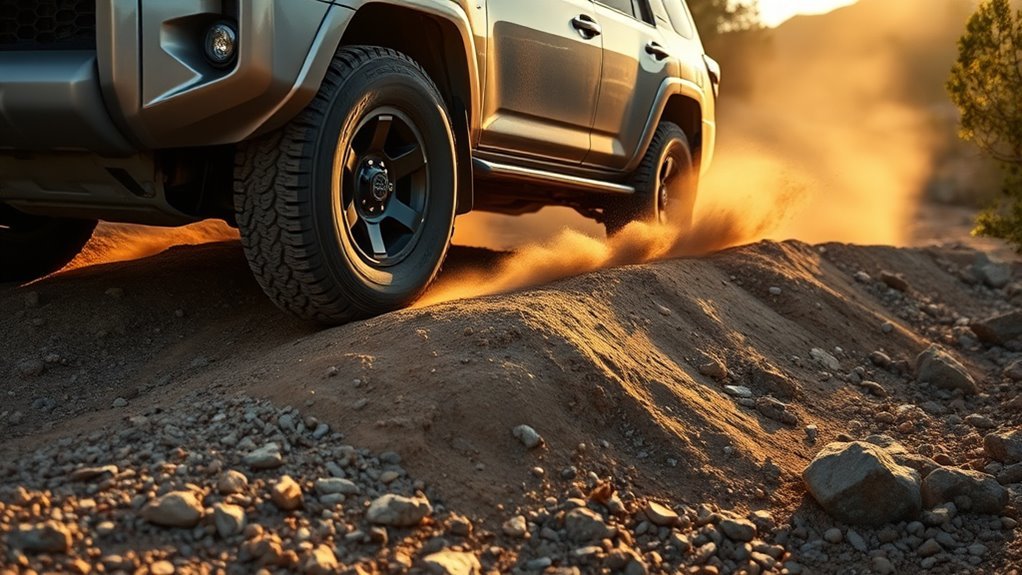
The most common low-range mistakes are using 4Lo when it is unnecessary, carrying too much speed into technical terrain, making abrupt control inputs, and continuing to drive after the vehicle gives clear warning signs.
Use low range for control, not speed. Choose the correct line, apply torque smoothly, and return to high range when the terrain no longer requires reduction gearing.
- Using 4Lo on easy terrain: Low range is unnecessary once the trail allows ordinary sustained speed. Move back to 4Hi or the correct high-range setting.
- Treating 15 mph as a universal cutoff: Toyota limits vary by vehicle. Use your manual rather than an internet-wide hard number.
- Driving too fast for the obstacle: Technical rocks and steep descents require enough time for tire placement and steering correction.
- Using abrupt throttle: Sudden torque can spin a tire or shock the driveline when traction returns.
- Turning tightly on high-traction ground: Locked/part-time four-wheel-drive systems need tire slip to relieve driveline speed differences.
- Ignoring indicators: A flashing 4LO light means the range change may not be complete; confirm the shift before demanding power.
- Assuming 4Lo is always best in snow or sand: When safe momentum is required, 4Hi may work better than low range.
When You Should Not Use 4Lo
Low range is usually the wrong choice when you are driving normally on pavement, traveling at sustained road or easy-trail speed, or moving across terrain that does not need extra torque or engine braking.
- Do not use 4Lo as a normal highway or street mode.
- Do not remain in low range simply because the trail is unpaved.
- Do not use a locked part-time 4WD configuration on dry high-traction pavement unless Toyota specifically permits it for your system.
- Do not shift ranges while the wheels are spinning.
- Do not force the transfer-case control if the requested mode will not engage.
Post-Use Checks: Transfer Case, U-Joints, Hubs, and Fluids
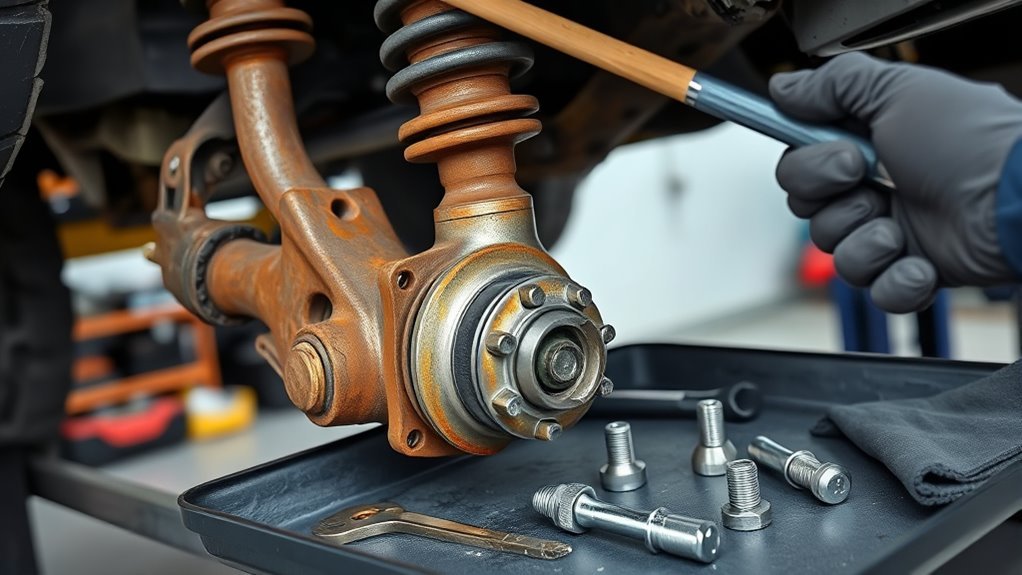
After a difficult trail, inspect the vehicle for damage before assuming everything survived simply because it still drives normally. Look underneath for fresh fluid, damaged boots, bent shields, loose components, wrapped vegetation, or impact marks around the drivetrain.
| Component | What to Check | When to Act |
|---|---|---|
| Transfer case | Fresh leaks, impact damage, abnormal noise, difficult shifting | Inspect/service if leakage, damage, or operation changes |
| Propeller shafts/U-joints | Impact damage, unusual play, vibration, damaged fittings where applicable | Service if looseness, binding, or vibration appears |
| CV boots/driveshaft boots | Cuts, tears, grease leakage | Repair promptly to prevent contamination and joint damage |
| Differentials | Leaks or impact damage | Inspect if fluid is visible or the housing was struck |
| Manual/serviceable hubs, if actually equipped | Engagement, seals, damage | Follow the hardware manufacturer or Toyota procedure |
| Tires | Cuts, sidewall damage, missing tread blocks, pressure | Repair or replace unsafe tires before road driving |
Most modern 4Runners do not require the driver to perform a generic manual locking-hub test after every trail. If an older or modified vehicle actually has serviceable/manual hubs, inspect them according to the applicable system documentation.
Likewise, do not use an invented “monthly transfer-case fluid change” rule. Follow Toyota’s factory schedule. The 2024 4Runner Warranty & Maintenance Guide includes transfer-case oil service under specified scheduled and special operating conditions, including certain dirt/dust and heavy-use conditions.
Quick Decision Guide: When to Switch Back to 4Hi or 2Hi
Switch out of 4Lo when the obstacle has ended and the extra reduction is no longer helping. The decision should be based on terrain and the operating instructions for your 4WD system—not an invented universal 10- or 15-mph trigger.
- The trail opens up: If you can maintain normal trail speed without needing low-range torque, use 4Hi where appropriate.
- You return to normal dry pavement: On a part-time 4WD model, return to 2Hi when Toyota specifies 2Hi for normal dry hard-surface driving.
- Engine speed is unnecessarily high: If low gearing is making the engine rev much higher than necessary for easy terrain, change to the appropriate high range.
- You feel driveline wind-up on firm ground: Stop forcing the drivetrain and select the correct mode as conditions allow.
- The vehicle develops abnormal noise or vibration: Stop and inspect rather than simply changing modes and continuing hard use.
For the exact shift sequence, consult the Toyota manual for your vehicle. Toyota maintains model-specific documentation through its 4Runner Manuals & Warranties portal.
Frequently Asked Questions
How fast can I drive my 4Runner in 4Lo?
Drive only as fast as necessary for the low-speed obstacle or terrain. There is no single Toyota 5-, 10-, or 15-mph limit that applies to every 4Runner generation. If you can travel at sustained ordinary trail or road speeds, 4Hi is usually the more appropriate range. Always follow your model-year owner’s manual.
What does 4Lo mean in a Toyota 4Runner?
4Lo is the transfer case’s low-range four-wheel-drive setting. It uses additional gear reduction to provide stronger wheel torque, finer low-speed control, and increased engine braking for steep, loose, or technical terrain.
Can I use 4Lo on dry pavement?
Generally, do not use a part-time 4WD or locked-center configuration on dry, high-traction pavement unless your Toyota manual specifically permits it. The tires may not be able to slip enough to relieve front-to-rear driveline speed differences during turns, which can cause wind-up and resistance.
Can I shift my 4Runner into 4Lo while moving?
Do not assume you can. Many automatic 4Runners require a complete stop, the brake pedal held, and the transmission in Neutral before shifting between high and low range. Some older/manual-transmission systems have different procedures. Follow the exact instructions for your model year and drivetrain.
Is 4Lo or 4Hi better in snow?
Use 4Hi for many snowy-road or faster loose-surface situations. Use 4Lo when you need very low-speed pulling power, control, or engine braking in deep snow or difficult off-road terrain. Low range is not automatically better simply because snow is present.
Why is my 4LO light flashing?
A flashing indicator can mean the requested transfer-case shift has not completed. Confirm the vehicle is stopped and the transmission/control positions match your owner’s manual. Some Toyota procedures allow moving forward or backward a short distance and retrying. If the light continues flashing or the system will not shift normally, have it inspected.
Conclusion
4Lo gives a Toyota 4Runner the gear reduction needed for steep climbs, controlled descents, rocks, deep mud, sand, snow, and other low-speed situations where torque matters more than speed. The key correction is that 5–10 mph is not an official universal operating range and 15 mph is not a universal Toyota hard limit.
Use low range slowly and deliberately, but let the owner’s manual for your exact year, trim, transmission, and four-wheel-drive system define the mechanical restrictions. Engage the range correctly, avoid unnecessary high-speed or high-traction operation, respond to abnormal vibration or noise, and return to 4Hi or 2Hi when low-range reduction is no longer useful.
Sources
- Toyota 4Runner Manuals & Warranties — official source for model-specific owner documentation.
- Toyota 2022 4Runner Quick Reference Guide — supports high-/low-range selection procedures for applicable part-time and full-time 4WD models.
- Toyota 2004 4Runner Owner’s Manual — demonstrates model/transmission-specific L4 operating limits and shifting guidance.
- Toyota 2024 4Runner Warranty & Maintenance Guide — supports scheduled and special-operating-condition transfer-case maintenance guidance.
- Toyota 2026 4Runner Brochure — confirms current high/low-range electronically controlled transfer-case availability on applicable 4WD models.