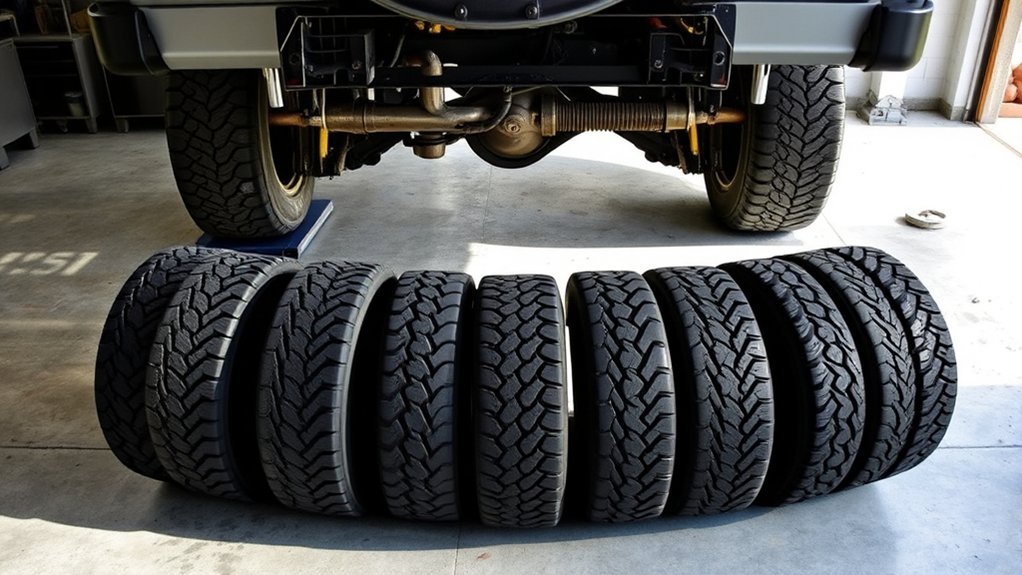
The best Land Cruiser tire rotation pattern for non-directional tires is the rearward cross: rear tires move straight to the front, and front tires cross to the opposite side at the rear. If you have a matching full-size spare, use a five-tire rotation so all five wear evenly. Toyota’s current maintenance schedule calls for a rotation every 5,000 miles.
This applies to the 200-series (2008–2021) and the 250-series (2024 on in the US), both of which use full-time 4WD. Directional tires need a different pattern, shown below.
Land Cruiser Tire Rotation Patterns at a Glance

| Pattern | When to use it | Moves |
|---|---|---|
| Four-tire rearward cross | Non-directional tires, spare not matching | LR → LF, RR → RF, LF → RR, RF → LR |
| Five-tire rearward cross | Non-directional tires with a matching full-size spare | Spare → RR, RR → RF, RF → LR, LR → LF, LF → spare |
| Front-to-rear (same side) | Directional tires | LF ↔ LR, RF ↔ RR |
| Side-to-side | Different-size front and rear wheels (rare on Land Cruisers) | LF ↔ RF, LR ↔ RR |
LF = left front, RF = right front, LR = left rear, RR = right rear. Your owner’s manual may show its own diagram; some owners find the five-tire diagram in the 250-series manual confusing, so a standard five-tire rearward cross is a common alternative.
Why the Spare Matters on a Land Cruiser
- Both generations have full-time 4WD, so keeping tread depth close across all tires is good practice for the drivetrain.
- Many Land Cruisers have a full-size spare, but some trims or replacement setups do not match the road tires. Check the size, brand and model on the sidewall before rotating it in.
- If the spare has sat unused, check its pressure and age (the DOT date code) before putting it on the road.
How Often to Rotate
Toyota’s published maintenance schedule for the current Land Cruiser lists a tire rotation every 5,000 miles. Check your Warranty and Maintenance Guide for your model year, and rotate sooner if you see uneven wear. Off-road and towing use can wear tires faster.
Tools Needed
- Floor jack rated for the truck’s weight, plus jack stands
- Breaker bar and correct lug nut socket
- Torque wrench
- Tire pressure gauge and tread depth gauge
- Wheel chocks
How to Rotate Land Cruiser Tires: Step by Step
- Choose your pattern from the table above based on tire type and spare.
- Park on level ground, set the parking brake, and chock the wheels.
- Lower the spare (if rotating five) using the tool kit in the vehicle.
- Loosen lug nuts slightly while the wheels are on the ground.
- Lift and support the truck at the jacking points shown in the owner’s manual, using jack stands. Lifting one side at a time works well.
- Move wheels to their new positions. Mark them with chalk first to avoid mix-ups.
- Hand-start every lug nut, lower the truck, then torque in a star pattern to the spec in your owner’s manual.
- Set pressures to the values on the driver’s door-jamb placard, including the spare.
- Reset or re-register the TPMS if your manual calls for it.
- Re-check lug torque after the first 50 to 100 miles.
Check Tires While You Rotate
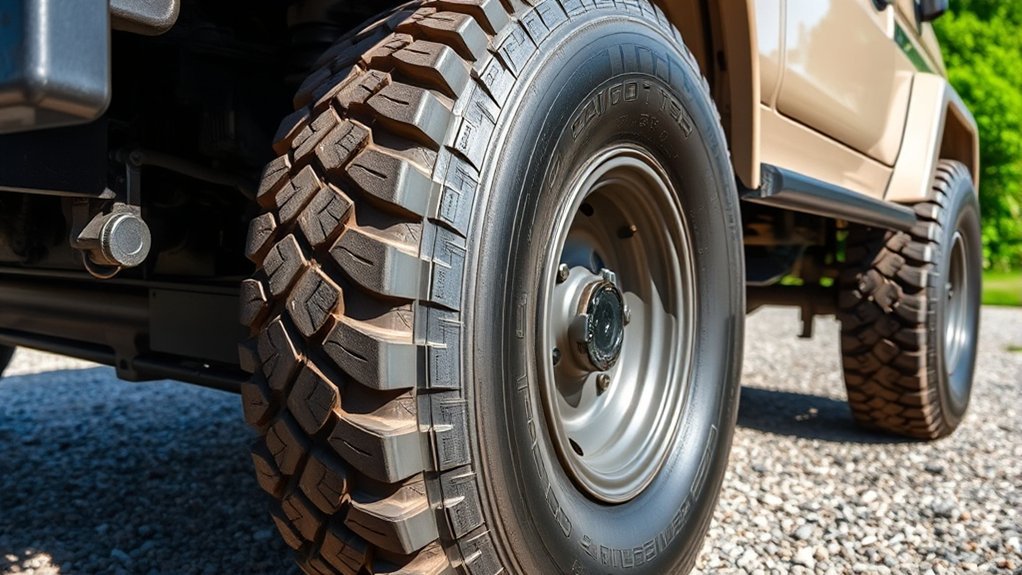
- Measure tread depth at the inner, center and outer grooves.
- Look for cupping, feathering, or one-sided wear, which can point to alignment, suspension, or bearing issues. Our guide to checking wheel bearings for play explains one common cause.
- Inspect sidewalls for cuts and bulges, especially after off-road trips.
- Replacing tires? Our load range C vs E explainer helps you pick the right load rating for a heavy SUV.
What Happens When You Skip Rotations

Front tires on a heavy SUV wear their shoulders faster from steering, while rears wear differently. Without rotation, you may end up replacing tires unevenly, and uneven tread can add noise and vibration.
Many tire warranties also require proof of regular rotation, so keep records.
Common Mistakes
- Crossing directional tires side to side.
- Rotating in a mismatched spare.
- Tightening lug nuts with an impact gun only, without a torque wrench.
- Forgetting to set the spare’s pressure.
Combine your rotation with other quick checks, such as testing Land Cruiser battery health.
Frequently Asked Questions
How often should I rotate Land Cruiser tires?
Toyota's maintenance schedule for the current Land Cruiser lists a tire rotation every 5,000 miles, and that interval has long been standard on Toyota trucks. Check the Warranty and Maintenance Guide for your model year and follow it.
What is the best tire rotation pattern for a Land Cruiser?
For non-directional tires on a 4WD Land Cruiser, the rearward cross is the usual choice: rear tires move straight forward and front tires cross to the opposite rear. With a matching full-size spare, a five-tire rearward cross brings the spare into the rotation.
Should I include the spare in the rotation?
Yes, if it is a full-size spare with the same size, brand and model as the other four. Rotating all five keeps tread depth even, which matters on a full-time 4WD system. If the spare does not match, leave it out.
Do I need to reset the TPMS after rotating?
Often, yes. Some Toyota systems need the tire positions re-registered or a reset after rotation, and owners report the system may take several minutes of driving to relearn. Follow the TPMS section of your owner's manual.
What lug nut torque does a Land Cruiser use?
Torque varies by model and wheel. The 200-series is commonly listed at 97 ft-lbf (131 N·m), but always confirm the figure in your owner's manual and use a torque wrench rather than an impact gun for the final tightening.
Bottom Line
Use a rearward cross for non-directional tires, add the spare with a five-tire rotation if it matches, and rotate every 5,000 miles as Toyota’s schedule lists. Torque the lug nuts to the owner’s manual spec and recheck them after a short drive.