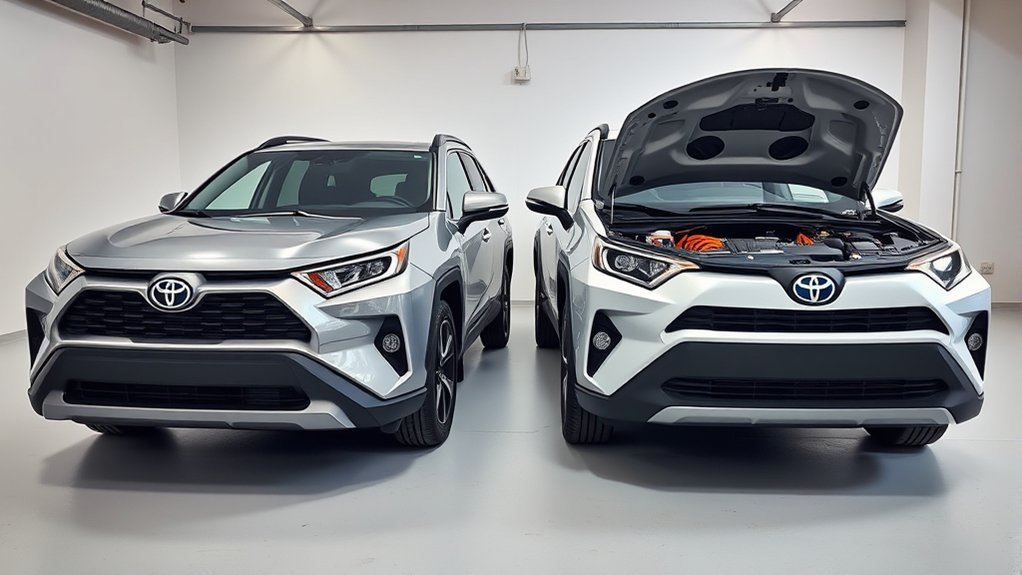
You’ll favor the RAV4 Hybrid if you want sharper acceleration (0–60 in 7.1s), stronger torque, and far better fuel economy (about 39 MPG combined) that cuts running costs and refill stops. The gas RAV4 costs less up front, rates higher for reliability, and suits heavy-use buyers or those prioritizing proven durability. Both share cargo space and towing limits, but the Hybrid’s AWD and efficiency make it the tech-forward choice—keep going to see exact tradeoffs and scenarios.
Quick Answer: Which 2025 RAV4 Should You Buy?
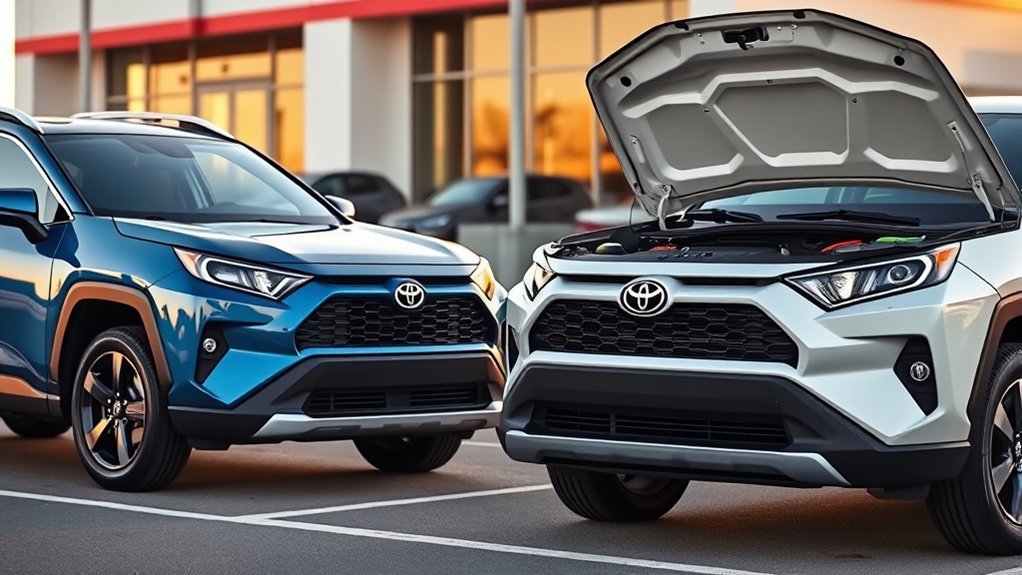
Wondering which 2025 RAV4 to pick? You’ll likely choose the Hybrid if you want performance, efficiency, and long-term savings: it delivers 41 MPG city/38 MPG highway, 219 hp, and 0–60 mph in 7.1 seconds versus the gas model’s 27/35 MPG and 8.0 seconds. You’ll pay about $3,050 more up front for the Hybrid, but it can cut roughly $2,500 in fuel costs over five years, a practical step toward financial and environmental freedom.
If your priority is lower initial outlay and identical cargo/interior space—37.6 cu ft behind the rear seats—the gas RAV4 remains sensible. Both trims share core safety ratings and comparable technology features, so you won’t sacrifice active safety systems or infotainment capability either way. For liberation-seeking drivers who prioritize efficiency and quicker acceleration, the Hybrid is the technically superior, forward-looking choice.
Price Comparison: 2025 RAV4 Vs RAV4 Hybrid
If you’re weighing sticker shock against running costs, the 2025 RAV4 Hybrid commands a clear upfront premium—$32,300 versus the gas RAV4’s $29,250, a $3,050 gap that widens slightly when you add AWD (Hybrid is $1,650 more than the gas AWD option). You’ll see the premium hold across trims: Limited Hybrid at $40,605 versus gas Limited AWD $38,955, with trim pricing spanning roughly $30,025 (LE) to $41,380 (Limited Hybrid). That consistent delta reflects Toyota’s pricing strategies and the added cost of hybrid components.
- Compare upfront delta: base and AWD differences to align with your liberation-focused budget.
- Evaluate trim trade-offs: higher-spec hybrids bring more tech at a steeper price.
- Factor preferences: if consumer preferences favor lower purchase cost, gas wins; if you prioritize advanced drivetrain, the hybrid justifies the premium.
Use this comparative, technical lens to match pricing strategies to your desired autonomy and long-term goals.
Fuel Economy & Running Costs for the 2025 RAV4
You’ll notice the 2025 RAV4 Hybrid delivers a technical leap in efficiency at an EPA-estimated 41/38/39 MPG versus the gas model’s 27/35/30, giving you substantially longer range per tank. That improved economy trims annual fuel costs by roughly $500 and compounds to about $2,500 in savings over five years, which helps offset the hybrid’s higher upfront price. Compare these figures when you weigh short-term purchase cost against total cost of ownership for daily commuting or high-mileage use.
Fuel Economy Comparison
The 2025 RAV4 Hybrid delivers up to 41 mpg city and 38 mpg highway (39 mpg combined), versus the gas model’s 27 city and 35 highway (up to 30 mpg combined), translating to roughly $500 a year in fuel savings at $4/gal and about $2,500 over five years—plus a notably longer range per tank (551–594.5 miles for the hybrid vs. 391.5–493 miles for the gas model). You’ll notice clear hybrid advantages in urban stop-and-go driving and extended range freedom, while gas drawbacks appear on cost-per-mile and refill frequency. Compare precisely:
- City driving: hybrid efficiency minimizes fuel use and emissions.
- Highway: hybrid still leads slightly, improving long trips.
- Range and costs: fewer stops, lower annual spend—more autonomy.
Five-Year Cost
Over five years, the RAV4 Hybrid cuts your fuel bill by about $2,500 versus the gas model—roughly $500 a year—thanks to its 39 mpg combined versus 30 mpg combined rating and a far greater per-tank range (551–594.5 miles vs. 391.5–493 miles). Your fuel cost analysis shows the hybrid averages about $1,500 annually in fuel compared with $2,000 for the gas RAV4, which helps offset the roughly $3,050 higher upfront price. Beyond fuel, lower maintenance from fewer moving parts and regenerative braking reduces service expenses, increasing net savings. When you compare five-year totals, the hybrid delivers clear ownership benefits: lower operating costs, longer range per fill, and a more liberated ownership experience that prioritizes efficiency and reduced dependency on frequent refueling.
Ownership Costs: Maintenance, Battery Life, Resale Value
Many owners find that paying $1,500–$2,500 more up front for a RAV4 Hybrid quickly pays back through lower fuel bills and simpler maintenance. You’ll enjoy measurable maintenance savings: fewer moving parts (no starter or alternator) and regenerative braking reduce wear and routine service frequency. Battery longevity is strong too — expect 150,000–200,000 miles with proper care and extended warranty support, so the battery rarely becomes a near-term cost concern.
- Resale value: Hybrids command higher resale prices thanks to fuel-efficiency demand, shrinking total ownership cost and freeing you to upgrade sooner.
- Maintenance profile: Lower brake and mechanical wear translates to fewer repairs and predictable service intervals, giving you operational freedom.
- Long-term risk: Extended battery warranties and proven longevity limit downside, so the initial premium often converts into long-term economic and practical liberation.
You’ll find the hybrid’s ownership calculus decisively favorable if you prioritize efficiency and reduced upkeep.
Performance & Driving Feel: Power, Torque, 0–60
Think of the Hybrid as the quicker, quieter RAV4: its combined 219 hp and 221 lb‑ft of torque outmuscle the gas model’s 203 hp and 184 lb‑ft, and that instant electric torque cuts 0–60 time to about 7.1 seconds versus 8.0 seconds for the gas variant. You’ll feel the hybrid advantages immediately: electric assist supplies near‑instant torque benefits at launch, so throttle inputs translate to faster, smoother acceleration with reduced lag. The gas RAV4 delivers competent power but depends solely on combustion torque curves, making midrange surge less immediate. The Hybrid’s quieter operation reduces auditory distraction, letting you focus on control and momentum. If you want liberation from sluggish responses and intrusive engine noise, the Hybrid’s drivetrain gives a more responsive, refined drive without sacrificing fuel‑tank parity (both keep a 55‑liter tank). In comparative, technical terms: the Hybrid optimizes transient torque delivery and launch performance, while the gas model remains straightforward and predictable—choose based on whether immediate punch and refinement matter to your driving ethos.
Practical Use Cases: Commuting, Road Trips, Towing, Off‑Road
For daily commuting you’ll notice the Hybrid’s up-to-41 MPG city rating and quicker 0–60 time translate to lower fuel costs and sharper acceleration in stop‑and‑go traffic compared with the gas model. On long road trips the Hybrid’s 551–594.5 mile range per tank extends time between refuels versus the gas RAV4, while both models offer similar cargo and comfort for long-haul driving. If you plan on light towing or occasional off‑road routes, both tow 1,750 lbs but the Hybrid’s standard AWD and improved traction give you an edge on slippery or uneven terrain.
Daily Commuting Efficiency
Although both RAV4 models handle daily driving reliably, the Hybrid gives you noticeably better efficiency and responsiveness for commuting and longer trips. You’ll feel instant torque in stop‑and‑go traffic, enjoy fuel savings, and get improved daily comfort from smoother acceleration and lower operating costs compared with the gas model.
- Commuting agility: Hybrid electric torque sharpens merges and city launches, freeing you from lag and improving lane changes.
- Cost liberation: 41 MPG combined vs 30 MPG translates to real fuel savings over weeks of commuting, reducing dependence on frequent fill‑ups.
- Practical range: for routine use the Hybrid’s efficiency extends intervals between refuels, so you gain convenience without sacrificing cargo or passenger space.
Choose the Hybrid if you value efficiency, responsiveness, and financial freedom on daily drives.
Long‑Distance Road Trips
You’ve already seen how the Hybrid’s instant electric torque and better mpg improve daily commutes; on long road trips those same traits magnify into measurable benefits. You’ll notice road trip efficiency immediately: the RAV4 Hybrid’s 39–40 MPG combined versus 27–30 MPG for the gas model extends range to roughly 551–594.5 miles, meaning fewer fuel stops and more autonomy. The hybrid advantages also include standard AWD for steadier traction in varied conditions, so you can push farther with confidence. Both models share a 1,750 lb towing cap, so light towing doesn’t favor one over the other. If you crave freedom from frequent refueling and want superior mileage and stability on extended drives, the Hybrid clearly liberates your itinerary.
Towing And Off‑Road
Towing and off‑road capability hinge on traction, torque, and payload, and here the RAV4 Hybrid gives you distinct advantages: both models tow up to 1,750 lb, but the Hybrid comes standard with AWD—improving grip on loose or wet terrain without the gas model’s $1,400 AWD option—and its electric motor delivers quicker low‑end torque that helps with steep grades, tight trail exits, and confident merges when hauling.
- Towing capacity: Both tops out at 1,750 lb, so you’re set for small trailers and boats; the Hybrid’s torque feels stronger when accelerating with a load.
- Off road capability: Standard AWD on the Hybrid yields better traction on dirt, mud, and slippery inclines; the gas model needs the paid upgrade.
- Practical freedom: Identical cargo space keeps your gear secure while you exploit improved hybrid traction and efficiency.
Final Recommendation: Who Should Pick Hybrid vs Gas and Why
Who should pick the RAV4 Hybrid versus the gas model depends on your priorities: if you want maximum fuel economy, a smoother, more responsive AWD system, and lower running costs over time, the Hybrid is the smarter choice; if you prioritize towing, proven long-term reliability, and a lower upfront purchase price, the gas model will likely serve you better.
Choose the Hybrid if you value hybrid benefits: EPA 39 MPG combined, about 219 hp with standard AWD, quieter operation, regenerative braking, and roughly $500 annual fuel savings that offset the ~$3,050 premium over time. It liberates you from frequent fuel stops and improves urban/highway responsiveness.
Opt for the gas model if towing or durability matters: its higher reliability rating (8.5 vs. 6.2) and lower starting price make it a pragmatic pick for heavy use or budget-conscious buyers. Both deliver capable SUVs; pick the one that aligns with how you want to move freely.
Frequently Asked Questions
What Is the Difference Between a Hybrid Engine and a Gasoline Engine?
A hybrid combines gasoline and electric motors for greater electric efficiency and fuel economy, while a gasoline engine relies solely on combustion; you’ll enjoy improved performance, regenerative braking, and lower operating costs that free your driving choices.
What Is the Difference Between a Regular RAV4 and a Hybrid RAV4?
Want better economy and performance? You’ll get superior fuel efficiency, reduced environmental impact, standard AWD, 219 hp and quicker acceleration with the Hybrid, while the regular RAV4 costs less and sacrifices those efficiencies and features.
Conclusion
If you want efficiency and instant torque, the 2025 RAV4 Hybrid is the clear winner—its fuel savings and smoother acceleration beat the gas model in most daily and long‑haul scenarios. If upfront cost, simpler maintenance, or lighter city driving matter more, the gas RAV4 still makes sense. You’ll save a fortune over time with the hybrid’s mpg gains, but pick the gas RAV4 if you prioritize lower purchase price and slightly cheaper repairs.