For most driving, leave your RAV4 in Normal. Switch to Eco when you want smoother, efficiency-focused response, Sport when you want sharper throttle and steering response, Trail for rough or uneven surfaces on equipped AWD models, and Snow for slippery winter pavement where equipped. A 2026 RAV4 Hybrid also has a short-distance, low-speed EV mode. On a RAV4 Plug-in Hybrid, EV, AUTO EV/HV, and HV help you decide when to use stored battery energy and when to conserve it for later.
Last updated: September 1, 2026
Quick Answer
Start with Normal. Use Eco for smoother fuel-conscious driving, Sport for quicker response on clear roads, Trail for rough or loose surfaces on equipped AWD models, and Snow for slippery winter pavement where equipped. The 2026 RAV4 Hybrid also offers EV mode for short, low-speed electric operation when conditions allow. On the 2026 RAV4 Plug-in Hybrid, use EV for electric-focused driving, AUTO EV/HV when you want the vehicle to bring in the engine when extra power is needed, and HV when you want to conserve battery charge for later.
Key Takeaways
- Normal is the best default when you do not need a special response, traction setting, or battery strategy.
- Eco smooths accelerator response and can restrain climate-control operation to support efficiency.
- Sport sharpens accelerator and steering response, but it does not raise the RAV4’s tow rating or create more tire grip.
- Trail is designed for equipped AWD models on rough, bumpy, loose, or uneven surfaces. It is not a dry-pavement MPG mode.
- Snow is for slippery winter surfaces where equipped, while Custom lets supported 2026 models tailor selected vehicle settings.
- EV on the 2026 RAV4 Hybrid is a limited low-speed, short-distance mode. EV, AUTO EV/HV, and HV on the 2026 Plug-in Hybrid manage a much larger externally rechargeable battery.
RAV4 Drive Modes at a Glance
| Normal | Everyday driving, mixed roads, passengers, towing within the vehicle’s limits |
| Eco | Smooth acceleration, commuting, stop-and-go driving, efficiency-focused trips |
| Sport | Highway merging, passing, hills, and situations where sharper response is useful |
| Trail / Snow | Trail for rough or uneven surfaces on equipped AWD models; Snow for slippery winter pavement where equipped |
| Hybrid EV | Short, low-speed electric operation when battery charge and system conditions allow |
| PHEV EV / AUTO EV-HV / HV | Use stored electricity, allow automatic engine assistance, or conserve battery range for later |
Simple decision rule: Start in Normal. Change modes only when you have a specific goal: smoother response, sharper response, extra traction management, or a different battery-use strategy. Drive modes do not increase tire grip, ground clearance, payload, tow rating, or braking capability.
Who This Guide Is For and What You’ll Learn

This guide is for RAV4 owners who want a clear answer to one question: which RAV4 drive mode should I use, and when? The answer depends on your model year, drivetrain, and powertrain. Toyota made the U.S. 2026 RAV4 lineup fully electrified, with Hybrid and Plug-in Hybrid powertrains, while older gas-only RAV4s remain common on the road.
You’ll learn what Eco, Normal, Sport, Trail, Snow, EV, AUTO EV/HV, HV, and Custom actually do, which modes apply to the redesigned 2026 models, and which features belong to older RAV4s. You’ll also learn why Trail mode is not a substitute for tire grip, why Sport does not increase towing capacity, and why Eco mode cannot create a large MPG gain by itself.
Note: Toyota changes features by model year, market, trim, drivetrain, and powertrain. Use this guide for decision-making, but follow the owner’s manual for your exact RAV4 before relying on a mode in severe weather, rough terrain, or towing situations.
What Do Eco, Normal, and Sport Do on a RAV4?
Eco, Normal, and Sport are the core RAV4 drive modes most owners use day to day. They do not mechanically transform the vehicle or unlock extra rated power. They change how the RAV4 responds to your inputs.
Toyota’s 2026 launch material describes Normal as the balanced factory-default setting. Eco is intended to help reduce fuel consumption during trips with frequent acceleration and braking. Sport makes throttle and steering response more immediate.
Eco Mode Effects
Eco mode is useful when you want calmer accelerator response and smoother energy use. Toyota’s 2026 documentation also notes that Eco can restrain heating and cooling operation to improve efficiency.
That makes Eco useful for stop-and-go traffic, school zones, parking lots, short errands, and relaxed commuting. The accelerator may feel less eager, which can make smooth inputs easier.
Eco mode is not magic. It cannot overcome underinflated tires, heavy cargo, hard braking, high highway speeds, roof-mounted cargo, cold weather, or aggressive acceleration. Smooth driving still matters more than the word displayed on the instrument panel.
Normal Mode Effects
Normal mode is the best set-it-and-forget-it choice for most drives. Use it when road conditions are ordinary, traffic is mixed, passengers are aboard, or you simply do not need a special response.
Normal is also the safest default when you are unsure which core mode to choose. Towing, rain, heavy cargo, and highway traffic do not automatically require Sport or Eco. The drive mode does not change the RAV4’s mechanical tow rating, braking capability, payload limit, or tire grip.
On the 2026 RAV4, Normal and Eco stay selected until another core drive mode is chosen. Sport and Custom return to Normal after the vehicle is powered off.
Sport Mode Dynamics
Sport mode is useful when you want quicker accelerator response. Toyota says the 2026 setting also makes steering more responsive and allows transmission operation at higher engine speeds.
That can feel useful while merging onto a highway, passing with adequate room, or driving a clear winding road. Sport does not make the RAV4 safer on a low-grip surface.
Sport may also encourage heavier accelerator use, which can reduce fuel economy. Treat it as a response setting rather than a fuel-saving shortcut.
- Use Sport for clear-road highway merges, hills, passing, and moments when quicker response is useful.
- Avoid Sport when smoother accelerator control is preferable on ice or other very low-grip surfaces.
- Do not use Sport to exceed tow limits, compensate for worn tires, or justify driving faster than conditions allow.
Which RAV4 Modes Come With Which Models?
RAV4 mode names vary by year and trim. That is why a current 2026 RAV4 Hybrid, a 2026 RAV4 Plug-in Hybrid, and an older gas-only RAV4 may have different controls even though some mode names overlap.
| RAV4 type | Common modes | Main purpose |
|---|---|---|
| Older gas RAV4 models (pre-2026 U.S.) | Eco, Normal, Sport; equipped AWD versions may add Snow or Multi-Terrain Select settings such as Mud & Sand and Rock & Dirt | Throttle response, steering feel, efficiency-focused driving, and surface-specific traction support |
| 2026 RAV4 Hybrid | Normal, Eco, Sport, Custom and EV; Trail on AWD models and Snow where equipped | Everyday response, personalized settings, limited low-speed EV operation, and traction support |
| 2026 RAV4 Plug-in Hybrid | Normal, Eco, Sport and Custom plus EV, AUTO EV/HV and HV; Trail and Snow depending on equipment | Response, traction management, and management of the larger externally rechargeable battery |
Toyota currently lists an EPA-estimated 54-mile all-electric range for the 2026 RAV4 Plug-in Hybrid SE. Range and equipment can differ by grade, so confirm the specification for the exact vehicle you are comparing.
Start in Normal. Switch modes only when you have a specific reason: smoother response, sharper response, extra traction management, or a different battery-use strategy.
How Do You Select a Drive Mode on a 2026 RAV4?
The redesigned 2026 RAV4 groups drive-mode selection in the center-stack area. Toyota’s new multimedia system also has a configurable home screen, so a Drive Mode widget can be placed alongside widgets for navigation, audio, connected devices, and weather.
Use the vehicle’s drive-mode controls to choose the mode available on your trim, then confirm the active mode on the vehicle display. Trail, Snow, and EV-related controls vary with drivetrain and powertrain, so do not assume every 2026 RAV4 has the same set of selections.
Two restart rules are especially useful. On 2026 models, Sport and Custom return to Normal after shutdown. Normal and Eco remain selected until another core drive mode is chosen. Specialized modes such as Trail and EV can also cancel automatically when their operating conditions are no longer met.
When Should You Use Trail, Snow, Custom, and EV Modes?
Trail, Snow, Custom, and EV have more specific jobs than the everyday Normal/Eco/Sport trio. Trail manages traction on rough surfaces. Snow is for slippery winter conditions where equipped. Custom changes selected vehicle settings. EV operation depends heavily on whether you have a regular Hybrid or Plug-in Hybrid.
When to Use Trail Mode
Trail mode is for equipped AWD RAV4 models on rough, bumpy, loose, or uneven surfaces. Toyota describes Trail Mode as integrated control of the AWD, braking, and drive-force systems to limit excessive wheel spin and help the vehicle use available traction.
In practice, that can help when a wheel begins spinning on an uneven dirt road or similar rough surface. The system can use brake intervention and drive-force control rather than simply allowing the spinning wheel to continue.
- Use Trail at appropriate speeds on rough dirt, ruts, loose gravel, mud, or other uneven surfaces.
- Use Trail when wheel-slip management on rough ground matters more than fuel economy.
- Turn Trail off when you return to ordinary paved-road driving.
- For slippery snowy pavement, use Snow mode instead when your RAV4 provides it.
Warning: Trail mode does not increase ground clearance, tire grip, braking capability, or safe water-fording depth. If the route is flooded, deeply rutted, dangerously icy, or beyond the vehicle’s limits, slow down, stop, or turn around instead of relying on a drive mode.
When to Use Snow Mode
Snow mode is available on equipped RAV4 versions for slippery winter surfaces. Use it when the road is still fundamentally a road but traction is reduced by snow or similar slick conditions.
Snow and Trail therefore solve different problems. Use Snow for slippery winter pavement. Use Trail for rough, uneven, or loose surfaces where the AWD and brake-control systems need to manage wheel spin over irregular ground.
Earlier gas AWD RAV4s may instead use Multi-Terrain Select with choices such as Mud & Sand, Rock & Dirt, and Snow. Follow the labels and limitations in the manual for that specific model year.
When to Use Custom Mode
Custom mode on the 2026 RAV4 lets you tailor supported vehicle settings. Toyota documentation identifies customizable areas including powertrain response, steering, and air-conditioning behavior.
Use Custom when you prefer a repeatable combination that differs from the standard presets. Remember that Custom returns to Normal when the vehicle is powered off, although your saved Custom configuration remains available to select again.
When to Use EV Mode
EV mode exists on both the 2026 RAV4 Hybrid and RAV4 Plug-in Hybrid, but its usefulness is very different.
On the regular 2026 RAV4 Hybrid, Toyota describes EV mode as short-distance, low-speed electric operation when battery charge and other conditions permit. Parking lots, garages, and very short low-speed movements are the clearest examples. It is not intended to turn the regular Hybrid into a long-range electric vehicle.
On the 2026 RAV4 Plug-in Hybrid, EV mode is a major operating mode because the vehicle has a much larger battery that can be charged from an external power source. Toyota currently lists an EPA-estimated 54-mile electric range on the SE.
Use EV mode on a Plug-in Hybrid when you want to use stored grid electricity for local trips, commuting, traffic, or other routes that fit within the available battery range.
When to Use AUTO EV/HV Mode
AUTO EV/HV mode on the RAV4 Plug-in Hybrid normally prioritizes electric driving but can start the gasoline engine when a large amount of power is required, such as during strong acceleration or uphill driving.
Use AUTO EV/HV when your route changes frequently and you want the vehicle to decide when additional engine power is useful. It can suit trips that mix city streets, hills, short highway segments, and changing speeds.
When to Use HV Mode
HV mode makes the RAV4 Plug-in Hybrid operate like a conventional hybrid, coordinating its gasoline engine and electric motors instead of intentionally consuming the plug-in battery first.
Toyota’s 2026 Plug-in Hybrid owner documentation recommends switching to HV on a highway or uphill when you want to reduce battery consumption and retain EV range.
- Use HV on a long highway stretch when you want EV range available for city streets later.
- Use HV before or during a sustained climb when conserving plug-in battery charge matters.
- Expect the vehicle to enter HV operation when usable EV battery charge becomes low.
- Use HV when predictable long-distance energy planning matters more than consuming EV range immediately.
What About Charge Mode on Earlier RAV4 Prime Models?
Earlier RAV4 Prime and Plug-in Hybrid documentation described a hybrid battery charge mode that could run the gasoline engine to add charge to the traction battery. Toyota also warned that fuel consumption was higher in that mode than in ordinary HV operation.
Do not automatically carry that older control into the redesigned 2026 model. The 2026 U.S./Canada Plug-in Hybrid operating-mode documentation used for this update identifies EV, AUTO EV/HV, and HV as the plug-in hybrid operating modes. If you own an earlier RAV4 Prime, follow that model year’s manual for its hybrid battery charge-mode procedure.
Pro Tip: On a Plug-in Hybrid RAV4, treat EV range as a trip-planning tool. Use stored electricity where it is most useful for your route, and switch to HV when preserving battery charge for later makes more sense.
Fuel-Saving Tactics: Mode Choice and Driving Habits
Eco mode can help, but your accelerator inputs, braking, speed, tire pressure, cargo, climate-control use, and charging routine have a larger effect than simply selecting a mode.
FuelEconomy.gov advises hybrid and plug-in hybrid drivers to use efficient driving habits, make good use of regenerative braking, manage accessories wisely, and keep plug-in batteries charged so electric operation is available.
For everyday RAV4 efficiency, focus on these habits first:
- Accelerate smoothly. Hard launches waste energy even when Eco is selected.
- Brake early and progressively. Hybrid and plug-in models can recover energy through regenerative braking.
- Watch highway speed. Aerodynamic drag rises with speed and can overwhelm a small drive-mode benefit.
- Use climate control wisely. Heavy heating or cooling can affect fuel economy and EV range.
- Keep tires properly inflated. Low pressure hurts both efficiency and handling.
- Charge a RAV4 Plug-in Hybrid regularly. Toyota currently lists an EPA-estimated 54-mile all-electric range on the 2026 SE, but the benefit depends on having usable battery charge available.
Pulse-and-glide techniques may help some hybrid drivers in suitable conditions, but they are not a guaranteed MPG shortcut. Never vary speed in a way that obstructs traffic or reduces safety. Smooth, predictable driving is the more useful general rule.
Which RAV4 Mode Should You Pick for City, Highway, Snow, and Towing?
For a quick decision, choose Eco for relaxed efficiency-focused city driving, Normal for everyday mixed routes, Sport when sharper response is useful on a clear road, Trail for rough or uneven surfaces on equipped AWD models, Snow for slippery winter pavement where equipped, and HV on a Plug-in Hybrid when you want to conserve EV range.
| Driving situation | Best mode | Why it works |
|---|---|---|
| Stop-and-go city driving | Eco; EV on a charged Plug-in Hybrid | Eco supports smoother response; a PHEV can use stored electricity for local driving |
| Everyday commuting | Normal | Balanced response with no special traction or battery strategy required |
| Highway merging or passing | Sport when roads are clear | Sharper throttle response makes the vehicle feel more immediate |
| Long highway trip in a Plug-in Hybrid | HV when you want to preserve battery | Lets the vehicle operate as a hybrid while retaining more plug-in battery energy for later use |
| Rough dirt, ruts, loose gravel, or uneven terrain | Trail on equipped AWD models | Coordinates AWD, braking, and drive-force control to manage wheel spin on rough surfaces |
| Slippery snowy pavement | Snow where equipped | Matches the traction strategy to slippery winter-road conditions |
| Towing or carrying a heavy load | Normal unless the owner’s manual says otherwise | Keeps response predictable; towing and payload limits still come from the exact vehicle specification |
[Products Worth Considering]

【FITMENT】Auovo 1 Piece Drive Mode Control Switch Knob Cover Trim Compatible with Toyota RAV4/RAV-4 Accessories 2025 2024 2023 2022 2021 2020 2019.
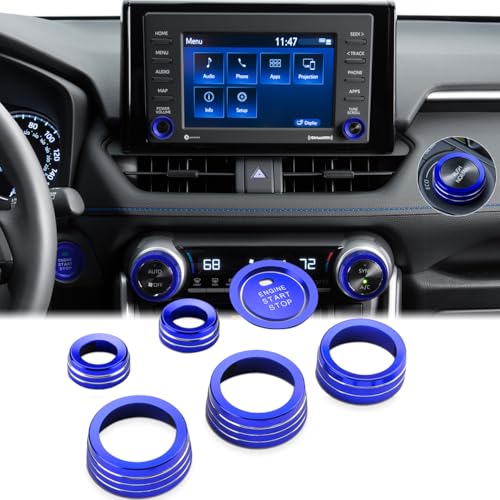
【Vehicle Compatibility】Auovo AC Knob Ring Set Fits for Toyota RAV4/RAV-4 2025 2024 2023 2022 2021 2020 2019 with 7-Inch Display (with Drive Mode) trims including LE/XLE/XLE Premium/Adventure/TRD Off Road/Limited/Hybrid LE/Hybrid XLE/Hybrid SE/Hybrid Woodland Edition/Hybrid XLE Premium/Hybrid XSE/Hybrid Limited/Plug-In Hybrid SE/Plug-In Hybrid XSE/Prime SE/Prime XSE. (Version 2. RAV4 has two kinds of radio knobs, please see the image of this listing to make sure it fit your vehicle before purchasing)

Replacement For - Suitable for Toyota RAV4 2019-2022.
Towing and Heavy Loads: What Drive Modes Can and Can’t Do
Use Normal for most towing and heavy-load driving unless the owner’s manual gives different guidance for your exact RAV4. Sport can make accelerator response feel sharper during a merge, but it does not raise towing capacity or improve trailer brakes.
Before towing, confirm the maximum trailer weight, tongue weight, payload, tire pressures, hitch requirements, and cooling guidance for your model year, grade, and drivetrain. RAV4 tow ratings differ substantially by configuration.
Warning: Never use a drive mode as a substitute for the correct tow rating, trailer setup, tire condition, or braking distance. If the trailer sways, the vehicle feels unstable, or the road is slick, reduce speed and stop when safe.
[Products Worth Considering]

Hitch Cover

Compatibility: Compatible with 2006-2018 Toyota RAV4. Please confirm your vehicle model before purchasing

Universal Design:The 2-inch size with the flag exterior design is not only suitable for most vehicles, easy to install, but also stylish and beautiful.Suitable for trailer hitches, towing hitches, etc., it is recommended that you can measure the pendant receiver size before purchasing.
Troubleshooting RAV4 Drive Modes: Indicators, Resets, and Mileage Quirks
Most drive-mode surprises are normal once you know which settings persist and which have operating limits. On the 2026 RAV4, Sport and Custom return to Normal after shutdown, while Normal and Eco remain selected until another core drive mode is chosen.
Specialized modes can also cancel when their required conditions are no longer present. EV operation depends on factors such as usable battery charge and power demand, and Trail is intended for a specific rough-surface traction task rather than permanent use.
Why Did the Mode Light Change or Disappear?
A mode indicator can disappear because the vehicle was restarted, another drive mode was selected, or the conditions required for that specialized mode changed. First check the multi-information display for the active mode and any warning message.
For a 2026 RAV4, remember the simple core-mode rule: Sport and Custom reset to Normal after shutdown; Normal and Eco persist until another core mode is chosen.
Why Won’t EV Mode Stay On?
On a regular RAV4 Hybrid, EV mode is intentionally limited. Toyota says the 2026 system is designed for short distances at low speed and depends on conditions such as battery charge.
On a Plug-in Hybrid, EV driving can also give way to engine operation when system conditions require it. AUTO EV/HV is specifically designed to start the engine more readily when stronger acceleration or climbing power is requested.
Why Didn’t Eco Mode Improve MPG?
Eco helps mainly by encouraging smoother response and reducing some accessory demand. If you still accelerate hard, brake late, drive quickly on the highway, carry extra weight, or use substantial cabin heating or cooling, the MPG difference may be small.
A smoothly driven RAV4 in Normal can therefore use less fuel than the same vehicle driven aggressively in Eco.
What to Do If a Drive Mode Seems Stuck
- Select Normal and then try the desired mode again.
- Check the multi-information display for a warning or unavailable-mode message.
- Confirm that the mode exists on your exact model year, drivetrain, and grade.
- For EV-related modes, check available traction-battery charge and current driving conditions.
- If warning lights remain on or the vehicle behaves abnormally, have the RAV4 inspected by a Toyota dealer or qualified technician.
Frequently Asked Questions
When should I use Trail mode on my RAV4?
Use Trail on equipped AWD RAV4 models when driving on rough, bumpy, loose, or uneven surfaces where wheel-spin management can help. Return to a normal road mode when you are back on ordinary pavement.
How do I change the drive mode on a 2026 RAV4?
Use the drive-mode controls in the 2026 RAV4’s center-stack area and confirm the selected mode on the vehicle display. Toyota’s new multimedia system also supports a configurable Drive Mode widget on its home screen. Available Trail, Snow, and EV-related controls depend on drivetrain and powertrain.
Is it better to drive in Sport mode or Eco mode?
Choose Eco when you want smoother, efficiency-focused response. Choose Sport when you want quicker accelerator and steering response on a suitable road. Neither is always better; Normal remains the balanced everyday choice.
Can you drive a RAV4 in Sport mode all the time?
Sport is a normal selectable drive mode, but its sharper response can encourage heavier accelerator use and lower fuel economy. It does not improve tire grip or make poor road conditions safe. On the 2026 RAV4, Sport also returns to Normal after the vehicle is powered off.
Does Eco mode really save gas in a RAV4?
Eco can help by smoothing torque response and restraining some climate-control operation. Actual fuel use still depends heavily on acceleration, braking, speed, tire pressure, cargo, temperature, and accessory use.
Should I use EV or HV mode on the highway?
On a RAV4 Plug-in Hybrid, HV is useful on a long highway stretch when you want to preserve plug-in battery charge for later. EV remains useful when consuming stored electricity now better fits your trip. Toyota’s 2026 manual specifically recommends HV for highway or uphill driving when reducing battery consumption is the goal.
Does Sport mode increase towing capacity?
No. Sport can sharpen response, but it does not increase tow rating, payload, braking capacity, tire grip, cooling capacity, or trailer stability. Follow the limits for your exact RAV4 configuration.
What is Custom mode on a RAV4?
Custom on the 2026 RAV4 lets you tailor supported settings such as powertrain response, steering, and air-conditioning behavior. The saved configuration can be selected again after restart, although Custom itself returns to Normal when the vehicle is powered off.
Is Snow mode the same as Trail mode?
No. Snow is for slippery winter-road conditions where equipped. Trail is designed for equipped AWD RAV4s on rough, bumpy, loose, or uneven surfaces where integrated AWD, brake, and drive-force control can manage wheel spin.
Does Eco mode stay on after I restart a 2026 RAV4?
Yes. Toyota’s 2026 documentation says Normal and Eco remain selected until another core drive mode is chosen. Sport and Custom return to Normal when the vehicle is powered off.
Does the 2026 RAV4 Plug-in Hybrid have the older battery charge mode?
The 2026 U.S./Canada Plug-in Hybrid operating-mode documentation reviewed for this update identifies EV, AUTO EV/HV, and HV modes. The engine-driven hybrid battery charge mode was documented on earlier RAV4 Prime/Plug-in Hybrid models, so do not assume the older control exists on the redesigned 2026 model.
Conclusion
There is no single best RAV4 drive mode for every situation. Keep Normal as your everyday baseline. Choose Eco for smoother efficiency-focused response, Sport for sharper response, Trail for rough or uneven surfaces on equipped AWD models, and Snow for slippery winter roads where equipped.
The 2026 RAV4 Hybrid also has a limited low-speed EV mode. On the 2026 RAV4 Plug-in Hybrid, use EV, AUTO EV/HV, and HV according to when you want to consume or preserve the much larger plug-in battery.
The simplest habit is to match the mode to a specific need and then drive for the actual road conditions. Software can change response and traction strategy, but it cannot replace good tires, safe speed, correct towing limits, or driver judgment.
Sources
- Toyota USA Newsroom — The Next Adventure Begins: 2026 RAV4 Arrives this Winter — 2026 Normal, Eco, Sport, Custom and Hybrid EV mode descriptions and drivetrain information.
- Toyota Owners — 2026 RAV4 Hybrid Driving Mode Select Switch — drive-mode behavior and operating guidance.
- Toyota Owners — 2026 RAV4 Hybrid Trail Mode — Trail Mode purpose, AWD/brake/drive-force coordination, and limitations.
- Toyota — 2026 RAV4 Brochure — current Hybrid drive-mode and equipment information.
- Toyota — 2026 RAV4 Plug-in Hybrid Owner’s Manual, U.S. and Canada — EV, AUTO EV/HV and HV operating-mode guidance.
- Toyota — 2026 RAV4 Plug-in Hybrid — current product specifications including EPA-estimated 54-mile all-electric range on SE.
- Toyota USA Newsroom — Latest Evolution of Toyota Multimedia — 2026 RAV4 configurable home screen and Drive Mode widget.
- FuelEconomy.gov — Tips for Hybrids, Plug-in Hybrids, and Electric Vehicles — efficient driving, regenerative braking, charging, and accessory-use guidance.