
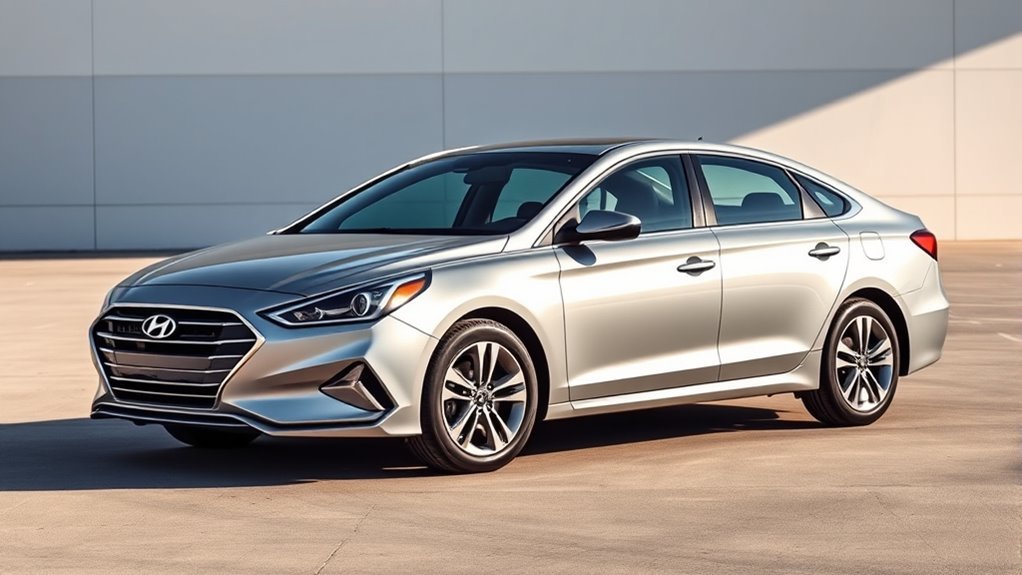
The 2026 Hyundai Sonata measures 193.3 inches long, 73.2 inches wide without mirrors, and 56.9 inches high, with a 111.8-inch wheelbase. That equals approximately 16 feet 1.3 inches long, 6 feet 1.2 inches wide before the mirrors, and 4 feet 8.9 inches high. Use the measurements below to check garage depth, garage-door width, driveway clearance, passenger space, trunk capacity, and trim weight before you buy.
Last updated: July 23, 2026
Quick Answer
The 2026 Hyundai Sonata is 193.3 inches long, 73.2 inches wide without mirrors, and 56.9 inches high. It has a 111.8-inch wheelbase, 5.3 inches of minimum ground clearance, a 35.9-foot curb-to-curb turning diameter, and 15.6 cubic feet of trunk space. Every trim uses the same main exterior dimensions, but curb weight ranges from 3,232 lb for the gas-powered SE to 3,687 lb for the Limited Hybrid.
Key Takeaways
- Every 2026 Sonata trim uses the same main exterior footprint: 193.3 inches long, 73.2 inches wide without mirrors, 56.9 inches high, and a 111.8-inch wheelbase.
- Curb weight ranges from 3,232 lb for the gas-powered SE to 3,687 lb for the Limited Hybrid; the Blue Hybrid weighs 3,439 lb.
- Hyundai does not publish a mirror-to-mirror width in the cited specification sheet, so measure the exact car before relying on a narrow garage-door opening.
- The 15.6 cu ft trunk is useful for everyday luggage and groceries, but Hyundai does not publish trunk-opening width or height in the cited specifications.
- Hyundai lists maximum towing or trailer capacity as “Not Recommended” for every 2026 Sonata trim.
2026 Hyundai Sonata Dimensions at a Glance
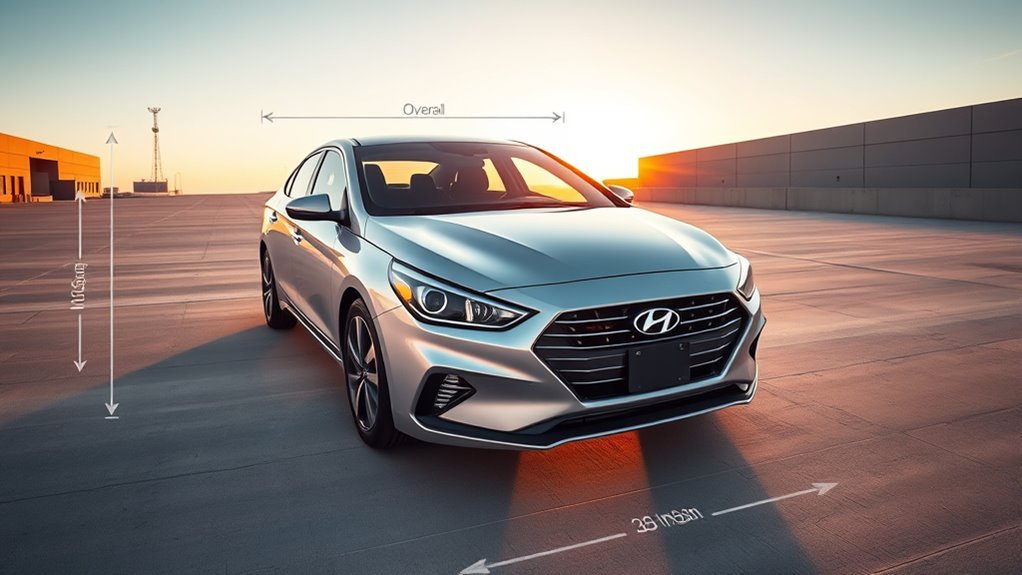
According to Hyundai’s 2026 Sonata specifications and its detailed model-year specification sheet, the gas, hybrid, AWD, and N Line versions share the same main exterior dimensions. Trim choice changes curb weight, wheel size, equipment, and powertrain, but not the listed body length, width, height, or wheelbase.
2026 Sonata Dimensions at a Glance
| Overall length | 193.3 in. (about 4,910 mm or 16 ft 1.3 in.) |
| Width without mirrors | 73.2 in. (about 1,859 mm or 6 ft 1.2 in.) |
| Height | 56.9 in. (about 1,445 mm or 4 ft 8.9 in.) |
| Wheelbase | 111.8 in. (about 2,840 mm) |
| Minimum ground clearance | 5.3 in. (about 135 mm) |
| Turning diameter, curb to curb | 35.9 ft. |
| Trunk space | 15.6 cu ft (about 442 L) |
| Passenger volume | 104.4 cu ft |
| Curb weight range | 3,232–3,687 lb, depending on trim and drivetrain |
The 73.2-inch width does not include the side mirrors. Hyundai’s cited specification sheet does not provide a mirror-to-mirror width, so do not use 73.2 inches as the required garage-door opening. Measure the exact vehicle at the dealer with its mirrors in the position you will use.
Garage-fit formula: Subtract 193.3 inches from your usable garage depth to find the total clearance left in front of and behind the car. For side clearance, subtract the physically measured mirror-to-mirror width from the narrowest garage-door opening, then divide the remainder by two.
How Do the Sonata’s Length and Wheelbase Affect Parking?
With a 111.8-inch wheelbase and 193.3-inch overall length, the Sonata is longer than a compact sedan and needs more garage depth. Its 35.9-foot curb-to-curb turning diameter helps describe low-speed maneuverability, but parking ease also depends on steering angle, visibility, wheelbase, camera equipment, and the shape of the space.
What Does the 111.8-Inch Wheelbase Mean?
A longer wheelbase can help a sedan feel calmer over some pavement changes because the axles are spaced farther apart. It also provides useful room for cabin packaging. Wheelbase alone does not guarantee a particular ride quality, however; suspension tuning, tires, wheel size, seat design, and vehicle weight also affect comfort.
Hyundai lists 46.1 inches of front legroom and 34.8 inches of rear legroom across the 2026 lineup. Those figures are more useful for passenger fit than assuming that a long wheelbase automatically creates equal space in both rows.
How Much Garage Depth Does a Sonata Need?
The body is 193.3 inches long, or approximately 16 feet 1.3 inches. Measure from the closed garage door to the nearest fixed obstacle, then subtract shelves, steps, storage bins, water heaters, bicycles, and garage-door hardware from the usable space.
- Calculate remaining depth: Usable garage depth minus 193.3 inches equals the combined front-and-rear clearance.
- Protect the front bumper: Leave space between the lower front fascia and parking stops or raised curbs.
- Leave a walking path: Decide whether you need room behind the trunk or in front of the hood after the garage door closes.
- Test the approach: Enter steep driveways slowly because the car has 5.3 inches of minimum ground clearance.
How Wide and Tall Is the 2026 Sonata?
The Sonata’s body is 73.2 inches wide without mirrors and 56.9 inches high. In a garage, measure the narrowest point of the door opening rather than relying on the interior wall-to-wall width. Tracks, trim, shelving, posts, tools, and the side mirrors may reduce the usable path.
How Should You Check Garage-Door Clearance?
Compare the stock 56.9-inch vehicle height with the actual clear opening under the raised garage door, opener arm, weather seal, or hanging storage. Do not rely only on the nominal door size.
Roof-mounted equipment changes the total height. Measure from the ground to the highest point after installing crossbars, a cargo box, ski equipment, or a bike carrier.
Note: Published vehicle height normally describes the vehicle in its factory configuration. Recheck total height whenever roof equipment, different tires, or suspension changes are added.
How Can You Judge the Sonata’s Width While Parking?
Keep in mind that the body width is not the vehicle’s widest operating measurement. The mirrors extend beyond the published 73.2-inch body width, and an open door requires substantially more space.
When parking, use small steering corrections and straighten the car before completing the maneuver. A physical test in your usual space is more reliable than estimating mirror clearance from the body-width specification.
Is 5.3 Inches of Ground Clearance Enough?
The Sonata’s 5.3 inches of minimum ground clearance is suitable for ordinary paved-road use, but it requires care around steep driveway transitions, deep potholes, tall parking blocks, accumulated snow, and uneven gravel entrances.
Warning: Do not treat the Sonata like a crossover or SUV. Slow down before steep ramps, broken pavement, and high curbs to reduce the risk of scraping the front fascia or underbody panels.
If your driveway has a sharp change in slope, test it at low speed during a dealer-approved test drive. You can also review this guide to measure ground clearance and driveway fit before buying.
Do 2026 Sonata Dimensions Change by Trim?
No. The main 2026 exterior dimensions stay the same across the SE, SEL Sport, N Line, Blue Hybrid, SEL Hybrid, and Limited Hybrid. The meaningful trim differences include curb weight, drivetrain, wheel and tire package, fuel capacity, equipment, and powertrain.
[Products Worth Considering]
This trailer breakaway kit is designed for trailers with an existing electric brake system, helping activate the brakes if the trailer separates from the tow vehicle. It includes a battery, breakaway switch, and charger with an LED display for easy status checks, making it a practical safety upgrade for caravans and trailers. The side-mount design supports quick installation, while weather and corrosion resistance help it stand up to outdoor use.

Custom Fitment: Designed specifically for 2021-2026 Hyundai Sonata, including N Line and Hybrid models. Strictly matches OEM wheel well space and 5x114.3mm bolt pattern for direct installation

Vehicle Fitment - These wheel lug nuts are compatible with Hyundai Kia Tucson Accent Elantra Sonata Genesis Tiburon Optima Rio Forte Rondo Soul EV and others, please see below for all fitments exact information.
Are Any 2026 Sonata Trims Shorter?
No listed trim changes the 193.3-inch length, 73.2-inch body width, 56.9-inch height, or 111.8-inch wheelbase. Choose the trim for its drivetrain, equipment, wheel size, efficiency, and driving character—not because one factory trim has a smaller body.
Installed accessories can still change practical fit. Roof equipment changes total height, while a front license-plate bracket, exterior accessory, or nonfactory modification may change clearance around a tight parking stop.
How Much Does Each 2026 Sonata Trim Weigh?
The gas-powered SE is the lightest 2026 Sonata at 3,232 lb. The Blue and SEL hybrids each weigh 3,439 lb, while the Limited Hybrid is the heaviest at 3,687 lb. Curb weight is useful for comparing configurations, but it does not predict ride or handling by itself. Suspension tuning, tires, wheel size, and weight distribution also matter.
Trim Weight, Wheel Size, and EPA MPG Snapshot
| Trim / drivetrain | Curb weight | Factory wheel size | EPA city / highway / combined |
| SE FWD | 3,232 lb | 16 in. | 28 / 38 / 32 mpg |
| SEL Sport FWD | 3,305 lb | 18 in. | 25 / 36 / 29 mpg |
| SEL Sport AWD | 3,466 lb | 18 in. | 24 / 33 / 27 mpg |
| N Line FWD | 3,534 lb | 19 in. | 23 / 32 / 27 mpg |
| Blue Hybrid | 3,439 lb | 16 in. | 47 / 56 / 51 mpg |
| SEL Hybrid | 3,439 lb | 17 in. | 44 / 51 / 47 mpg |
| Limited Hybrid | 3,687 lb | 17 in. | 44 / 51 / 47 mpg |
How Do Fuel-Tank Size and Range Differ?
Hyundai lists a 15.9-gallon fuel tank for the gas-powered SE, SEL Sport, and N Line. Hybrid trims use a 13.2-gallon tank.
FuelEconomy.gov lists the Blue Hybrid at 51 mpg combined and an estimated total range of 673 miles. The other Sonata Hybrid configurations are listed at 47 mpg combined and approximately 620 miles of total range. Actual mileage and range vary with speed, temperature, traffic, terrain, load, tire pressure, and driving style.
How Do the Exterior Dimensions Affect Interior and Cargo Space?
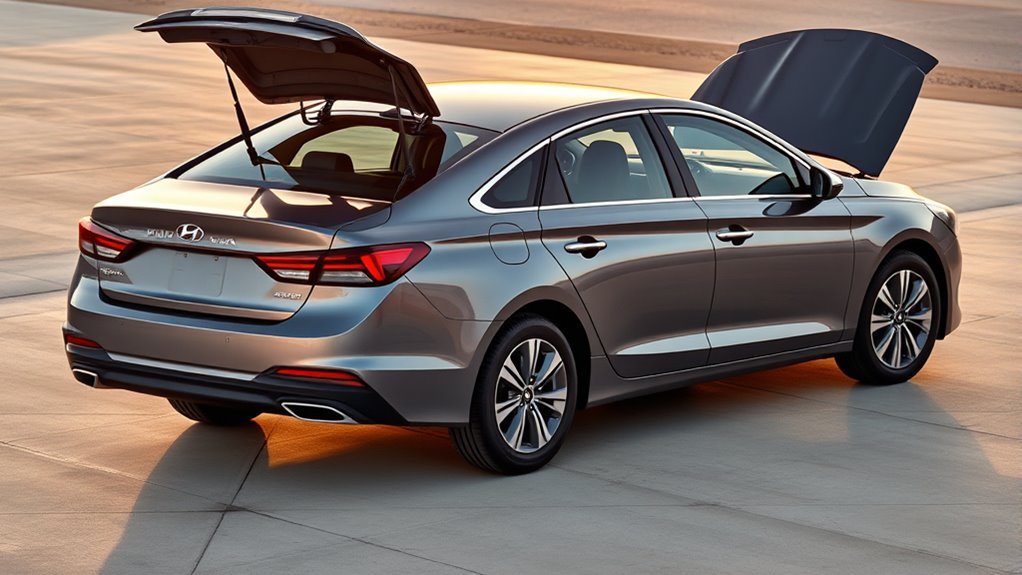
The 2026 Sonata has 104.4 cubic feet of passenger volume. Hyundai lists 46.1 inches of front legroom, 34.8 inches of rear legroom, 57.9 inches of front shoulder room, and 56.1 inches of rear shoulder room.
Headroom changes when a sunroof is installed. Hyundai lists 40.0 inches of front headroom and 37.8 inches of rear headroom without a sunroof. With a sunroof, the figures are 38.4 inches in front and 37.4 inches in back. Taller drivers should sit in the exact trim they plan to buy rather than assuming every roof configuration feels the same.
The 15.6 cu ft trunk is useful for groceries, luggage, sports bags, and other everyday cargo. However, the cited Hyundai specification sheet publishes cargo volume rather than trunk-opening width or height. Measure the opening, floor depth, hinge intrusion, and rear-seat pass-through on the actual car before buying it for a stroller, wheelchair, golf bag, large tool case, or rigid box.
Cargo volume tells you how much measured space the trunk contains. The opening width, opening height, hinge shape, and floor depth determine whether a particular rigid item can actually be loaded.
Will a 2026 Sonata Fit in Your Garage, Parking Spot, or Driveway?
The Sonata may fit your space, but the answer depends on usable measurements rather than a generic definition of a “standard” garage. Start with the 193.3-inch body length and 73.2-inch body width, then account for mirrors, door swing, storage, walking room, and the driveway approach.
- Measure usable depth: Measure from the closed garage door to the nearest fixed obstacle. Subtract shelves, steps, tools, and storage.
- Calculate front-and-rear clearance: Subtract 193.3 inches from the usable depth. Decide how much of the remainder must stay in front of and behind the car.
- Measure the narrowest door opening: Check between trim, weather seals, tracks, or posts—not only the nominal door size.
- Measure mirror-to-mirror width: Hyundai’s cited specifications do not provide this figure. Check the exact vehicle with the mirrors extended and folded.
- Allow room to exit: Body fit does not guarantee that a driver or passenger door can open far enough.
- Check overhead obstacles: Compare the 56.9-inch stock height with the real clearance under the raised door and opener hardware.
- Test the driveway approach: Enter slowly because the Sonata has 5.3 inches of minimum ground clearance.
Pro Tip: During a dealer-approved test drive, park the exact trim in your garage or assigned space. This reveals mirror, bumper, door-swing, and driveway-angle issues that a specification table cannot show.
[Products Worth Considering]
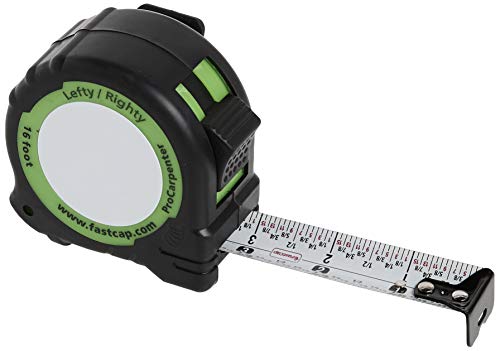
Dual Reading Capability: The Standard/Standard Reverse features standard measurements that are readable when the tape is extended from either the right or left hand

Easy, Accurate Parking: Provides a stopping point in your garage for easy parking; Ideal for parking cars, trucks, trailers, RVs, boats and other vehicles accurately and consistently

13 ft. Of reach*: allows for easy measurements when working alone (*based on maximum extension of average professional user)
Can the 2026 Sonata Tow or Carry Roof Accessories?
Hyundai’s official 2026 specification sheet lists maximum towing or trailer capacity as “Not Recommended” for every Sonata trim. Do not use the Sonata to tow a trailer, even if an aftermarket receiver or hitch component is available.
Warning: An aftermarket hitch or physical attachment point does not create an approved towing rating. Follow Hyundai’s model-year-specific guidance and do not exceed any vehicle, rack, carrier, tire, axle, or accessory rating.
For bikes, skis, or a cargo box, confirm that the rack system is approved for the exact roof and trim. Check the Hyundai owner’s manual, rack instructions, carrier rating, and installation requirements. A roof accessory changes total height, wind noise, aerodynamic drag, and garage clearance.
Keep heavy cargo low and secured in the trunk when possible. Do not exceed the vehicle’s load limits, block rear visibility, or allow loose cargo to move during braking or cornering.
What Should You Measure Before Buying?
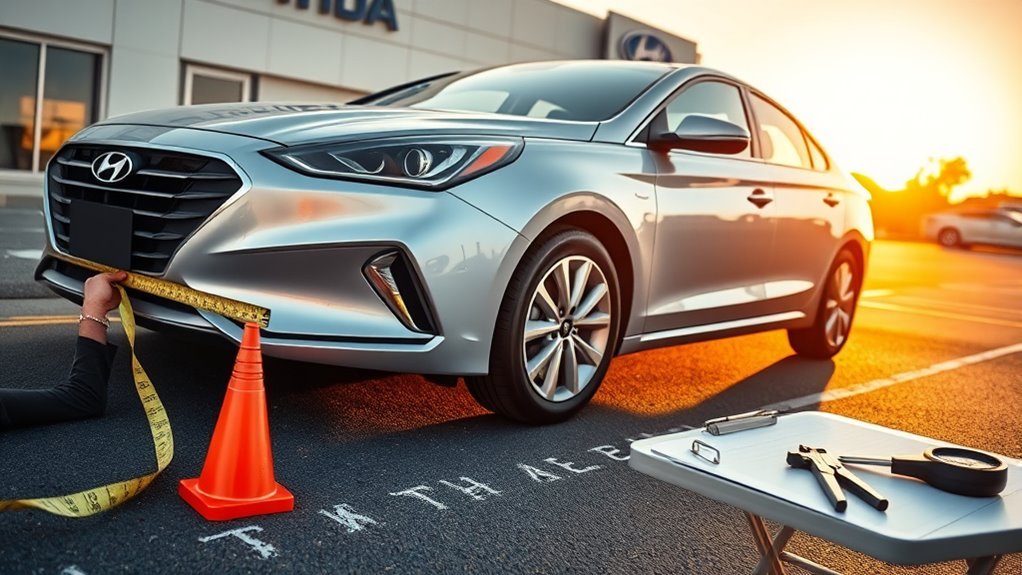
Bring a tape measure, your garage dimensions, and the measurements of any cargo you carry often. Use Hyundai’s published specifications as a starting point, then verify the dimensions the manufacturer does not publish.
- Garage depth: Record usable depth after subtracting shelves, steps, storage, and door hardware.
- Garage-door width: Measure the narrowest clear opening.
- Mirror width: Measure the exact Sonata with mirrors extended and folded.
- Door swing: Check whether occupants can enter and exit after the car is parked.
- Driveway slope: Photograph or measure steep transitions, curb lips, and drainage channels.
- Trunk opening: Measure clear opening width, opening height, floor depth, and hinge intrusion.
- Passenger fit: Sit in the exact sunroof or nonsunroof trim because published headroom differs.
- Roof equipment: Add the installed rack or carrier height to the 56.9-inch stock vehicle height.
- Regular cargo: Bring the dimensions of strollers, luggage, golf bags, mobility equipment, or work cases.
Which 2026 Sonata Trim Best Fits Your Needs?
Every trim has the same listed body dimensions, so garage fit does not improve by choosing a different factory trim. Choose based on drivetrain, wheel size, curb weight, efficiency, equipment, and passenger fit.
- Lightest configuration: SE FWD at 3,232 lb, with 16-inch wheels.
- Best EPA range: Blue Hybrid, rated at 51 mpg combined and approximately 673 miles of total range.
- Available AWD choice: SEL Sport AWD at 3,466 lb, with 18-inch wheels.
- Performance configuration: N Line at 3,534 lb, with 19-inch wheels and the turbo powertrain.
- Highest curb weight: Limited Hybrid at 3,687 lb, with 17-inch wheels and the most extensive hybrid equipment package.
- More front headroom: A configuration without a sunroof, based on Hyundai’s published 40.0-inch nonsunroof figure versus 38.4 inches with a sunroof.
Confirm availability and equipment on the specific vehicle because dealer inventory, factory options, accessories, and regional configurations can differ.
[Products Worth Considering]
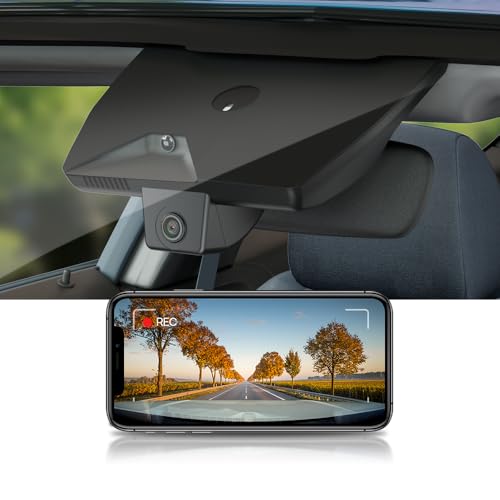
*How to Select the correct model? Firstly, confirm your vehicle style and year of manufactured. e.g 2025 Hyundai Sonata Limited. Secondly, make sure your original part number ends with L1600. Please feel free to reach FITCAMX to confirm the model
![Dash Cam Hardwire Kit,[Upgraded Version] USB C Hardwire Kit for Dash Camera with 12V-24V to 5V Power Supply,Fuse Tap,Blade Fuses & Pry Tool,Protecting Car Dash Cam Front and Rear](https://m.media-amazon.com/images/I/41Lw3-pYLFL._SL500_.jpg)
24-Hour Full Day Monitoring:A dash cam that can stably record must have a set of step-down wires silently accompanying it! And our product is such a presence! It can provide 24-hour uninterrupted power supply for your dash cam. Even if the car stalls, it can still operate stably. Providing strong guarantees for maintaining the safety of your car and property
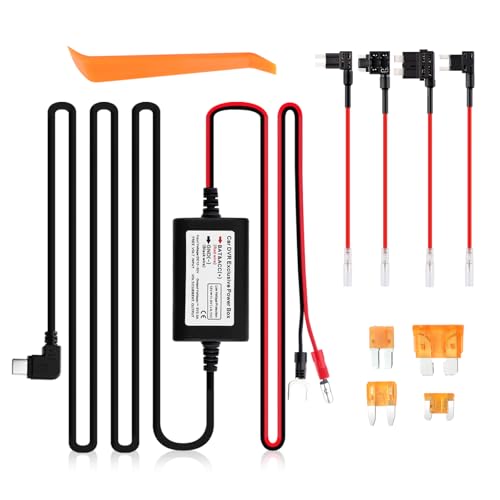
List of Package: This is a complete dash cam hardwire kit USB C with full accessories, including 1pc power cord with 9.68 feet length, 4pcs fuse tap with 16AWG specification, 4pcs 5A blade fuse and 1pc warp plate, you can use these kits to complete the wiring installation easily
Frequently Asked Questions
How long is a 2026 Hyundai Sonata in feet?
The 2026 Sonata is 193.3 inches long, which equals approximately 16 feet 1.3 inches. Use the full 193.3-inch figure when calculating garage clearance because rounding down to 16 feet removes more than an inch from the car’s published length.
Is a 2026 Sonata bigger than a 2026 Camry?
The Sonata is slightly shorter but wider. The Sonata measures 193.3 inches long and 73.2 inches wide without mirrors, while the 2026 Camry is listed at approximately 193.5 inches long and 72.4 inches wide. The Sonata also has a 111.8-inch wheelbase compared with the Camry’s 111.2-inch wheelbase. See the site’s 2026 Camry dimensions guide for a fuller comparison.
Will a Hyundai Sonata fit in a standard garage?
It may, but “standard garage” dimensions vary. Measure the usable depth and subtract the Sonata’s 193.3-inch length. Also check the narrowest door opening, physical mirror-to-mirror width, door-swing room, overhead hardware, storage obstacles, and driveway slope.
How wide is the Sonata with its mirrors?
Hyundai lists the body width as 73.2 inches without mirrors, but the cited 2026 specification sheet does not provide a mirror-to-mirror width. Measure the exact vehicle at the dealer with its mirrors extended and folded before checking a narrow garage opening.
Do Sonata trims have different exterior dimensions?
No. Hyundai lists the same 193.3-inch length, 73.2-inch width without mirrors, 56.9-inch height, and 111.8-inch wheelbase across the 2026 lineup. Trims differ in curb weight, drivetrain, wheel size, powertrain, and equipment.
How much trunk space does the Sonata have?
The 2026 Sonata has 15.6 cubic feet of trunk volume, or approximately 442 liters. Hyundai’s cited specification sheet does not list the trunk-opening width or height, so measure the actual opening before buying the car for a large rigid item.
Does the Sonata’s sunroof reduce headroom?
Yes. Hyundai lists front and rear headroom at 40.0 and 37.8 inches without a sunroof. With a sunroof, the figures decrease to 38.4 and 37.4 inches. Taller occupants should test the exact roof configuration before buying.
Is 5.3 inches of ground clearance enough?
It is suitable for normal paved roads and many ordinary driveways. It provides less margin than a crossover or SUV, so approach steep ramps, deep potholes, tall parking blocks, and accumulated snow slowly.
Can a 2026 Hyundai Sonata tow a trailer?
Hyundai’s official 2026 specification sheet lists maximum towing or trailer capacity as “Not Recommended” for every Sonata trim. Do not use the car to tow a trailer merely because an aftermarket hitch can be physically installed.
Conclusion
The 2026 Hyundai Sonata is 193.3 inches long, 73.2 inches wide without mirrors, and 56.9 inches high. It has a 111.8-inch wheelbase, 5.3 inches of minimum ground clearance, a 35.9-foot curb-to-curb turning diameter, and 15.6 cubic feet of trunk space.
Before buying, complete three checks: calculate your usable garage depth against the 193.3-inch length, physically measure the car’s mirror-to-mirror width and trunk opening, and sit in the exact sunroof or nonsunroof trim. Once the space check is complete, compare drivetrain, wheel size, curb weight, efficiency, and equipment rather than looking for a shorter trim—the listed exterior footprint is the same across the lineup.
Sources
- Hyundai USA — 2026 Sonata specifications — supports the official trim lineup, exterior dimensions, interior measurements, cargo capacity, and equipment comparisons.
- Hyundai News — 2026 Sonata features and specifications — supports exact dimensions, curb weights, wheel sizes, fuel-tank capacities, EPA estimates, and the “Not Recommended” towing guidance.
- FuelEconomy.gov — 2026 Hyundai Sonata fuel economy — supports EPA MPG and estimated total-range figures.
- Toyota — 2026 Camry vs. Hyundai Sonata comparison — supports current Camry and Sonata comparison context.
- Hyundai Owners — Manuals & warranties — supports checking model-year-specific loading, accessory, maintenance, and owner guidance.


[…] Depending on the model year and manufacturer-submitted data, a decoder may return the make, model, body class, engine, fuel type, restraint system, trim or series, and assembly […]
[…] connect Apple CarPlay in a Hyundai Sonata, park the car, start the infotainment system, and make sure Siri is enabled. For wired CarPlay, […]