
Using a Toyota Tacoma payload calculator is the safest way to know how much weight your truck can actually carry before you load passengers, camping gear, tools, a bed rack, or trailer tongue weight. The key is simple: start with the payload number on your driver-side door jamb label, then subtract every person, accessory, cargo item, and hitch load you add to the truck.
Quick Answer
To use a Toyota Tacoma payload calculator, find the “combined weight of occupants and cargo should never exceed” number on the driver-side door jamb label. Subtract passengers, cargo, accessories, and trailer tongue weight. The number left is your remaining safe payload.
Key Takeaways
- Your Tacoma’s door-jamb payload label is the best starting point because it reflects the truck as built from the factory.
- Payload includes passengers, cargo, bed gear, aftermarket accessories, and trailer tongue weight.
- Toyota’s published maximum payload is useful for comparison, but your exact trim, cab, drivetrain, options, and accessories can change the real number.
- When towing a conventional trailer, Toyota’s Tacoma manual recommends tongue weight at 9% to 11% of gross trailer weight.
At a Glance
| Time Required | 5–10 minutes |
| Difficulty | Easy |
| Tools Needed | Door-jamb payload label, calculator, passenger/cargo weights, optional public scale ticket |
| Cost | Free, unless you use a public scale |
Understanding Payload and Why It Matters
Payload is the total weight your Tacoma can safely carry in or on the truck. That includes the driver, passengers, pets, luggage, tools, camping gear, recovery boards, a bed rack, a rooftop tent, a tonneau cover, aftermarket bumpers, and the downward force from a trailer on the hitch.
Toyota lists the 2025 Tacoma with a maximum payload of up to 1,705 pounds when properly configured, but that does not mean every Tacoma can carry 1,705 pounds. A base gas model, a hybrid TRD Pro, a Trailhunter, and a truck with dealer-installed accessories can all have different real-world payload numbers.
Warning: Do not use a published “maximum payload” number as your personal limit. Always use the payload label on your specific Tacoma, then subtract the weight you add after purchase.
Finding Your Tacoma’s Payload, Curb Weight, and GVWR
Before using a payload calculator, find the two labels on the driver-side door jamb:
- Tire and loading information label: Look for the line that says, “The combined weight of occupants and cargo should never exceed…” This is the easiest payload number to use.
- Certification label: This lists GVWR and GAWR. GVWR is the maximum allowed loaded vehicle weight. GAWR is the maximum allowed weight on each axle.
GVWR minus curb weight is the standard payload formula, but the door-jamb payload label is usually better for everyday use because it is specific to the vehicle as built. Federal vehicle labeling rules require the occupant-and-cargo load value to be shown so the loaded vehicle does not exceed its GVWR.
Note: Curb weight means the truck’s weight with standard equipment and fluids. It does not include your passengers, cargo, or most accessories added after the truck leaves the factory.
Entering Data Into the Calculator Step by Step
A Tacoma payload calculator is only as accurate as the numbers you enter. Use this order:
- Enter your door-jamb payload number. This is the combined occupant-and-cargo limit for your truck.
- Subtract the driver and passengers. Use actual weights, not guesses, when possible.
- Subtract cargo in the cab and bed. Include coolers, tools, camping bins, spare fuel, water, firewood, recovery gear, and luggage.
- Subtract accessories added after purchase. Bed racks, steel bumpers, sliders, skid plates, tonneau covers, winches, larger tires, and rooftop tents all reduce available payload.
- Subtract trailer tongue weight if towing. Tongue weight counts against payload because it pushes down on the truck.
- Check axle balance. Heavy bed cargo can overload the rear axle even when total payload looks acceptable.
[Products Worth Considering]

The VXDAS 2-in-1 TPMS relearn tool is designed to activate and reset tire pressure sensors on compatible GM and Ford vehicles with an easy model switch button for quick use. It helps complete TPMS relearning after tire rotation, sensor replacement, or warning light resets, making it a practical tool for drivers and technicians who want a fast, cost-effective solution.

The MaxxHaul Solid Rubber Wheel Chock 2-Pack provides dependable vehicle stabilization for cars, trucks, trailers, and RVs in garages, driveways, job sites, and campgrounds. Its solid rubber construction, non-slip traction surface, and built-in handle make placement easy while delivering long-lasting grip and all-weather durability for safer parking and storage.

These off-road traction boards are designed to help vehicles recover from mud, sand, and snow with reliable grip and easier ramp-up. Their double-sided diamond construction, cross-shaped teeth, and contoured ramps improve traction while the durable polypropylene build stays flexible in harsh conditions. Convenient mounting points, ergonomic handles, and a visible leash make them practical to carry, store, and retrieve when recovery is needed.
Calculating Your Usable Payload Capacity
The basic formula is:
Remaining payload = door-jamb payload rating − passengers − cargo − accessories − trailer tongue weight.
Here is a simple example:
| Item | Weight |
|---|---|
| Door-jamb payload rating | 1,400 lbs |
| Driver and passenger | -360 lbs |
| Bed rack and tonneau cover | -120 lbs |
| Camping gear and cooler | -300 lbs |
| Trailer tongue weight | -450 lbs |
| Remaining payload | 170 lbs |
In this example, the truck is still within the payload number, but only by 170 pounds. That small margin can disappear quickly if you add water jugs, a generator, firewood, or another passenger.
[Products Worth Considering]
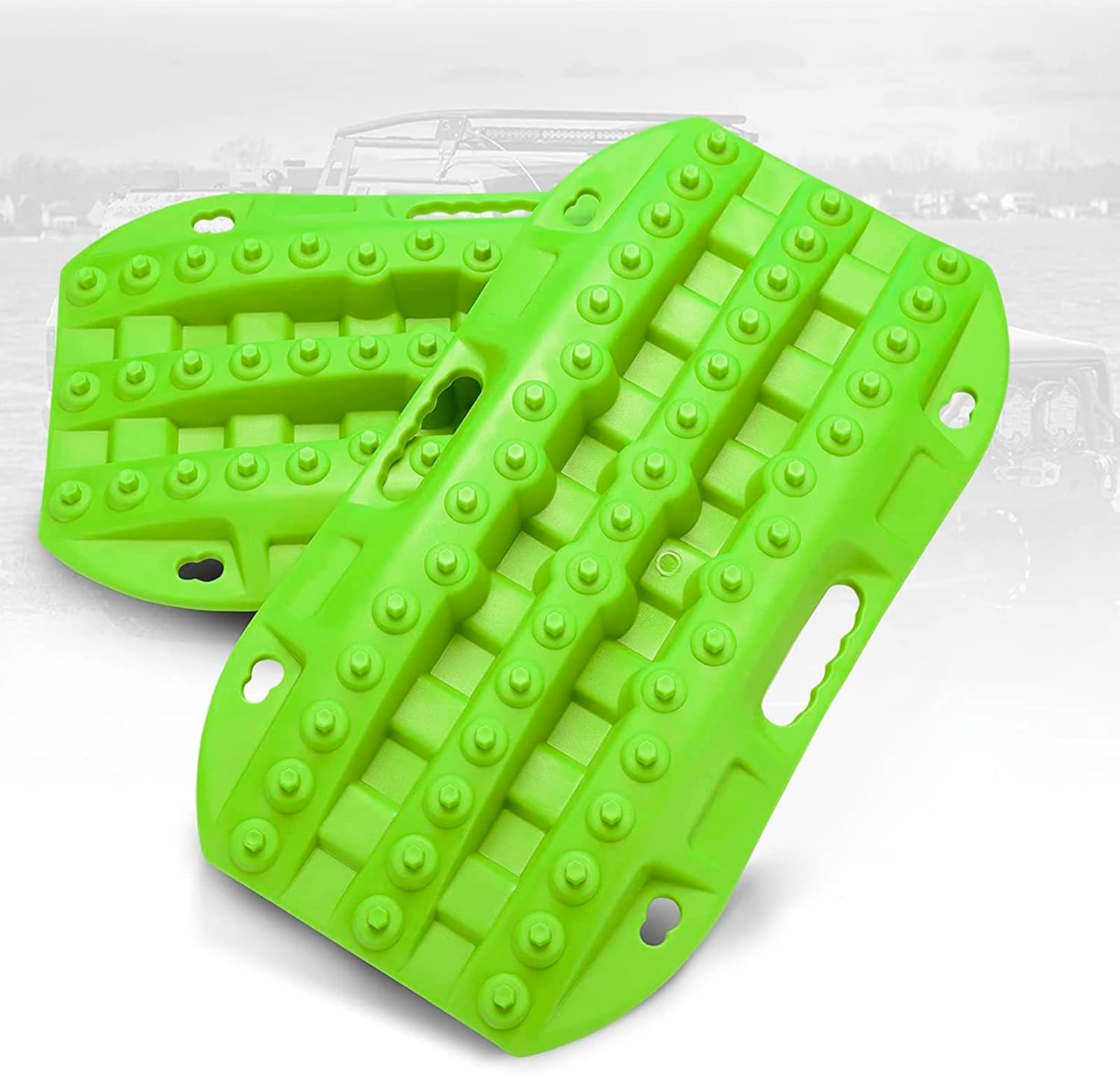
These short recovery traction boards are designed to help ATVs, UTVs, and other off-road vehicles regain grip in mud, sand, and snow. Built with strengthened teeth and a durable polypropylene construction, they provide reliable traction, easy handling, and year-round performance in tough conditions. Their nested, space-saving design and integrated shovels make them practical for carrying and using on remote adventures.

Protect and refresh your Toyota RAV4 entry points with these carbon fiber leather door sill guards designed to cover existing scuffs and help prevent new scratches. The adhesive-backed trim offers a secure fit, easy installation, and durable everyday protection while adding a sporty, OEM-style look to your vehicle interior. Suitable for front and rear doors, this set is made to match the contours of the specified RAV4 model years.

PROTECTIVE HINGED COVER: Features a hinged, hard cover that protects the keys and display when stored, making this handheld calculator durable and easy to carry safely.
Accounting for Passengers and Cargo Weight
Passengers are part of payload. So is anything carried in the cab, on the roof, in the bed, or on the hitch. A common mistake is to treat the payload number as “bed capacity,” but it is really a combined limit for occupants and cargo.
Understanding Weight Contributions
Small items add up fast. A family of four, a full cooler, recovery gear, camping bins, a bed rack, and a rooftop tent can consume most of a Tacoma’s available payload before you put anything heavy in the bed.
- People: Count the driver and every passenger.
- Cab cargo: Backpacks, tools, pets, and under-seat storage items count.
- Bed cargo: Gear, boxes, appliances, firewood, and building supplies count.
- Accessories: Aftermarket parts reduce payload if they were not included in the door-jamb label weight.
- Trailer tongue weight: Hitch load counts against truck payload.
Calculating Total Payload Limit
For everyday loading, use the payload label first. For the most accurate real-world calculation, weigh the truck on a public scale with a full tank of fuel and your normal accessories installed. Then use this formula:
Real-world remaining payload = GVWR − actual scale weight of the truck.
This method is useful if you have added heavy modifications such as steel bumpers, rock sliders, skid plates, a winch, larger tires, a cap, a drawer system, or an overlanding setup.
Pro Tip: If your Tacoma is modified, get a scale ticket with the truck loaded the way you usually drive it. Compare total weight to GVWR and front/rear axle weights to GAWR.
Next Steps for Loading Your Tacoma Safely
Once you know your remaining payload, load the Tacoma so weight is controlled and balanced:
- Keep heavy items low. This lowers the center of gravity and helps stability.
- Center weight between the bed sides. Avoid loading all heavy gear on one side.
- Place heavy cargo forward when practical. Keeping weight closer to the cab can reduce rear overhang leverage.
- Secure everything. Use tie-downs, ratchet straps, cargo nets, or boxes so the load cannot shift.
- Check tire pressure cold. Use the pressure listed on the vehicle placard unless your tire manufacturer or vehicle documentation requires a different setup for your equipment.
[Products Worth Considering]

Easy To USE: By threading a screw or bolt through the 13/32" diameter bolting hole( (that's between 3/8" and 7/16") on the mounting clip and securing to any wood or metal surface such as minivans and SUVs, interior cargo vans, enclosed box trucks, pickup beds and tailgates, Perfect attach to T slot nut Cleats for Toyota Tacoma Bed Rail System, NOTE: if mount on Tacoma Bed, you will first need to slightly enlarge the mounting holes to 1/2” to fit the bed bolts.

Custom Fit: Designed for Toyota Tacoma 2005–2026 and Toyota Tundra 2008–2026 equipped with the factory bed rail system. Please verify your vehicle is equipped with the factory cargo rail system before purchasing.

Perfect Fit for Toyota Tacoma & Tundra - Tacoma tie down anchors specifically designed for 2005‑2025 Tacoma , 2022‑2025 Tundra / Tundra HV with factory‑installed Utili‑Track system
How to Account for Tongue Weight When Towing
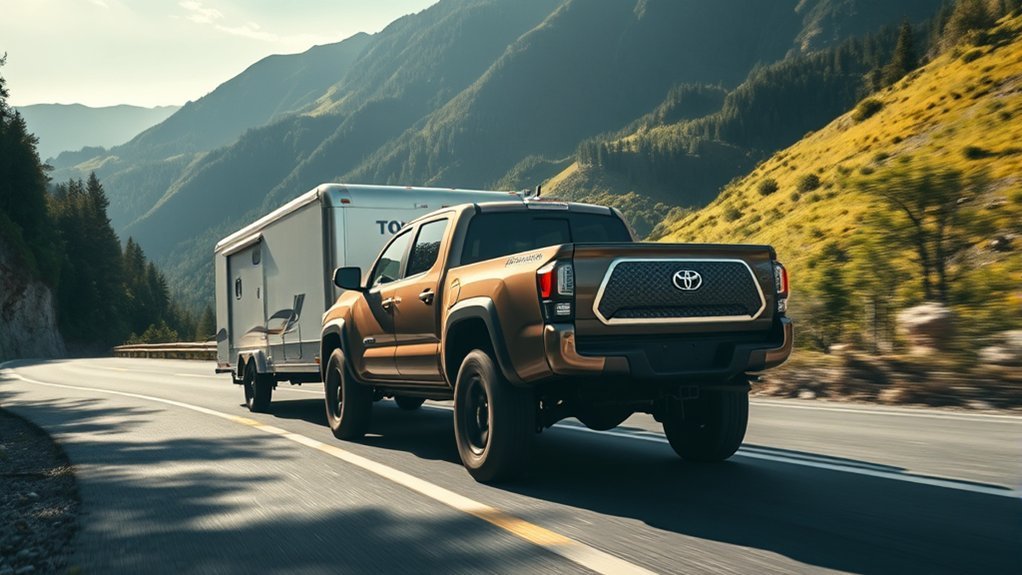
Tongue weight is the downward force the trailer places on the hitch. It counts as payload because the truck is carrying that weight. Toyota’s 2026 Tacoma towing guidance says conventional trailer tongue weight should be 9% to 11% of gross trailer weight.
| Loaded Trailer Weight | 9% Tongue Weight | 11% Tongue Weight |
|---|---|---|
| 3,000 lbs | 270 lbs | 330 lbs |
| 4,000 lbs | 360 lbs | 440 lbs |
| 5,000 lbs | 450 lbs | 550 lbs |
| 6,000 lbs | 540 lbs | 660 lbs |
For example, if your Tacoma has 1,300 pounds of payload and your loaded trailer adds 450 pounds of tongue weight, you have 850 pounds left for people, cargo, and accessories. You still need to stay within GVWR, rear GAWR, hitch rating, tire rating, and Toyota’s towing limits.
Warning: Do not reduce tongue weight below Toyota’s recommended range just to “save payload.” Too little tongue weight can make a trailer unstable. Instead, reduce cargo, use a lighter trailer, or choose a vehicle with higher ratings.
Essential Tips for Safe Loading and Effective Weight Distribution
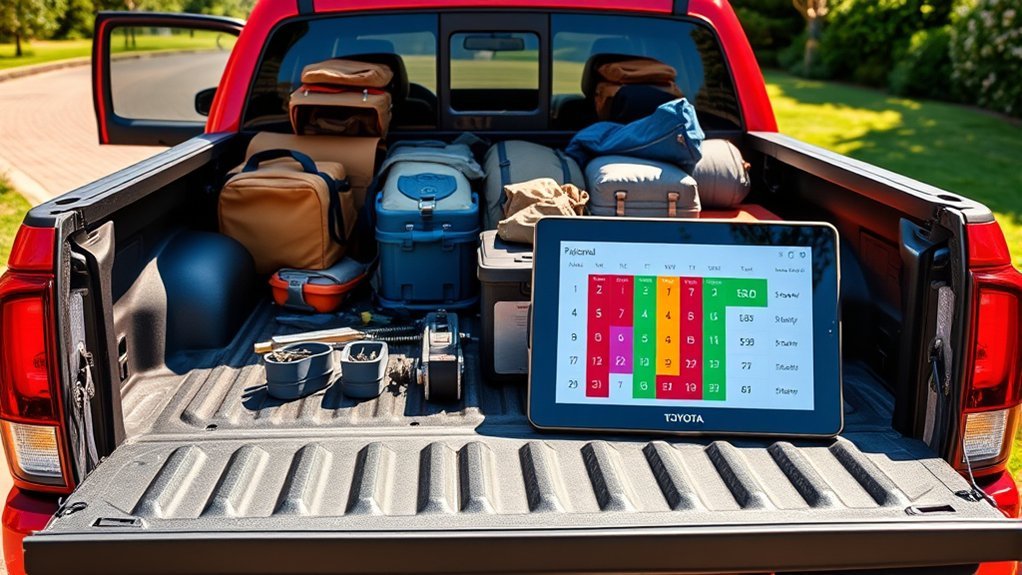
Safe loading is not just about staying under one number. You also need to keep the truck balanced, the cargo secured, and the axle weights within their limits.
1. Calculate Your Payload Capacity
Start with the payload number on the door-jamb label, then subtract everything you add. If you are towing, include the trailer tongue weight. If you are heavily modified, use a public scale to confirm your actual loaded truck weight.
2. Distribute Weight Evenly
Place heavier items low and near the center of the bed when practical. Avoid stacking weight high above the bed rails or placing all heavy gear behind the rear axle. A high or rear-heavy load can make the truck feel loose, increase sway, and reduce control during braking or emergency maneuvers.
3. Secure Your Load Properly
Use the Tacoma’s tie-down points, quality straps, and cargo nets to keep items from shifting. Recheck straps after a few miles because cargo can settle. Loose cargo can damage the truck, fall out of the bed, or suddenly shift weight during a turn or stop.
Watch Out for These Common Payload Calculation Mistakes
- Using the highest advertised payload for every Tacoma: Your truck’s trim, options, cab, drivetrain, and accessories matter.
- Forgetting passenger weight: The driver and passengers reduce available cargo capacity.
- Ignoring aftermarket accessories: Heavy bumpers, sliders, racks, tents, winches, and drawer systems can remove hundreds of pounds from usable payload.
- Confusing payload with towing capacity: Towing capacity is what the truck can pull. Payload is what the truck carries.
- Leaving out tongue weight: Trailer tongue weight is carried by the truck and must be subtracted from payload.
- Only checking GVWR: You also need to stay under front and rear GAWR, tire ratings, hitch ratings, and gross combined weight limits when towing.
- Guessing cargo weight: Weigh heavy items or use scale tickets when the load is close to the limit.
Quick Tacoma Payload Worksheet
| Calculator Line | What to Enter |
|---|---|
| Starting payload | Door-jamb occupant-and-cargo limit |
| People | Driver, passengers, and pets |
| Cab cargo | Bags, tools, electronics, under-seat items |
| Bed cargo | Gear, materials, coolers, water, fuel, equipment |
| Accessories | Racks, covers, caps, bumpers, winches, tents, drawer systems |
| Tongue weight | 9% to 11% of loaded conventional trailer weight, unless your Toyota manual says otherwise |
| Remaining payload | Starting payload minus every line above |
Frequently Asked Questions
How do I calculate my Tacoma payload?
Find the payload number on the driver-side door jamb label. Subtract the weight of the driver, passengers, cargo, accessories, and trailer tongue weight. The result is your remaining usable payload.
Is Tacoma payload the same as bed capacity?
No. Payload is the combined weight of occupants and cargo. It includes the driver, passengers, cargo in the cab, cargo in the bed, accessories, and trailer tongue weight.
Can I calculate payload with GVWR minus curb weight?
Yes. GVWR minus curb weight gives a payload estimate. For daily use, the door-jamb payload label is usually better because it reflects your truck’s factory configuration. For modified trucks, weigh the truck and subtract its actual scale weight from GVWR.
Does trailer tongue weight count against Tacoma payload?
Yes. Tongue weight pushes down on the hitch, so the truck carries it. Subtract trailer tongue weight from available payload along with passengers, cargo, and accessories.
What does a 1,400 lb payload mean?
A 1,400 lb payload means the combined weight of occupants and cargo should not exceed 1,400 pounds. That total includes people, gear, accessories added after purchase, and trailer tongue weight.
What is the safest way to confirm my loaded Tacoma is within limits?
Use a public scale. Weigh the truck loaded as you drive it, then compare the total weight to GVWR and the front/rear axle weights to GAWR. This is especially helpful for overlanding builds and towing setups.
Conclusion
A Toyota Tacoma payload calculator helps you turn a door-jamb number into a real-world loading plan. Start with your truck’s specific payload label, subtract passengers, cargo, accessories, and tongue weight, then confirm heavy or modified setups with a scale. When you stay within payload, GVWR, GAWR, tire, hitch, and towing limits, your Tacoma is safer, more stable, and better prepared for work, travel, or weekend adventure.
Sources
- Toyota USA Newsroom — 2025 Tacoma — maximum published Tacoma payload and towing figures.
- Toyota.com — 2026 Tacoma — current Tacoma model information, trims, powertrains, and towing technology.
- Toyota Owners — 2026 Tacoma Trailer Towing — tongue weight guidance for conventional towing.
- Toyota Owners — 2025 Tacoma Manuals and Warranties — official owner manual reference for load limits and vehicle specifications.
- eCFR — 49 CFR 571.110 — federal tire, rim, and load carrying capacity labeling requirements.
- NHTSA TireWise — tire safety, placard, and load-rating information.

[…] For a longer worksheet and towing examples, use the Tacoma payload calculator guide. […]
[…] sags significantly, exhibits light front-end steering, or sways at highway speeds, inspect your remaining payload, verify that tongue weight is within 10%–15% of gross trailer weight, and confirm that rear […]