Your Toyota Tacoma’s four-wheel drive is simple once you separate the two big questions: which mode to use and how to shift into it. Most 4WD Tacomas use a part-time system with 2H, 4H, and 4L. Some Tacoma Hybrid full-time 4WD models use H4F, H4L, and L4L. The safest habit is to use 2H on dry pavement, use 4H on loose or slippery surfaces, and save 4L or L4L for slow, high-torque situations.
Quick Answer
To use four-wheel drive on a Toyota Tacoma, shift from 2H to 4H when you need extra traction on snow, ice, mud, gravel, sand, or off-road trails. Toyota allows 2H-to-4H shifting below 62 mph, but 4L requires a complete stop, brake held, and Neutral selected before turning the 4WD control switch.
Key Takeaways
- Use 2H for normal driving on dry, hard-surfaced roads.
- Use 4H only when the tires can slip, such as on snow, ice, mud, gravel, sand, or trails.
- Use 4L or L4L for slow off-road driving, steep hills, deep snow, mud, sand, or situations that need maximum torque.
- You do not need to stop for 2H-to-4H shifts on many Tacomas, but you must slow below 62 mph and avoid shifting while wheels are spinning.
- Toyota recommends driving in four-wheel drive for at least 10 miles each month to lubricate front drive components.
At a Glance
| Time Required | A few seconds for 2H/4H; about 30–60 seconds for 4L |
| Difficulty | Easy |
| Tools Needed | None |
| Cost | Free |
Why Engage Your Four-Wheel Drive Regularly?
Engaging your four-wheel drive regularly is not just for off-road trips. Toyota says Tacoma owners should drive in four-wheel drive for at least 10 miles each month so the front drive components stay lubricated.
This matters most if your Tacoma spends most of its life in 2H. Infrequent use can make the system feel reluctant to engage when you finally need it in snow, mud, or loose dirt. A monthly 4WD exercise drive helps keep the system ready.
Pro Tip: Do your monthly 4WD exercise on a loose or slippery surface when possible, such as gravel, dirt, wet grass, or snow. Avoid tight turns on dry pavement while using part-time 4WD.
Understanding Tacoma 4WD Modes
The right 4WD mode depends on your Tacoma’s drivetrain. Most models use part-time 4WD, while some Tacoma Hybrid full-time 4WD models use a center differential and different mode names.
| Mode | System | Best Use |
|---|---|---|
| 2H | Part-time 4WD | Normal dry-road driving, best fuel economy, quietest ride, least wear |
| 4H | Part-time 4WD | Off-road, icy, snow-covered, muddy, sandy, or loose surfaces |
| 4L | Part-time 4WD | Slow-speed crawling, steep hills, deep mud, sand, snow, or maximum pulling power |
| H4F | Full-time 4WD | Normal driving, including dry hard-surfaced roads |
| H4L | Full-time 4WD, center differential locked | Off-road, icy, or snow-covered roads where tires can slip |
| L4L | Full-time 4WD low range, center differential locked | Maximum power and traction for steep hills, off-road driving, sand, mud, or deep snow |
Understanding Full-Time 4WD: When and Why to Use It
Some Tacoma Hybrid full-time 4WD models use H4F as the normal driving mode. Unlike part-time 4WD, H4F is designed for dry hard-surfaced roads because the center differential allows front and rear axle speed differences while turning.
Use H4L when you want the center differential locked for slippery or loose surfaces. Use L4L only when you need low-range gearing and maximum traction, such as crawling up a steep trail, descending a loose hill, or pulling through deep mud, sand, or snow.
Note: Full-time 4WD and part-time 4WD are not used the same way. H4F can be used on dry pavement. Part-time 4H should be reserved for surfaces that let the tires slip.
How to Properly Use Part-Time 4WD on Your Tacoma
Part-time 4WD is the system most Tacoma owners have. It is strong and simple, but it needs the right surface. Use 2H on dry pavement. Shift to 4H when the road or trail is loose, wet, snowy, icy, muddy, sandy, or uneven enough that the tires can slip.
How to Shift From 2H to 4H
- Drive straight and reduce speed to below 62 mph.
- Make sure the wheels are not slipping or spinning.
- Push and turn the 4WD control switch to 4H.
- Wait for the 4HI indicator to come on.
- Drive smoothly and avoid sharp turns on high-traction pavement.
How to Shift From 4H to 2H
- Reduce speed to below 62 mph.
- Drive straight if possible.
- Push and turn the 4WD control switch back to 2H.
- Confirm that the 4HI indicator turns off.
How to Shift From 4H to 4L
- Stop the Tacoma completely.
- Keep the brake pedal firmly pressed.
- Shift the transmission to N on automatic models. On manual models, depress and hold the clutch pedal.
- Push and turn the 4WD control switch to 4L.
- Wait until the 4LO indicator comes on before driving.
Warning: Do not shift the 4WD control switch while wheels are slipping or spinning. Stop the slipping first, then shift. Also, complete the 4L shift before placing the transmission in Park, because an incomplete transfer shift can let the vehicle roll.
When to Use 4H vs. 4L
Use 4H when you need more grip but can still drive at normal low-to-moderate road or trail speeds. This includes snowy streets, gravel roads, muddy access roads, wet grass, sand, and light trails.
Use 4L when you need low-speed control instead of speed. This includes steep climbs, steep descents, rock crawling, deep ruts, deep snow, deep mud, soft sand, or controlled pulling. In 4L, the Tacoma multiplies torque, so throttle inputs feel stronger and vehicle speed should stay low.
Debunking Common Myths About 4WD Systems
Myth 1: 4WD Makes You Stop Faster
Four-wheel drive helps you accelerate and move through low-traction areas. It does not magically shorten braking distance. Your brakes, tires, road surface, speed, and driver input still determine how quickly you stop.
Myth 2: Part-Time 4WD Is Fine on Dry Pavement
Part-time 4WD locks the front and rear driveline together. On dry pavement, the tires may not slip enough to release driveline stress, especially while turning. That can cause binding, hopping, vibration, and extra wear.
Myth 3: You Always Need to Stop Before Using 4H
For many modern Tacomas, Toyota allows shifting between 2H and 4H while driving below 62 mph. However, you should be driving straight, the wheels should not be spinning, and you should slow down before switching. You do need a complete stop for 4L.
How Tire Maintenance Impacts 4WD Performance
Tires matter more in 4WD than many owners realize. Four tires with uneven tread depth, mismatched sizes, or incorrect pressure can make the Tacoma feel rough in 4WD and may add stress to driveline parts.
Tire Rotation Importance
Regular tire rotation helps keep tread wear even. Toyota’s maintenance materials generally call for tire rotation according to the scheduled maintenance guide, and Toyota’s broader maintenance guidance notes that rotation helps equalize wear and extend tire life.
For a Tacoma that sees off-road use, towing, heavy loads, or frequent rough roads, inspect the tires more often. Uneven wear, cupping, feathering, pulling, or vibration are signs that the tires, alignment, balance, or suspension may need attention.
Tire Size Matching
All four tires should match in size, type, and similar tread depth. Mismatched tires can rotate at slightly different speeds, which can make a 4WD system feel rough and can increase driveline stress.
| Example Tire Size | Tread Depth | 4WD Set Match? |
|---|---|---|
| 265/70R16 | 10/32″ | Yes, if all four match |
| 275/70R16 | 12/32″ | No, if mixed with 265/70R16 |
| 255/75R16 | 10/32″ | No, if mixed with other sizes |
| 265/75R16 | 8/32″ | No, if tread depth differs greatly |
| 285/75R16 | 11/32″ | No, if mixed with stock sizes |
Impact of Wear Patterns
Check tire pressure, tread depth, and wear patterns at least monthly and before off-road trips. NHTSA notes that tire treadwear indicators are molded at the 2/32-inch tread depth level, where traction can drop quickly. For snow, rain, and off-road use, replace tires before they are badly worn.
How Tire Maintenance Prevents Vibration Issues
If your Tacoma vibrates only in 4WD, do not assume the transfer case has failed. Start with the simple checks first: tire size, tread depth, pressure, wheel balance, recent tire rotation, and alignment.
Common 4WD Vibration Causes
- Using part-time 4WD on dry pavement: This can create driveline binding and a hopping or shuddering feel.
- Mismatched tires: Different sizes or tread depths can make the tires rotate at different speeds.
- Uneven tire wear: Cupping, feathering, or one-sided wear can create vibration at road speed.
- Low or uneven tire pressure: Pressure differences change effective tire diameter and handling.
- Suspension or lift changes: Poor alignment, worn components, or incorrect angles can make vibration more noticeable.
Impact of Modifications
Lift kits, larger tires, wheel spacers, heavy bumpers, and off-road suspension changes can improve trail performance, but they can also affect alignment, balance, steering feel, and driveline angles. After any major modification, get the truck aligned, recheck torque on suspension hardware, and test 4WD on a safe loose surface.
What Toyota Recommends for Optimal 4WD Use
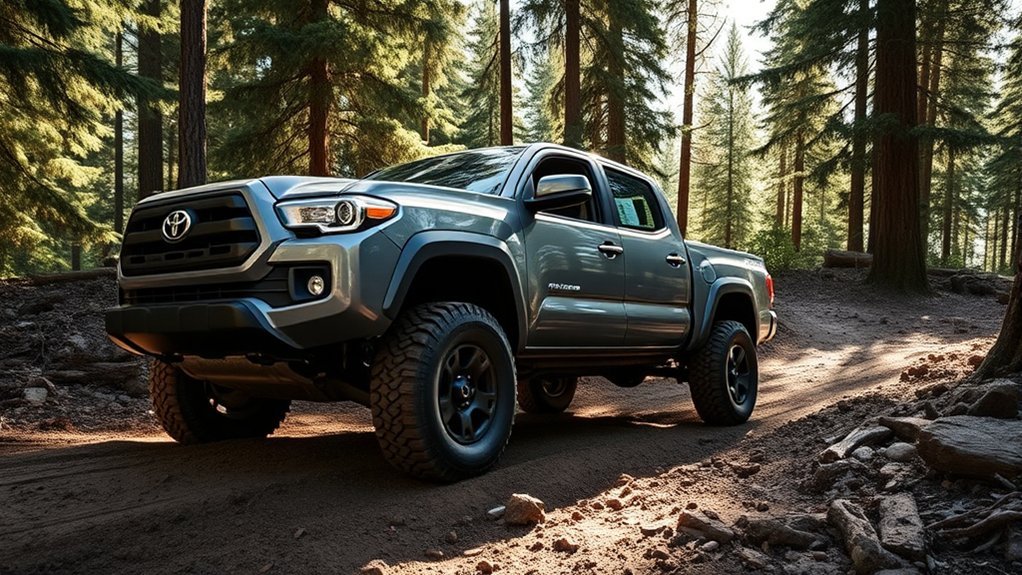
Toyota’s official guidance is the best starting point for your specific model year. For current Tacoma 4WD models, Toyota describes 2H as the normal dry-road mode, 4H as the mode for off-road, icy, or snow-covered surfaces, and 4L as the mode for maximum power and traction.
Toyota also states that 2H-to-4H and 4H-to-2H shifts should be made below 62 mph. Shifting between high range and low range requires a complete stop and the correct transmission position. On many models, VSC turns off automatically in 4L or L4L.
The simplest Tacoma 4WD rule: use high-range 4WD for traction, low-range 4WD for controlled torque, and 2H for dry pavement unless your model has full-time H4F.
How to Optimize Your Tacoma for Off-Road Driving
Good 4WD technique starts before the trail. Check your tires, select the right mode early, and avoid waiting until the truck is already stuck or sliding.
- Select 4H before the obstacle: Shift before deep snow, mud, sand, or loose climbs rather than after traction is gone.
- Use 4L for slow control: Choose 4L before steep climbs, steep descents, rock gardens, or deep ruts.
- Drive smoothly: Sudden throttle and brake inputs can break traction.
- Avoid binding: Do not make tight turns in part-time 4WD on dry, high-traction pavement.
- Inspect after trail use: Look for tire damage, loose underbody parts, packed mud, fluid leaks, and damaged skid plates.
Note: Four-wheel drive helps the Tacoma move, but it does not replace good tires, careful speed, recovery gear, or safe judgment. In winter driving, leave extra stopping distance even when 4WD is engaged.
What to Do if the 4WD Indicator Flashes
A flashing 4HI, 4LO, or center differential lock light usually means the shift has not completed yet. Do not panic. Use the following checks:
- Drive straight slowly while gently accelerating or decelerating.
- If safe, stop and shift again using the correct procedure.
- For 4L or L4L, confirm the vehicle is fully stopped and the transmission is in Neutral.
- Do not keep spinning the wheels while trying to shift.
- If the indicator flashes rapidly or a warning remains, have the 4WD system inspected by a Toyota dealer or qualified technician.
Customer Insights: Learning From Real-World Experiences
Most real-world Tacoma 4WD complaints come from three avoidable issues: using part-time 4WD on dry pavement, shifting into 4WD after the tires are already spinning, or running mismatched tires. Owners who exercise 4WD monthly, rotate tires regularly, and shift before traction disappears usually have a smoother experience.
Full-time 4WD Tacoma owners should also learn the difference between H4F and locked-center modes. H4F is the normal full-time setting, while H4L and L4L are traction modes for surfaces that can tolerate tire slip.
Frequently Asked Questions
Do you need to stop to switch to 4-wheel drive in a Tacoma?
You do not usually need to stop when shifting between 2H and 4H on many Toyota Tacoma 4WD models. Toyota instructs drivers to reduce speed below 62 mph and shift while the wheels are not slipping. You do need to stop completely to shift between 4H and 4L.
Can I drive my Tacoma in 4H on dry pavement?
Do not use part-time 4H on dry pavement unless your owner’s manual gives different instructions for your exact model. Part-time 4H is for surfaces where the tires can slip, such as snow, ice, mud, gravel, sand, or dirt. Full-time H4F models are different because H4F is designed for normal driving.
When should I use 4L in a Toyota Tacoma?
Use 4L for slow situations that need maximum torque and control, such as steep climbs, steep descents, rock crawling, deep mud, deep sand, deep snow, or pulling through difficult off-road conditions. Stop completely and shift to Neutral before selecting 4L.
Why does my Tacoma feel like it binds or hops in 4WD?
Binding or hopping often happens when part-time 4WD is used on dry, high-traction pavement, especially while turning. It can also come from mismatched tire sizes, uneven tread depths, incorrect tire pressure, or suspension alignment issues.
How often should I engage Tacoma 4WD?
Toyota recommends driving in four-wheel drive for at least 10 miles each month. This helps lubricate the front drive components and keeps the system ready for snow, mud, sand, and off-road use.
Conclusion
Using your Tacoma’s 4WD system correctly comes down to matching the mode to the surface. Use 2H for dry pavement, 4H for slippery or loose terrain, and 4L for slow, high-torque off-road situations. If your Tacoma has full-time 4WD, learn the H4F, H4L, and L4L differences before you need them. Keep your tires matched, rotate them on schedule, exercise 4WD monthly, and your Tacoma will be much more confident when the road turns rough.
Sources
- Toyota Owners: 2026 Tacoma Four-Wheel Drive System — backs up 2H, 4H, 4L usage, 62 mph 2H/4H shifting, 4L shifting procedure, and monthly 10-mile 4WD use.
- Toyota Owners: 2024 Tacoma Four-Wheel Drive System — backs up current-generation part-time 4WD mode guidance and shift instructions.
- Toyota Owners: 2024 Tacoma Hybrid Full-Time 4WD System — backs up H4F, H4L, and L4L mode descriptions and center differential lock guidance.
- Toyota Owners: 2025 Tacoma Tires — backs up tire inspection, uneven wear checks, treadwear indicators, and tire replacement guidance.
- NHTSA TireWise Tire Safety — backs up tire pressure, tread, rotation, and tire safety best practices.
- NHTSA Interpretation: Treadwear Indicators — backs up the 2/32-inch treadwear indicator depth and traction safety context.