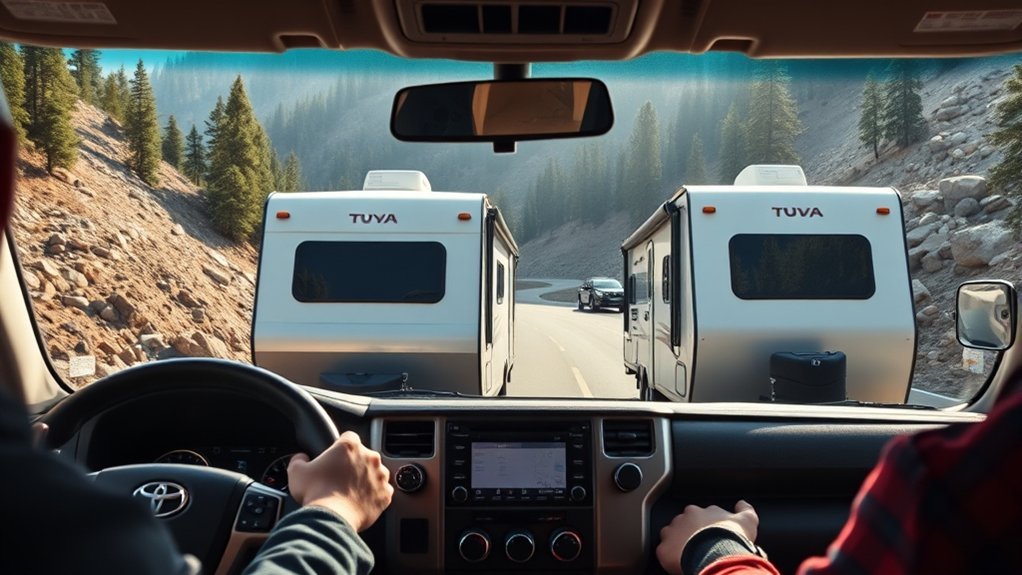
Prep the Tundra and trailer: inspect lights, hitch, chains, tires and brake controller, and confirm WDH fit for the trailer GVWR. Use Tow/Haul, downshift to hold RPMs near 2,400 uphill, and maintain steady throttle. Use engine braking and higher initial trailer-brake gain on descents to control speed and limit service-brake heating. Monitor transmission temp and brakes; stop if you see fading or vibrations. Keep tools, compressor, spares and an exit plan handy to continue learning practical procedures.
Pre-Drive Checklist: Tundra & Trailer (30‑Min)
Before you roll out, spend 30 minutes running a methodical pre-drive checklist: you’ll complete a focused trailer inspection and lighting check, verify hitch security, and set vehicle systems for mountainous towing. Walk the rig to confirm coupler engagement, safety chains, and electrical harness seating; tighten fasteners and recheck torque points. Cycle turn signals, brake lights, and running lamps while an assistant watches; confirm brake-controller output and that trailer brakes actuate. Engage Tow/Haul mode and confirm transmission response under light throttle to guarantee gear-hold capability on grades. Verify tire pressures and load distribution visually and with a gauge; correct pressures reduce heat and improve control. Review route profiles for steepness and run length so you can plan engine braking and passing zones. With systems confirmed, you’ll approach the climb liberated by preparation, minimizing surprises and retaining command over speed, braking, and drivetrain durability throughout the descent and ascent.
Set Up Hitch, Weight Distribution & Trailer Brakes
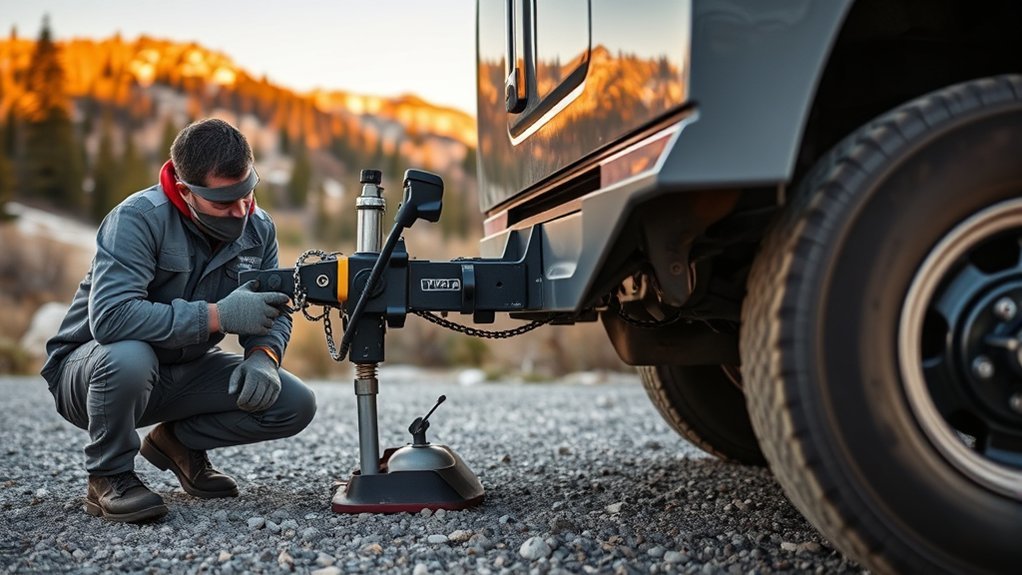
With your pre-drive checks complete, focus on hitch setup, weight distribution and trailer braking to lock in predictable handling on grades. Verify your hitch is rated for your trailer’s GVWR and that the ball mount matches trailer coupler size; different hitch types demand specific mounts and torque specs, so secure fasteners to spec. Fit a Weight Distribution Hitch (WDH) when tongue weight or trailer length threatens rear sag—set spring bar angles and shank height per manufacturer instructions to transfer load evenly across axles and restore steering authority. Inspect safety chains and electrical plugs; secure connections remove failure modes. Set trailer brakes to a higher initial gain for descents, then fine-tune on a controlled downgrade. Confirm brake calibration on the controller so vehicle and trailer decelerate together—perform a test brake at low speed and adjust proportional or time-based output until synchronized. These precise steps reduce oscillation, preserve control, and free you to command mountain roads confidently.
Use Tow/Haul, Gears & Speed for Uphills and Downhills
Engage Tow/Haul and downshift into a low gear (for example S4) when climbing or descending to keep shifts minimal, hold RPMs near 2,400, and use steady throttle inputs so the transmission and engine stay cool and predictable. You’ll use Tow/Haul to optimize shift programming and reduce hunting; that lowers transmission temps versus Drive and preserves control on grades. For uphill runs, choose gear selection that maintains torque without excess RPMs; steady throttle prevents unnecessary shift events that spike heat. On descents, downshift into S4 to use engine braking and avoid overworking service brakes. Maintain speed discipline—around 60–65 mph on flats—and reduce speed appropriately for grade severity while keeping RPMs near target. These towing techniques let you command the vehicle confidently, minimize transmission load, and manage thermal risk. Execute gear changes deliberately, prioritize engine braking over frequent brake application, and keep inputs smooth so you stay free to move without mechanical compromise.
Monitor Transmission, Brakes & Tires : When to Stop
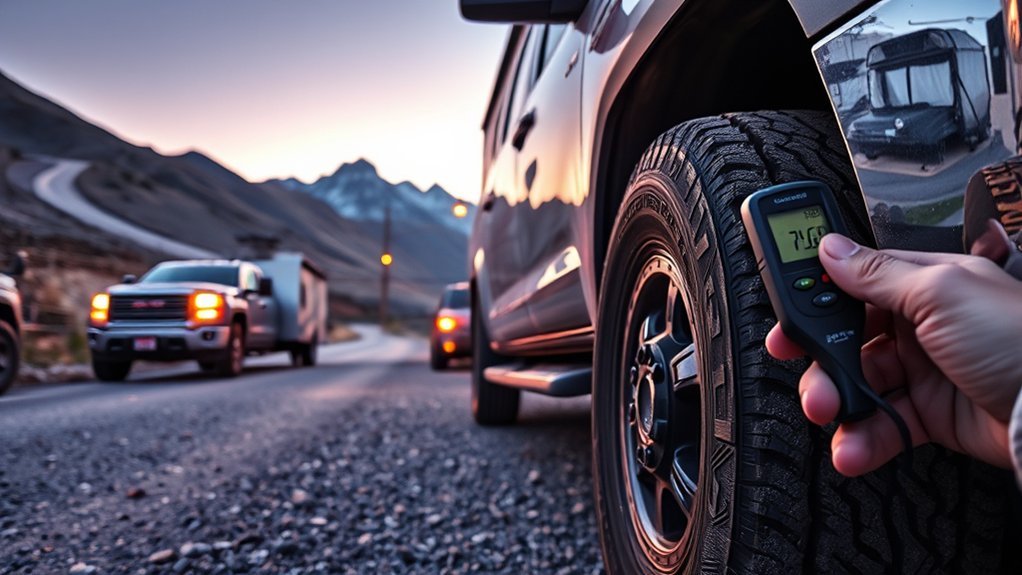
Shifting into S4 and managing speed helps keep temperatures and brake use under control, but you still need to know when to stop and inspect. You’ll practice disciplined transmission monitoring and perform routine brake assessments to prevent failures on steep grades. Watch dash temps: D can hit ~230°F on long ascents, S4 holds ~203–204°F; pull over if transmission temp climbs toward critical limits or rises rapidly. Check brakes after extended descents—trailers do ~80% of work and can overheat. Inspect tires for pressure changes, cuts, or sidewall deformation; elevation and load shift performance.
- Stop and inspect immediately if you feel vibration, fading, or reduced stopping power.
- Pause at regular intervals after prolonged climbs/descents to verify transmission temperature and brake pad/drum condition.
- Confirm tire pressures and visual integrity before resuming; adjust or repair as needed.
You’re reclaiming control: timely stops and systematic checks keep you moving safely and independently.
Must-Have Gear, Maintenance Steps & Emergency Plan
Why risk being stranded on a mountain road when a few key items and checks will keep you safe and in control? Equip your Tundra with proven gear recommendations: a reliable brake controller (Prodigy), a Weight Distribution Hitch (WDH), and quality tires like Hankook or Goodyear. Those safety essentials stabilize handling, improve braking response, and reduce trailer sway on steep grades.
Before you tow, inspect trailer brakes, lights, and connections; secure hitch components and verify electrical continuity. Monitor transmission temperature—use Tow/Haul and downshift to keep it under 230°F—and confirm brake function during short tests. Carry a compact toolkit, portable air compressor, extra tire inflators, and spare fuses.
Create an emergency plan: route exits, phone and signal backups, and clear roles for vehicle and trailer procedures. Practice controlled stops and low-speed maneuvers before remote stretches. These maintenance steps and contingency measures free you to move confidently in mountains, minimizing risk and maximizing autonomy.
Frequently Asked Questions
Should I Use Tow Haul Mode in Mountains?
Yes — you should use Tow/Haul mode in mountains. You’ll gain better towing techniques, enhanced engine braking, consistent RPMs, and lower transmission temps for safer mountain driving, letting you tow confidently and maintain control.
Conclusion
You’ve done the prep, hitched properly, and kept an eye on gears, heat and brakes—so you’ll avoid surprises on steep roads. Treat the truck as a sensible partner: don’t push it into a corner, let systems catch their breath, and let weight and brakes do the heavy thinking. Carry the right tools, stop before things get “tired,” and have a clear exit plan. Drive with respect, and the mountain will respect your load.