Toyota Tacoma Brake Caliper Replacement: Safe DIY Overview
A conventional Toyota Tacoma front brake caliper can be replaced by an experienced DIY mechanic, but the job is not complete until the pedal is firm and every hydraulic connection stays dry under pressure. Match the caliper to the exact axle, side, brake package, and connection type. Support the truck on jack stands, keep the system clean, hand-start every fitting, use model-specific Toyota torque data, and bleed all trapped air before any road test.
This guide is primarily a conventional front-disc-caliper workflow. A 2024-or-newer rear caliper uses an electronic parking brake, so its release, piston retraction, installation, and post-repair checks must follow Toyota’s model-specific service procedure.
Editorial basis: This guide synthesizes Toyota owner and service resources, NHTSA recall records, federal safety rules, and RepairPal cost data. It does not claim hands-on testing across every Tacoma model year or brake package.
Quick Answer
To replace a conventional Toyota Tacoma front brake caliper, support the truck on rated jack stands, remove the wheel, disconnect the hose or tube without twisting it, install the correct left/right caliper with the bleeder at the top, torque each fastener to exact model-specific service data, and bleed until the fluid is bubble-free and the pedal is firm. Inspect every connection under pedal pressure before a controlled low-speed test. Do not apply this generic workflow to a 2024-or-newer rear caliper without Toyota’s electronic-parking-brake instructions.
Key Takeaways
- Do not use a universal caliper torque spec. Tacoma brake hardware changes by model year, axle, trim, brake package, and connection type.
- The 2024 redesign introduced standard front and rear disc brakes. Earlier Tacomas commonly use front discs with rear drums.
- Toyota expanded the rear-brake-hose recall to certain 2024–2025 Tacoma 2WD and 4WD trucks with 16-inch brakes and specified 17- or 18-inch Toyota wheels. Check the VIN because model year alone does not determine eligibility.
- Never rely on a jack alone. Support the truck with rated jack stands before working near the brake assembly.
- Keep the master-cylinder reservoir above the MIN line while bleeding so air does not enter the system.
- Replace copper crush washers when the caliper uses a banjo-style hose connection.
- Do not drive if the pedal is soft, sinks, requires pumping, or any fitting, bleeder, hose, or caliper seal leaks.
At a Glance
| Time Required | Varies with corrosion, fitting condition, brake layout, bleeding needs, and access to the exact Toyota service procedure |
| Difficulty | Intermediate DIY; stop and use a professional if you are unsure about brake bleeding, electronic parking-brake procedures, or torque specifications |
| Tools Needed | Jack, jack stands, wheel chocks, socket set, torque wrench, line wrench, bleeder hose and bottle, brake cleaner, fresh Tacoma brake fluid, rags, gloves, and eye protection |
| Professional Cost Context | RepairPal’s estimate, last updated June 18, 2026 and checked July 31, 2026, lists $699–$767, including estimated labor of $146–$215 and parts around $552, before taxes, fees, location adjustments, and related repairs. |
Should You Replace the Tacoma Caliper Yourself?
Proceed only when you can identify the installed brake system, obtain exact service data, and complete a hydraulic leak test. A brake job that begins as a caliper swap can become a hose, tube, ABS, or electronic-parking-brake repair if a fitting is damaged or air enters farther upstream.
| Continue With DIY Only If | Stop and Arrange Professional Service If |
|---|---|
| The truck is stable on rated jack stands and the correct jacking/support points are known | The truck cannot be supported securely or a jack stand shifts |
| The exact axle, side, brake package, connection type, and replacement caliper are confirmed | The replacement does not match the casting, ports, mounting ears, hardware, or bleeder position |
| Toyota torque values and the applicable bleeding procedure are available before disassembly | A torque value, electronic-parking-brake step, or ABS bleeding requirement cannot be verified |
| Hydraulic fittings loosen cleanly and can be hand-started during installation | A fitting rounds, cross-threads, cracks, or the brake tube is kinked or badly corroded |
| The pedal becomes firm and all connections stay dry under steady pressure | The pedal stays soft, sinks, requires pumping, a warning remains active, or any fluid leak appears |
How Do You Know the Tacoma Caliper Is the Problem?
Before replacing parts, confirm the problem points to the caliper and not the pads, rotor, flexible hose, steel brake tube, wheel bearing, master cylinder, ABS components, or parking-brake hardware. A leaking caliper may leave wet fluid near the piston seal, bleeder, banjo bolt, tube fitting, or inside the wheel. A sticking caliper may cause pulling, uneven pad wear, a hot wheel, a burning odor, or a rotor that continues to drag after a short drive.
A damaged or internally restricted flexible hose can also hold pressure at the caliper and mimic a seized piston. If a dragging wheel releases only after the bleeder is opened, stop and diagnose the hose and upstream hydraulic circuit instead of assuming that a new caliper will solve the problem.
Do not diagnose from one symptom alone. Inspect both sides of the axle, compare inner and outer pad wear, check hose routing, and look for fluid loss at every hydraulic connection. Use this Tacoma brake-pad lifespan and wear guide for related pad checks. If the pedal sinks, feels spongy, requires pumping, or the truck pulls hard under braking, treat it as a no-drive condition until the cause is found.
[Products Worth Considering]
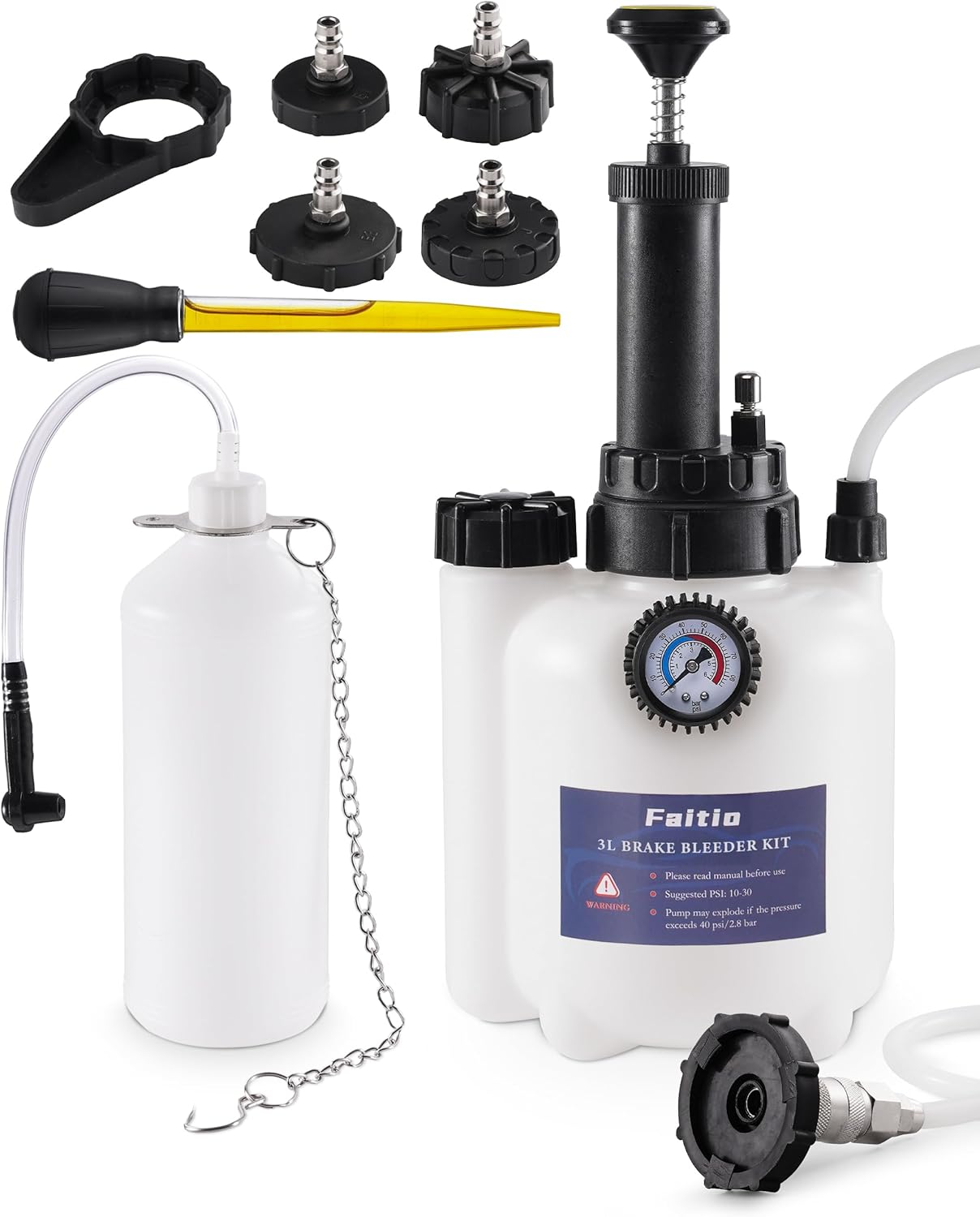
This one-man brake bleeding kit helps flush old brake fluid and remove trapped air for firmer, more responsive braking without the hassle of a second person. Its improved sealing and translucent catch bottle help prevent leaks while making fluid level checks easy during use. With multiple adapter sizes for many vehicle makes, it is a practical tool for clean, efficient brake system maintenance.

This universal brake bleeder kit makes one-person brake and clutch line bleeding simple by using compressed air to create stable vacuum-assisted fluid flow. Its extra-large 3L tank helps complete full-system flushes with fewer interruptions, while the included refill bottle, flexible hose, and universal adapter support clean, efficient use on standard and ABS brake systems.

The Mityvac MV8500 Silverline Elite is a versatile automotive service kit for brake and clutch bleeding, diesel fuel priming, and vacuum or pressure testing. Its dual-capability pump streamlines diagnostics and maintenance across motorcycles, cars, trucks, and SUVs, while the ergonomic design supports comfortable use during longer jobs. Built with a durable zinc-aluminum die-cast body and a 4.5oz fluid reservoir, it delivers reliable performance for professional and DIY repair work.
What Tools and Safety Steps Do You Need?
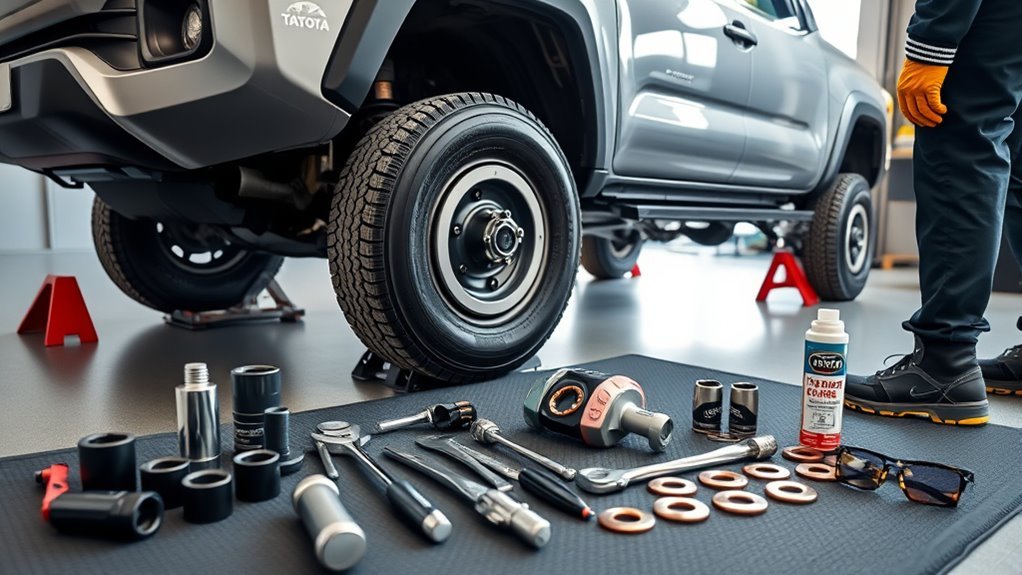
Start by identifying the axle and brake layout. Toyota states that the 2024 redesign introduced four-wheel disc brakes, with brake-package variation by configuration. Earlier Tacomas commonly combine front disc brakes with rear drums. Review this Tacoma drum-brake versus disc-brake guide if you are unsure which system is installed.
| Tacoma Brake Location | Likely Layout | How This Guide Applies |
|---|---|---|
| Earlier-generation front axle | Conventional disc caliper, with fitment differences by brake package | The workflow generally applies after exact part and torque verification |
| Earlier-generation rear axle | Commonly rear drum brakes | A drum assembly has no brake caliper; use the correct drum-brake procedure |
| 2024-and-newer front axle | Disc caliper with brake-package variation | Verify the VIN, installed brake package, caliper casting, and Toyota TIS procedure |
| 2024-and-newer rear axle | Rear disc caliper with an electronic parking brake | Use Toyota’s model-specific electronic-parking-brake procedure, not a generic front-caliper workflow |
2024-and-newer rear-caliper warning: Do not apply the generic front-caliper steps to a rear caliper. The rear system uses an electronic parking brake. Follow Toyota TIS for the parking-brake release, piston retraction, installation, and post-repair checks. Do not force the actuator or piston.
Before buying parts, match the replacement caliper to your Tacoma’s year, VIN, trim, engine, drivetrain, wheel setup, installed brake-package size, axle, and left/right side. Compare the replacement with the original before opening the hydraulic line. Check the casting shape, piston arrangement, mounting ears, hose or tube port, pad hardware, and bleeder position.
The bleeder screw must sit above the brake hose or tube connection when the caliper is installed. If the bleeder is below the connection, you likely have the wrong side, and trapped air may prevent a firm pedal.
Scope: This is a safety-focused workflow based on official service and safety references. It is not a substitute for a documented Toyota repair procedure covering every Tacoma model year and brake package.
Warning: Brake repairs affect your ability to stop. If a fitting is rounded, a bleeder is seized, the pedal stays soft, or you are not comfortable bleeding brakes, have the truck towed to a qualified technician instead of driving it.
Gather these tools and supplies before lifting the truck:
- Hydraulic floor jack rated for the Tacoma’s weight
- Rated jack stands and wheel chocks
- Lug-nut socket and breaker bar
- Metric socket set and ratchet
- Calibrated torque wrench
- Flare-nut or line wrench for brake-tube fittings
- Box-end wrench for the bleeder screw
- Brake-bleeder hose and catch bottle
- Brake cleaner and clean rags
- Fresh DOT brake fluid specified in the exact owner’s manual and on the reservoir cap
- Replacement copper crush washers if the caliper uses a banjo bolt
- High-temperature silicone brake grease for approved pad contact points or slide pins where applicable
- Nitrile gloves and safety glasses
Use the brake fluid printed on your Tacoma reservoir cap and listed in the exact owner’s manual for your model year. FMVSS No. 116 defines performance requirements for DOT brake-fluid grades used in hydraulic systems. Use fluid from a newly opened, sealed container, keep the cap closed when you are not pouring, and never reuse drained fluid. See also the site’s guides to checking Tacoma brake-fluid level and the Tacoma brake-fluid service interval.
Recall check for 2024–2025 trucks: The original NHTSA report for campaign 25V-058 covered certain 4WD trucks. Toyota’s July 2, 2025 update expanded the U.S. recall to certain 2024–2025 Tacoma 2WD and 4WD vehicles with 16-inch brakes and specified 17- or 18-inch Toyota wheels, bringing the stated U.S. population to about 222,000. Mud or dirt buildup can damage the rear brake hoses and cause a fluid leak. Check the VIN because Toyota replaces both rear hoses at no charge only on affected vehicles.
VIN verification: Check your Tacoma at NHTSA’s recall lookup and Toyota’s recall lookup. Recall eligibility is determined by VIN, not by model year alone.
[Products Worth Considering]

This brake bleeder bottle helps simplify brake fluid replacement by draining old fluid while reducing air in the line. Its rubber connector fits most bleed screws, and the included hose and chain help keep the bottle securely in place during use. Built from durable, corrosion-resistant plastic, it is suitable for a wide range of vehicles including cars, motorcycles, ATVs, dirt bikes, and scooters.

This brake bleeder hose kit helps remove old brake fluid and air from motorcycle brake and clutch systems quickly and efficiently. Its one-way check valve prevents air from being drawn back into the system, while the easy-to-connect clips make bleeding simple for routine maintenance. Built for reliable use, it is a practical tool for keeping motorcycle braking performance responsive.

[Vehicle Fitment]: 2003 2004 2005 2006 2007 2008 2009 For Toyota For 4Runner 4.0L,2003 2004 2005 2006 2007 2008 2009 For Toyota For 4Runner 4.7L,2007 2008 2009 2010 2011 2012 2013 2014 For Toyota For FJ Cruiser 4.0L
Lift the Truck and Remove the Wheel Safely
Park on a flat, solid surface. Shift into Park for an automatic transmission or into gear for a manual transmission. Chock the wheels that will stay on the ground. Set the parking brake when appropriate for the axle being serviced and the applicable Toyota procedure.
If you are working on a rear brake, release or service the parking-brake system only after the truck is securely supported and only as directed by the exact repair procedure. Do not improvise an electronic-parking-brake release.
- Break the lug nuts loose while the tire is still touching the ground. Do not remove them yet.
- Position the floor jack at the Tacoma’s approved jacking point from the owner’s manual.
- Raise the truck only high enough to remove the wheel comfortably.
- Place rated jack stands under solid frame or approved support points.
- Lower the truck gently onto the stands and shake the vehicle lightly to confirm stability.
- Remove the lug nuts and pull the wheel straight off the hub.
Warning: Never work under or beside a truck supported only by a hydraulic jack. A jack can leak down, shift, or tip even on a flat surface.
Replacement Workflow and Where DIY Jobs Usually Stall
The table below shows where the work usually slows down. Part verification, rusty fittings, brake bleeding, and the final leak test matter more than simply removing the mounting bolts.
| Stage | Planning Note | What Matters Most |
|---|---|---|
| Verification, prep, and lifting | Do not begin disassembly until fitment, service data, and approved support points are confirmed | Correct axle, side, brake package, service data, and stable jack stands |
| Removal | Rusty or rounded fittings can turn the job into a brake-line repair | Avoid rounded fittings, damaged tubes, and fluid contamination |
| Installation | Pause if any fitting will not hand-start or the hose cannot route without twisting | Correct caliper orientation, hand-started threads, hose routing, and exact torque |
| Bleeding and testing | Repeat the correct procedure until the discharge is bubble-free and the pedal is firm | Bubble-free discharge, firm pedal, no leaks, and a controlled low-speed test |
Why Must Tacoma Torque Specs Be Model-Specific?
Tacoma brake torque specifications are not one-size-fits-all. Values can change by generation, axle, brake package, caliper design, and hydraulic connection.
Do not apply a small brake-line fitting value to a caliper mounting bolt. Do not apply a high mounting-bolt value to a tube fitting, banjo bolt, bleeder screw, slide pin, or lug nut. These fasteners perform different jobs and use different values.
Use Toyota’s official repair information, a factory repair manual, or a professional database for the exact VIN or model year. Toyota provides model-specific repair information through the Toyota Technical Information System resources.
Even wheel torque shows why a universal number is unsafe. The 2024 Tacoma owner’s manual lists 97 ft-lb for aluminum-wheel configurations and 154 ft-lb for certain steel-wheel configurations. Those are wheel examples only, not caliper specifications. Use the exact owner’s-manual or repair-data value for the fastener and configuration being serviced.
If a source cannot separately identify the caliper mounting bolts, slide or guide hardware where applicable, brake-tube fitting, banjo bolt, bleeder screw, and wheel lug nuts, it is not detailed enough for final tightening.
| Fastener / Connection | Why You Must Verify | Safe Guidance |
|---|---|---|
| Caliper mounting bolts | Often use much more torque than small hydraulic fittings | Look up the exact factory value and thread-preparation instructions |
| Slide or guide hardware | Not every Tacoma uses the same caliper design | Identify the component correctly before selecting a value |
| Brake-tube fitting | Can be damaged by over-tightening or cross-threading | Hand-start, use a line wrench, and torque to service data |
| Banjo bolt / flexible-hose union | Requires correct washers and clean sealing surfaces | Use new copper crush washers and verify the exact torque |
| Bleeder screw | The seat or screw can be damaged by over-tightening | Close and torque only to the applicable service value |
| Wheel lug nuts | The correct value depends on the vehicle and wheel setup | Use the owner’s-manual value and tighten in a star pattern |
Pro Tip: Write the verified torque values on cardboard before starting. Separate “caliper mounting bolts,” “slide or guide hardware,” “brake hose or banjo bolt,” “brake-tube fitting,” “bleeder screw,” and “lug nuts” so you do not mix high-torque and low-torque fasteners.
Control Fluid Loss & Remove the Caliper Step by Step
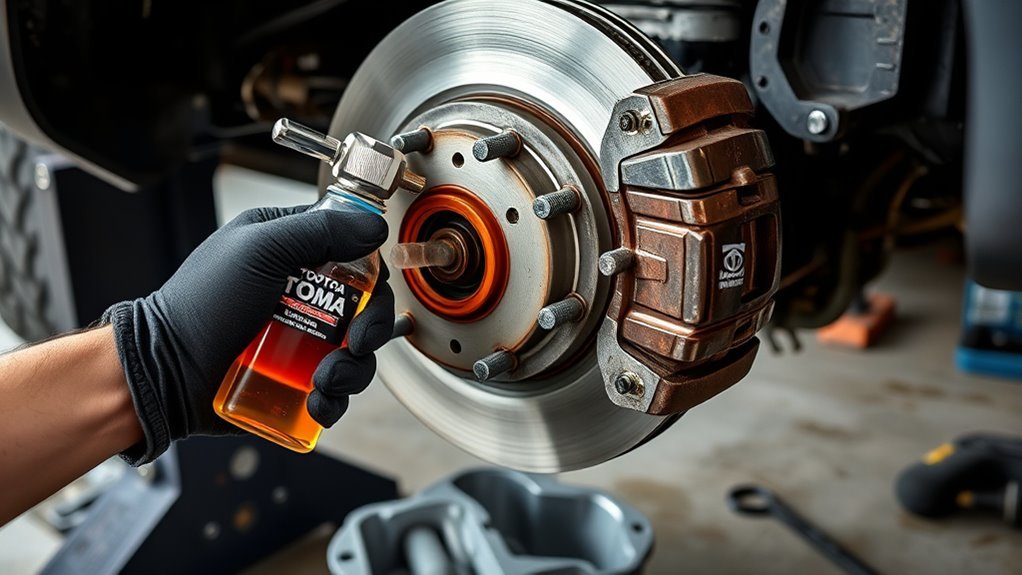
You do not need to drain the entire brake system to replace one conventional caliper. The goal is to control fluid loss, prevent the reservoir from running dry, and keep dirt and moisture out of every open connection.
- Clean the caliper, hose connection, bleeder area, and surrounding parts with brake cleaner.
- Place a drain pan or catch bottle under the caliper.
- Clean the master-cylinder reservoir cap and surrounding area. Check the fluid level through the reservoir. Open the cap only when adding specified fluid, then reinstall it before any pedal pumping unless the exact Toyota procedure directs otherwise. Keep the level above MIN throughout the repair.
- If the applicable repair procedure calls for pushing the old pistons back, attach a hose to the bleeder, open the bleeder slightly, and push slowly so displaced fluid exits into the catch bottle instead of being forced backward through the system.
- Close the bleeder once fluid flow slows. Do not leave it open while removing the caliper.
- Remove pad pins, clips, springs, and pads as required for your Tacoma’s caliper design.
- Support the caliper so it does not hang by the brake hose or tube.
- Loosen the caliper mounting bolts and remove the caliper from the bracket or knuckle.
- Disconnect the brake hose, banjo bolt, or brake tube last, then cap or plug the open connection immediately with a clean, compatible plug.
If the brake-tube fitting is rusty, use a flare-nut wrench instead of an open-end wrench. If the fitting starts to round, stop. A damaged brake line can turn a caliper replacement into a line repair, and a cracked, kinked, or badly corroded brake tube is not safe to reuse.
Remove Pads, Pins & Clips: Tips to Avoid Damage
Tacoma front calipers may use pad pins, anti-rattle springs, clips, shims, or guide hardware depending on the installed design. Remove the parts in order and lay them on a clean towel. Take a photo before disassembly so you can confirm spring and clip orientation during reassembly.
- Tap stuck pins straight out with a suitable punch; do not bend them sideways.
- Support the pads so they do not fall against the rotor or spread brake dust.
- Inspect pins for grooves, rust, bending, or pitting.
- Compare inner and outer pad wear on both sides of the axle.
- Uneven wear may indicate a seized piston, restricted hose, stuck slide or pin, or damaged hardware.
- Replace damaged clips, springs, shims, and pins instead of forcing worn parts back into place.
Brake-dust safety: Do not blow brake dust with uncontained compressed air. OSHA’s asbestos standard restricts compressed-air cleaning of asbestos-containing material unless the dust cloud is effectively captured. Use an appropriate brake-cleaning method, disposable towels, gloves, and local disposal guidance.
Disconnect the Brake Line Safely and Minimize Fluid Loss
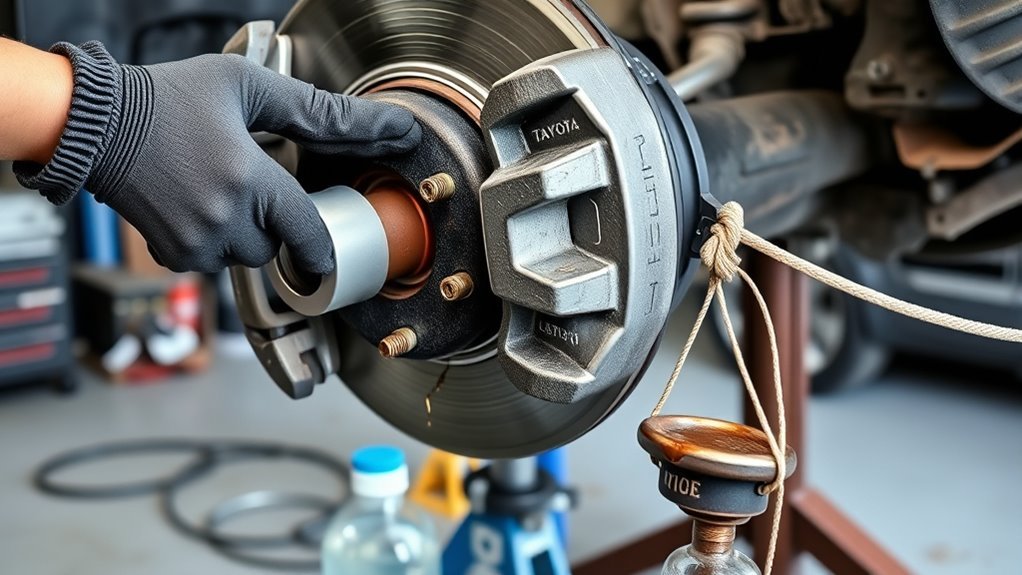
The hydraulic connection is one of the easiest places to create a leak, so work slowly and keep every surface clean. The correct procedure depends on the connection type:
| Connection Type | What to Do | Common Mistake |
|---|---|---|
| Brake-tube fitting | Use a flare-nut wrench, loosen steadily, and hand-start the fitting during installation | Using an open-end wrench and rounding the nut |
| Banjo bolt and flexible hose | Use new copper crush washers on both sides of the banjo fitting | Reusing old washers or installing them in the wrong order |
| Flexible-hose routing | Keep the hose untwisted and clear of the tire, wheel, suspension, and steering movement | Installing the caliper with the hose looped, stretched, kinked, or rubbing |
Once the line is disconnected, cap the hose or tube with a clean, compatible plug. Do not let the open end touch dirt, and do not press the brake pedal while the hydraulic connection is open.
Install the New Tacoma Caliper and Start the Brake Line by Hand
Compare the replacement with the original before bolting it on. Confirm the casting shape, mounting ears, hose or tube port, bleeder location, piston arrangement, and pad-hardware fit. The bleeder must be at the top when the caliper is installed so trapped air can escape.
- Clean the mounting surface and bracket or knuckle area.
- Position the replacement caliper over the rotor or bracket without forcing it.
- Install the caliper mounting bolts by hand first to avoid cross-threading.
- If using a brake-tube fitting, hand-thread the fitting into the caliper before applying a wrench.
- If using a banjo bolt, install new copper crush washers: one between the bolt head and hose fitting and one between the hose fitting and caliper.
- Confirm that each washer sits flat against a clean sealing surface.
- Make sure the flexible hose is not twisted, kinked, stretched, or rubbing any moving part.
- Turn the steering from side to side where applicable and confirm that the hose retains safe clearance throughout its travel.
- Torque each mounting bolt, tube fitting, banjo bolt, and other fastener only to the verified model-specific service specification.
Warning: Do not tighten brake hardware by feel alone. Under-tightened mounting bolts can loosen. Over-tightened hydraulic fittings can crack, strip, distort sealing surfaces, or leak.
Install New Pads, Springs & Pin Clips and Reassemble
If you are installing pads with the caliper, keep the friction surfaces clean. Do not get grease, brake fluid, or dirty fingerprints on the pad friction material or rotor face. If fluid contacts the rotor, clean the rotor thoroughly with brake cleaner before assembly.
Brake pads should be replaced in axle sets so friction material and wear remain balanced from left to right. Inspect the rotor condition and thickness using the exact service limits for the vehicle rather than assuming that a visually smooth rotor is reusable.
Pad, Spring, and Clip Seating
Install the pads, shims, anti-rattle spring, clips, and retaining pins in the same orientation as the original hardware or the factory diagram. If a pad uses a wear indicator, match the correct location shown in the service information.
- Apply only a thin film of approved high-temperature brake grease to specified metal-to-metal contact points.
- Do not grease the pad friction material, rotor, rubber boots, or any location not approved by the repair procedure.
- Seat springs, clips, and retainers fully so they cannot move out of position during braking.
- Confirm that the pads move as designed without binding or rattling loosely.
Pin Greasing and Installation
Use grease sparingly on guide pins or pad pins only where the brake design and lubricant instructions call for it. Too much grease can attract grit, swell incompatible rubber, or make future service harder. Replace badly corroded, bent, grooved, or pitted pins instead of polishing them and hoping they will move correctly.
After the pads and hardware are seated, rotate the rotor by hand. Light pad contact can be normal, but the rotor should not be locked, heavily dragging, or grinding.
How Do You Bleed a Tacoma Caliper After Replacement?
Bleeding removes compressible air from the hydraulic system. Fluid color alone is not the completion test. Continue until the discharge is free of bubbles, the reservoir remains at the correct level, the pedal is firm, and every connection stays dry under pressure.
- Check the master-cylinder reservoir and add fresh, specified brake fluid to the correct level. Reinstall the reservoir cap before pedal pumping unless the exact Toyota procedure states otherwise.
- Attach a clear hose to the caliper bleeder screw and place the other end in a suitable catch bottle.
- Have a helper press the brake pedal slowly and hold it down.
- Open the bleeder briefly to release fluid and air, then close it before the helper releases the pedal.
- Repeat until bubble-free fluid comes through the hose.
- Check the reservoir often and keep it above MIN.
- Close and torque the bleeder screw to the applicable service specification. Do not over-tighten it.
- Clean the caliper, bleeder, and hydraulic connections with brake cleaner so new leaks are easy to identify.
If the reservoir ran dry, the pedal remains soft, or the system stayed open for an extended time, bleed the full system in the sequence specified by Toyota for the exact truck. Do not assume that the farthest-wheel-first method applies to every Tacoma brake and ABS configuration.
If air may have entered the ABS hydraulic components, the brake or parking-brake warning remains active, or correct manual bleeding does not produce a firm pedal, stop. Use Toyota service information or a qualified technician. A model-specific scan-tool or actuator procedure may be required.
A caliper replacement is not finished when the bolts are tight. It is finished when the pedal is firm, the fluid discharge is bubble-free, and every hydraulic connection stays dry under pedal pressure.
Disposal: Collect used brake fluid and contaminated shop materials in suitable closed containers and follow local household-hazardous-waste rules. Do not pour brake fluid down a drain, onto the ground, or into a storm sewer. See the U.S. EPA household hazardous-waste guidance.
[Products Worth Considering]

Direct replacement - this disc brake caliper repair kit is designed to match the original components required to repair the caliper and restore proper operation of disc brakes on specified vehicles

Direct replacement - this disc brake caliper repair kit is designed to match the original components required to repair the caliper and restore proper operation of disc brakes on specified vehicles

PLEASE CONFIRM YOUR FITMENT: Using the Amazon Confirmed Fit bar at the top of the page or check the Product Description to confirm your vehicle fitment. This may be delivered in multiple boxes
What Should You Check Before Driving?
Before reinstalling the wheel, inspect every connection with a bright light:
- Bleeder screw dry
- Brake hose or tube fitting dry
- Banjo-bolt washers dry, if equipped
- Caliper piston seals dry
- Flexible hose not twisted, kinked, stretched, or rubbing
- Pad pins, clips, springs, and retainers fully seated
- Brake-fluid reservoir filled to the correct level
- No tools, plugs, caps, or loose parts left near the brake assembly
Reinstall the wheel and hand-start every lug nut. Tighten the nuts in a star pattern. Lower the truck until the tire just contacts the ground, then torque the lug nuts to the exact owner’s-manual value. Fully lower the truck and recheck the pattern.
Warning: Do not road-test the Tacoma if the pedal feels spongy, sinks slowly, requires pumping, or travels farther than expected. Re-bleed the system and inspect for leaks first.
With the engine off, press the brake pedal several times to seat the pads and build a firm pedal. Hold steady pressure and watch for continued sinking. The pedal should remain controlled rather than moving steadily toward the floor.
Start the engine and press the pedal again. It may move slightly as brake-booster assistance becomes available, but it should still feel controlled and firm. Confirm that no brake, ABS, or parking-brake warning indicates a fault.
For the first test, stay in a safe, level, low-speed area away from traffic. Apply the brakes gently several times. Stop, secure the truck, and inspect the caliper, bleeder, hose, tube fitting, and reservoir level again. If you installed new pads, follow the pad manufacturer’s bedding procedure without exceeding safe road conditions.
Troubleshooting After a Tacoma Caliper Replacement
| Problem | Likely Cause | What to Do |
|---|---|---|
| Soft or spongy pedal | Air remains in the system, the reservoir ran low, or the bleed procedure is incomplete | Re-bleed using Toyota’s sequence; get professional help if it does not improve |
| Pedal slowly sinks | External leak or another hydraulic fault | Do not drive; inspect the full hydraulic system |
| Fluid at banjo bolt | Old or misplaced washers, dirty sealing surface, damaged fitting, or incorrect torque | Replace the washers, inspect the surfaces, and torque to the exact specification |
| Fluid at bleeder | Loose bleeder, damaged seat, cracked screw, or caliper defect | Inspect and repair the leak before driving |
| Brake drag or hot wheel | Bound hardware, twisted or restricted hose, seized pin, incorrect parking-brake procedure, or caliper problem | Stop driving and inspect the hose, hardware, caliper, and applicable parking-brake system |
| Pulling to one side | Air, uneven pad or rotor condition, sticking caliper, hose restriction, or contaminated friction surface | Inspect both sides of the axle and bleed again if required |
| Brake or parking-brake warning remains on | Low fluid, hydraulic fault, ABS issue, electronic-parking-brake fault, or incomplete model-specific procedure | Do not continue normal driving; diagnose the warning with Toyota service information |
Frequently Asked Questions
How much does it cost to replace brake calipers on a Toyota Tacoma?
Parts cost depends on whether you buy OEM, remanufactured, or aftermarket components and whether related pads, rotors, hoses, or brake fluid are needed. RepairPal’s estimate, last updated June 18, 2026 and checked July 31, 2026, lists $699–$767, including estimated labor of $146–$215 and parts around $552, before taxes, fees, location adjustments, and related repairs.
Should I replace one Tacoma brake caliper or both sides?
You can replace only the failed caliper if the opposite side is confirmed to be in good condition, although RepairPal recommends replacing calipers in pairs. Inspect both sides for corrosion, piston or pin binding, leaks, hose restriction, and uneven pad wear. Replace brake pads in axle sets rather than on only one side.
What brake fluid does a Toyota Tacoma use?
Use the brake fluid listed in the exact Tacoma owner’s manual and printed on the reservoir cap. Do not choose by forum advice or model name alone. Use the DOT grade Toyota specifies for your model year and fluid from a newly opened, sealed container.
Do I have to bleed all four brakes after replacing one caliper?
Not always. If the line was capped quickly, the reservoir never ran low, and the pedal becomes firm after correctly bleeding the replaced caliper, a full-system bleed may not be necessary. If the reservoir dropped below MIN, the pedal stays soft, the system remained open, or air may have reached the ABS hydraulic components, follow Toyota’s full model-specific bleeding procedure.
What are the Tacoma caliper bolt torque specs?
There is no single safe torque specification for every Tacoma brake caliper. Mounting bolts, slide or guide hardware, brake-tube fittings, banjo bolts, bleeder screws, and lug nuts use different values. Those values can vary by model year, axle, caliper design, and brake package. Verify each specification in Toyota TIS, the factory repair manual, or a professional repair database before tightening.
Can I drive with a leaking brake caliper?
No. A leaking caliper, hose, tube fitting, banjo bolt, or bleeder can reduce hydraulic pressure and stopping ability. Do not drive until the leak is repaired, the system is correctly bled, the pedal is firm, and every connection stays dry under pressure.
Does a 2024-or-newer Toyota Tacoma have rear brake calipers?
Yes. The redesigned 2024-and-newer Tacoma uses front and rear disc brakes, so it has rear brake calipers. The rear system also uses an electronic parking brake. Rear-caliper work therefore requires the applicable Toyota service procedure for parking-brake release, piston retraction, installation, and post-repair checks.
Why is the brake pedal soft after replacing a Tacoma caliper?
A soft pedal usually means air remains in the hydraulic system, but it can also result from a low reservoir, a leak, an incomplete bleed, or a caliper installed on the wrong side with the bleeder below the hose connection. Do not drive. Confirm the bleeder is at the top, inspect every fitting under pressure, and follow Toyota’s model-specific bleeding procedure.
Do I need Toyota Techstream to bleed Tacoma brakes?
Not for every one-caliper repair. Manual bleeding may be enough when the reservoir stayed above MIN, the hydraulic opening was controlled, and the pedal becomes firm. If the reservoir ran dry, air may have entered ABS hydraulic components, a warning remains active, or manual bleeding does not restore normal pedal feel, Toyota’s model-specific service procedure may require Techstream or another approved actuator-bleeding process.
Is there a brake-hose recall for the 2024–2025 Toyota Tacoma?
Yes. NHTSA campaign 25V-058 began with certain 2024–2025 Tacoma 4WD trucks. Toyota’s July 2, 2025 update expanded the recall to certain 2WD and 4WD trucks with 16-inch brakes and specified 17- or 18-inch Toyota wheels, for a stated U.S. total of about 222,000 vehicles. Mud or dirt buildup can damage the rear hoses and cause a fluid leak. Check the VIN because not every truck from those model years is included; Toyota replaces both rear hoses at no charge on affected vehicles.
Conclusion
A Tacoma caliper replacement is a careful hydraulic-brake repair, not a shortcut job. First identify the model year, axle, brake layout, brake-package size, and whether an electronic parking brake or open recall changes the procedure. Support the truck correctly, keep the system clean, prevent the reservoir from running dry, install the correct caliper on the correct side, use new sealing washers where required, and torque every fastener to the exact Toyota specification.
Finish by bleeding until the fluid discharge is bubble-free, confirming a firm pedal, checking every connection under pressure, and performing a controlled low-speed test. Stop and arrange professional service if the pedal remains soft, a warning stays active, a fitting is damaged, or any leak returns.
Sources
- Toyota Support — Repair information and publications — supports using Toyota TIS and factory repair information for model-specific procedures and torque specifications
- Toyota Newsroom — 2024 Toyota Tacoma — supports the fourth-generation front-and-rear disc-brake layout, brake-package variation, and electronic parking brake
- Toyota Owners — 2024 Tacoma maintenance data — supports the listed brake-fluid grades and the configuration-dependent wheel-nut torque examples
- NHTSA — Part 573 Safety Recall Report 25V-058 — supports the affected 2024–2025 Tacoma rear brake-hose condition, safety risk, and dealer remedy
- Toyota Newsroom — updated 2024–2025 Tacoma rear-brake-hose recall statement — supports the July 2, 2025 expansion to certain 2WD and 4WD configurations and the approximate 222,000-vehicle U.S. total
- NHTSA Recalls — supports checking open safety recalls by VIN
- Toyota Recall Lookup — supports Toyota-specific VIN recall checks
- eCFR — 49 CFR 571.116, Motor Vehicle Brake Fluids — supports DOT brake-fluid performance, labeling, and packaging requirements
- eCFR — 49 CFR 571.135, Light Vehicle Brake Systems — supports cleaning the reservoir cap and using specified fluid from a sealed container
- OSHA — Asbestos Standard — supports avoiding uncontained compressed-air cleaning of potentially asbestos-containing brake dust
- U.S. EPA — Household Hazardous Waste — supports proper disposal of used brake fluid and contaminated shop materials
- RepairPal — Toyota Tacoma Brake Caliper Replacement Cost — supports the estimate last updated June 18, 2026 and checked July 31, 2026