
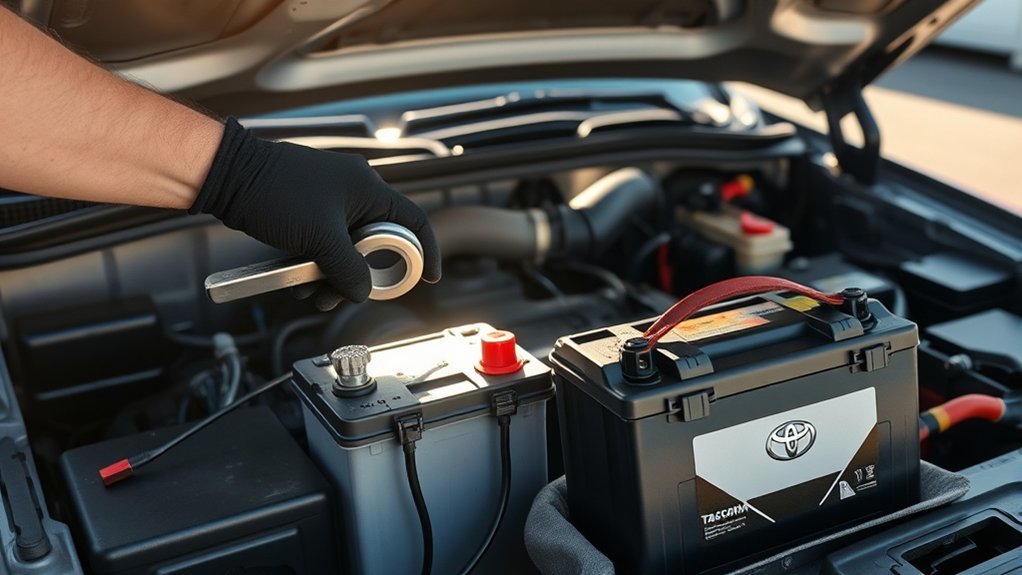
To replace a Toyota Tacoma battery with an accessible under-hood 12-volt battery, park safely, turn the truck off, wear eye and hand protection, and confirm the replacement by VIN, battery label, terminal layout, and hold-down fit. Disconnect the negative terminal first, then the positive; remove the hold-down; lift the old battery out upright; secure the new battery; then reconnect positive first and negative last. This page explains replacement, not the diagnosis of repeated battery drain or charging faults. Do not apply these under-hood steps to a Tacoma Hybrid battery behind interior trim.
Disclosure: This page may contain affiliate links inserted by the site. We may earn a commission at no extra cost to you.
Quick Answer
For an accessible under-hood Tacoma 12-volt battery, disconnect negative first and positive second, remove the hold-down, lift the battery out upright, and install a VIN-matched replacement in the same orientation. Secure the hold-down, connect positive first and negative last, then start the truck and check for model-specific initialization needs. Stop if the battery is behind interior trim or the truck is a Tacoma Hybrid.
Key Takeaways
- Always remove the negative cable first and reconnect it last to reduce the risk of sparks and short circuits.
- Confirm the correct battery by year, trim, engine, battery type, terminal orientation, and VIN before buying a replacement.
- Use this DIY process only for an accessible under-hood 12-volt battery. Tacoma Hybrid battery replacement should follow the exact owner’s manual and qualified-service guidance.
- A resting voltage of about 12.6 volts suggests a fully charged 12-volt battery, but a load test is better for confirming battery health.
- Return the old battery to a retailer, Toyota dealer, recycler, or household hazardous waste program instead of putting it in household trash.
At a Glance
| Applies To | Tacomas with an accessible under-hood 12-volt battery |
| Time Required | Varies by access, corrosion, and model year; work slowly and do not rush terminal removal |
| Difficulty | Easy to moderate; hybrid or interior-trim battery access is outside this DIY procedure |
| Tools Needed | Correctly sized socket or wrench, ratchet, gloves, safety glasses, terminal brush, multimeter, and the correct replacement battery |
| Cost | Varies by battery type, trim, warranty, and refundable core charge |
Tacoma Battery Fitment Checklist
| Confirm first | Exact model year, trim, engine, hybrid status, and VIN-based fitment |
| Match the old battery | Group size, terminal orientation, hold-down fit, CCA rating, battery type, and any vent or sensor connection |
| Check for extras | Battery sensor, vent tube, terminal cover, insulation sleeve, or nonstandard access |
| Stop and get help if | The truck is a hybrid, the battery is behind interior trim, or the case is leaking, swollen, frozen, cracked, or heavily corroded |
Which Toyota Tacoma Battery Does This DIY Guide Cover?
This procedure covers a conventional 12-volt battery that is easy to reach under the hood. Do not assume every Tacoma uses the same group size, terminal layout, or battery type. Specifications can vary by model year, trim, engine or powertrain, market, factory equipment, and hybrid status. Check the existing battery label, your owner’s manual, a Toyota parts counter, or a fitment tool that uses your VIN.
At a minimum, match these items before installation:
- Battery group size and physical dimensions: The battery must fit the tray and hold-down securely.
- Terminal orientation: Positive and negative posts must line up with the Tacoma’s cables without stretching them.
- Cold-cranking amps (CCA): Use a battery that meets or exceeds the Tacoma’s requirement for your configuration and climate.
- Battery type: Do not swap flooded, AGM, or EFB batteries without confirming the correct type for your truck.
- Vent or sensor connections: Reconnect any factory vent tube, battery sensor, or terminal cover exactly as found.
Scope note: The removal and installation steps below apply only to an accessible under-hood 12-volt battery. If your Tacoma is a hybrid, the battery is behind interior trim, or orange high-voltage cables or covers are nearby, stop and use the exact owner’s manual or a qualified Toyota technician. Never touch, remove, probe, or reroute orange high-voltage components.
Should You Replace the Tacoma Battery or Test It First?
Replace the battery when it has failed a load or conductance test, has a damaged or swollen case, will not hold a charge after proper charging, or has reached the end of its useful life and shows starting problems. Test before replacing when the truck has a single no-start after lights were left on, the battery is discharged but otherwise undamaged, or the new battery keeps going dead.
| What You Find | Best Next Step | Why |
|---|---|---|
| Battery fails a load or conductance test | Replace with the correct VIN-matched battery | The battery cannot reliably deliver starting current |
| Battery is low after lights or accessories were left on | Charge it fully, then retest | A discharged battery is not automatically a failed battery |
| New battery dies overnight or after sitting | Test for a Tacoma parasitic battery drain | Replacing another battery will not remove a key-off electrical draw |
| Battery warning light or repeat low charge while driving | Check the charging system; use the Tacoma alternator multimeter guide for a conventional gas model | The alternator, wiring, belt, or control strategy may be the real fault |
| Case is cracked, leaking, swollen, frozen, or strongly odorous | Stop handling it and use professional service | The battery may be unsafe to move or test |
What Tools Do You Need to Replace a Tacoma Battery?

Gather your tools before loosening anything. Use the socket or wrench that fully fits each fastener. A 10 mm socket or wrench is common on many Tacoma terminal clamps, but the hold-down hardware and model-year details can differ, so verify before applying force. You should also have safety glasses, chemical-resistant work gloves, a terminal-cleaning brush, a clean rag, and a multimeter. A battery-terminal puller is useful when a clamp will not lift free; do not pry against the battery case.
A battery-terminal protector or anti-corrosion washers can help slow future corrosion. Apply protectant only as the product directs, normally after the electrical connection is clean and tight; do not place an insulating coating between the post and clamp unless the product instructions specifically require it. A memory saver is optional and can keep circuits energized, so use one only when the model-specific service procedure and the tool instructions permit it. Otherwise, skip it and reset stored settings afterward.
Warning: Automotive batteries can contain corrosive sulfuric acid and may release flammable hydrogen gas. Keep sparks, cigarettes, open flames, metal jewelry, and loose metal tools away from the battery. If the battery case is cracked, leaking, swollen, frozen, or smells like rotten eggs, do not handle it further; have it inspected professionally.
[Products Worth Considering]

The MOTOPOWER MP0514A makes it easy to check battery and charging system health with simple plug-and-test operation. Its digital LCD display and LED indicators provide clear voltage readings and alternator status, while built-in reverse connection and over-voltage protection help support safe use. Compact and portable, it is a practical tool for drivers and mechanics who want quick, reliable diagnostics.

The TOPDON BT100 helps you quickly check the health and charge status of 12V lead-acid batteries with clear analytical results, including state of health, state of charge, voltage, and cranking performance. It supports a wide range of battery types and vehicles, making it a practical tool for diagnosing starting and charging issues at home or in the shop. Compact and easy to use, it provides fast, reliable testing without needing to charge the device first.

The AstroAI S8 is a compact 12V lithium jump starter designed to get gas and diesel vehicles back on the road quickly, even from low or fully drained batteries. It combines powerful starting performance with smart boost mode, built-in safety protections, and a versatile 5-in-1 design that also works as a power bank and flashlight for everyday emergencies and travel.
When You Should Not Replace the Battery Yourself
Use a Toyota dealer, battery shop, or qualified technician if your Tacoma is a hybrid, the battery is behind interior trim, or the battery is leaking, swollen, frozen, cracked, or heavily corroded. Also get help if cables are damaged, the hold-down hardware is missing, the truck has repeated dead-battery problems, or the battery sits near components you cannot identify safely.
DIY replacement works best when the old battery is easy to reach, the replacement battery matches the truck exactly, and the terminals and hold-down are in good condition. Do not use this job as a shortcut for diagnosing a weak alternator, parasitic draw, or damaged ground cable.
How to Replace a Toyota Tacoma Battery Step by Step
Use these steps only for a conventional, accessible under-hood 12-volt battery. Park the Tacoma on a flat, dry surface. Shift to Park, set the parking brake, turn the ignition off, remove the key or keep the smart key away from the truck, and let the vehicle sit briefly so electronics can power down.
[Products Worth Considering]

This smart automatic battery charger and maintainer helps keep automotive batteries charged and ready by delivering a full charge before switching to float mode for long-term maintenance. It supports 6V and 12V batteries with broad compatibility for lead-acid, AGM, gel, and lithium types, while built-in safety features like reverse polarity detection and spark-proof connection help ensure reliable use. Compact construction, included connection cables, and indicator lights make it a convenient choice for cars, SUVs, trucks, and storage maintenance.

This battery terminal cleaning and repair kit helps restore worn or damaged top-post battery connections for cars, RVs, boats, and other vehicles. It includes lead shims for improving fit, stainless steel brushes for removing corrosion and debris, and fiber washers to help reduce future buildup and maintain a reliable electrical connection.
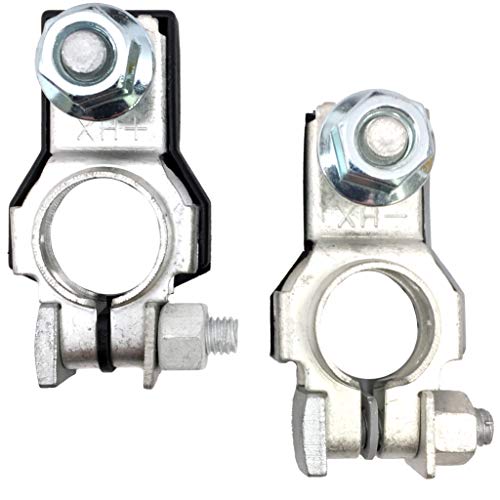
Positive and Negative Terminal Assemblies - 1 Each with M8 Nut
1. Locate the Battery and Inspect the Area
Open the hood and locate the conventional 12-volt battery. If the battery is not clearly accessible under the hood, stop; this procedure does not apply. Before touching the terminals, inspect the case, cables, hold-down, and tray. If you see heavy corrosion, damaged cables, a loose battery, or signs of leakage, use professional service.
2. Disconnect the Negative Terminal First
Confirm the negative (-) marking on the battery, then use the correctly sized socket or wrench to loosen that terminal. Lift the cable off the post and move it away so it cannot spring back into contact. Do not rely on cable color alone if the wiring has ever been repaired. Removing the negative cable first reduces the chance that a tool touching the positive side will complete a circuit through the truck’s body.
3. Disconnect the Positive Terminal
Confirm the positive (+) marking, remove any positive-terminal cover, then loosen and lift off the positive terminal. Do not let your wrench touch the positive post and a metal body part at the same time. If the clamp is stuck, use a terminal puller rather than twisting hard enough to damage the post. Move the positive cable aside and keep the cover for reinstallation.
4. Remove the Battery Hold-Down
Remove the battery tie-down, clamp, or bracket. Keep the hardware together so it does not fall into the engine bay. A missing or loose hold-down can let the battery vibrate, shorten battery life, and damage cables.
5. Lift Out the Old Battery
Lift the battery straight up with both hands or with its built-in handle if it has one. Car batteries are heavy, so keep your back straight and ask for help if needed. Set the old battery upright on cardboard or another stable surface. Never tip it over or place it where it can fall.
Clean and Prepare the Battery Tray
Before installing the new battery, clean the tray and cable ends. Light corrosion can often be removed with a battery terminal brush. If corrosion is heavy, wear eye protection and use a battery-safe cleaning method rather than scraping aggressively around acid residue.
Check the battery cables for cracking, looseness, frayed strands, or green/white corrosion that has moved under the insulation. A new battery will not fix a damaged cable, poor ground, failing alternator, or parasitic draw.
Pro Tip: Take a photo of the battery before removal. The picture gives you a quick reference for terminal orientation, cable routing, hold-down placement, and any sensor or vent connection.
How Do You Install the New Tacoma Battery?
Place the new battery in the tray with the positive and negative posts facing the same direction as the original battery. Make sure the battery sits flat and does not pinch any cables, wiring, or vent tubes.
- Install the hold-down first. Refit the battery tie-down, clamp, or bracket. Use the model-specific service-manual torque when available; otherwise tighten only until the battery cannot slide or bounce. Do not guess at a universal torque or overtighten enough to damage the case.
- Connect the positive terminal first. Push the positive terminal fully down on the positive post, then tighten it until snug. Reinstall the positive terminal cover.
- Connect the negative terminal last. Push the negative terminal fully down on the negative post and tighten it until snug.
- Check cable movement. Gently wiggle each terminal by hand. The terminals should not rotate or lift off the posts.
- Apply corrosion protection. If using terminal protector spray, grease, or washers, follow the product directions and keep the connection clean and tight.
[Products Worth Considering]
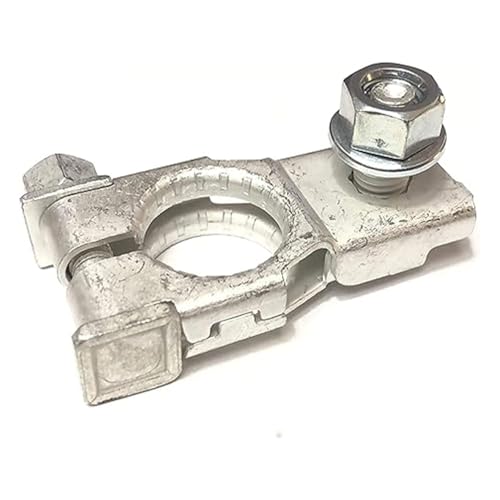
Perfect OEM Replacement (90982-05054): Designed to match the exact specifications of the original 18mm positive battery terminal for reliable fit and performance.

Battery Terminal

𝟵𝟬𝟵𝟴𝟮-𝟬𝟱𝟬𝟲𝟭 Positive Battery Terminal
Which Tacoma Battery Terminal Do You Connect First?
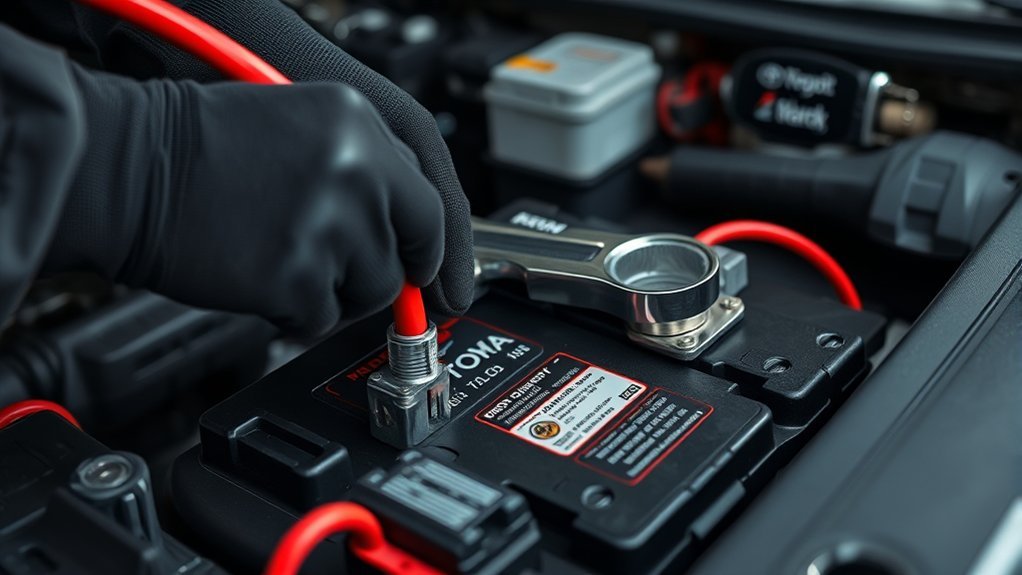
The safe reconnection order is the reverse of removal: positive first, negative last. This helps reduce the chance of an accidental short. Tighten the terminals enough that they are secure, but avoid crushing the terminal clamp or stripping the fastener.
| Step | Action | Why It Matters |
|---|---|---|
| 1 | Connect positive terminal | Restores power path while the ground is still disconnected |
| 2 | Tighten snugly | Prevents no-starts, flickering lights, and voltage drops |
| 3 | Install positive cover | Helps prevent accidental contact with metal tools or parts |
| 4 | Connect negative terminal | Completes the circuit only after the positive side is secure |
Verify Your New Battery Installation
Once the new battery is installed, perform a quick check before driving:
- Confirm the battery is seated flat and secured by the hold-down.
- Make sure both terminal clamps are tight and fully seated.
- Verify the positive terminal cover is back in place.
- Start the truck and watch for warning lights that remain on.
- Check headlights, interior lights, locks, windows, and infotainment power.
- Reset the clock, radio presets, window auto-up/down function, or other saved settings if needed.
Battery disconnection can clear stored settings or require model-specific initialization. Toyota’s 2024 Tacoma owner information lists PKSB (Parking Support Brake), when equipped, as requiring initialization after the battery is reconnected or changed. Requirements vary by year and equipment, so check the initialization section for your exact Tacoma. If warning lights remain, the truck will not start, or a camera, smart-key, window, power-tailgate, or parking-support feature does not return to normal, diagnose the problem before driving.
How to Test the Battery and Charging System
A multimeter can help screen battery charge, but it cannot measure the battery’s full cranking ability. Test resting voltage after the truck has been off long enough for recent charging and surface charge to settle. Temperature also affects the reading. Use the table as a first check, then confirm weak or inconsistent results with a load test and a model-specific charging-system test.
| Reading or Symptom | Likely Meaning | Next Step |
|---|---|---|
| About 12.6 volts or higher at rest | Battery is likely fully charged | Load test if starting problems continue |
| Below about 12.4 volts at rest | Battery may be undercharged | Charge and retest, then inspect charging system |
| Slow crank with decent voltage | Possible weak battery, starter issue, or cable resistance | Perform a load test and inspect terminals/cables |
| Battery keeps dying | Possible parasitic draw, bad alternator, or weak battery | Have the charging system and draw tested |
| Often about 13.5 to 14.5 volts with a gas engine running | The conventional charging system is likely adding voltage | Smart charging can vary; compare with model-specific service data |
| Tacoma Hybrid in READY mode | Do not judge it by a gas-model alternator rule | Use Toyota’s hybrid-specific test procedure or qualified service |
A resting voltage check is a useful first screen. A load test is the better way to confirm whether a Tacoma battery can still deliver starting current reliably.
Avoid These Battery Replacement Mistakes
Most battery-replacement problems come from rushing, using the wrong replacement battery, or ignoring terminal order. Avoid these common mistakes:
Ignoring Terminal Order
For this negative-ground Tacoma procedure, do not remove the positive terminal first. During removal, disconnect negative first, positive second. During installation, connect positive first, negative second. This order reduces the chance of sparks and accidental tool shorts.
Installing the Wrong Battery
A battery can look close and still be wrong. If the case is too small, the hold-down may not secure it. If the posts are reversed, the cables may be stretched or connected incorrectly. If the battery type or CCA rating is wrong, starting performance and service life may suffer.
Leaving the Hold-Down Loose
The battery must not move when the truck hits bumps or rough roads. Vibration is hard on batteries and can damage plates, cables, and terminals. Tighten the hold-down securely without cracking the case.
Overtightening the Terminals
Battery terminals should be snug, not crushed. Overtightening can distort the clamp or damage the post, while undertightening can cause intermittent power loss, flickering lights, and no-start conditions.
Replacing the Battery Without Finding the Cause
A dead battery can be the result of an old battery, but it can also follow an alternator fault, loose ground, corroded cable, lights left on, or excessive key-off draw. If a correctly fitted new battery loses charge again, stop replacing batteries and test the charging system and parasitic draw.
Skipping the Final Test
Do not close the hood or reinstall trim until the truck starts and the electrical system checks out. Catching a loose cable immediately is much easier than diagnosing it later in a parking lot.
Troubleshooting Common Battery Issues
If your Tacoma still struggles after a battery replacement, the battery may not be the only problem. Use the symptoms below to narrow your next step.
| Issue | Common Symptoms | What to Check |
|---|---|---|
| Loose terminal | Clicking, flickering lights, intermittent no-start | Retighten and fully seat both terminals |
| Corroded connection | Slow crank, dim lights, voltage drop | Clean posts, clamps, and ground connection |
| Weak new battery | Slow start soon after installation | Charge and load test the battery |
| Charging-system issue | Battery warning light, repeat dead battery | Gas model: test alternator and belt; hybrid: use the Toyota-specific charging-system procedure |
| Parasitic draw | Battery dies overnight or after sitting | Test for excessive key-off current draw |
| Wrong battery fitment | Poor hold-down fit, stretched cables, weak cold starts | Verify group size, CCA, type, and terminal layout |
If the new battery repeatedly loses charge, use the symptom pattern to choose the next test instead of replacing parts at random. See the Tacoma parasitic battery drain guide for key-off draw diagnosis. For a conventional gas Tacoma, the Tacoma alternator multimeter guide explains a basic charging check.
How to Dispose of the Old Battery
Do not put the old battery in household trash. Lead-acid automotive batteries should be recycled through a battery retailer, Toyota dealer, scrap recycler, or local household hazardous waste program. Many stores charge a refundable core deposit when you buy a new battery and refund it when you return the old one.
Keep the old battery upright during transport. Place it in a sturdy box or plastic tray if available, and do not carry it inside the passenger compartment if it is leaking or damaged.
Frequently Asked Questions
How do I know if my Toyota Tacoma battery needs replacement?
Common signs include slow cranking, clicking when you try to start, dim lights, battery warning messages, frequent jump-starts, corrosion, a swollen case, or a battery that fails a load or conductance test. Battery age alone does not prove failure, but testing becomes more useful as the battery approaches the common three-to-five-year range.
Can I replace a Tacoma battery without professional help?
Yes, many owners can replace a Tacoma battery with basic hand tools and safety gear. Do the job yourself only if you can identify the correct battery, access it safely, follow the terminal order, and secure the hold-down properly. Use a technician if the battery is leaking, swollen, hard to access, or tied into sensors you are unsure about.
What is the average lifespan of a Toyota Tacoma battery?
Most 12-volt automotive batteries last about three to five years, but Tacoma battery life depends on heat, vibration, short trips, accessory use, battery type, and charging-system health. Hot climates and long periods of sitting can shorten battery life. See the Tacoma battery lifespan and testing guide for a fuller diagnosis checklist.
What battery size does a Toyota Tacoma use?
There is no safe one-size answer for every Tacoma year and powertrain. Match the replacement by VIN and verify the group size, physical dimensions, terminal orientation, hold-down fit, CCA requirement, battery type, and any vent or sensor connection against the battery already installed and Toyota fitment information.
Where is the battery on a Toyota Tacoma?
Many non-hybrid Toyota Tacoma models have the 12-volt battery in the engine bay. A Tacoma Hybrid may place its 12-volt battery behind interior trim and uses a different charging architecture, so do not apply the under-hood replacement steps. Confirm the exact year and powertrain in the owner’s manual and use qualified service for hybrid battery access.
Will replacing the battery reset my Tacoma’s settings?
It can. You may need to reset the clock, infotainment preferences, radio presets, window auto functions, or other saved settings. Some model years also list equipment-specific initialization after the battery is reinstalled, so check the owner’s manual if a camera, parking-assist, smart-key, or window function does not return to normal.
What voltage should a healthy Tacoma battery show?
A fully charged 12-volt battery commonly reads around 12.6 volts or slightly higher at rest. A lower reading may mean the battery needs charging, but voltage alone does not prove the battery is good. A load test is the better check if the truck cranks slowly or repeatedly needs a jump-start.
Where can I dispose of the old battery?
Return it to the store where you bought the new battery, a Toyota dealer, an auto-parts retailer, a battery recycler, or a local household hazardous waste collection site. Keep it upright during transport and never place it in household trash.
Which battery terminal should I remove first on a Tacoma?
Remove the negative terminal first, then the positive terminal. During installation, reverse the order by connecting positive first and negative last. This order lowers the risk of sparks and accidental tool shorts.
Can I use this procedure on a Toyota Tacoma Hybrid?
No. The step-by-step procedure in this article is for an accessible under-hood 12-volt battery. A Tacoma Hybrid uses a different layout and charging architecture, and its 12-volt battery may require interior-trim access and model-specific precautions. Follow the exact hybrid owner’s manual or use a qualified Toyota technician.
Do I need a memory saver before replacing a Tacoma battery?
A memory saver is optional. Use one only if you understand its instructions and know it is safe for your Tacoma. If you skip it, you may need to reset the clock, radio presets, window auto functions, or infotainment settings afterward.
Conclusion
Replacing a Toyota Tacoma battery is a reasonable DIY job when the 12-volt battery is accessible under the hood, undamaged, and matched by VIN and physical fit. Protect your eyes and hands, disconnect negative before positive, keep the battery upright, secure the hold-down, reconnect positive before negative, and check the owner’s manual for initialization steps. Do not use this procedure for a Tacoma Hybrid battery behind interior trim. If the truck still cranks slowly or loses charge again, test the battery, cables, charging system, and key-off draw instead of replacing parts at random.
Sources
- Toyota: How to Replace a Car Battery — supports general safety, terminal order, and replacement workflow.
- Toyota Owners: 2024 Tacoma battery discharge guidance — supports Tacoma-specific battery-reconnect cautions.
- Toyota Owners: 2024 Tacoma items to initialize — identifies PKSB, when equipped, as requiring initialization after the battery is reconnected or changed.
- Toyota Owners: 2025 Tacoma Hybrid 12-volt battery — supports checking hybrid 12-volt battery location and safety notes.
- AutoZone: Car Battery Voltage Guide — supports resting-voltage ranges and multimeter testing context.
- Interstate Batteries: Car Battery Lifespan — supports the 3–5 year general battery-life range and lifespan variables.
- U.S. EPA: Lead-Acid Battery Collection Network — supports proper recycling and disposal guidance.


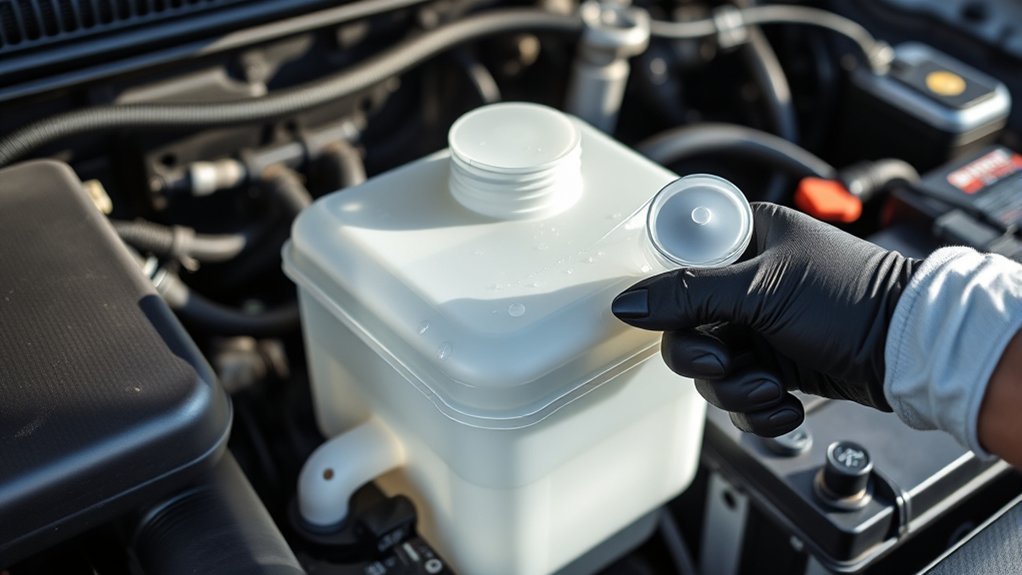

[…] For a complete tool list, safety procedure, and model-specific cautions, read the Toyota Tacoma battery replacement guide. […]
[…] healthy 12-volt battery should be charged and tested first; low charge or a weak battery can look like a parasitic […]