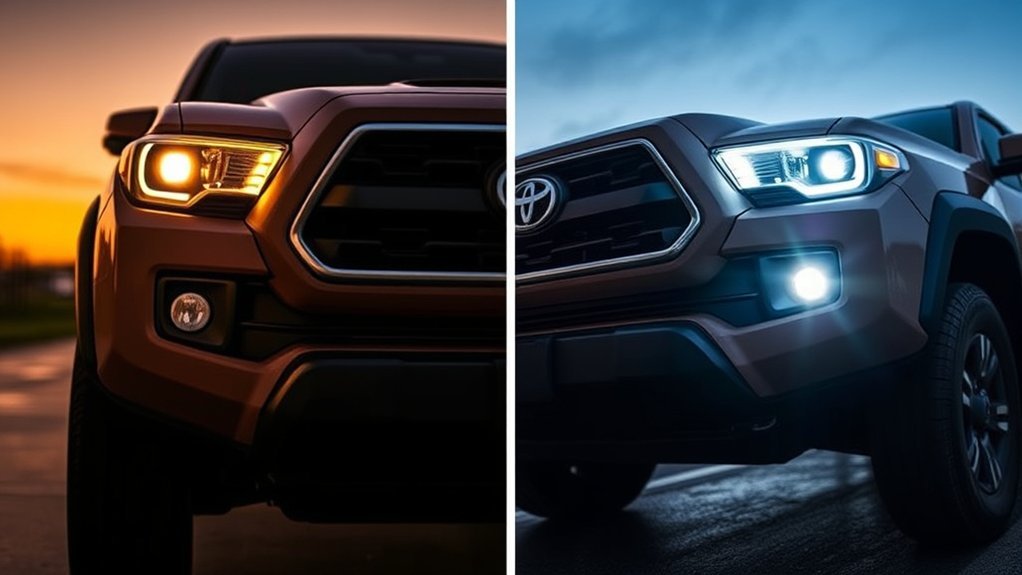
Choosing between halogen and LED headlights for your Toyota Tacoma is not just a “brighter is better” decision. The best choice depends on your Tacoma’s model year, factory headlight housing, local lighting rules, driving conditions, and whether you are replacing a bulb or upgrading the entire headlight assembly.
Quick Answer
For most Tacoma owners, quality halogen bulbs are the safest simple replacement in factory halogen housings. Factory-style LED headlight assemblies can be a strong upgrade, but plug-in LED bulbs placed inside halogen housings can cause glare, poor beam patterns, and possible compliance issues.
Key Takeaways
- Beam pattern and proper aim matter more than advertised lumen numbers.
- Halogen bulbs are usually cheaper, simple to replace, and well matched to Tacoma halogen housings.
- LEDs work best when they are part of a properly engineered LED headlight assembly, not just a random bulb swap.
- Check your Tacoma owner’s manual and headlight label before ordering bulbs, because bulb type and factory lighting vary by year and trim.
- Any headlight upgrade should avoid glare and comply with FMVSS No. 108 and your local vehicle-lighting rules.
At a Glance
| Best Simple Replacement | Quality OEM-style halogen bulbs in factory halogen housings |
| Best Full Upgrade | DOT-marked, Tacoma-specific LED headlight assemblies |
| Main Risk | Poor beam pattern or glare from incompatible LED retrofit bulbs |
| Tools Needed | Gloves, basic hand tools, owner’s manual, and a flat wall or aiming surface |
| Cost Range | Lowest for halogen bulbs; higher for complete LED assemblies |
Understanding Halogen and LED Headlights for Tacoma
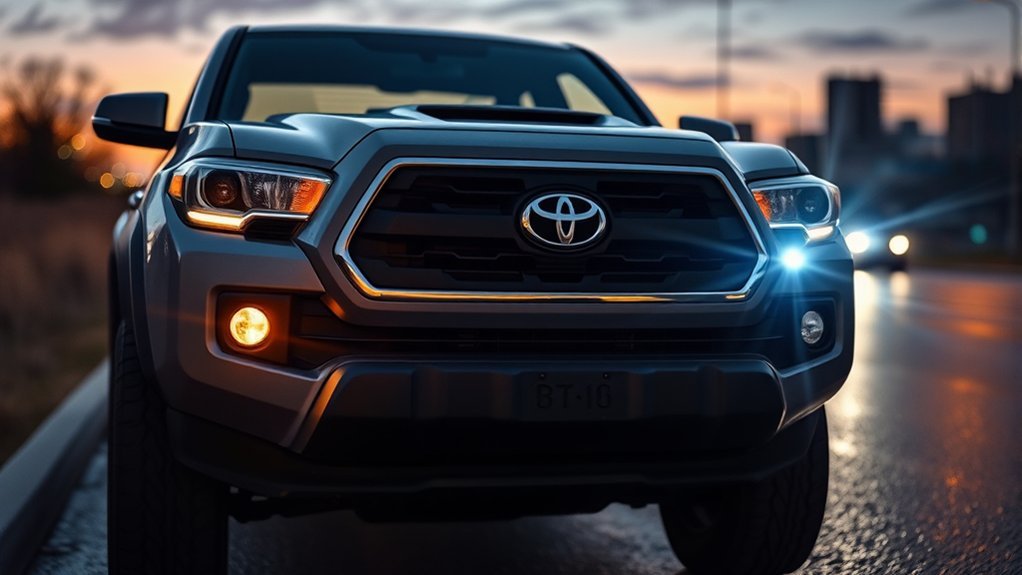
Halogen headlights use a heated filament inside a gas-filled bulb. Many Tacoma models with factory halogen lighting use replaceable halogen bulbs, and common H11 halogen bulbs are typically rated at 12 volts and 55 watts, as shown in manufacturer specifications such as the Philips H11 LongLife EcoVision listing. They are affordable, easy to replace, and designed to work with the reflector or projector optics already built into the headlight housing.
LED headlights use light-emitting diodes instead of a filament. A well-designed factory LED system can be efficient, durable, and bright, but the important phrase is “well-designed.” LEDs are highly directional, so the exact location and shape of the light source must match the headlight optics. When an LED bulb is installed in a housing engineered for a halogen filament, the beam may scatter, create dark spots, or send glare toward oncoming traffic.
The safest way to compare halogen vs. LED headlights for a Tacoma is to separate two upgrades: replacing a bulb and replacing the whole headlight assembly. A direct halogen-to-halogen bulb replacement is usually straightforward. A proper LED upgrade is usually best done with a complete Tacoma-specific LED assembly that has been engineered, tested, and marked for road use.
Warning: Do not assume a plug-in LED bulb is legal or safe just because it fits the socket. The headlight assembly, light source, beam pattern, and markings all matter.
Key Differences in Performance: Halogen vs. LED
Halogen and LED headlights perform differently in brightness, efficiency, color, heat, beam control, and long-term value. The biggest mistake is judging them only by advertised lumens. A bulb can claim a high lumen number and still perform poorly if the headlight housing cannot focus that light correctly.
| Factor | Halogen Headlights | LED Headlights |
|---|---|---|
| Best Use | Simple OEM-style replacement | Factory LED or complete engineered LED assembly |
| Beam Pattern | Usually predictable in halogen housings | Excellent when designed correctly; poor if mismatched |
| Color | Warmer, often around 3000K | Cooler white, commonly marketed around 5000K–6500K |
| Efficiency | Uses more power and creates more heat | Uses less power for the same useful output when properly designed |
| Cost | Lower upfront cost | Higher for quality assemblies |
| Weather Behavior | Heat can help reduce snow and ice buildup | Lens may stay cooler, so snow and ice may need more cleaning |
A standard H11 halogen bulb is commonly listed near 55 watts, and many OEM-style H11 bulbs are rated around 1,350 lumens depending on the specific product and standard. LEDs can be more efficient, but the useful light on the road depends on beam control, not just the raw light produced by the diodes.
The real test is not how bright the bulb looks in your hand. It is how evenly the headlight lights the road without glaring into other drivers’ eyes.
Installation Challenges: Halogen vs. LED
Halogen replacement is usually the easier path. If your Tacoma came with halogen headlights and you are replacing the bulb with the correct OEM-style bulb, the job often involves accessing the back of the headlight, removing the connector, twisting or unlocking the old bulb, and installing the new one without touching the glass.
LED upgrades can be more complicated. Some LED bulbs include heat sinks, drivers, fans, or external modules that may not fit cleanly behind the Tacoma headlight housing. Even if they physically fit, the LED chips may not sit in the same optical position as the original halogen filament. That difference can change the beam cutoff and throw light where it should not go.
Complete LED headlight assemblies are usually the better upgrade route when you want LED performance. They cost more, but the optics, LED placement, reflector or projector design, and cutoff are engineered together. Before buying, confirm the assembly fits your Tacoma’s exact year, trim, wiring, and factory lighting package.
Note: Use the official Toyota owner’s manual and warranty manuals page to confirm bulb type and service guidance for your exact Tacoma model year.
[Products Worth Considering]

Upgrade your vehicle’s fog lighting with bright, reliable illumination designed for clearer visibility in fog, rain, and snow. This compact LED bulb offers a factory-style fit for fast installation, long service life, and broad compatibility with many cars, trucks, and SUVs. Its sealed construction and built-in CANbus support help deliver dependable performance in harsh driving conditions.

AUXITO LED fog light bulbs deliver bright amber-yellow illumination with a focused beam designed to improve visibility in fog, rain, and snow. The fanless, compact build helps manage heat quietly and reliably, while the plug-and-play design makes installation quick and easy. Built for broad vehicle compatibility, these bulbs provide a safer, clearer driving experience with Canbus-ready performance and waterproof protection.

AUXITO H11/H8/H16 LED fog light bulbs deliver bright cool white illumination to improve nighttime visibility and help you see farther in poor weather. Designed with CSP LED chips, a fanless aluminum body, and a safe 1:1 beam pattern, they offer easy plug-and-play installation, strong waterproofing, and broad vehicle compatibility for fog lights and DRL use.
Heat Management: Impact on LED and Halogen Performance
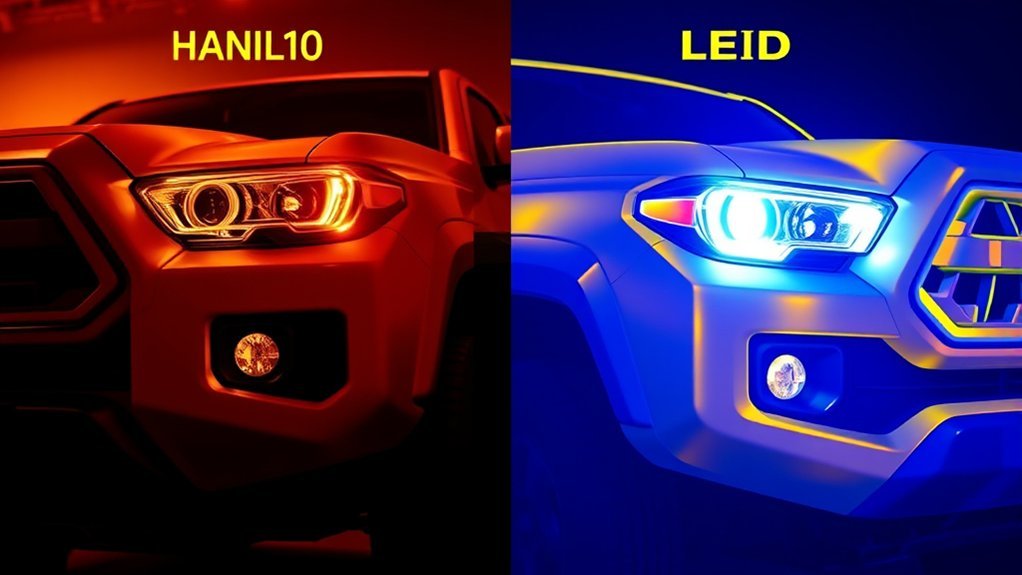
Halogen bulbs create a lot of heat because the filament must get extremely hot to produce light. That heat is one reason halogens use more power and have a shorter service life than many LED systems. It also means the headlight lens area may warm up more than an LED lens, which can help reduce light snow or ice buildup in cold weather.
LEDs are more efficient, but they are not heat-free. The heat is concentrated at the electronics and LED chips, so quality heat sinks and thermal design are critical. If an LED bulb or assembly cannot manage heat properly, light output can drop and the electronics may fail early.
Fan-cooled LED bulbs may look impressive, but fans add another failure point. Passive heat sinks can be more durable when they fit correctly, but they still need enough space and airflow. In tight Tacoma headlight housings, fitment and cooling should be checked before relying on any aftermarket LED bulb.
Pro Tip: Replace halogen bulbs in pairs. If one bulb is old enough to fail, the other is usually close behind, and a matched pair gives more even color and output.
Weather Performance: How Headlights Perform in Adverse Conditions
In rain, fog, snow, and dusty trail conditions, the best headlight is not always the whitest or brightest one. Beam pattern, aim, and glare control matter more. A cooler LED color can look crisp on dry pavement, but in heavy rain or snow, some drivers find warmer halogen light more comfortable because it creates less harsh backscatter.
Halogen headlights also produce more forward heat, which may help slow light snow or ice buildup on the lens. That does not make halogens perfect winter lights, and you still need to keep the lenses clean, but it is a practical advantage in freezing conditions.
LED headlights can still perform very well in bad weather when they are part of a proper assembly with a controlled beam pattern. The problem is usually not LED technology itself; it is mismatched LED retrofit bulbs installed in housings that were never designed for them.
Understanding Beam Patterns: Why They Matter
Beam pattern is the shape and placement of light on the road. A good low beam gives you enough distance and width to see safely while keeping a sharp cutoff that protects oncoming drivers from glare. The IIHS headlight evaluation specifically measures both road illumination and glare, which shows why aim and beam control are just as important as brightness.
Beam Pattern Importance
Halogen bulbs are built around a small filament in a precise location. A halogen reflector or projector housing is designed around that filament. When you install the correct bulb, the optics can place light where the manufacturer intended.
LED bulbs use chips that may be larger, flatter, offset, or arranged differently from a filament. If the LED chips do not mimic the halogen filament location closely enough, the headlight may create bright hot spots, dark gaps, or glare above the cutoff line.
Light Distribution Effects
Good light distribution gives you useful visibility without wasting light. Excessive foreground light can make the road directly in front of the bumper look bright while reducing your ability to see farther ahead. Too much light above the cutoff can dazzle oncoming drivers and reduce safety for everyone.
| Headlight Setup | Likely Result | Best Practice |
|---|---|---|
| Correct halogen bulb in halogen housing | Predictable beam and cutoff | Use quality bulbs and aim properly |
| LED bulb in halogen housing | Can create glare or uneven light | Avoid unless tested and compliant for that housing |
| Complete LED assembly | Best LED beam control when properly designed | Choose Tacoma-specific, road-compliant assemblies |
| Lifted Tacoma with stock aim | Low beams may shine too high | Re-aim headlights after suspension changes |
Visibility and Safety Factors
Visibility is a balance between seeing farther and not blinding others. After installing new bulbs, replacing assemblies, lifting your Tacoma, or adding weight to the rear suspension, check the headlight aim. Even a good headlight can become unsafe if it points too high.
Also inspect the lens condition. Cloudy, oxidized, or scratched headlight lenses can ruin the beam pattern no matter what bulb you install. Restoring or replacing worn housings may improve nighttime visibility more than switching bulb types.
Cost vs. Value: Comparing Headlight Options
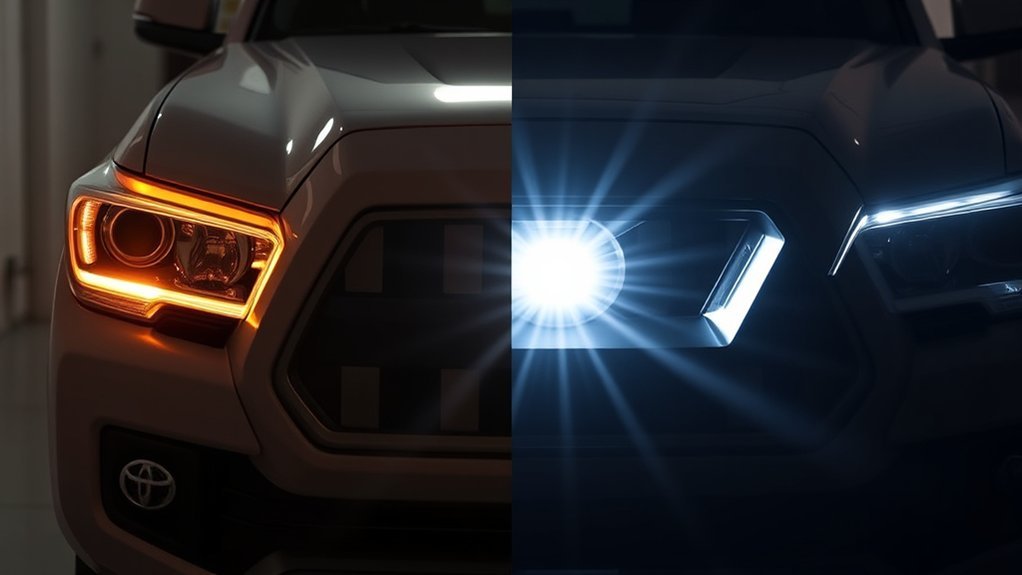
Halogen bulbs usually win on upfront cost. They are widely available, simple to replace, and compatible with factory halogen housings when you buy the correct type. If your main goal is restoring original nighttime visibility, a fresh pair of quality halogen bulbs is often the best value.
LEDs can win on efficiency and lifespan when they are part of a properly engineered system. A complete LED assembly costs more, but it may provide better durability, a modern appearance, and strong light output with good beam control. The value depends on the quality of the assembly, not just the word “LED” in the product name.
Cheap LED retrofit bulbs can be a false economy. They may look bright in the driveway but perform poorly on the road, fail early from heat, or create glare. If you drive often at night, on rural roads, or in bad weather, the safest upgrade is the one that improves useful road illumination while keeping a clean cutoff.
[Products Worth Considering]

These SEALIGHT H10 LED fog light bulbs deliver bright 6000K xenon white illumination with a focused beam pattern that helps improve visibility without dazzling oncoming traffic. Their compact, halogen-like size makes installation quick and simple, while non-polarity plug-and-play design supports easy replacement for a wide range of compatible vehicles. Built with aluminum heat dissipation and long service life, they are a practical upgrade for fog lights, turn signals, or DRLs.

SYLVANIA SilverStar Ultra H11 halogen bulbs are designed to deliver brighter down-road visibility and a whiter light for improved clarity at night. Patented Tri-Band Technology enhances contrast to help you spot road signs and hazards more easily, while replacing bulbs in pairs supports more consistent performance. Built for exact-fit compatibility in H11 applications, this two-bulb pack is a practical upgrade for safer nighttime driving.

Fitment: Headlights Compatible with Toyota Tacoma 2005 2006 2007 2008 2009 2010 2011. Interchange Part Number: 8115004163, 8111004163, 8115004173, 8111004173, TO2502157, TO2503157, TO2503181, TO2503181
Legal and Safety Checks Before You Upgrade
In the United States, vehicle lighting is regulated under Federal Motor Vehicle Safety Standard No. 108. Replacement headlamps and lighting equipment must meet applicable requirements, and compliant headlamp lenses or assemblies are marked accordingly. NHTSA has also addressed aftermarket LED headlight concerns in interpretation letters, including its LED headlight interpretation.
For Tacoma owners, the practical takeaway is simple: a bulb that fits the socket is not automatically compliant. Look for road-use markings on the assembly, buy from reputable manufacturers, and avoid products marketed only for “off-road use” if you plan to use them on public roads.
- Confirm your bulb type in the owner’s manual before buying.
- Choose DOT-marked headlight assemblies where required.
- Do not use off-road-only lights as low beams on public roads.
- Re-aim headlights after installation, suspension lifts, or heavy rear load changes.
- Test the beam pattern against a wall before driving at night.
Which Headlights Should You Choose for Your Tacoma?
Choose halogen headlights if you want the easiest, lowest-risk replacement for a Tacoma that came with halogen lights. A quality OEM-style halogen bulb keeps the beam pattern predictable, avoids most fitment headaches, and works well for daily driving.
Choose a complete LED headlight assembly if you want a more modern upgrade and are willing to pay for a proper Tacoma-specific setup. This is the better route for LED performance because the light source and optics are designed together.
Be cautious with plug-in LED bulbs for halogen housings. Some may fit physically, but fitment is only one part of the equation. The beam pattern, heat management, electrical compatibility, and road-use compliance all matter.
| Your Priority | Best Choice | Why |
|---|---|---|
| Lowest cost | Halogen replacement bulbs | Affordable and easy to find |
| Least installation hassle | Correct OEM-style halogen bulbs | Designed for the factory housing |
| Modern look | Complete LED assemblies | Cleaner styling and integrated optics |
| Best glare control | Properly aimed compliant assemblies | Beam pattern matters most |
| Snow and freezing conditions | Halogen or heated/quality LED assembly | Cool LED lenses can collect ice more easily |
[Products Worth Considering]

Fitment: Headlights Compatible with Toyota Tacoma 2005 2006 2007 2008 2009 2010 2011. Interchange Part Number: 8115004163, 8111004163, 8115004173, 8111004173, TO2502157, TO2503157, TO2503181, TO2503181

[Fit For] - 97-00 Toyota Tacoma 2WD; [NOT Fit For] - Tacoma Prerunner & 4WD Trims

Fitment - Headlights Compatible with Toyota Tacoma 2005 2006 2007 2008 2009 2010 2011
Final Thoughts on Choosing Headlights
Choosing the right headlights for your Tacoma comes down to more than brightness. Halogen headlights are affordable, reliable, and well matched to factory halogen housings. LED headlights can be excellent when they are engineered as a complete system, but random LED bulb swaps can create glare, uneven lighting, and compliance problems.
If you want a simple replacement, install the correct quality halogen bulbs and aim them properly. If you want a serious LED upgrade, choose a Tacoma-specific complete LED assembly from a reputable brand and verify that it is intended for road use. Either way, the goal is the same: a clean beam pattern, safe visibility, and less glare for everyone on the road.
Frequently Asked Questions
Why upgrade headlights on a Toyota Tacoma?
Upgrading or refreshing Tacoma headlights can improve nighttime visibility, restore output from old bulbs, modernize the truck’s appearance, and make bad-weather driving more comfortable. The safest upgrade is one that improves the beam pattern without adding glare.
Can I put LED bulbs in Tacoma halogen headlights?
You may find LED bulbs that physically fit, but that does not mean they will perform correctly or comply with road-use rules. Halogen housings are designed around a filament, so LED retrofit bulbs can create glare or uneven light unless the product is specifically engineered and compliant for that application.
Are halogen headlights better than LED headlights in snow?
Halogens can have an advantage in snow because they create more heat near the headlight, which may help reduce ice or snow buildup. However, a properly designed LED assembly can still perform well. In winter weather, beam pattern, aim, lens cleanliness, and glare control matter more than bulb type alone.
Do LED headlights last longer than halogen bulbs?
Quality LED systems can last longer than halogen bulbs, but lifespan depends heavily on heat management, electronics, and build quality. Cheap LED retrofit bulbs can fail early if the driver, fan, or heat sink is poorly designed.
Do I need to aim my Tacoma headlights after replacing bulbs?
Yes, it is smart to check aim after replacing bulbs, installing new assemblies, lifting the truck, or changing suspension height. Proper aim helps you see farther without blinding oncoming drivers.
Sources
- eCFR — 49 CFR § 571.108, FMVSS No. 108 — federal lighting and headlamp requirements.
- NHTSA LED Headlights Interpretation — federal interpretation related to LED headlight compliance concerns.
- IIHS Headlight Test Information — explains how illumination and glare are evaluated.
- Toyota Owners Manuals and Warranties — official Toyota manual lookup for Tacoma owners.
- Philips H11 LongLife EcoVision Headlight Bulb — H11 bulb type and 12V/55W specification reference.