
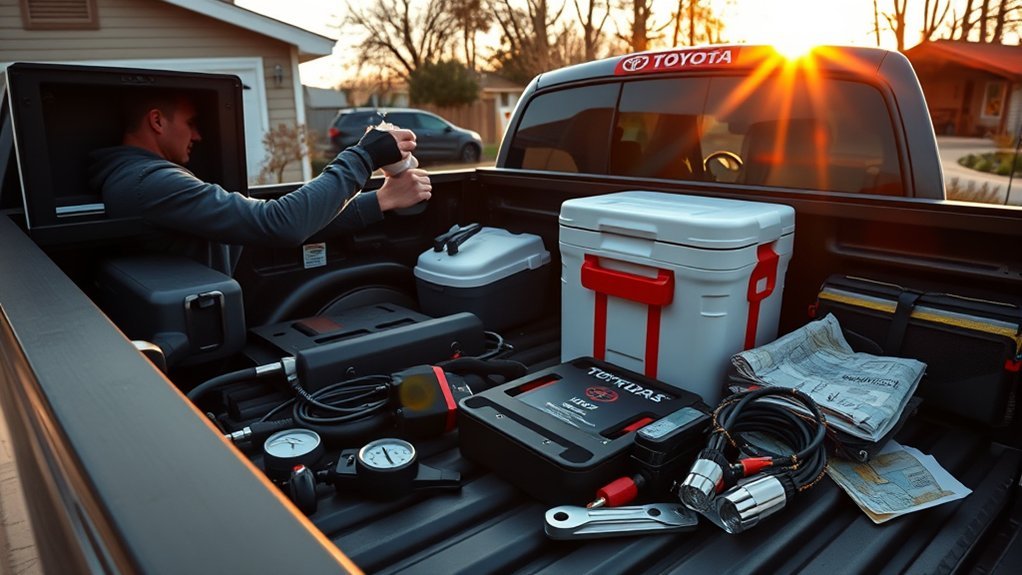
A long Toyota Tundra road trip is easier when you treat prep like a short inspection instead of a last-minute guess. Work on level ground, check the truck when it is cool, use your model-year owner’s manual for exact specifications, and fix anything that affects tires, braking, steering, cooling, charging, visibility, or load security before you leave.
Quick Answer
To prep a Toyota Tundra for a long trip, check all fluids, cold tire pressure, tread, spare tire, battery health, brakes, suspension, lights, wipers, HVAC, cargo tie-downs, and emergency gear. Use the door-jamb tire label and your owner’s manual for exact specs.
Key Takeaways
- Use the Tundra’s owner’s manual and Tire and Loading Information Label instead of relying on generic oil, tire pressure, or payload numbers.
- Check tires cold, inspect tread and age, and make sure the spare tire, jack, and lug tools are usable before departure.
- Test the battery, lights, wipers, HVAC, brakes, steering, suspension, and cargo tie-downs before the truck is fully loaded.
- Schedule professional service early if you are towing, hauling a camper top, driving off-road, or finding leaks, brake noise, steering play, or warning lights.
At a Glance
| Time Required | 30–60 minutes for DIY checks; longer if repairs are needed |
| Difficulty | Easy for visual checks; professional inspection recommended for brakes, suspension, leaks, and towing concerns |
| Tools Needed | Tire pressure gauge, tread depth gauge, flashlight, gloves, multimeter, basic tools, air compressor, owner’s manual |
| Cost | Mostly free if DIY; shop inspection and repairs vary by location and findings |
Quick Pre-Trip Checklist for Your Toyota Tundra
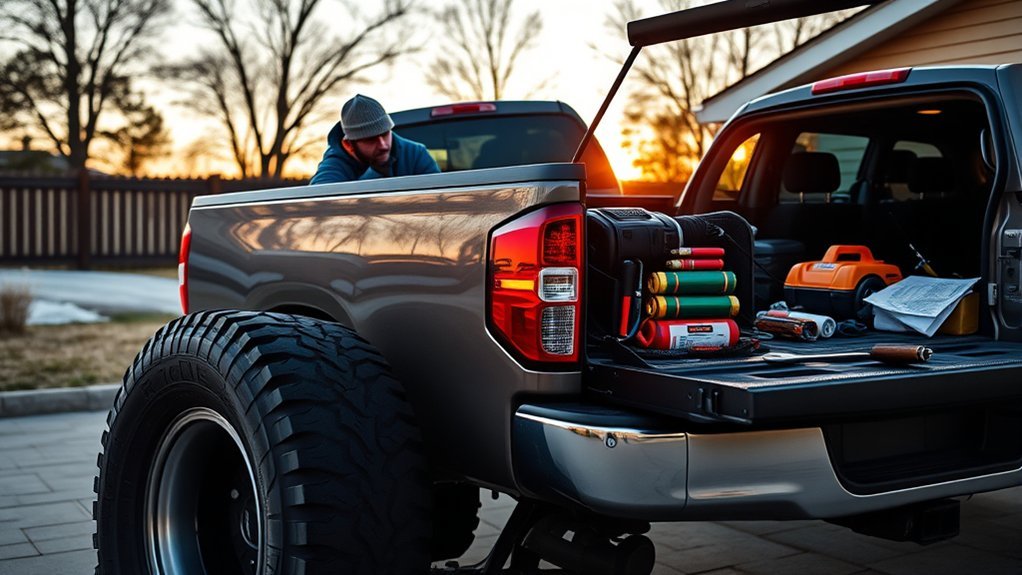
Start with the systems most likely to stop a trip: tires, fluids, battery, brakes, lights, wipers, and cargo security. Move around the truck slowly and use a written checklist so you do not miss the spare tire, trailer wiring, camper-top latches, or the underside of the truck.
- Check engine oil, coolant, brake fluid, washer fluid, and visible leaks.
- Set tire pressure when tires are cold, using the tire label on the driver’s door jamb or the owner’s manual.
- Measure tread depth and inspect sidewalls, valve stems, and the spare tire.
- Test the battery, clean terminals, and pack jump-start equipment.
- Inspect brake feel, steering response, suspension noise, lights, wipers, windshield, and HVAC.
- Confirm cargo weight, tie-downs, camper-top latches, trailer wiring, and emergency gear.
Note: Toyota recommends scheduled maintenance at regular mileage or time intervals, and the current maintenance guide for the Tundra uses 5,000-mile or six-month service points. Before a major road trip, check whether your truck is already due.
Confirm Model-Year Specs Before You Start
Do this before buying oil, coolant, brake fluid, tires, or towing gear. Tundra specifications vary by model year, drivetrain, trim, tire package, and whether the truck is gas or hybrid.
- Oil: Many late-model Tundras call for SAE 0W-20, but always verify the viscosity and oil grade in your model-year owner’s manual or on Toyota’s official manuals page.
- Tire pressure: Use the Tire and Loading Information Label on the driver’s door jamb, not the number molded into the tire sidewall.
- Payload: Use the truck’s tire/loading label and certification label to confirm how much combined passenger, cargo, hitch, trailer tongue weight, and camper/topper weight your specific truck can carry.
- Maintenance interval: Use Toyota’s maintenance guide for your year. Towing, heavy loading, off-road driving, dusty roads, and frequent short trips can require more frequent service.
Official Toyota manuals are available through Toyota Owners Manuals and Warranties. For newer Tundras, Toyota’s Warranty & Maintenance Guide is the best place to confirm factory maintenance intervals.
Schedule a Multi-Point Inspection
If your trip is more than a few hours, if you are towing, or if the truck is close to a service interval, schedule a multi-point inspection at least two to four weeks before departure. That gives you time to order parts and fix anything that affects safety.
Ask the technician to inspect brakes, brake lines, tires, suspension, steering linkage, ball joints, belts, hoses, wiper blades, lights, battery condition, fluid levels, visible leaks, and any towing or camper-top hardware. Toyota’s maintenance chart includes repeated inspections for fluid levels, brake linings/pads/discs, tire rotation, and wiper blades, so these checks fit normal factory maintenance rather than being optional extras.
Pro Tip: Bring your trip plan to the service visit. Tell the shop if you will tow, haul a rooftop box, carry a camper top, drive mountain grades, or travel off-road, because those conditions change what should be inspected.
Check Oil, Coolant, Transmission, and Other Fluids
Fluids protect the engine, brakes, transmission, cooling system, and visibility. Check them on level ground and follow the owner’s manual procedure, because some systems must be checked cold while others have specific temperature or service requirements.
Check Engine Oil
Check engine oil with the truck parked level. Follow the owner’s manual for whether the oil should be checked warm or after a waiting period. The oil should be between the dipstick marks, and it should not smell burnt, feel gritty, or appear milky.
For many late-model Tundras, Toyota specifies SAE 0W-20 engine oil, but the safe rule is simple: use the viscosity and grade listed for your exact model year. Under normal conditions, Toyota’s newer maintenance guidance allows oil and filter replacement by the listed interval, while severe conditions such as dusty-road driving or repeated short trips in freezing weather can require more frequent oil changes.
- Top off only with the correct oil type.
- Change the oil before the trip if it is due during the trip.
- Carry one quart of the correct oil if you will be far from service centers.
- Do not ignore oil pressure warnings, burning smells, or visible oil leaks.
Inspect Coolant System
Check the coolant reservoir when the engine is cool. The level should sit between the low and full marks. Inspect the radiator area, hoses, clamps, intercooler plumbing if equipped, and the ground under the truck for dried residue or drips.
Warning: Never remove a radiator cap or coolant pressure cap when the engine is hot. Pressurized coolant can spray and cause serious burns. Hybrid and high-voltage components should be left to trained technicians.
Also inspect these fluids and systems:
- Brake fluid: The level should be within range and the fluid should not look dark or contaminated. Low brake fluid can indicate brake wear or a leak.
- Transmission fluid: Many newer transmissions are sealed or have specific service procedures. Do not guess; follow the owner’s manual or have a technician inspect leaks and service needs.
- Power steering fluid: If your model has a serviceable reservoir, check the level and look for leaks.
- Washer fluid: Fill it before the trip and test the spray pattern.
- Differential and transfer case: If you tow, drive off-road, or see seepage, have these inspected before a long trip.
Tires & Spare for Your Tundra: Pressure, Tread, Alignment
Tires carry the truck, passengers, cargo, trailer tongue weight, and any camper-top load. Check them carefully before you load the truck, then re-check pressure and handling after loading.
The National Highway Traffic Safety Administration recommends checking tire pressure on all tires, including the spare, when tires are cold. It also says the correct pressure is the vehicle manufacturer’s listed pressure on the door label or in the owner’s manual.
| Item | How to Check | Action Before Trip |
|---|---|---|
| Tire pressure | Use an accurate gauge when tires are cold | Set to the door-jamb label or owner’s manual spec |
| Tread depth | Use a tread depth gauge across the tire | Replace at 2/32 inch minimum; consider earlier for rain, snow, towing, or heavy loads |
| Sidewalls | Look for cuts, bulges, cracks, exposed cords, or embedded objects | Replace damaged tires before departure |
| Spare tire | Check pressure, age, tread, jack, lug wrench, and access | Inflate to the specified spare pressure and confirm the tools work |
| Alignment | Watch for pulling, vibration, steering-wheel offset, or uneven wear | Get an alignment or tire inspection before a long drive |
| Rotation | Check service records and tire wear | Rotate at the scheduled service interval unless your manual says otherwise |
A tire can look fine and still be unsafe. Pressure, tread depth, sidewall condition, tire age, and load rating all matter before a long Tundra trip.
[Products Worth Considering]
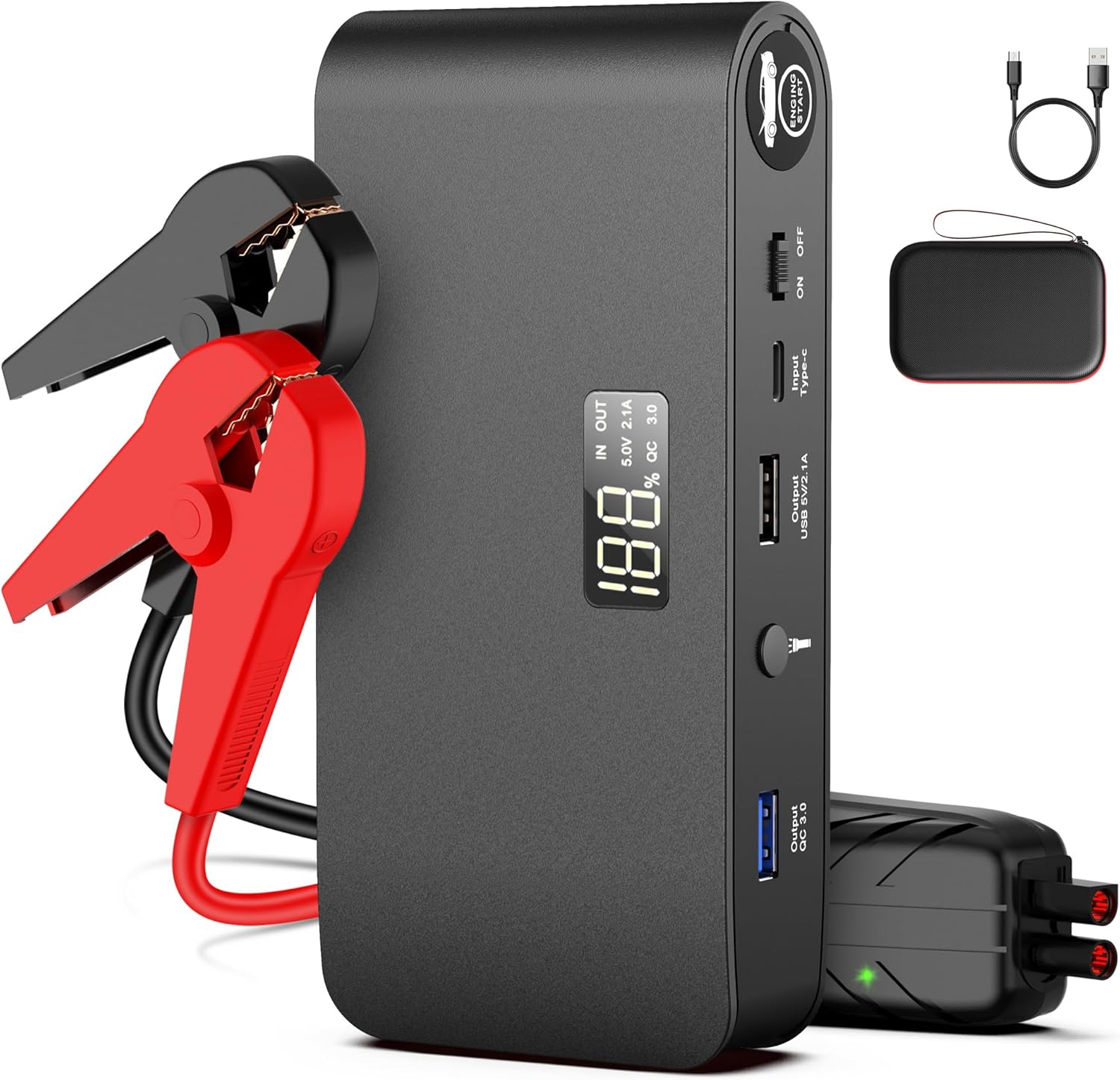
This portable jump starter delivers powerful 12V starting support for cars, trucks, boats, motorcycles, and more, helping you restart dead batteries in seconds. It also doubles as a high-capacity power bank with USB charging, plus a built-in LED flashlight with emergency modes for roadside and outdoor use. Smart safety protections and a rugged waterproof case make it a reliable companion for emergencies.

This portable jump starter delivers powerful starting performance for 12V vehicles with gas and diesel engines, helping revive dead batteries quickly in emergencies. It also doubles as a high-capacity power bank for charging phones and other USB devices, while its built-in multifunction light adds visibility for roadside repairs and outdoor use. Designed with rugged protection and multiple safety safeguards, it offers dependable, beginner-friendly support when you need it most.

The OXILAM jump starter delivers powerful emergency starting performance for gas engines and up to 12L diesel engines, helping revive dead batteries in seconds. It also doubles as a portable power bank and LED flashlight, with USB and Type-C ports for convenient device charging. Built with multiple safety protections, a clear LED display, and a rugged portable design, it is a reliable roadside companion for cars, trucks, motorcycles, and more.
Test the Battery and Prepare Jump-Start Options
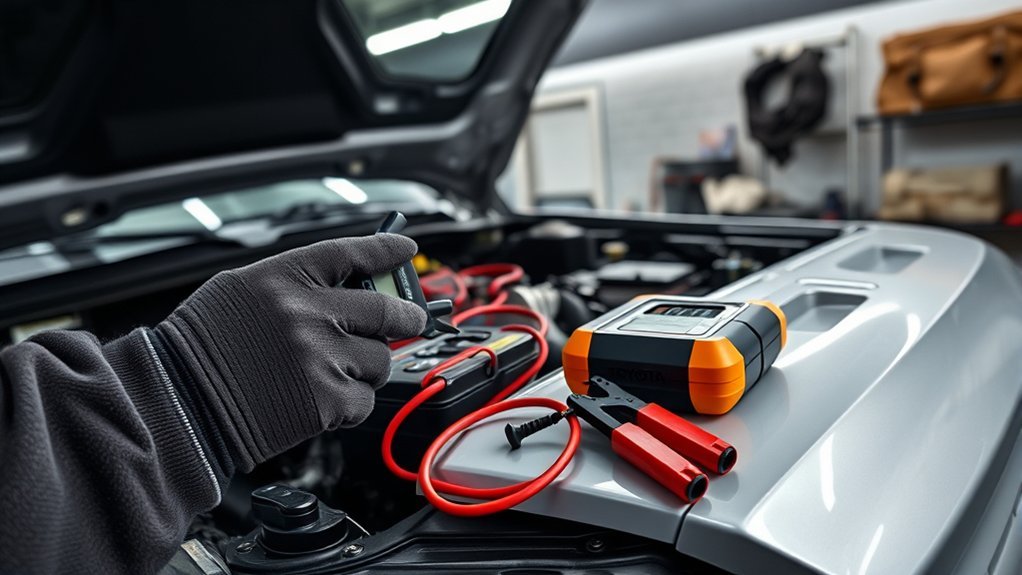
Battery trouble is one of the easiest problems to find before a trip. With the engine off, a healthy 12-volt battery is typically around 12.6 volts. With the engine running, the charging system is commonly around 14 volts. If your reading is well below that, or below about 12.4 volts at rest, have the battery and charging system tested before you leave.
AAA notes that car batteries often last three to five years depending on climate, driving habits, and parking conditions. Do not automatically replace a battery only because it is three years old, but start testing it regularly after that point and replace it if it fails a load test, cranks slowly, shows corrosion or swelling, or repeatedly needs a jump.
- Inspect the case for cracks, swelling, leaks, or a sulfur smell.
- Clean corrosion from terminals only when safe to do so and the battery is not leaking.
- Tighten loose connections.
- Pack jumper cables or a portable jump starter rated for a full-size truck.
- Know the jump-start sequence before you need it roadside.
Warning: Do not jump-start a frozen, leaking, swollen, or rotten-egg-smelling battery. Follow the Tundra owner’s manual and the jump starter instructions. When using jumper cables, the final negative connection is typically made to a solid, unpainted metal ground away from the discharged battery.
[Products Worth Considering]

This car emergency roadside assistance kit helps drivers handle unexpected breakdowns and roadside incidents with confidence. It includes jumper cables and a tire inflator to support quick, practical solutions in emergencies, while the compact bag keeps everything organized in the trunk. Ideal for new drivers, families, road trips, and seasonal travel, it is a thoughtful and useful safety essential for any vehicle.

TOPDC heavy duty jumper cables are designed to help drivers get a dependable boost when a battery runs down. The 20-foot length offers added reach for cars, SUVs, and trucks, while insulated serrated clamps provide a secure connection to top-post and side-terminal batteries. A flexible PVC jacket, carry bag, and included guide make these cables practical for everyday emergency use.

This dial type tire tread depth gauge helps you quickly check tread wear on motorcycles, cars, trucks, and buses with easy-to-read 1/32-inch increments. Its colorful zone markings make it simple to assess tire condition for safer driving in different weather, while the durable zinc cast body and legible dial provide dependable everyday use.
Check Brakes, Suspension, and Steering for Safety
Brakes, suspension, and steering determine how well the Tundra stops, tracks, and handles when loaded. Do not wait until you are descending a grade or pulling a trailer to discover brake pulsation, steering play, or worn suspension parts.
During your inspection, look and listen for:
- Brake squeal, grinding, pulsing, a soft pedal, pulling while braking, or a brake warning light.
- Fluid leaks near wheels, brake hoses, calipers, shocks, struts, or suspension joints.
- Clunks, wandering, vibration, or looseness in the steering wheel.
- Uneven tire wear that may point to alignment, suspension, or inflation problems.
- Damaged bushings, leaking shocks, worn ball joints, or torn dust boots.
Toyota’s maintenance guide calls for repeated inspection of brake linings, drums, pads, discs, steering gear, steering linkage, ball joints, and dust covers at scheduled intervals. If anything feels wrong, have a qualified technician inspect it before the trip.
Note: Secure the driver’s floor mat before departure. A stacked, loose, or wrong-size mat can interfere with pedals and create a serious safety risk.
Verify Lights, Wipers, HVAC, and Windshield Visibility
Visibility checks take only a few minutes, but they matter at night, in heavy rain, in fog, and during long hot or cold drives. Test every exterior light with a helper or by using reflections in a garage door or window.
- Low beams, high beams, fog lights if equipped, brake lights, reverse lights, license-plate lights, hazards, and turn signals.
- Wiper blades for streaking, skipping, cracking, or separation.
- Washer nozzles and washer fluid.
- Windshield chips, cracks, haze, and inside glare film.
- Defroster, A/C, heat, fan speeds, and cabin air flow.
- Mirrors, backup camera, and trailer camera or trailer wiring if equipped.
Replace poor wiper blades before you leave. Clean the inside of the windshield as carefully as the outside, because interior film becomes glare during night driving.
Emergency Kit and Essential On-Road Tools for the Tundra
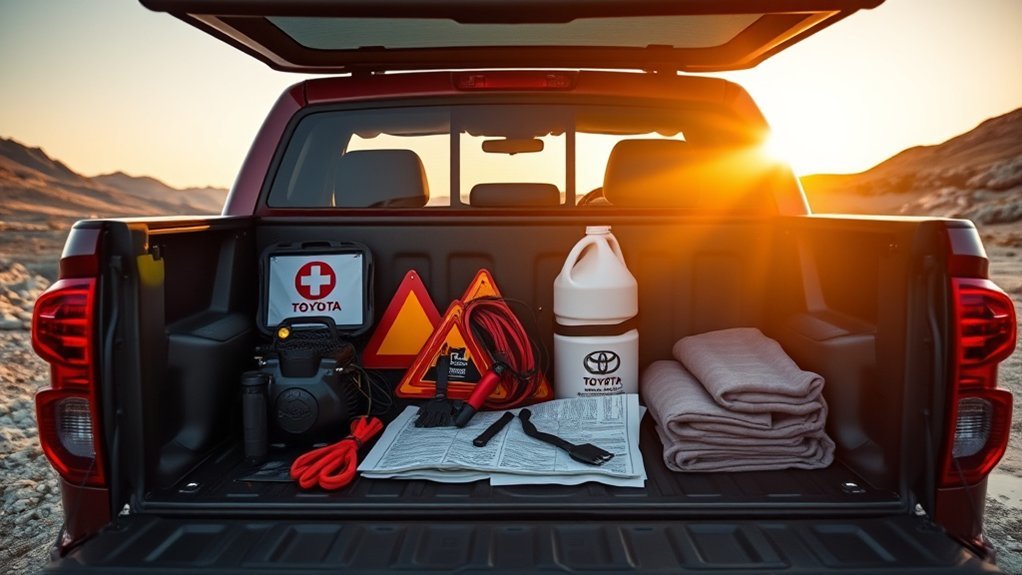
A good emergency kit helps you handle a delay safely, not just fix the truck. Ready.gov recommends planning long trips carefully and keeping emergency supplies in the car in case you are stranded. Build the kit for your route, weather, passengers, and whether you will be towing or driving remote roads.
[Products Worth Considering]

This all-in-one roadside emergency tool combines a powerful jump starter, tire inflator, power bank, and LED light in one compact unit. It can help start dead 12V batteries in gas and diesel vehicles, inflate tires quickly, and keep phones charged during unexpected roadside issues. Built with spark-proof smart cables, multiple safety protections, and a rugged carry case, it is designed for reliable use in emergencies and everyday travel.

This portable roadside emergency car kit helps drivers stay prepared with essential tools for common breakdowns and unexpected roadside situations. It includes jumper cables, a tow strap, a flashlight, a rain poncho, gloves, and a first aid kit, all stored in a durable zippered case for easy access and organization. With included roadside assistance coverage, it adds extra peace of mind for commuters, new drivers, and road trips.

This tire inflator attachment combines accurate pressure reading and easy inflation in one heavy-duty tool for maintaining tire pressure with less hassle. A longer hose and 360-degree swivel air chuck help create a secure seal while giving you better control during use. Designed for universal compressor compatibility, it measures, inflates, and deflates without batteries.
Essential Emergency Kit Items
- First aid kit, prescription medications if needed, and personal emergency information.
- Water, nonperishable snacks, blanket, gloves, and weather-appropriate clothing.
- Flashlight or headlamp with spare batteries or USB charging.
- Reflective triangles, reflective vest, emergency beacon, or road flares where legal.
- Paper map, emergency contacts, roadside-assistance information, and a charged phone power bank.
- Fire extinguisher rated for automotive use, if you know how to use it safely.
On-Road Repair Tools
Pack tools you can actually use safely. The goal is to handle minor issues and make the truck visible while you wait for help, not to perform major repairs on the shoulder.
- Portable jump starter and jumper cables.
- Tire pressure gauge and portable air compressor.
- Tire plug kit for temporary tread-area puncture repairs where appropriate.
- Jack, lug wrench, wheel lock key if equipped, and a board for soft ground.
- Basic wrench set, screwdrivers, pliers, utility knife, duct tape, zip ties, and work gloves.
- Small tarp or mat for kneeling and keeping tools out of dirt.
Portable Power and Lighting
Keep lighting and power gear easy to reach, not buried under cargo. Charge all power banks, jump starters, radios, and flashlights the day before departure.
- High-lumen LED flashlight or headlamp.
- USB-C and 12-volt charging cables.
- Portable power bank for phones and small devices.
- Compact solar panel if you will camp or travel remotely.
- Magnetic LED warning light or beacon for roadside visibility.
Pack, Load, and Inspect Camper-Top and Cargo Security
Cargo security is not just about keeping gear from sliding around. Overloading can reduce steering and braking ability, and Toyota’s load guidance ties total load capacity to the tire and loading label. Include passengers, cargo, tools, camper/topper weight, hitch hardware, and trailer tongue weight when you calculate load.
Warning: Do not exceed the payload, GVWR, GAWR, tire load rating, or towing limits for your specific Tundra. If a camper top, bed rack, rooftop tent, trailer tongue weight, or heavy tools are added, subtract that weight from available payload.
Before leaving, inspect the camper top or bed cover:
- Latch every door, window, hatch, and access panel.
- Check seals for cracks, gaps, looseness, or water leaks.
- Confirm clamps, bolts, bed-rack mounts, and tie-downs are tight.
- Keep heavy items low and centered, not high or behind the rear axle when avoidable.
- Use rated tie-downs, not light-duty bungee cords, for heavy cargo.
- Re-check straps and latches after the first 10–20 miles.
Before heading out, make sure camper latches, seals, windows, tie-downs, and load weight are correct. A secure, balanced load keeps the Tundra more stable and predictable.
Do a Short Test Drive Before Departure
After loading the truck, drive 5–10 miles on local roads before starting the long route. Listen for new rattles, watch for pulling or vibration, test the brakes gently, and confirm that the steering still feels normal.
When you return, do one more walkaround:
- Look under the truck for fresh fluid leaks.
- Re-check cargo straps, camper-top latches, and trailer coupler or safety chains if towing.
- Verify that tire pressure is correct before the tires heat up again.
- Confirm that warning lights are off.
- Make sure the spare, jack, emergency kit, and tools are still accessible.
Frequently Asked Questions
Is a Toyota Tundra good for long-distance driving?
Yes, a well-maintained Tundra can be comfortable and capable for long-distance driving, especially when tires, fluids, brakes, battery, and cargo weight are prepared correctly. Fuel use may be higher than a smaller vehicle, especially when towing or hauling heavy gear.
How do I prepare my truck for a long road trip?
Check fluids, tires, spare tire, battery, brakes, lights, wipers, windshield, HVAC, steering, suspension, cargo tie-downs, and emergency gear. If the truck is due for service, towing, or showing leaks, warning lights, brake noise, vibration, or uneven tire wear, schedule a professional inspection before leaving.
How do I prepare for a 12-hour road trip in a Tundra?
Inspect the truck several days ahead, pack emergency gear, plan fuel stops, check weather and road conditions, download offline maps, and schedule rest breaks every few hours. For a 12-hour trip, driver fatigue matters as much as mechanical prep.
What tire pressure should I use for a Toyota Tundra road trip?
Use the cold tire pressure listed on the driver’s door-jamb Tire and Loading Information Label or in your owner’s manual. Do not use the maximum pressure printed on the tire sidewall unless the manual or tire label specifically calls for it.
Should I get an oil change before a long trip?
Change the oil before departure if it is due during the trip, if the oil level or condition is questionable, or if the truck has been used under severe conditions such as towing, dusty roads, heavy loads, or frequent short trips. Use the oil grade and interval for your model year.
What should I check if I have a camper top or heavy cargo?
Confirm payload capacity, camper/topper weight, passengers, gear, hitch hardware, and trailer tongue weight. Keep heavy items low and centered, use rated tie-downs, latch the camper top, inspect seals, and re-check the load after a short test drive.
Conclusion
Before a long trip, give your Toyota Tundra a complete pre-trip check: fluids, tires, spare, battery, brakes, suspension, steering, lights, wipers, HVAC, windshield, cargo weight, camper-top security, and emergency tools. Use the owner’s manual and door-jamb labels for exact specs, keep service records, and fix safety issues before departure. A methodical inspection takes less time than a roadside breakdown and gives you a safer, calmer drive.
Sources
- Toyota Owners Manuals and Warranties — model-year manuals and official maintenance information.
- Toyota 2026 Tundra Warranty & Maintenance Guide — scheduled maintenance intervals and inspection items.
- NHTSA TireWise — tire pressure, tread depth, spare tire, alignment, and rotation safety guidance.
- AAA: Dead Battery vs. Bad Alternator — battery voltage and charging-system guidance.
- AAA: Beginner’s Guide to Understanding Your Car Battery — battery lifespan, jump-start overview, and wear signs.
- Ready.gov Car Safety — emergency car kit and long-trip safety preparation.

[…] Mount suction cup, so it is ready to use straight away. If you are mapping out a long drive, our Tundra road trip prep checklist covers the rest of the […]