To clear OBD2 codes on your Toyota Camry, connect an OBD-II scanner to the diagnostic port under the dashboard. Turn the ignition to “ON” without starting the engine. Select “Read Codes” to check for stored error codes, then choose “Erase Codes” to clear them. Make sure to address any underlying issues first to prevent reoccurrence. Understanding your vehicle’s check engine light status can save you from costly repairs, and there’s more to explore on maintaining peak performance.
Immediate Steps to Clear OBD2 Codes
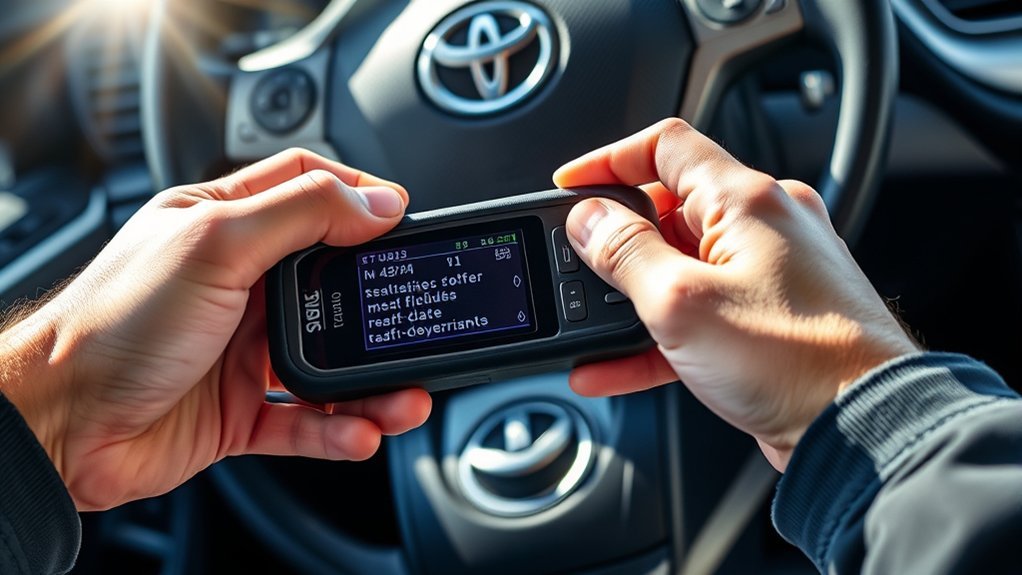
To clear OBD2 codes on your Toyota Camry, start by connecting an OBD-II scanner to the diagnostic port found under the dashboard on the driver’s side. Next, turn the vehicle’s ignition to the “ON” position without starting the engine to power up the scanner. Navigate to the trouble codes section on the scanner and note any error codes displayed; this step is essential for troubleshooting.
Avoid common mistakes, like erasing codes before addressing the underlying issues, as this could lead to the check engine light reappearing. Select the option labeled “Erase Codes” or “Clear Codes,” and confirm the prompt to erase all information. Remember, erasing codes without fixing the root problems won’t liberate you from potential future complications. Always verify you’ve thoroughly diagnosed the issue before resetting to maintain your vehicle’s performance.
Explore Your OBD II Scanner’s Features
Your OBD II scanner‘s display options can substantially enhance your diagnostic process. By interpreting codes effectively, you can pinpoint specific issues and monitor real-time engine parameters. Familiarizing yourself with these features will streamline your troubleshooting and repairs.
Scanner Display Options
An OBD II scanner can greatly enhance your ability to diagnose and monitor your Toyota Camry’s performance. Understanding the scanner display options is vital for effective use. Most scanners feature a menu that allows you to view live data, helping you track real-time vehicle performance. Additionally, advanced models offer freeze frame data to capture specific conditions at the time a fault occurs.
| Feature | Description |
|---|---|
| Live Data | Real-time monitoring of vehicle performance |
| Diagnostic Trouble Codes | Read and clear DTCs to reset the check engine light |
| Freeze Frame Data | Captures conditions when a fault was detected |
| Readiness Tests | Guarantees emission systems function properly |
| User-Friendly Interface | Simplifies navigation through scanner functions |
Exploring these options can empower you to maintain your Camry effectively.
Code Interpretation Guidance
Understanding how to interpret codes from your OBD-II scanner allows for effective diagnosis of your Toyota Camry’s issues. Start by familiarizing yourself with your scanner’s menu options to navigate features for code retrieval and erasure efficiently. Confirm the ignition is on, but the engine is off, for accurate readings. Once you retrieve the trouble codes, utilize the scanner’s code interpretation feature to pinpoint specific problems, such as P0420, which indicates catalytic converter efficiency concerns. Many scanners also offer live data streaming, enhancing your troubleshooting strategies by providing real-time engine parameters. Always consult your vehicle’s manual or reliable online resources for specific code definitions and effective code interpretation techniques to address the errors displayed.
Step-by-Step Guide to Reading Trouble Codes
To effectively read trouble codes on your Toyota Camry, start by locating the OBD-II diagnostic port, typically found under the dashboard on the driver’s side near the steering column. Follow these steps for efficient troubleshooting:
- Turn the ignition to the “ON” position without starting the engine to power up the OBD-II scanner.
- Connect the OBD-II scanner to the diagnostic port.
- Navigate to the menu and select “Read Codes” to retrieve trouble codes stored in the engine control module.
- Take note of the displayed trouble codes, like P0102 or P0113, which indicate specific issues.
Understanding these codes is essential for effective troubleshooting strategies. They provide insight into the code history and help you identify necessary repairs. Once you’ve addressed any issues, don’t forget to use the scanner’s “Erase Codes” function to clear the trouble codes and turn off the check engine light.
Key OBD2 Codes for Your Toyota Camry
When troubleshooting your Toyota Camry, it’s essential to recognize key OBD2 codes that can indicate specific issues. Common codes like P0420, P0171, and P0300 provide insights into catalytic converter efficiency, fuel mixture problems, and cylinder misfires, respectively. Understanding these codes not only aids in diagnosing problems but also streamlines communication with your mechanic.
Common OBD2 Codes
OBD2 codes serve as crucial indicators of your Toyota Camry’s performance and potential issues. Familiarizing yourself with common codes can streamline diagnostic procedures and help you identify problems swiftly. Here are some key codes to watch for:
- P0420: Catalytic converter efficiency issues.
- P0171/P0174: Lean fuel mixture, often due to a vacuum leak.
- P0300: Random or multiple cylinder misfires, typically from worn spark plugs or ignition coils.
- P0440: Malfunction in the evaporative emission control system, frequently caused by a loose gas cap.
Understanding these common causes can enhance vehicle health and prevent costly repairs. Regular monitoring of OBD2 codes is crucial for maintaining your Camry’s peak performance.
Code Meanings Explained
Understanding the meanings behind key OBD2 codes can greatly streamline your troubleshooting process for a Toyota Camry. Each code carries significant diagnostic importance that can help you identify issues swiftly. For instance, P0420 points to a catalytic converter efficiency problem, often indicating a need for replacement if it persists. Codes P0171 and P0174 signal a lean system, typically due to a vacuum leak or a failing oxygen sensor. If you encounter P0300, it denotes a random or multiple cylinder misfire, usually caused by worn spark plugs or ignition coils. Finally, P0440 highlights an evaporative emission control system malfunction, often linked to a loose gas cap. Recognizing these codes’ significance empowers you to address issues effectively.
Troubleshooting Tips Provided
While diagnosing issues with your Toyota Camry, knowing key OBD2 codes can greatly streamline your troubleshooting process. Utilizing advanced diagnostics empowers you to pinpoint the root causes of potential problems. Here are some key codes to watch for:
- P0420: Catalytic converter efficiency issues.
- P0171/P0174: System too lean, often due to vacuum leaks or faulty sensors.
- P0300: Random/multiple cylinder misfires, usually from worn spark plugs or ignition coils.
- P0440: Evaporative emission control malfunction, frequently caused by a loose gas cap.
Addressing these codes through regular preventive maintenance not only enhances your vehicle’s performance but also prevents more severe issues down the line. Stay proactive in your diagnostics for a smoother ride!
Troubleshooting Common Issues Before Clearing OBD2 Codes

Before you clear OBD2 codes on your Toyota Camry, it’s essential to troubleshoot common issues that may be triggering the check engine light. Start by checking the gas cap; a loose cap can cause error codes like P0440. Use diagnostics tools, such as an OBD-II scanner, to retrieve error codes indicating potential problems like vacuum leaks (P0171/P0174) or misfires (P0300). Additionally, inspect electrical systems for blown fuses or relays that could contribute to the check engine light.
Here’s a quick reference table to guide you:
| Issue | Possible Code(s) | Action Needed |
|---|---|---|
| Loose Gas Cap | P0440 | Tighten gas cap |
| Vacuum Leak | P0171/P0174 | Inspect hoses for leaks |
| Electrical Issues | P0300 | Check fuses and connections |
Address these issues before clearing the codes, as simply erasing them won’t fix the root cause.
Erasing OBD2 Codes: Your Step-by-Step Guide
To erase OBD2 codes on your Toyota Camry, you’ll need an OBD-II scanner and access to the diagnostic port under the dashboard. Once you’ve connected the scanner and confirmed the ignition is on, you can navigate through the menu to erase any stored codes. Follow these steps carefully to clear the errors and keep your vehicle running smoothly.
Required Tools Overview
Clearing OBD2 codes on your Toyota Camry requires just a few essential tools, primarily an OBD-II scanner. You can purchase or borrow one from an auto parts store. Familiarize yourself with different OBD II scanner types to find one that suits your needs.
Before you start, verify the ignition is in the “on” position without starting the engine. Locate the diagnostic port under the dashboard to connect your scanner properly. Here’s what you’ll need:
- OBD-II scanner
- Access to the diagnostic port location
- A notebook for recording trouble codes
- A basic understanding of error codes
Having these tools at hand will set you up for successfully clearing those codes and understanding your vehicle’s needs.
Code Erasure Process Steps
Begin by connecting your OBD-II scanner to the diagnostic port under the dashboard of your Toyota Camry, making sure the ignition is in the “on” position without starting the engine. Navigate to the scanner’s menu for a diagnostics overview, where you can access the trouble codes stored in the engine control module. After addressing any underlying issues indicated by these codes, select the option to erase them from the scanner menu. Confirm the prompt to perform a code reset, which will permanently delete all stored error codes and reset the check engine light. Finally, restart your vehicle to verify that the check engine light remains off, confirming that the issues have been resolved effectively.
Confirming the Check Engine Light Is Off: Why It Matters?
Confirming that the check engine light is off is essential for maintaining your Toyota Camry’s health. This step guarantees that any underlying issues have been resolved, preventing potential engine damage. If the light persists after resetting, it indicates that the problem wasn’t properly addressed, requiring further diagnostics.
Regularly monitoring the check engine light enhances vehicle performance and fuel efficiency by identifying issues early. Ignoring it—even if it turns off temporarily—can lead to costly repairs due to unresolved mechanical problems.
Regularly monitoring your check engine light is crucial; ignoring it can lead to costly repairs and reduced vehicle performance.
- Guarantees diagnostic accuracy for future assessments.
- Prevents costly repairs by addressing issues promptly.
- Enhances vehicle performance and fuel efficiency.
- Indicates successful code resolution with your OBD-II scanner.
When to Seek Professional Help for Persistent Codes?
While you might feel confident tackling minor OBD-II codes on your Toyota Camry, persistent error codes warrant professional attention. If the check engine light remains illuminated after clearing codes, it signals that the underlying issue hasn’t been resolved. This could indicate deeper mechanical or electrical problems that require advanced diagnostic techniques.
If you’re unsure about the meaning of the error codes or how to address the issues, it’s wise to seek help. Auto repair shops possess sophisticated diagnostic equipment that offers more accurate insights than standard OBD-II scanners can provide. Ignoring persistent codes can lead to more significant damage or safety concerns, making timely professional assistance essential. Engaging experts in error code analysis can guarantee you tackle the problem effectively, preserving both your vehicle’s performance and your peace of mind.
Essential Maintenance Tips for Your Toyota Camry

To keep your Toyota Camry running smoothly, regular maintenance is essential. By following these maintenance reminders and performing routine checks, you can guarantee peak performance and longevity.
Regular maintenance is crucial for your Toyota Camry to ensure optimal performance and long-lasting reliability.
- Check and tighten the gas cap to prevent the check engine light from triggering; a loose cap is a common issue.
- Change the engine oil and filter every 5,000 to 7,500 miles for peak engine performance.
- Inspect and replace air filters every 15,000 to 30,000 miles to guarantee proper airflow and fuel efficiency.
- Rotate tires every 5,000 to 7,500 miles to promote even wear and enhance handling and safety.
Additional Resources for Toyota Camry Owners: Forums and Tools
Maintaining your Toyota Camry goes beyond routine checks; having the right resources can greatly enhance your ownership experience. Engaging in forums like ToyotaNation connects you with fellow Camry owners who share troubleshooting tips and experiences. This forum engagement can help you find solutions or gain insights that you might not have considered.
For diagnosing issues, investing in OBD-II scanners is essential. These diagnostic tools allow you to read and clear error codes directly from your vehicle, providing immediate feedback on the health of your engine. If you prefer professional assistance, local auto repair shops often have advanced diagnostic equipment that can pinpoint issues more accurately.
Additionally, YouTube tutorials and official service manuals are excellent resources. They guide you through resetting OBD-II codes and offer detailed instructions for repairs, empowering you to take control of your Camry’s maintenance.
Frequently Asked Questions
How Do I Turn off the Check Engine Light on My Toyota Camry?
To turn off the check engine light on your Toyota Camry, use an OBD2 scanner for engine diagnostics. Follow maintenance tips, troubleshoot issues, and guarantee any underlying problems are resolved for lasting results.
Conclusion
Now that you know how to clear OBD2 codes on your Toyota Camry, you might wonder—will the check engine light stay off this time? If it reignites, don’t ignore it; underlying issues may persist. Remember, maintaining your Camry is key to long-term reliability. Trust your instincts—if something feels off, seek professional help. Your vehicle’s performance depends on it. Will you take the next step to guarantee your Camry runs smoothly? The choice is yours.