Last updated: July 31, 2026
Method: This guide separates Toyota service procedures, Toyota parts lookup, aftermarket application data, and general cooling-system references. A pressure value is not treated as vehicle-specific unless the source identifies the relevant cap, engine, or application.
Affiliate disclosure: AutoReviewNest may earn a commission from qualifying purchases made through links on this page, at no extra cost to you.
What’s in This Article
- Quick Answer: Camry Radiator Cap Pressure
- How to Read kPa, Bar, and PSI
- What a Cooling-System Pressure Cap Does
- Camry Cap Locations and Verified Pressure Examples
- How Cap Pressure Raises Coolant Boiling Point
- Risks of the Wrong Cap PSI for Your Camry
- Cap Rating vs. Cooling-System Test Pressure
- How to Test a Cap and Verify Its Pressure
- When to Replace a Camry Radiator Cap
- When to Stop Driving
- Where to Get the Right Cap
- Frequently Asked Questions
Toyota Camry radiator cap pressure is not one universal number. Camry pressure-cap applications commonly appear near 88 to 90 kPa, roughly 13 PSI, or 108 to 110 kPa, roughly 16 PSI. The correct value depends on the model year, engine, market, coolant circuit, cap design, and sometimes the radiator or filler neck installed on the car.
Read the marking on the correct pressure-control cap and confirm its OE part number by VIN before replacing it. Match the pressure, neck depth, diameter, locking design, seals, and recovery-valve function. Do not install a 1.1 bar cap in place of a specified 0.9 bar cap as an “upgrade.”
This page focuses on cap pressure, identification, substitution, and testing. For broader faults such as coolant loss, poor circulation, or overheating, use the linked Camry cooling-system guide and leak-diagnosis resources.
Quick Answer: Camry Radiator Cap Pressure
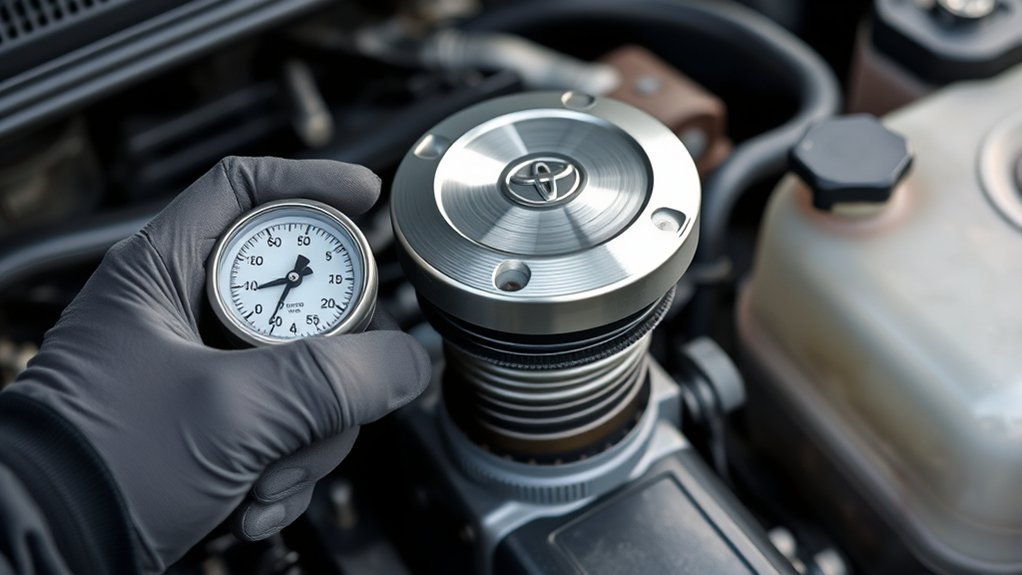
Your Camry may use a pressure cap marked near 0.9 bar or 88–90 kPa, which is about 13 PSI, or near 1.1 bar or 108–110 kPa, which is about 16 PSI. A 1.0 bar cap is about 14.5 PSI. None of these ratings is universally correct for every Camry.
Use the pressure specified for the exact radiator cap, coolant filler cap, or pressurized reservoir cap fitted to your vehicle. Confirm the coolant circuit, OE part number, pressure marking, neck dimensions, and recovery-valve design.
An HKS aftermarket application chart lists an 88 kPa N-type cap for AXVH70 Camry Hybrid applications in its January 2017–December 2023 range. This confirms that an 88 kPa Camry application exists, but it does not establish the factory cap for every country, engine, or VIN.
Key Takeaways
- Camry pressure caps commonly appear near 13 PSI or 16 PSI, but the correct rating is vehicle- and circuit-specific.
- Match the replacement by VIN, OE part number, cap type, pressure, physical dimensions, and recovery function.
- Do not replace a specified 0.9 bar cap with a 1.1 bar cap to increase boil-over protection.
- A cap test measures relief-valve opening pressure; it is not the same as a cooling-system leak test.
- Never remove a radiator, filler, or pressurized reservoir cap while the system is hot.
How to Confirm the Correct Cap in 60 Seconds
| What you find | What to do | What not to assume |
|---|---|---|
| The original cap is present and readable | Photograph the pressure marking and part number, then compare them with a VIN-based Toyota parts lookup. | Do not assume the old cap is correct merely because it has been on the car. |
| The marking is missing or unreadable | Record the VIN, engine, market, cap location, and radiator part number. Use Toyota parts information or a qualified parts counter. | Do not estimate pressure from cap size, spring resistance, or appearance. |
| The radiator has been replaced | Identify the radiator manufacturer and part number. Confirm the cap that fits its neck and the pressure required by the vehicle. | Do not assume the cap supplied with an aftermarket radiator is correct for the Camry. |
| The Camry has more than one coolant circuit | Identify the engine, inverter, power-control, or other circuit before ordering or exchanging a cap. | Do not swap similar-looking caps between circuits. |
| The new cap fits but symptoms began after installation | Recheck the part number, pressure, neck depth, seals, and recovery-valve design. | Do not treat physical fit as proof of compatibility. |
How to Read kPa, Bar, and PSI
A replacement cap may display its pressure in kilopascals, bar, kilograms-force per square centimeter, or PSI. Parts catalogs may also round the same nominal rating differently. Use the table as a conversion guide, then confirm the exact part rather than matching only the nearest number.
| Cap marking | Approximate bar | Approximate PSI | What it means |
|---|---|---|---|
| 88 kPa | 0.88 bar | 12.8 PSI | Often grouped with 0.9 bar or 13 PSI applications |
| 90 kPa | 0.9 bar | 13.1 PSI | Commonly sold as a 13 PSI cap |
| 100 kPa | 1.0 bar | 14.5 PSI | Mid-range rating that still requires exact fitment confirmation |
| 108 kPa | 1.08 bar | 15.7 PSI | Often rounded and sold as a 16 PSI cap |
| 110 kPa | 1.1 bar | 16.0 PSI | Commonly marked 1.1 bar or 16 PSI |
Pressure conversion alone does not establish compatibility. Two caps can share the same pressure but use different neck depths, diameters, seals, valve designs, or locking tabs.
What a Cooling-System Pressure Cap Does
The pressure cap seals the pressurized side of the cooling system and controls when expanding coolant can move into a recovery or expansion tank. Its spring-loaded relief valve opens near a specified pressure so the system does not continue building pressure without control.
A second valve manages vacuum as the coolant cools and contracts. In a recovery system, this vacuum valve allows coolant to return from the recovery tank. A failed vacuum valve can leave the radiator low, trap air in the system, or contribute to a collapsed hose.
The cap does not force the cooling system to remain at its full rated pressure at all times. Its rating identifies the approximate pressure at which the pressure valve is designed to open.
Not every coolant-container lid performs these jobs. A simple overflow-bottle lid may only keep dirt out. The radiator cap, coolant filler cap, or pressurized expansion-tank cap is the component that controls system pressure.
Where Is the Camry Pressure Cap, and What Ratings Are Verified?
Your Camry may use a radiator-mounted cap, a separate coolant filler cap, a pressurized reservoir cap, or more than one coolant circuit. The layout changes by generation, engine, hybrid system, and market. Do not buy a replacement from a broad Camry listing without confirming which cap you are replacing.
A Camry Hybrid may have separate engine and power-control cooling components. Do not exchange caps between circuits, even when the caps look similar. Use the owner’s manual, VIN-based Toyota parts lookup, or exact OE number to identify each cap.
Radiator, Filler, and Reservoir Caps
A traditional radiator cap locks onto a metal filler neck at the radiator. Other Camrys place the pressure-control cap on a remote filler neck or pressurized reservoir. A non-pressurized overflow bottle can still have a lid, but that lid does not replace the system’s pressure cap.
With the system completely cold, inspect the rubber pressure seal, upper seal, vacuum valve, spring, and locking surfaces. Replace a cap with cracked, flattened, swollen, hardened, or separated rubber. A worn pressure seal can release coolant too early, while a failed vacuum valve can prevent coolant from returning as the system cools.
What the Verified Sources Actually Show
Cap pressure does not follow a reliable older-versus-newer rule. Published values must be separated by source type because a nominal cap rating, a cap-test opening range, an aftermarket application listing, and a system leak-test pressure do not mean the same thing.
| Source or application | Published value | How to use it |
|---|---|---|
| Toyota radiator-cap inspection bulletin EG014-05 | Inspection procedures for 88 kPa and 108 kPa cap types | Confirms that Toyota uses both pressure-cap families. It does not identify which one fits every Camry VIN. |
| HKS AXVH70 application chart | 88 kPa N-type cap for the chart’s January 2017–December 2023 range | Shows one application-specific aftermarket listing. It is not a universal Toyota factory fitment table. |
| XV70 A25A-FKS radiator-cap service data | 74–103 kPa opening-pressure range for a new cap and 59 kPa minimum for a used cap | This is a service-test range for that engine application, not permission to choose any cap whose label falls inside the range. |
| 2004 Camry 1AZ-FE cooling-system leak test | 118 kPa, or 17.1 PSI | This is a system leak-test pressure, not the cap’s replacement rating. |
Toyota’s cap-inspection procedure identifies the cap type and kPa family before testing. It includes separate procedures for N-type, compact, and plastic caps, which is another reason not to select a replacement from PSI alone.
Use this verification order:
- Identify the coolant circuit: Confirm whether the cap belongs to the radiator, engine filler neck, pressurized reservoir, or a separate hybrid cooling circuit.
- Confirm the OE part: Use the VIN and Toyota parts information rather than model name alone.
- Read the pressure marking: Match the specified kPa, bar, or PSI value.
- Match the physical design: Confirm neck depth, cap diameter, locking tabs, seals, and valve style.
- Check recovery function: Use a recovery-style cap when the system depends on coolant returning from an overflow or recovery tank.
If the old cap conflicts with a VIN-based parts lookup, do not assume the old cap is correct. A previous owner or radiator replacement may have introduced the wrong part.
How to Identify the Pressure-Control Cap
Start with a fully cold engine or hybrid system. Find the cap connected to the pressurized cooling circuit and look for a pressure marking, warning label, spring-loaded valve, or sealing gasket.
- Trace the hoses: Identify whether the container connects directly to the pressurized cooling circuit or only serves as an overflow bottle.
- Read the cap: Look for markings such as 88 kPa, 90 kPa, 108 kPa, 110 kPa, 0.9 bar, or 1.1 bar.
- Check the manual: Confirm which caps Toyota identifies for the engine and any separate hybrid cooling circuit.
- Verify the part number: Match the replacement using the VIN and original cap design.
If the marking is missing or unreadable, do not estimate the rating from cap size or spring resistance. Record the VIN, engine, market, cap location, and radiator part number, then use Toyota parts information or a qualified parts counter.
How Cap Pressure Raises Coolant Boiling Point
Increasing cooling-system pressure raises the temperature at which the coolant boils. Tridon’s radiator-cap guide uses a rule of thumb of about 2.5°F, or 1.4°C, of additional boiling margin for each added PSI. Treat this only as a general explanation. Actual protection depends on coolant chemistry, concentration, elevation, temperature, and test conditions.
For context, one 50/50 ShellZone coolant technical data sheet lists a boiling point near 226°F at atmospheric pressure and boil-over protection near 265°F in a system using a 15 PSI cap. Those figures describe that coolant and test condition, not every coolant mixture.
The cap does not make a healthy engine operate at a lower temperature. It helps the coolant remain liquid at a higher temperature so it can continue transferring heat. If the Camry has low coolant, poor airflow, a stuck thermostat, weak water-pump flow, or another fault, installing a higher-pressure cap does not repair that problem.
For coolant-mixture guidance, see the Toyota Camry coolant concentration guide.
Risks of the Wrong Cap PSI for Your Camry
The difference between a 0.9 bar and 1.1 bar cap is about 20 kPa or 3 PSI. That change affects when the relief valve opens and how much pressure hoses, seals, plastic tanks, fittings, and clamps may experience.
Use the pressure Toyota specifies for the exact cap and coolant circuit. A higher number is not an automatic upgrade, and a lower number is not automatically safer.
- About 13 PSI or 0.9 bar: Correct for some Camry applications. It may vent too early if installed on a circuit designed for a higher pressure.
- About 14.5 PSI or 1.0 bar: Correct only when the exact cap application specifies it. It is not a universal compromise between 0.9 and 1.1 bar.
- About 16 PSI or 1.1 bar: Correct for some Camry applications. It can add unnecessary system stress when used in place of a specified 0.9 bar cap.
- Above the specified rating: May delay pressure release and expose weakened hoses, seals, radiator tanks, and fittings to more pressure than intended.
If coolant loss or overheating began immediately after a cap change, stop treating the new cap as correct merely because it fits. Recheck the part number, pressure rating, cap depth, and valve design before replacing larger components.
Broader overheating causes are covered in the Camry overheating guide.
Do Not Confuse Cap Rating With System Test Pressure
A radiator-cap test and a cooling-system leak test are separate procedures. The cap test measures the relief valve’s opening pressure and checks vacuum-valve operation. A system leak test pressurizes the cooling circuit to a service-manual value and watches for leakage.
The two numbers may differ. For example, a 2004 Camry 1AZ-FE repair-manual procedure specifies 118 kPa, or 17.1 PSI, for that engine’s cooling-system leak check. That test value is not an instruction to install a 17.1 PSI cap.
Never select a replacement cap from a system leak-test specification. Use the exact cap part and its specified opening-pressure range.
How to Test a Cap and Verify Its Pressure
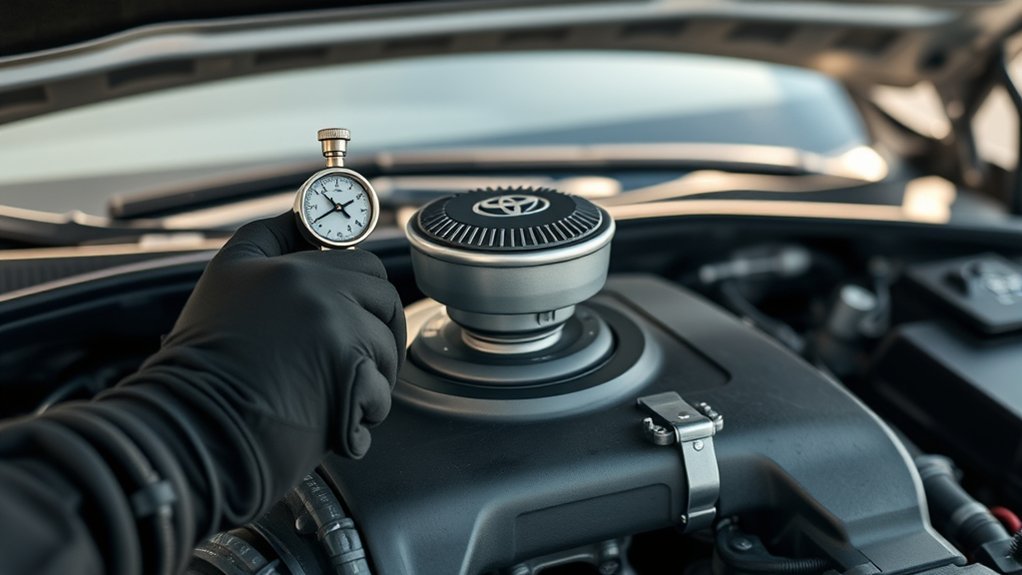
Use a radiator-cap tester and the adapter designed for the cap style. The engine and cooling system must be completely cold before you remove any pressure cap.
Warning: Never remove a radiator cap, coolant filler cap, or pressurized reservoir cap while the engine, hybrid system, radiator, or coolant remains hot. Pressurized coolant and steam can cause severe burns.
[Products Worth Considering]

Radiator Leak down Tester Kit: The radiator pressure tester kit helps you change coolant and test for leaks in your vehicle's cooling system, including the radiator, heater core and radiator cap, in a simple and straightforward manner. Self-locking quick coupler for easy adapter installation, and thumb-operated relief valve allows for repeated pressure tests and pressure release while testing the cooling system. Stainless steel thermometer(0-200℃ / 32-400℉) measures coolant temperature.
Before You Test the Cap
- Let the vehicle cool completely.
- Wear eye protection and chemical-resistant gloves.
- Keep children and pets away from the work area.
- Clean coolant residue and foreign material from the cap seals.
- Inspect the filler neck for dents, corrosion, cracks, or damaged sealing surfaces.
- Confirm that the tester adapter matches the cap type.
- Read the cap marking and locate the correct service procedure before applying pressure.
Clean coolant spills immediately. The ASPCA warns that ethylene glycol is highly toxic to animals and can be fatal in a small amount, so prevent access by children and pets.
Cap Pressure Testing
- Inspect the seals and valves: Replace the cap without further testing if the rubber is cracked, swollen, separated, or badly hardened.
- Moisten the seals: Lightly wet the pressure and relief-valve seals with clean coolant or water when required by the tester procedure.
- Attach the correct adapter: Lock the cap onto the adapter exactly as it seats on the vehicle.
- Check the vacuum valve: Follow the service procedure to confirm that the valve allows the required return flow.
- Measure opening pressure: Pump at the rate specified by the tester and vehicle procedure. Toyota’s EG014-05 cap-inspection procedure, for example, identifies the cap type first, holds the tester at least 30 degrees upward, and uses a pumping rate of about one pump per second.
- Compare with the correct specification: Use the standard and minimum values for that exact cap type. Replace the cap if it opens below the minimum, fails the vacuum-valve check, or leaks through a damaged seal.
Do not apply a universal “hold for 30 to 60 seconds” or “10% pressure loss” rule to every cap. Cap styles and manufacturer test procedures differ.
Interpreting Test Results
| Finding | Likely meaning | Action |
|---|---|---|
| Cracked, swollen, flattened, or separated seal | The cap may not seal consistently | Replace the cap with the verified part |
| Relief valve opens within the specified range | The pressure valve passes that part of the test | Complete the vacuum-valve and visual checks |
| Relief valve opens below the service minimum | The cap can release pressure too early | Replace the cap |
| Vacuum valve sticks or fails the return-flow check | Coolant may not return correctly as the system cools | Replace the cap |
| Air leaks at the tester adapter | The adapter may be wrong, loose, or damaged | Correct the setup and repeat the test before condemning the cap |
| New cap has the correct pressure but does not seat fully | The neck depth, diameter, tabs, or seal design is wrong | Do not use it; verify the exact part number |
When to Replace a Camry Radiator Cap
Replace the cap when it fails the specified pressure or vacuum-valve test, cannot lock securely, has damaged seals, or shows heavy corrosion. Do not rely on an arbitrary replacement interval when the correct procedure is to inspect and test the cap.
Check the pressure cap early when you notice:
- Coolant residue around the filler neck or overflow hose.
- A recovery tank that repeatedly overfills or empties.
- Coolant that moves into the recovery tank but does not return after cooling.
- An upper radiator hose that collapses as the engine cools.
- Intermittent overheating without an obvious external leak.
- Repeated low coolant after the system has been filled and bled correctly.
These symptoms do not prove that the cap is the only fault. A leaking hose, damaged filler neck, trapped air, thermostat problem, radiator restriction, water-pump fault, or combustion-gas leak can produce similar symptoms. Toyota owner information advises having the cap and cooling system tested when coolant drops and no visible leak can be found.
If a verified cap passes but coolant still drops, test the cooling system for leaks using the exact service-manual pressure. If no external leak appears, professional diagnosis may include heater-core inspection and testing for internal or combustion-gas leakage.
For leak diagnosis, see Toyota Camry coolant leak causes and checks. For basic cold-level checks and topping up, see how to check and refill Camry coolant safely.
[Products Worth Considering]


📨【Pre-Purchase Notes】 Please confirm the fitment of your vehicle's year, model, radiator size and radiator type by using the owner's manual or actual measurements. Double check with the applicable model information and Amazon Fitment provided by us to confirm that there is no error before placing your order to avoid not being able to use it after purchase.
When to Stop Driving
Stop in a safe location and shut the vehicle down if the temperature warning rises into the danger range, steam appears, coolant pours out, cabin heat suddenly disappears while the engine runs hot, or overheating returns after a cap change.
Do not open a pressure cap to “release heat.” Toyota warns that a hot cooling system can spray pressurized coolant and steam when a reservoir or radiator cap is loosened. Let the system cool fully and arrange professional diagnosis if the vehicle has repeated overheating or rapid coolant loss.
Where to Get the Right Cap: OEM and Aftermarket Tips
A correct pressure number does not guarantee a correct cap. The replacement must also match the neck depth, diameter, locking tabs, seal arrangement, pressure valve, and vacuum or recovery function.
- New OEM cap: Use the VIN through Toyota’s parts system or a Toyota parts counter. This is the simplest way to match the original design and any superseded part number.
- New aftermarket cap: Choose a recognized cooling-system manufacturer and confirm the exact year, engine, market, coolant circuit, OE cross-reference, pressure, dimensions, and recovery function.
- Replacement-radiator application: Identify the radiator manufacturer and part number. Confirm both the cap that physically fits its filler neck and the pressure rating required by the Camry’s cooling system. Do not assume a cap supplied with an aftermarket radiator is correct for the vehicle.
- Salvage cap: Do not install a used cap as a permanent replacement. Its spring, seals, and remaining service life are unknown. Use it only for visual comparison before buying a new verified cap.
Reject a cap when the seller provides only a broad “fits Toyota Camry” statement without identifying the engine, year range, cap location, OE cross-reference, pressure rating, and recovery design.
[Products Worth Considering]

REPLACEMENT RADIATOR CAP : The radiator cap holds the coolant inside the radiator, but it also works as a two-way valve that keeps the right pressure inside so the radiator does it work correctly. If the pressure isn't maintained, the coolant can boil and evaporate, putting the engine at risk of overheating. Symptoms of a Bad Radiator Cap: air enters the system, low coolant level, coolant leaks, overflowing reservoir, overheating engine.
Frequently Asked Questions
What Pressure Radiator Cap Does a Toyota Camry Use?
There is no single pressure for every Toyota Camry. Common Camry applications use approximately 88 to 90 kPa, about 13 PSI, or 108 to 110 kPa, about 16 PSI. Confirm the exact cap by VIN, engine, market, coolant circuit, OE part number, pressure marking, and cap design.
Which Is Better for a Toyota, a 0.9 or 1.1 Bar Radiator Cap?
Neither is universally better. A 0.9 bar cap is about 13 PSI, while a 1.1 bar cap is about 16 PSI. Use the rating Toyota specifies for the exact pressure-cap location and coolant circuit.
Can I Use a 1.1 Bar Cap Instead of a 0.9 Bar Cap?
Do not make that substitution unless Toyota’s parts information or service documentation confirms it for your exact vehicle. The higher cap changes the relief pressure and can place additional stress on cooling-system components.
What Is the Difference Between 13, 14.5, and 16 PSI Caps?
The rating identifies the approximate pressure at which the cap’s relief valve opens. A lower rating releases pressure sooner. A higher rating permits more pressure before release. The correct setting balances boiling margin with the pressure limits of the cooling system.
Does Every Camry Coolant Reservoir Cap Hold Pressure?
No. Some reservoirs are pressurized and use a rated sealing cap, while other bottles only collect overflow and use a simple lid. Follow the hoses, read the cap markings, and check the owner’s manual before treating a reservoir lid as the system pressure cap.
Where Is the Pressure Cap on a Toyota Camry?
The pressure-control cap may be on the radiator, a remote coolant filler neck, or a pressurized reservoir, depending on the year, engine, hybrid system, and market. A nearby non-pressurized overflow bottle may have a simple lid that does not control system pressure.
What if the Old Cap Is Missing or the Radiator Was Replaced?
Do not guess from cap size or choose a universal 13 or 16 PSI cap. Record the VIN, engine, market, cap location, and radiator part number. Confirm the vehicle’s required pressure and the cap design that fits the installed filler neck.
Is a Higher PSI Radiator Cap Better?
No. A higher rating can increase boiling margin, but it does not repair low coolant, poor airflow, a stuck thermostat, restricted coolant flow, or a leaking system. It may also expose weak hoses, seals, fittings, and plastic tanks to more pressure than intended.
Can a Bad Radiator Cap Cause Overheating?
Yes. A cap that releases pressure too early can lower the coolant’s boiling margin. A failed pressure or vacuum valve can also contribute to coolant loss, air entry, recovery-tank problems, or poor coolant return. Test the cap and inspect the rest of the cooling system before replacing larger parts.
How Do You Test a Camry Radiator Cap?
With the system fully cold, inspect and clean the cap, use the correct tester adapter, check the vacuum valve, and record the relief valve’s maximum opening pressure. Compare the result with the service specification for that exact cap type rather than applying a universal percentage-loss rule.
Conclusion
The correct Toyota Camry radiator cap pressure may be near 13 PSI or 16 PSI, but the vehicle’s exact cap part and coolant circuit decide the answer. Confirm the VIN, OE cross-reference, cap marking, neck dimensions, recovery-valve design, and any replacement-radiator information before installing a cap.
Test a suspected cap with the correct adapter and cap-specific procedure. Replace it when the seals are damaged, the vacuum valve fails, or the relief valve opens outside the specified range. If the temperature warning rises, steam appears, or coolant drops quickly, stop driving and diagnose the complete cooling system rather than trying a higher-pressure cap.
References
- Toyota 2014 Camry Owner’s Manual OM33B27U, coolant-level checks, hot-system warnings, and cooling-system inspection guidance.
- Toyota Genuine Radiator Cap Sub-Assembly, Toyota Parts, OE part-number and vehicle-fitment lookup.
- Toyota Technical Service Bulletin EG014-05: Radiator Cap Inspection, reproduced by Operation CHARM, cap identification, 88 kPa and 108 kPa test procedures, adapter use, and pumping method.
- HKS Radiator Cap Application Chart, AXVH70 88 kPa aftermarket application data.
- Toyota Camry XV70 A25A-FKS Radiator Inspection, reproduced service information for cap-test opening-pressure range, minimum pressure, tester angle, and pumping rate.
- Toyota Camry Repair Manual RM915E: Cooling-System Inspection, 2004 1AZ-FE system leak-test procedure and safety warning.
- ShellZone Multi-Vehicle Antifreeze/Coolant 50/50 Technical Data Sheet, atmospheric boiling point and 15 PSI protection data for that coolant.
- Radiator Caps Technical Guide, Tridon, pressure conversion, cap selection, recovery-cap function, boiling-point rule of thumb, and general testing information.
- Choosing the Correct Radiator Cap Pressure Rating, MotoRad, compatibility and wrong-pressure risks.
- Dangers of Antifreeze and Pets, ASPCA, ethylene-glycol coolant safety.